Tooth decay in children can be prevented and treated, and yes, a cavity should be treated even on a baby tooth. An untreated cavity in a baby tooth can cause pain and infection, and that tooth is holding the place for the permanent tooth forming just underneath it, as France’s national health insurance (ameli.fr) points out. The good news is that decay is by no means inevitable: brushing with an age-appropriate fluoride toothpaste, limiting sugars, regular check-ups and, when needed, dental sealants can prevent it to a large extent. This article takes stock, without alarmism, of what parents can understand and put in place.
As an oral surgeon in Kénitra, I often see families feeling anxious at the thought of a child’s first dental treatment. The aim here is not to dramatize but to give reliable guidance, distinguishing what has been demonstrated from what has to be assessed case by case.
What exactly is tooth decay in children?
Tooth decay is a bacterial disease, and a very common one. The WHO describes it as the most widespread noncommunicable disease in the world, affecting around 2.5 billion people. In children, decay in baby teeth remains one of the most common chronic diseases, with several hundred million children affected according to global burden of disease estimates (GBD 2021, BMC Oral Health).
The mechanism is easy to understand. The bacteria present in the mouth feed on sugars from food and produce acids. According to the WHO, it is the combination of a high sugar intake, insufficient exposure to fluoride and ineffective plaque removal through brushing that leads to decay. These acids first demineralize the enamel, the outer layer, then reach the deeper dentine, and finally the pulp, where the nerve and blood vessels are found.
Why a cavity can go unnoticed
An important point for parents: an early cavity is often painless. The very first sign is sometimes nothing more than a white or dull patch on the enamel. At this stage the lesion can progress silently, and pain generally only appears later, once the dentine or the pulp is involved. That is why you cannot rely on the presence or absence of pain alone to know whether a tooth is healthy.
Why should a cavity in a baby tooth be treated?
This is the question almost every parent asks: why treat a tooth that is going to fall out anyway? The answer comes down to several points, all documented by France’s national health insurance (ameli.fr).
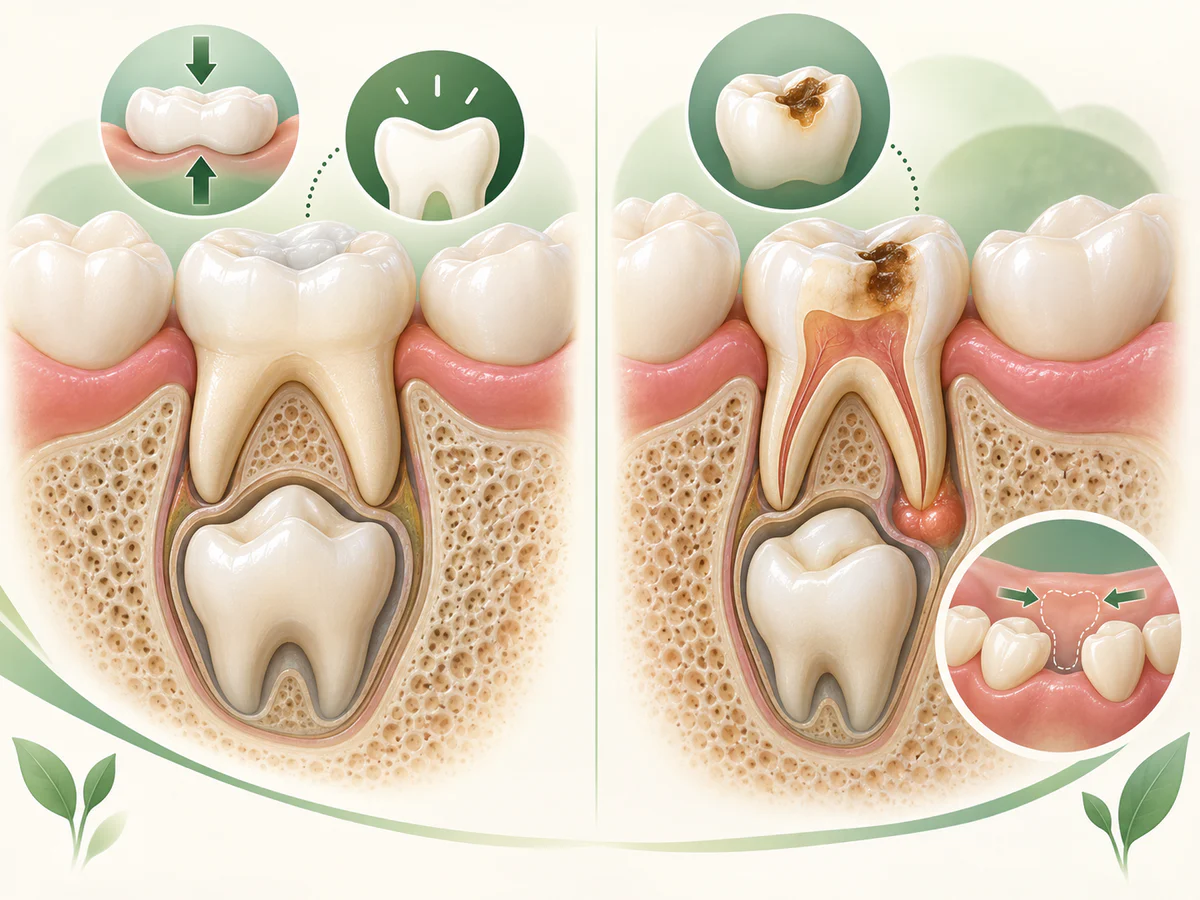
- A decayed baby tooth can hurt and become infected, potentially leading to an abscess.
- The permanent tooth forms just beneath the baby tooth; an infection can disrupt its development.
- Baby teeth hold the space needed for the permanent teeth to come through; losing one too early can lead to a lack of room.
- They are used to chew properly, to speak, and to guide the permanent dentition.
In other words, a baby tooth is not a disposable tooth. Treating it means protecting the child’s health today and preparing their future dentition. An early lesion, caught in time, can sometimes be stabilized without drilling; a fully formed cavity, on the other hand, has to be treated.
The role of sugar: frequency as much as quantity
Sugar is the main risk factor. The WHO is clear on this point: the consumption of free sugars in food and drinks is the most common risk factor for tooth decay. Free sugars include added sugars, but also those found in fruit juices, honey and syrups.
The WHO recommends limiting free sugars to less than 10% of total energy intake, and ideally below 5%, in order to reduce the risk of decay throughout life. Beyond the quantity, it is the frequency that counts: snacking on sugary foods all day long or sipping a sweet drink exposes the enamel to repeated acid attacks, without giving saliva the time to neutralize the environment.
In practice, a few simple habits help:
- Keep sugary foods to mealtimes rather than as snacks.
- Favor water as the drink between meals.
- Avoid sugary drinks at bedtime.
Baby bottle tooth decay: a risk specific to very young children
What is known as baby bottle tooth decay deserves particular attention. According to ameli.fr, when a child falls asleep with a bottle of milk, juice or another sweetened drink, the liquid stays in prolonged contact with the teeth. During sleep, saliva production decreases and no longer cleans the mouth effectively. The baby teeth, especially those at the front, can then decay quickly, turn dark and, in advanced cases, be lost prematurely.
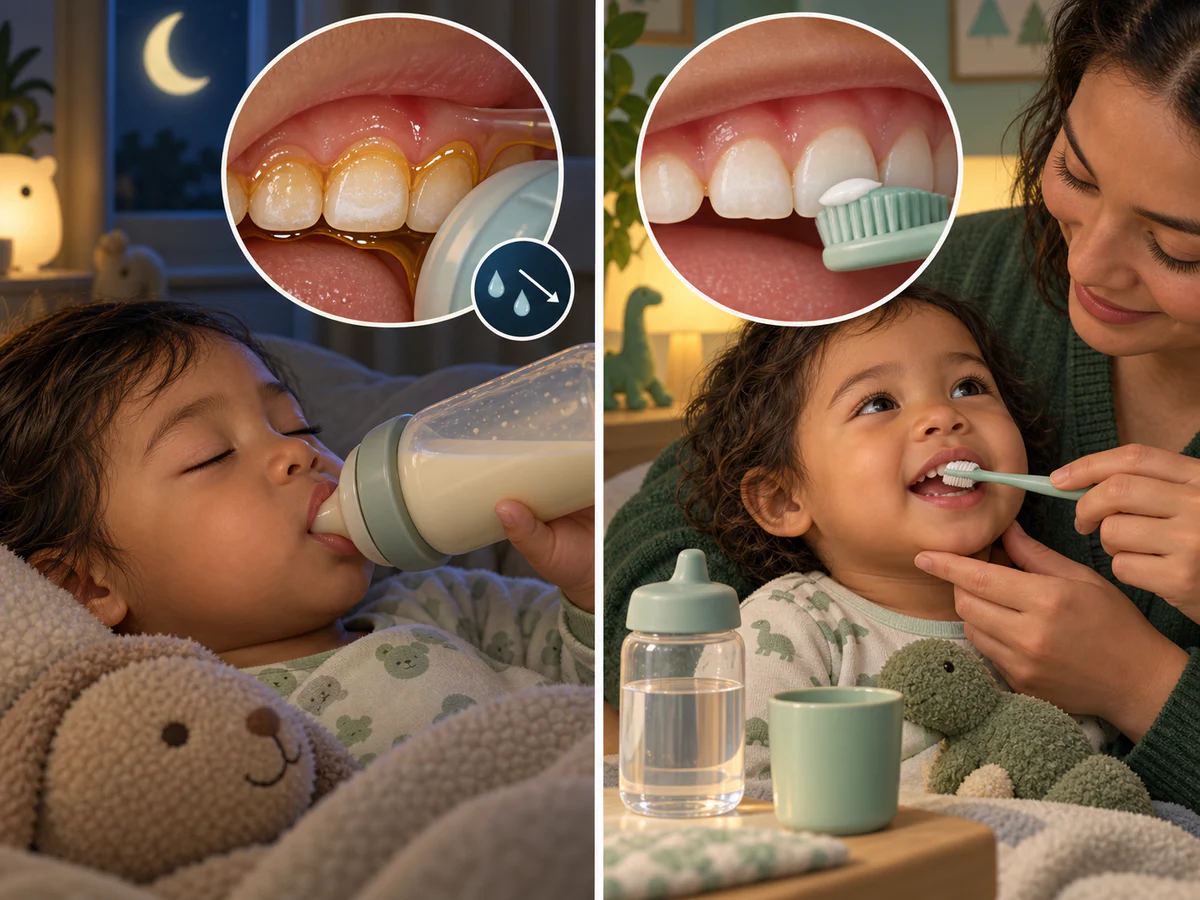
Prevention is simple:
- Do not give a sweetened bottle to help the child fall asleep.
- Offer water if the child needs a bottle during the night.
- Avoid letting the child suck for a long time on a bottle containing a sweetened drink.
This point is essential, because the damage can be rapid and affect a very young child, sometimes even before the first dental appointment.
Fluoride by age: a topic where the authorities differ
Fluoride is a recognized ally against tooth decay. The WHO recommends brushing twice a day with a fluoride toothpaste. But this is a subject where we need to be precise and honest, because recommendations on fluoride concentration are not identical from one authority to another.
The amount of toothpaste is a point of consensus
On the amount to apply, the references agree. The ADA and the EAPD recommend a rice-grain-sized smear for very young children, then a pea-sized amount between the ages of 3 and 6. Two pieces of advice go with these guidelines: supervise young children while they brush, and teach them to spit out rather than swallow the toothpaste, which limits fluoride ingestion and the risk of fluorosis (marks on the enamel linked to excess fluoride while the teeth are forming).
Fluoride concentration: France and international guidance are not aligned
This is where the recommendations diverge, and it is useful for parents to know it.
| Reference | Before age 3 | Ages 3 to 6 | From age 6 |
|---|---|---|---|
| WHO / EAPD / ADA | fluoride toothpaste, rice-grain amount | pea-sized amount | brushing 2x/day |
| France (ameli.fr) | more cautious fluoride concentration | around 500 ppm | 1000 to 1500 ppm |
The WHO, the EAPD and the ADA opt for a toothpaste of around 1000 to 1500 ppm of fluoride as soon as the first teeth appear, adjusting the amount used instead. The French authorities, via ameli.fr, apply a more cautious threshold before the age of 3, as a precaution against fluorosis, before aligning with the higher concentrations from the age of 6.
There is therefore no single figure that applies everywhere. The most sensible approach is to discuss it with your dentist, who will tailor the advice to the concentration recommended locally, to the child’s age and to their individual risk of decay.
Day-to-day brushing
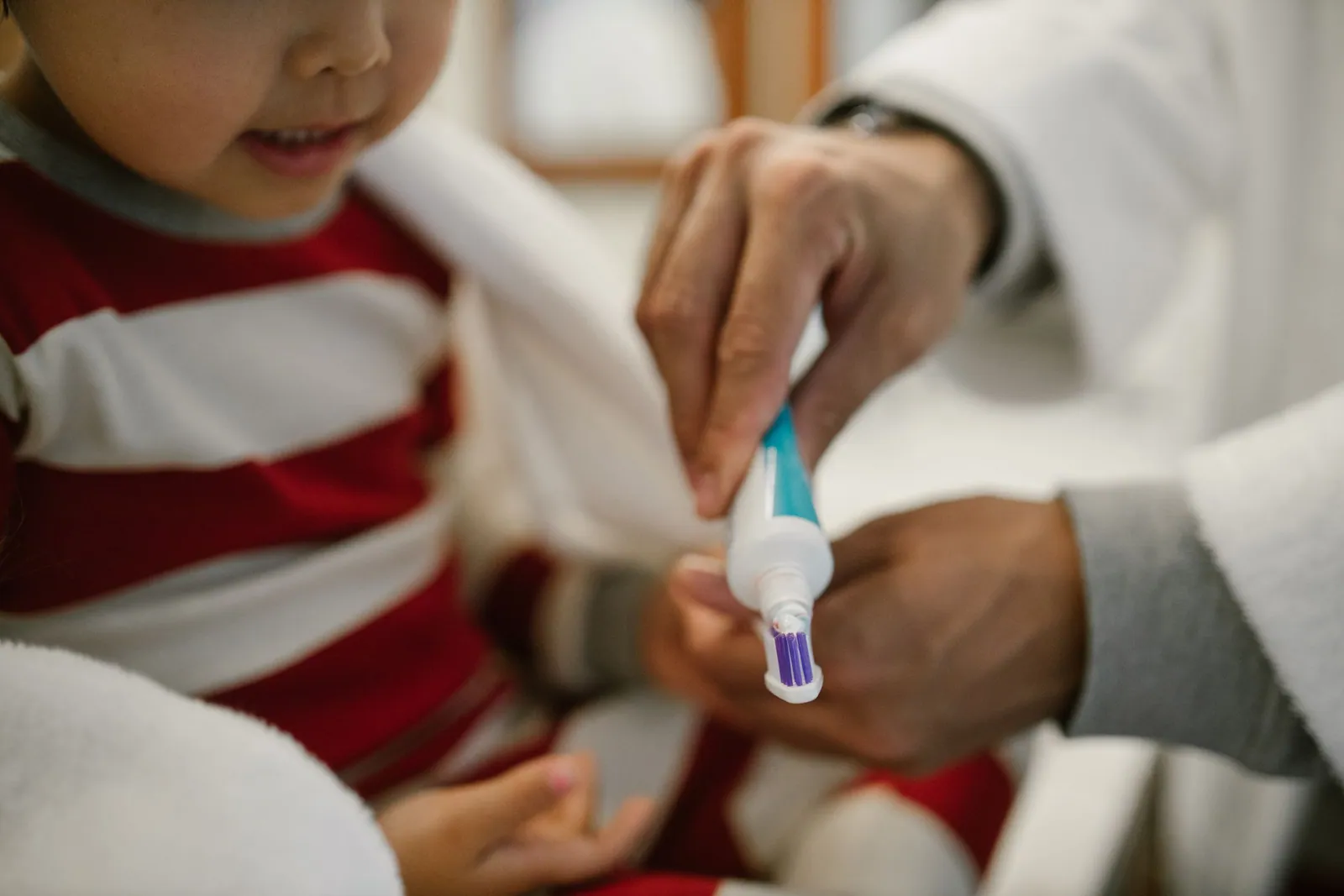
The basic guidance is simple and well established. According to ameli.fr and the WHO, teeth should be brushed twice a day, for two minutes, with a fluoride toothpaste. For young children, brushing should be done, or gone over again, by an adult, as manual dexterity is not sufficient before a certain age.
A few practical points:
- Brush morning and evening, with the evening brushing before bedtime being particularly important.
- Use a soft-bristled brush suited to the child’s age.
- Supervise until the child has mastered the technique.
To go further into technique and frequency for the whole family, you can read our article on everyday dental hygiene.
Dental sealants: who are they for, and what is the benefit?
Permanent molars have deep grooves on their chewing surface, where the toothbrush struggles to reach and plaque builds up. Sealing consists of filling these grooves with a thin material, to smooth the surface and make it easier to clean.
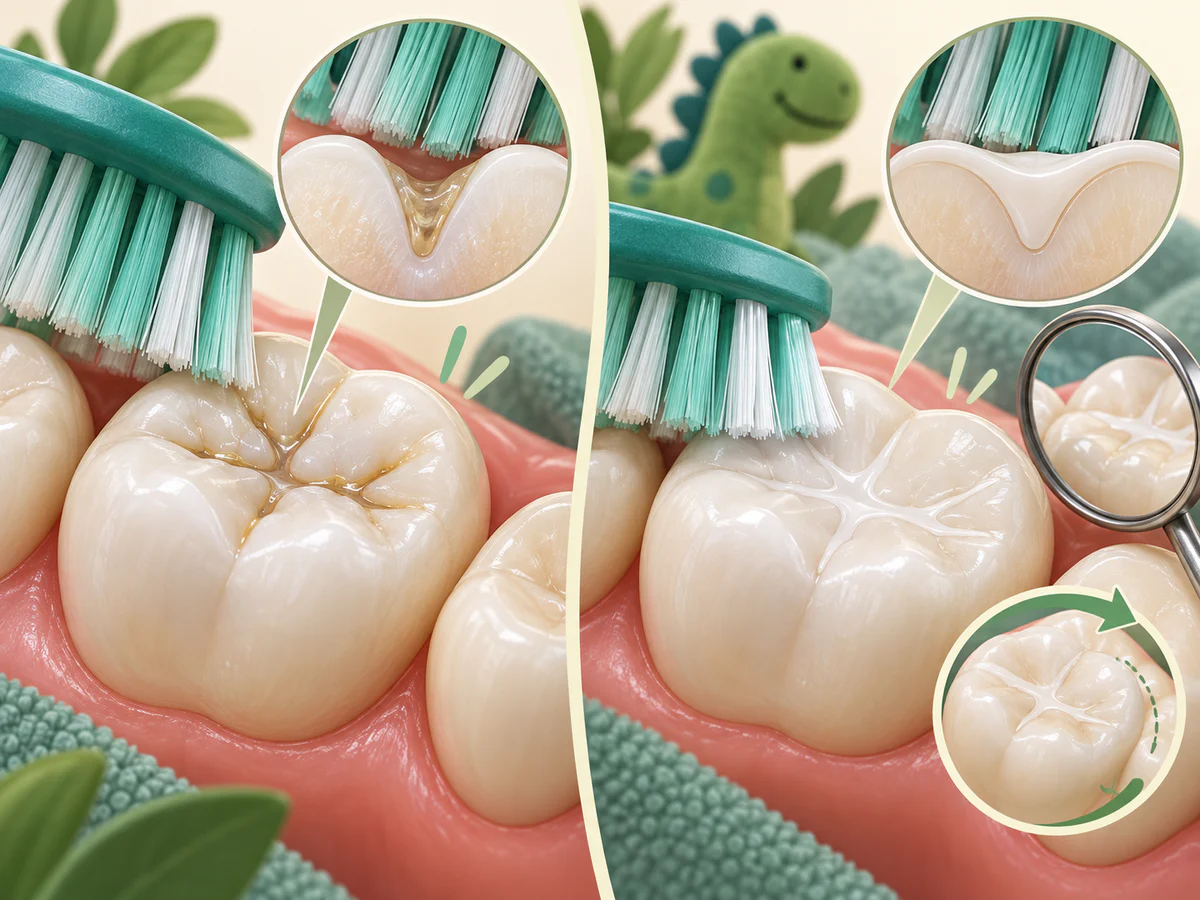
What does the evidence say? The 2017 Cochrane review (Ahovuo-Saloranta and colleagues) concludes that sealing the chewing surfaces of permanent molars reduces the risk of decay on those surfaces, with moderate-quality evidence. The benefit is real but varies from one study to another, and it is expressed as a reduction in risk rather than as a fixed success rate.
Two important qualifications:
- Sealants are aimed above all at children at moderate or high risk of decay, and at the most exposed molars.
- The material wears down over time and can partially come away; regular check-ups are needed so it can be redone if necessary.
Sealing is therefore a useful measure, but it is neither an absolute guarantee nor a substitute for brushing and limiting sugars.
The first visit and follow-up
When should you come in for the first time? In France, ameli.fr recommends a first visit to the dentist between 6 and 12 months, around the time the first teeth appear. This early appointment serves above all to screen, to advise on brushing and diet, and to familiarize the child with the practice, which makes subsequent appointments easier.
As for how often to follow up, the French public guidance is at least once a year. A closer interval may be advisable depending on the child’s risk of decay, on the dentist’s advice. There is no single six-month rule for everyone: individual assessment takes precedence.
And if a cavity is already there?
When a cavity has formed, it will not disappear on its own and needs to be treated. Treatment in children is carried out in a way suited to their age, generally under local anesthetic when necessary, to make the procedure comfortable. It would be dishonest to promise a complete absence of pain; on the other hand, gentle, gradual and well-explained care usually makes treatment well tolerated. On the principle of treating the tooth and the root, our article on root canal treatment, how it goes and the pain involved explains what is done and why.
In the event of severe pain, swelling or a dental injury in a child, it is better not to wait. Our page on dental emergencies in Kénitra sets out the situations that warrant a prompt appointment.
Key takeaways
Tooth decay in children is common, but it can be prevented and treated. The levers are known and documented:
- Limit free sugars, in quantity and above all in frequency (WHO).
- Brush twice a day, for two minutes, with an age-appropriate fluoride toothpaste, supervising young children (ameli.fr, WHO).
- Avoid the sweetened bedtime bottle to prevent baby bottle tooth decay (ameli.fr).
- Seal the grooves of the molars in children at risk, with follow-up (Cochrane 2017).
- Come in early, from 6 to 12 months, then at least once a year (ameli.fr).
On fluoride, bear in mind that there is no universal figure: France applies a more cautious threshold before the age of 3 than the WHO, the EAPD and the ADA. The right reflex is to ask your dentist for personalized advice, taking into account your child’s age and individual risk. Treating a baby tooth is not a minor detail: it protects the child’s comfort today and their permanent dentition for tomorrow.
Frequently asked questions
Does a cavity on a baby tooth that is going to fall out really need treating?
How much fluoride toothpaste should a young child use?
At what age should I take my child to the dentist for the first time?
Do dental sealants really protect against cavities?
Is a white spot on a tooth already a cavity?
Sources
Medical references consulted for this article.
- 1OMS, Sucres et carie dentaire (aide-memoire), consulte 2026
- 2OMS, Sante bucco-dentaire (aide-memoire), consulte 2026
- 3ameli.fr (Assurance Maladie), Dents de lait : importance et risque lie aux caries
- 4ameli.fr (Assurance Maladie), Prevenir les caries dentaires
- 5ADA (American Dental Association), Oral Health Topics : Toothpastes
- 6EAPD, Guidelines on the use of fluoride for caries prevention in children, 2019
- 7Cochrane (Ahovuo-Saloranta et coll., 2017), scellements de sillons, via PubMed PMID 28759120
- 8GBD 2021 / BMC Oral Health, charge de la carie des dents de lait
Contents
Share