
The first visit to the dentist should be planned earlier than most parents expect: as soon as the first tooth appears, and no later than the child’s first birthday. That is the recommendation of the American Academy of Pediatric Dentistry (AAPD), which advises a first appointment when the first tooth comes in, and no later than the first birthday. In France, the Assurance Maladie (ameli.fr) recommends coming in between 6 and 12 months, around the time the first teeth appear, and then offers annual prevention appointments through the « M’T dents » program. There is nothing worrying about this early visit: its purpose is above all to prevent, to advise and to get the child used to the dental office — not to “treat”.
As a dental surgeon in Kénitra, I often meet parents who wonder whether it is too early to bring in a toddler, or who, on the contrary, discover a cavity that has already taken hold in a child who has never been seen. This article takes stock, without alarmism, of the recommended age, the purpose of that first appointment, how to prepare your child, what actually happens and how often to come back. The aim is to give reliable landmarks, distinguishing what is broadly agreed upon from what is adapted to each family.
At what age should the first visit take place?
There is broad international agreement on the answer, even if the wording varies slightly from one country to another.
The AAPD, the leading professional body in pediatric dentistry, recommends that a child see a dentist as soon as the first tooth appears, and no later than his or her first birthday. It goes further with the notion of the “dental home”: according to its official policy, every child should establish an ongoing follow-up relationship with a dentist by the age of 12 months at the latest, in order to lay the foundations of good oral health throughout life.
In France, the Assurance Maladie (ameli.fr) recommends a first appointment between 6 and 12 months, that is, around the time the first baby teeth come in. The Union française pour la santé bucco-dentaire (UFSBD) uses a very similar benchmark: a first visit within the six months following the appearance of the first tooth, and in any case before the first birthday.
These benchmarks all converge on the same idea: it is better to come in early, around the first tooth, than to wait for pain or a visible problem. The first tooth generally appears at around 6 months, but the age of eruption varies from one child to another; it is the arrival of the tooth, more than an exact date, that signals the right moment.
And the « M’T dents » program in France
In France, the Assurance Maladie’s « M’T dents » scheme offers covered prevention appointments with a dental surgeon. According to ameli.fr, this program applies to young people aged 3 to 24 and now provides an oral examination every year, whereas it used to be offered at fixed, widely spaced ages. This examination includes a medical history, an oral examination and age-appropriate prevention advice, and can be supplemented if needed by X-rays and some treatment.
One point should be clear to avoid any confusion: « M’T dents » starts at age 3. For very young children, before that age, it is the early consultation recommended by the AAPD, ameli and the UFSBD (as soon as the first tooth appears, around age 1) that takes over. The two approaches complement each other: a very early first visit, then regular follow-up that « M’T dents » makes easier from age 3.
Why come in so early? The purpose of the early visit
One question comes up often: what is the point of bringing in a baby who has only a few teeth? The aim is not to carry out treatment, but to prevent and to guide. The AAPD in fact compares this early visit to a well-child check-up with the pediatrician, centered on parent education and cavity prevention.
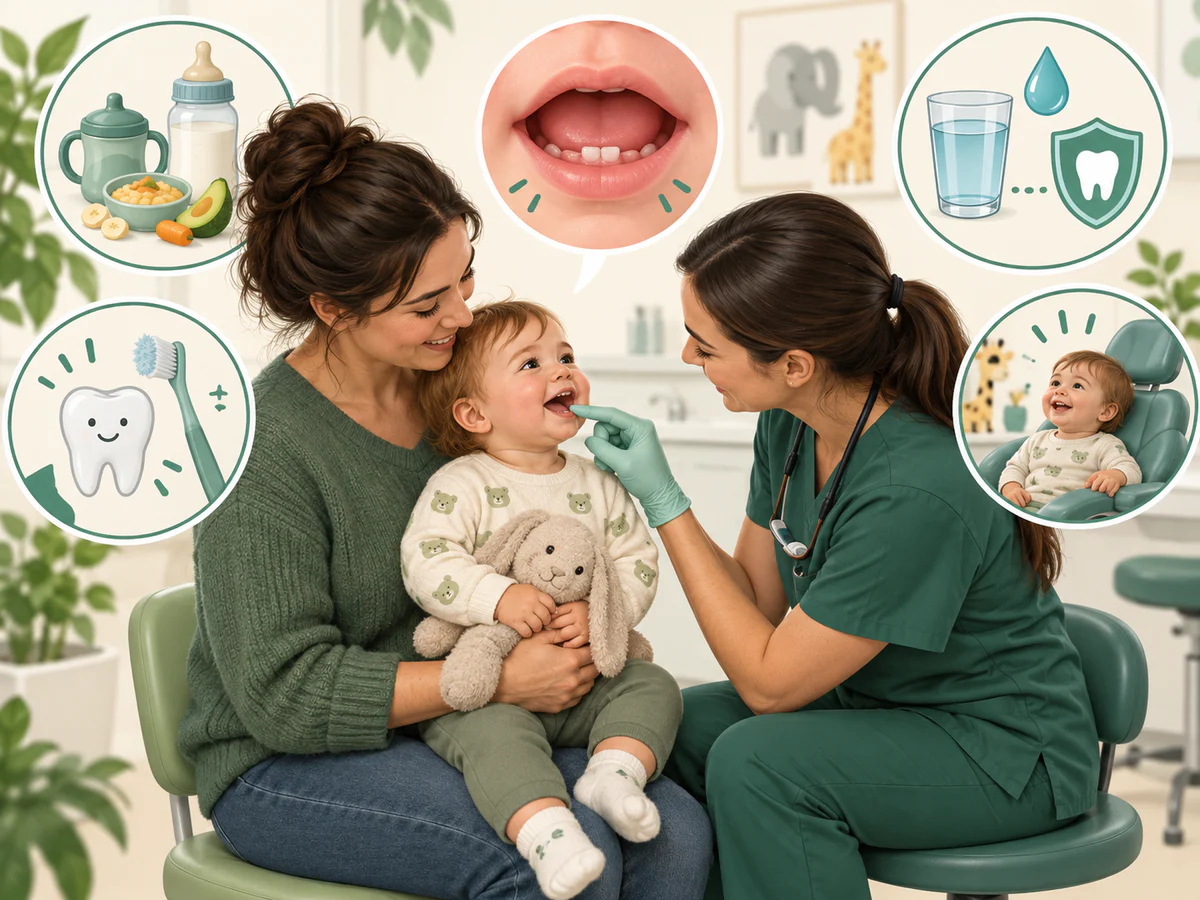
In practical terms, this first meeting serves several documented purposes:
- Detecting problems early. The examination makes it possible to spot an early cavity or signs of weak enamel before any pain appears. As ameli points out, an early cavity is often painless: the absence of pain is therefore not something to rely on when judging whether a tooth is healthy.
- Identifying risky habits. The dentist can spot the situations that encourage cavities in very young children, particularly the sweetened bottle at bedtime (see below).
- Advising on hygiene and fluoride. Parents leave with practical advice on brushing and on using fluoride toothpaste, adapted to the child’s age.
- Familiarizing the child. Coming in early, in a calm setting and with no treatment involved, helps the child associate the dental office with a neutral or positive experience, which makes later appointments easier.
Prevention is the key word here. The World Health Organization (WHO) points out that most oral diseases are largely preventable and can be treated at an early stage. According to the WHO, tooth decay results from a combination of high sugar intake, insufficient exposure to fluoride and ineffective removal of plaque by brushing: three levers that an early visit makes it possible to act on before the disease sets in. To go further into these mechanisms and how they are managed, our article on cavities in children: prevention, baby teeth and treatment covers the subject in detail.
The particular case of baby bottle tooth decay
So-called “bottle” decay (or early childhood caries) is on its own a reason for early vigilance. According to ameli, when a child falls asleep with a bottle of milk, juice or another sweetened drink, the liquid stays in prolonged contact with the teeth; during sleep, saliva no longer cleans the mouth effectively, and baby teeth, particularly the front ones, can decay quickly and darken.
The preventive measures are simple and come down to a few habits:
- Do not give a sweetened bottle to help the child fall asleep.
- Offer water if the child needs a bottle during the night.
- Avoid letting the child keep a bottle or a cup of sweetened drink all day long.
This risk concerns very young children, sometimes even before the first appointment: it is one of the reasons why coming in early, and discussing diet from the very first visit, is useful.
How to prepare your child for a first visit
Preparation matters as much as the appointment itself. Many children have no apprehension at all; in others, a fear can appear, often passed on by those around them. The advice below draws on the UFSBD’s recommendations for approaching this first time calmly.

- Use positive language. Explain calmly where you are going and why, in simple, reassuring words. It is better to avoid wording that suggests fear or pain, even when it is meant to reassure (“it won’t hurt”, “don’t be scared”), since it can unintentionally introduce the idea of danger.
- Do not pass on your own fears. The UFSBD recommends not sharing your own bad experiences or your own apprehension about the dentist in front of your child, so as not to pass on an anxiety he or she does not have.
- Use play and books. Reading an age-appropriate book together, watching a video that presents the dentist in a positive light, or playing “dentist” at home (counting teeth with a small spoon, opening wide) helps the child picture what is going to happen.
- Choose the right time of day. The UFSBD advises favoring a morning appointment, when children are often better rested, more cooperative and more receptive.
This preparation serves what the UFSBD describes as the central aim of the first visit: putting the child at ease and building a relationship of trust with the dentist, more than performing a technical procedure. A child whose first encounter goes calmly will approach the following ones more easily.
What happens during the first appointment
A toddler’s first appointment is generally short, gentle and gradual. What it includes is adapted to the child’s age and cooperation, but it most often follows a simple pattern.
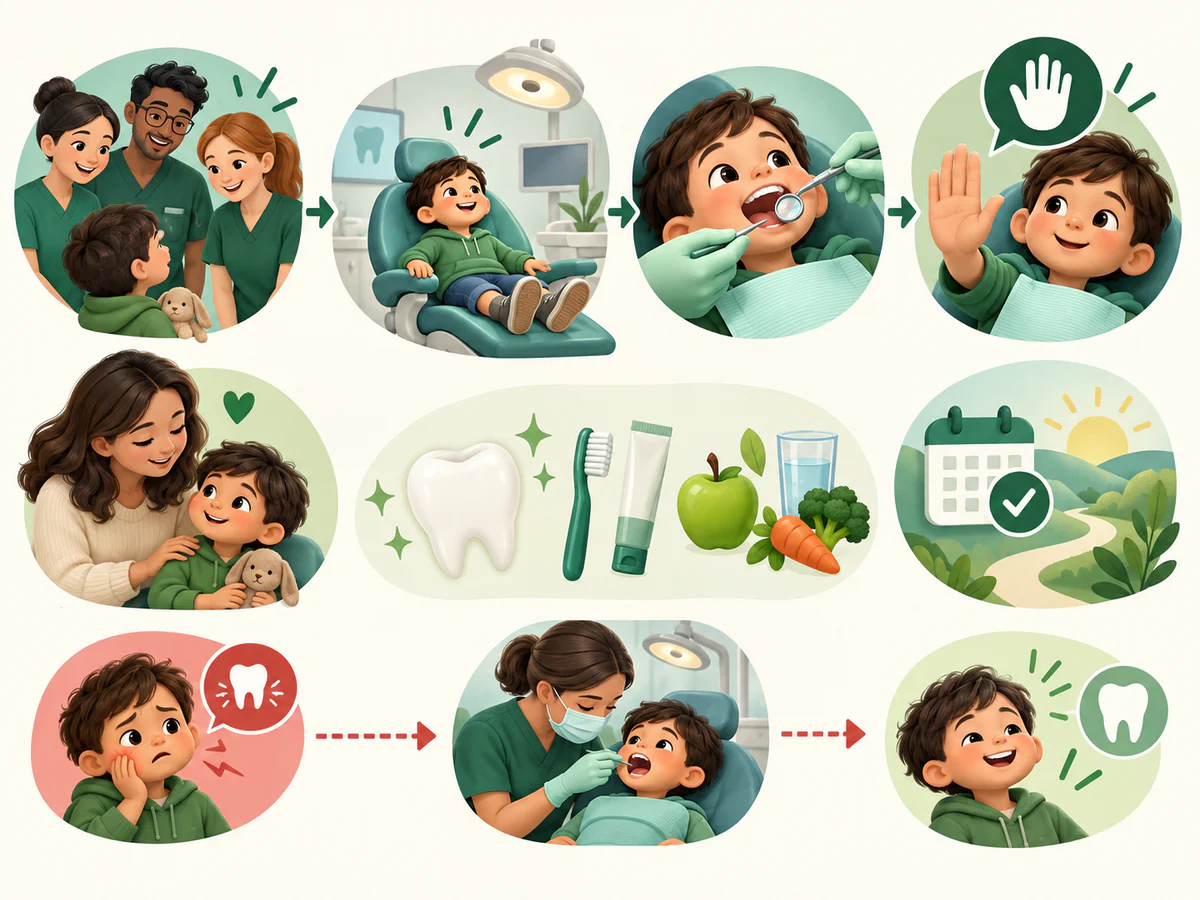
The dentist starts with a conversation with the parents: medical history, diet, habits (bottle, pacifier), brushing routine already in place. This medical history is part of the examination as described by ameli. Then comes the examination of the mouth: looking at the teeth already present, the gums and the development of the jaws, in order to detect an early cavity or an abnormality. In a very young child, this examination can be done on the parent’s lap, a position that is both reassuring and practical.
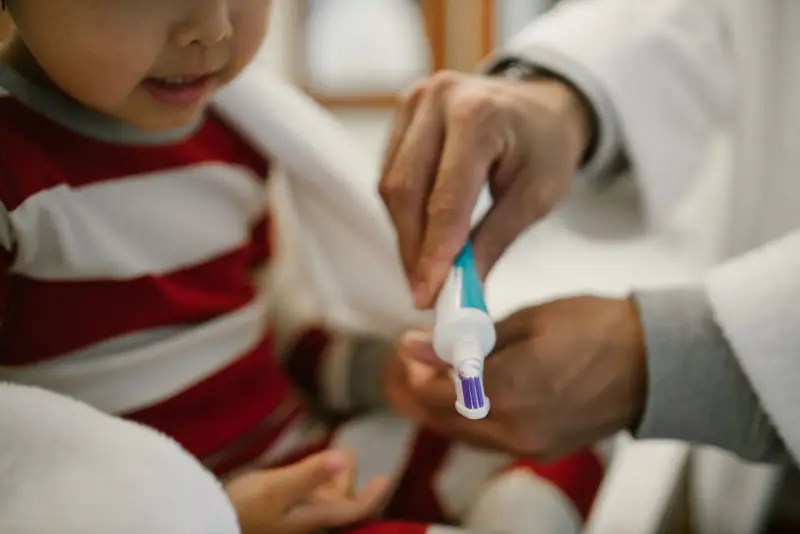
The practitioner then uses the appointment to show parents the appropriate brushing technique, to advise on the amount and the fluoride content of toothpaste according to age, and to answer questions. Depending on needs and age, the examination may be supplemented by targeted dietary advice. For an early first visit, there is generally no treatment: the goal remains observation, advice and familiarization.
It would be dishonest to promise that every child will stay perfectly cooperative. Some cry, refuse to open their mouth or want to stay in their parent’s arms: this is common and normal. A patient approach, without forcing, and if needed a further visit soon afterwards, most often allow the child to get used to the office step by step. The point of an early first visit is precisely to have the time to build that trust, without the pressure of pain.
How often should you come back afterwards?
Once the first visit is behind you, regular follow-up takes over. In France, the public benchmark is at least one appointment a year, which the « M’T dents » program also reflects with its annual examination from age 3. The AAPD frames this idea through the notion of the “dental home”: an ongoing follow-up relationship, rather than a one-off visit.
There is no universal six-month rule for everyone. The pace is adjusted to the child’s decay risk: a child at high risk (cavities already present, a sugary diet, difficult hygiene) may warrant more frequent check-ups, on the dentist’s advice, while a child at low risk will follow a more spaced-out schedule. It is the individual assessment that counts, not an automatic rule.
| Benchmark | Recommendation | Source |
|---|---|---|
| First visit (international) | As soon as the first tooth appears, no later than around age 1 | AAPD |
| First visit (France) | Between 6 and 12 months | ameli.fr |
| First visit (France) | Within the 6 months following the 1st tooth, before age 1 | UFSBD |
| Follow-up afterwards | At least once a year, to be adapted to risk | ameli.fr / « M’T dents » (from age 3) |
Dentistry at different ages: what each stage of childhood brings
Each child dental visit is adapted to the child’s age, because the mouth changes a great deal between the first tooth and the teenage years. The aim stays the same, prevention, but the focus shifts:
- Babies and toddlers: an examination often done on your lap, and advice on brushing, on the amount of fluoride toothpaste and on bottle habits.
- Preschool years: a check-up in the chair, a look for any early cavity, and brushing reviewed with the child. Depending on the risk of decay, the dentist may suggest a protective fluoride varnish.
- School years: the first adult molars come through behind the baby teeth. Their deep grooves can be protected with sealants when the risk of decay justifies it, and the dentist watches how the teeth and jaws are lining up.
- Teenage years: cleaning around braces if there are any, a mouthguard for contact sports, and attention to sugary and acidic drinks.
What if my child is already in pain or has a problem?
The recommendations about age concern the first preventive visit, in a child who is doing well. But some situations should not wait for the “theoretical” age of the first visit, or for the next scheduled appointment.
Faced with a toothache, swelling of the gum or the cheek, a tooth broken or knocked out after a fall, or a brown spot that is getting worse, it is better to seek care without delay, whatever the child’s age. Our page on dental emergencies in Kénitra sets out the situations that warrant a prompt appointment. And if a cavity has already formed, it will not go away on its own: on the principle of treating the tooth and its root, our article on root canal treatment, how it works and pain explains what is done and why, it being understood that treatment in children is always carried out in a way that is adapted to their age.
Key takeaways
The first visit to the dentist is planned early and goes smoothly when it is well prepared. The essential landmarks are simple:
- Come in as soon as the first tooth appears, no later than around the first birthday (AAPD); in France, between 6 and 12 months (ameli.fr, UFSBD).
- Understand that the aim is to prevent, detect, advise and familiarize, not to treat right away (AAPD).
- Watch out for baby bottle tooth decay and avoid sweetened drinks at bedtime (ameli.fr).
- Prepare your child through positive language, play and reading, without passing on your own fears (UFSBD).
- Continue with regular follow-up, at least once a year, adapted to the child’s risk (ameli.fr, « M’T dents » from age 3).
An early, calm first visit is an investment in what comes next: it protects the baby teeth, which have a real role to play, and builds in the child a trusting relationship with the dental office that will serve him or her for life.
Frequently asked questions
At what age should my child have a first visit to the dentist?
What is the point of a visit if my baby has only a few teeth?
How can I prepare my child who is afraid of the dentist?
What is the « M'T dents » program and from what age does it apply?
What actually happens during the first appointment?
How often should we come back after the first visit?
Should parents stay in the room during a child's dental visit?
Sources
Medical references consulted for this article.
- 1AAPD (American Academy of Pediatric Dentistry), FAQ parents : première visite (première dent / premier anniversaire), consulté 2026
- 2AAPD, Policy on the Dental Home (établir un foyer dentaire au plus tard à 12 mois), consulté 2026
- 3ameli.fr (Assurance Maladie), Dents de lait : importance et risque lié aux caries (première visite 6 à 12 mois, carie du biberon)
- 4ameli.fr (Assurance Maladie), « M'T dents tous les ans ! » : rendez-vous de prévention offerts (3 à 24 ans)
- 5ameli.fr (Assurance Maladie), « M'T dents tous les ans ! » : examen bucco-dentaire annuel (chirurgien-dentiste)
- 6UFSBD (Union française pour la santé bucco-dentaire), Bébés - Enfants (âge de la première visite, préparation)
- 7OMS, Santé bucco-dentaire (aide-mémoire) : prévention, fluor, sucres
Contents
Share