
A dental infection, a root-canal-treated tooth or a jaw disorder can raise questions about general health. To answer them, we need to tell apart four things:
- proven causation: one problem causes the other;
- association: two problems occur together more often than by chance;
- shared risk factors: the same factor feeds both problems;
- coexistence: two problems are simply present at the same time.
This article explains those distinctions and the limits of available knowledge.
Observing two problems in one person does not prove that one causes the other. This distinction helps avoid unnecessary treatment. It also helps avoid delays in appropriate medical assessment.
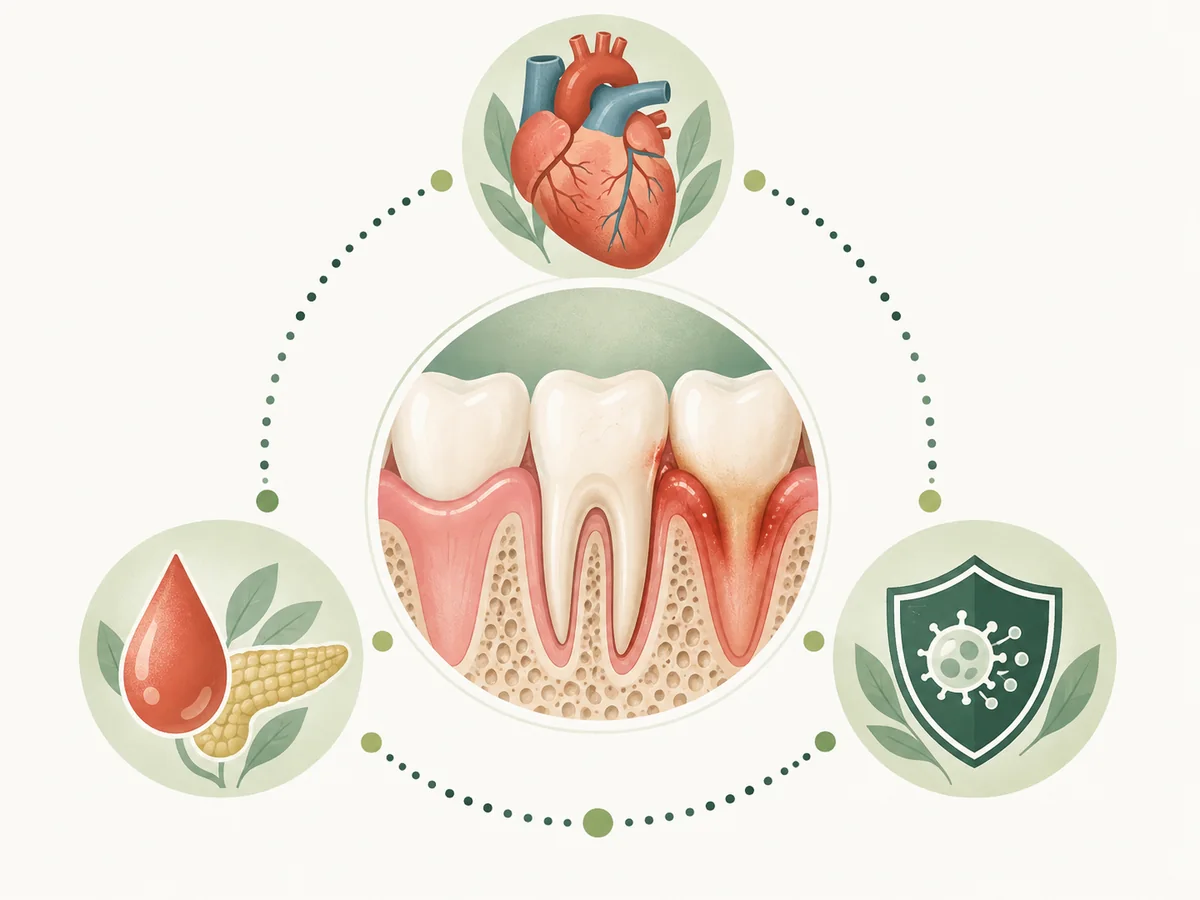
A genuine dental infection can become serious. Periodontitis is a gum disease that damages the tissues supporting the teeth. It sustains chronic (long-lasting) inflammation. Its relationships with diabetes and cardiovascular disease are documented. However, no recognised scientific figure shows that 80% of health problems come from the teeth. And the time at which a symptom appears does not identify its cause.
Start with clinical signs, not a general theory
Assessment looks for concrete signs:

- localised pain;
- swelling;
- a sinus tract (a small channel that drains pus, often onto the gum);
- mobility (a loose tooth);
- chewing discomfort;
- wear;
- jaw tension.
Distant symptoms without oral signs may require medical evaluation.
The aim is to recognise established links and uncertainty. It is also to know when to consult a dentist or doctor.
Where does the idea that ‘everything comes from the teeth’ come from?
In the early twentieth century, the focal infection theory attributed many systemic diseases to silent dental foci. Systemic diseases affect the whole body. Silent dental foci are hidden sources of infection in the teeth. The theory led to the extraction of teeth that could sometimes have been saved. This broad claim was later abandoned because reliable evidence did not support it. The American Association of Endodontists states that no valid scientific evidence links properly performed root-canal treatment with systemic disease.
That does not make dental infection harmless. An untreated abscess (a pocket of pus caused by infection) can spread into nearby tissues. Rarely, it can threaten the airway or general health. So the reasonable conclusion is not ‘teeth have nothing to do with the rest of the body’. Nor is it ‘almost everything comes from the teeth’. It is more precise: a real dental focus must be diagnosed and treated, without blaming it for distant symptoms on intuition alone.
What is genuinely established about oral and general health
The World Health Organization treats oral health as part of general health. Oral diseases share several risk factors with other chronic diseases, including:

- tobacco;
- diets high in free sugars (sugars added to food and drinks, and those in honey, syrups and fruit juices);
- alcohol;
- barriers to care;
- social determinants, such as income and living conditions.
These shared factors explain some of the associations observed.
Periodontitis and diabetes: a two-way relationship
The best documented link concerns diabetes and periodontitis. A joint consensus from the European Federation of Periodontology and the International Diabetes Federation describes a two-way relationship:
- poorly controlled diabetes increases the risk and severity of periodontitis;
- severe periodontitis can make glycaemic control (control of blood sugar) more difficult.
This supports coordinated prevention and follow-up. It does not mean that a particular tooth ‘corresponds’ to the pancreas.
The 2022 Cochrane review includes 35 trials and 3,249 participants, mostly with type 2 diabetes. Cochrane reviews pool the results of clinical trials on one question. With moderate certainty, this review reports lower HbA1c after periodontal treatment. HbA1c is a blood marker of average blood sugar over the past two to three months. The mean reductions were 0.43 percentage points at 3–4 months and 0.30 at six months. These averages do not guarantee individual benefit or replace diabetes care.
Periodontitis and cardiovascular disease: association is not causation
Studies also show an association between periodontitis and atherosclerotic cardiovascular disease. This is heart and blood-vessel disease linked to fatty deposits in the arteries. Plausible mechanisms include bacteria briefly entering the bloodstream, and inflammation. However, affected people also share risk factors such as smoking, age and social conditions. The EFP/WHF consensus recommends taking periodontal health seriously. But it does not promise that treating the gums alone will prevent a heart attack or stroke.
The 2022 cardiovascular Cochrane review found only two trials, at high risk of bias. Evidence is insufficient to conclude that periodontal treatment prevents a first or recurrent cardiovascular event. This does not mean no link exists. Treatment mainly addresses the teeth and periodontal tissues (the gums and the bone around the teeth).
Symptoms on waking: what teeth may explain, and what they do not prove
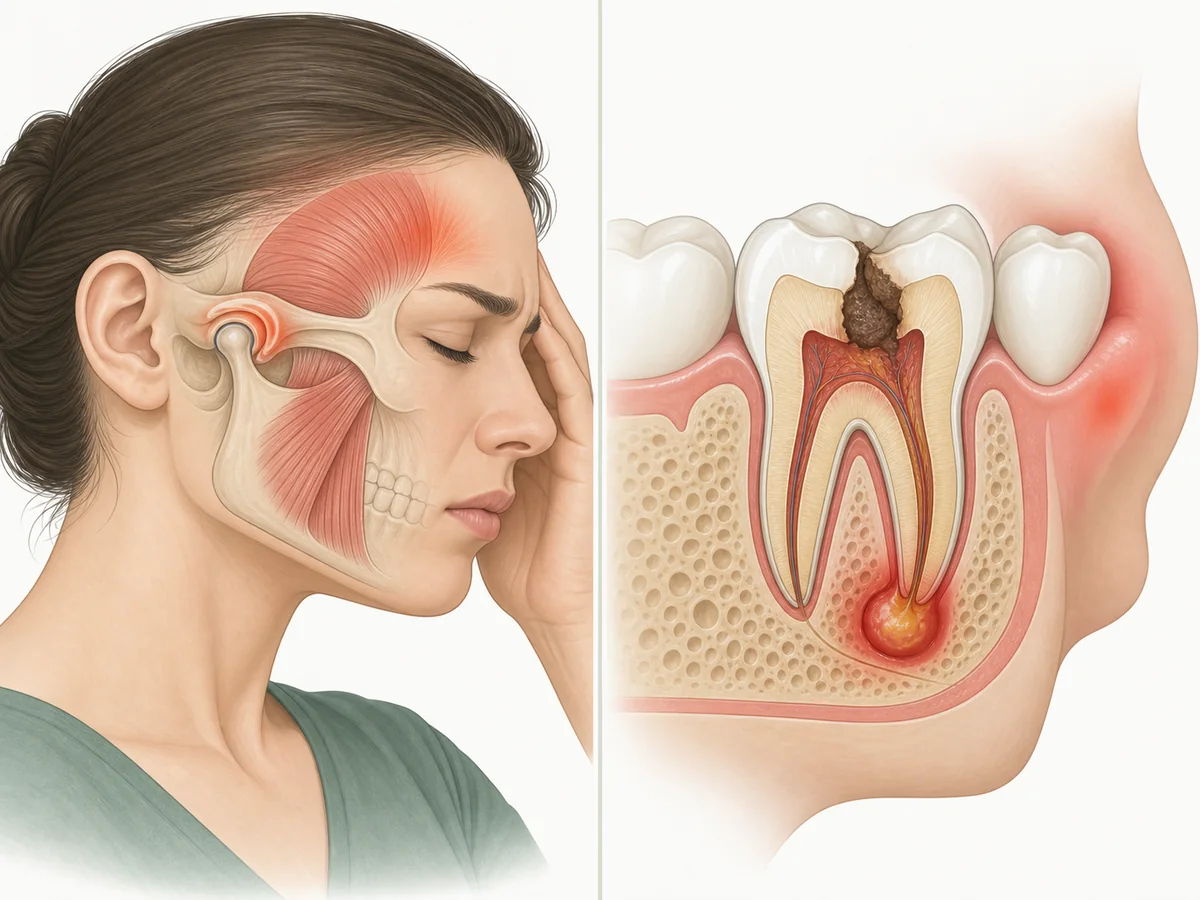
Bruxism (clenching or grinding the teeth) can involve jaw pain or fatigue, and headaches. Temporomandibular disorders affect the jaw joints and chewing muscles. Some of them can coexist with dizziness without proving a dental cause. Dizziness needs appropriate assessment. Dental treatment should not delay investigation of other causes.
A 2023 systematic review found an association between temporomandibular disorders and some primary headaches, particularly migraine. Primary headaches are not caused by another condition. The overall certainty of this finding was moderate.
For dizziness, a 2026 systematic review found associations mainly in descriptive studies, which only describe what is observed. Analytical studies, which test a link against a comparison, found no statistically significant relationship. The review could not establish causation. In practice, jaw pain can guide the examination. But neurological, vestibular (inner-ear balance) and other medical causes must not be overlooked.
The same institute states that research does not support a ‘bad bite’ as a general cause of temporomandibular disorders. Permanently changing the bite should therefore not be offered as a universal solution. Assessment starts with:
- the history of the symptoms;
- an examination of the jaw and teeth;
- conservative measures (simple, reversible care) when appropriate.
By contrast, lower-back pain or heel pain that improves with movement is not a validated sign of dental infection. Migraine or dizziness on waking does not prove that a tooth is responsible either. These symptoms may relate to:
- sleep;
- the inner ear;
- muscles;
- joints;
- medication;
- neurological causes;
- other medical conditions.
A dental examination may be part of the work-up when oral signs are present. But it does not replace appropriate medical assessment.
Crowns, root-canal-treated teeth and amalgam: presence is not disease
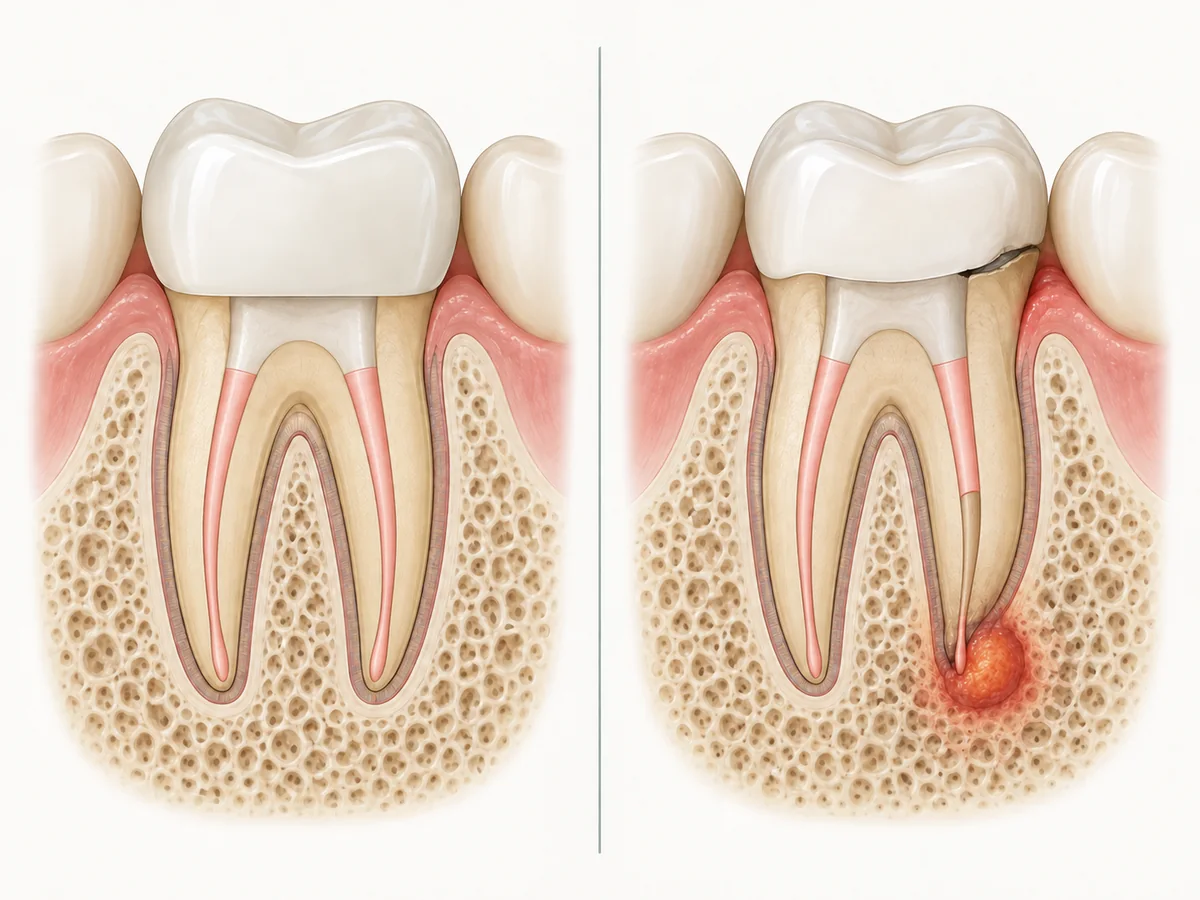
A crown or root-canal-treated tooth can function for a long time. Like any restoration, it can also develop:
- secondary decay (new decay at the edge of the restoration);
- a crack;
- leakage;
- infection around the root.
These are local, verifiable problems:
- pain on biting;
- a draining sinus;
- swelling;
- a radiographic finding (something seen on an X-ray);
- a clinical change.
The mere presence of root-canal treatment does not demonstrate a source of systemic illness.
Dental amalgam is the metal filling material that contains mercury. For amalgam, the FDA says the available evidence does not show harmful effects in the general population at typical exposure levels. It does, however, identify groups for whom extra precautions are advised when choosing a new restoration. It does not recommend removing an intact amalgam solely to prevent disease. Removal sacrifices healthy tooth tissue. It also temporarily increases exposure to mercury vapour.
The term ‘electrogalvanism’ is sometimes used for local electrical effects between different metals in the mouth. On its own, it is not a diagnosis for dizziness, migraine or systemic disease. A restoration that is painful, damaged or feels wrong deserves an examination. Replacement should be based on a clinical finding, not a promise to cure distant symptoms.
When a dental infection can genuinely threaten health
The most useful signs are local:
- severe or persistent toothache;
- pain on pressure;
- a swollen gum or cheek;
- a bad taste;
- discharge;
- fever;
- swollen glands;
- difficulty opening the mouth.
An abscess does not resolve on its own and needs dental treatment. Antibiotics alone do not always remove the cause.
The following signs require immediate medical care:
- difficulty breathing, speaking or swallowing;
- substantial swelling in the mouth;
- a swollen or painful eye;
- visual changes;
- rapid general deterioration.
Marked difficulty opening the mouth, especially with swelling or infection, also needs urgent assessment rather than a routine appointment. See dental emergency guidance in Kénitra.
Antibiotics do not replace treatment of the cause. ADA guidance concerns certain pulpal or periapical pain and infections. These affect the soft inner tissue of the tooth (the pulp) or the area around the root tip. The guidance covers immunocompetent adults, meaning adults whose immune system works normally. Decisions depend on systemic signs, the risk of spread and prompt access to dental care. Do not take antibiotics without an appropriate prescription.
A simple way to avoid choosing the wrong cause
Start with the signs that are present, not a universal theory. See a dentist for:
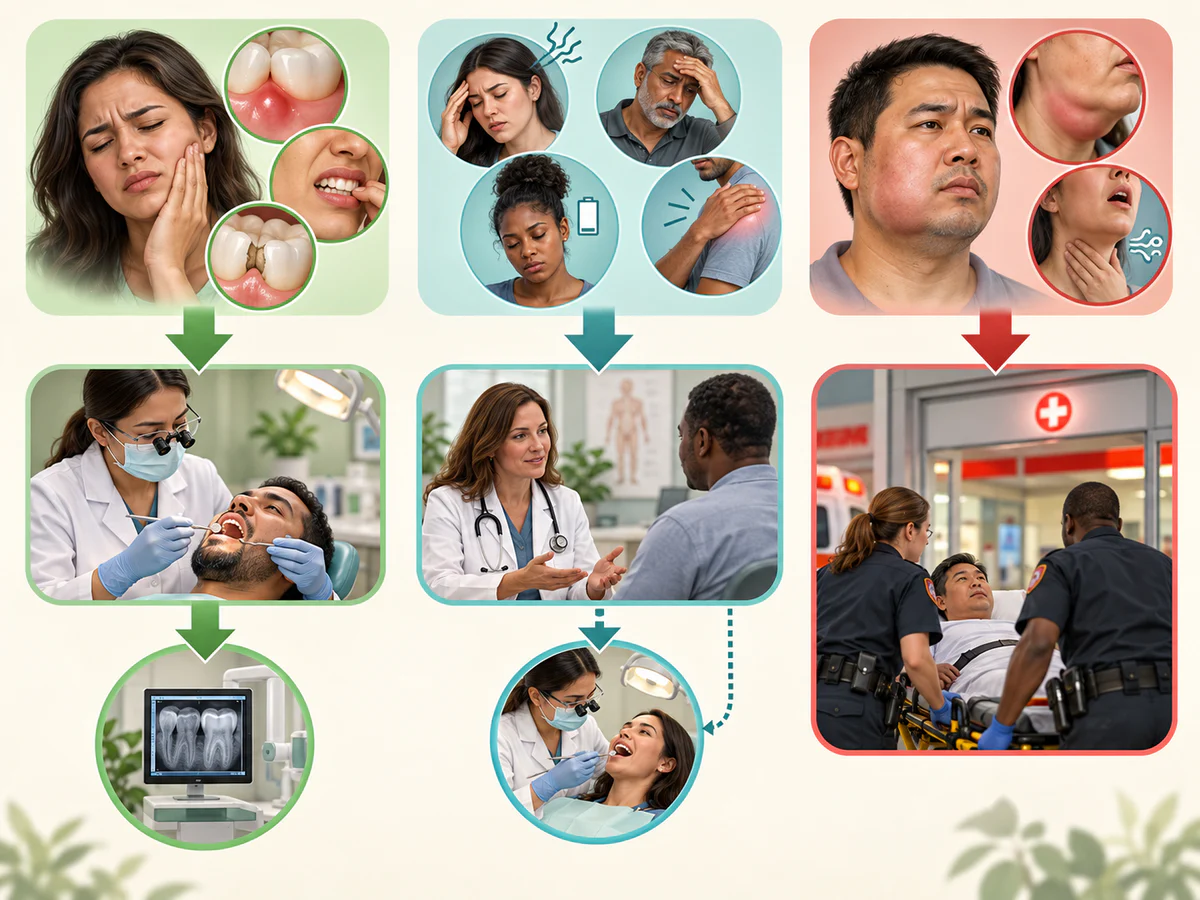
- tooth pain;
- a swollen gum;
- a broken restoration;
- pain when chewing;
- jaw pain.
For dizziness, migraine, joint pain or fatigue without a clear oral sign, a medical assessment is usually the first reference point. When symptoms overlap, both opinions can complement each other.
A careful examination looks for observable findings:
- the condition of the teeth and gums;
- tenderness;
- mobility;
- bite;
- jaw muscles and joints.
Imaging follows when indicated. This avoids two opposite errors. One is overlooking a genuine dental focus. The other is blaming the teeth for a condition that needs different care.
Key points
Oral health does matter to general health:
- dental infection needs treatment;
- diabetes and periodontitis interact;
- periodontitis is associated with cardiovascular risk.
These facts do not mean that every symptom comes from the teeth. Nor do they mean that a particular tooth corresponds to a specific organ.
Toothache, swelling, chewing discomfort or jaw pain warrant a dental assessment. Dizziness or other symptoms without clear oral signs often need medical advice. Assessments can complement one another when symptoms overlap.
The aim is to identify genuine oral problems without blaming the teeth for symptoms that need another assessment.
Frequently asked questions
Is it true that 80% of diseases come from the teeth?
Can a tooth cause dizziness or headaches?
Can a root-canal-treated tooth make someone ill?
Should an intact amalgam filling be removed to protect health?
Which signs of dental infection require prompt care?
Sources
Medical references consulted for this article.
- 1Organisation mondiale de la santé (OMS), Oral health, fiche d'information, 17 mars 2025
- 2Sanz M et coll., consensus EFP/IDF sur les maladies parodontales et le diabète, Diabetes Research and Clinical Practice, 2018
- 3Simpson TC et coll., revue Cochrane sur le traitement de la parodontite et le contrôle glycémique, 35 essais randomisés, 2022
- 4Sanz M et coll., consensus EFP/WHF sur la parodontite et les maladies cardiovasculaires, Global Heart, 2020
- 5Ye Z et coll., revue Cochrane sur le traitement parodontal et la prévention cardiovasculaire, 2022
- 6NIDCR (National Institutes of Health), Temporomandibular Disorders (TMD)
- 7NIDCR (National Institutes of Health), Bruxism
- 8Dibello V et coll., revue systématique sur les troubles temporo-mandibulaires et les céphalées primaires, Journal of Oral & Facial Pain and Headache, 2023
- 9Binduhayyim RIH et coll., revue systématique et méta-analyse sur les troubles temporo-mandibulaires et les vertiges, 2026
- 10American Association of Endodontists, Root Canal Safety
- 11U.S. Food and Drug Administration, Dental Amalgam Fillings
- 12NHS, Dental abscess: symptoms and emergency signs
- 13American Dental Association, recommandation clinique sur les antibiotiques pour les douleurs et gonflements dentaires, 2019
Contents
Share