
In short: If drinking cold water after eating makes a tooth hurt for a moment, the usual cause is exposed dentin: enamel wear, acid erosion or the exposure that occurs when gums recede leaves the tubules of the dentin open, and the cold moves the fluid inside them. A toothpaste for sensitive teeth and gentle brushing often help. Pain that lingers, throbs or comes on when biting deserves an examination.
A sip of cold water, a spoonful of ice cream, sometimes just cool air passing over a tooth: the pain is brief, sharp, and disappears as soon as the stimulus stops. This sensitivity to cold and heat has a precise name, dentin hypersensitivity. It occurs when the dentin, the tissue that lies beneath the enamel, becomes exposed. Cold, heat or air then set in motion the fluid contained in its microtubules, which mechanically stimulates the nerve located at the edge of the pulp. This is the hydrodynamic theory, the most widely accepted mechanism according to the review published on PMC in 2020. The good news: in most cases, simple at-home measures are enough to noticeably reduce the discomfort. The important nuance: a tooth that reacts to cold does not always mean simple sensitivity, and some kinds of pain should lead you to seek care.
This article describes the mechanism, the verified causes, the graduated solutions from home to the office, and above all the signs that distinguish ordinary sensitivity from a more serious problem.
What is tooth sensitivity to cold and heat?
Dentin hypersensitivity is defined as a brief, sharp pain triggered by a stimulus that should not normally hurt: cold, heat, air, contact, or sweet or acidic food. According to the 2020 review (PMC), this pain arises from exposed dentin and cannot be attributed to any other dental disease or defect. You may also see it written dentine hypersensitivity, the British spelling of the same term.
That last point is essential. Dentin hypersensitivity is what is known as a diagnosis of exclusion: it is only retained after other possible causes of pain, such as a cavity, a crack or inflammation of the pulp, have been ruled out. In other words, a tooth that reacts to cold is not necessarily “just sensitive.”
A common complaint, but a hard one to quantify
Tooth sensitivity is common, particularly in adults. Putting a single figure on it would nonetheless be misleading. According to a systematic review with meta-analysis published in 2019 in the Journal of Dentistry (PubMed), estimates vary enormously depending on the survey method: around 11.5% as a conservative estimate, up to roughly one third on average across studies, with a very wide range. Let us hold on to the idea rather than the percentage: this is an everyday reason for consultation, affecting a significant share of adults.
How is the pain transmitted? The role of dentinal tubules
To understand the solutions, you have to understand the mechanism. Dentin is not a solid block. It is crossed by thousands of microscopic channels, the dentinal tubules, filled with fluid and running from the surface toward the pulp, where the nerves are located.
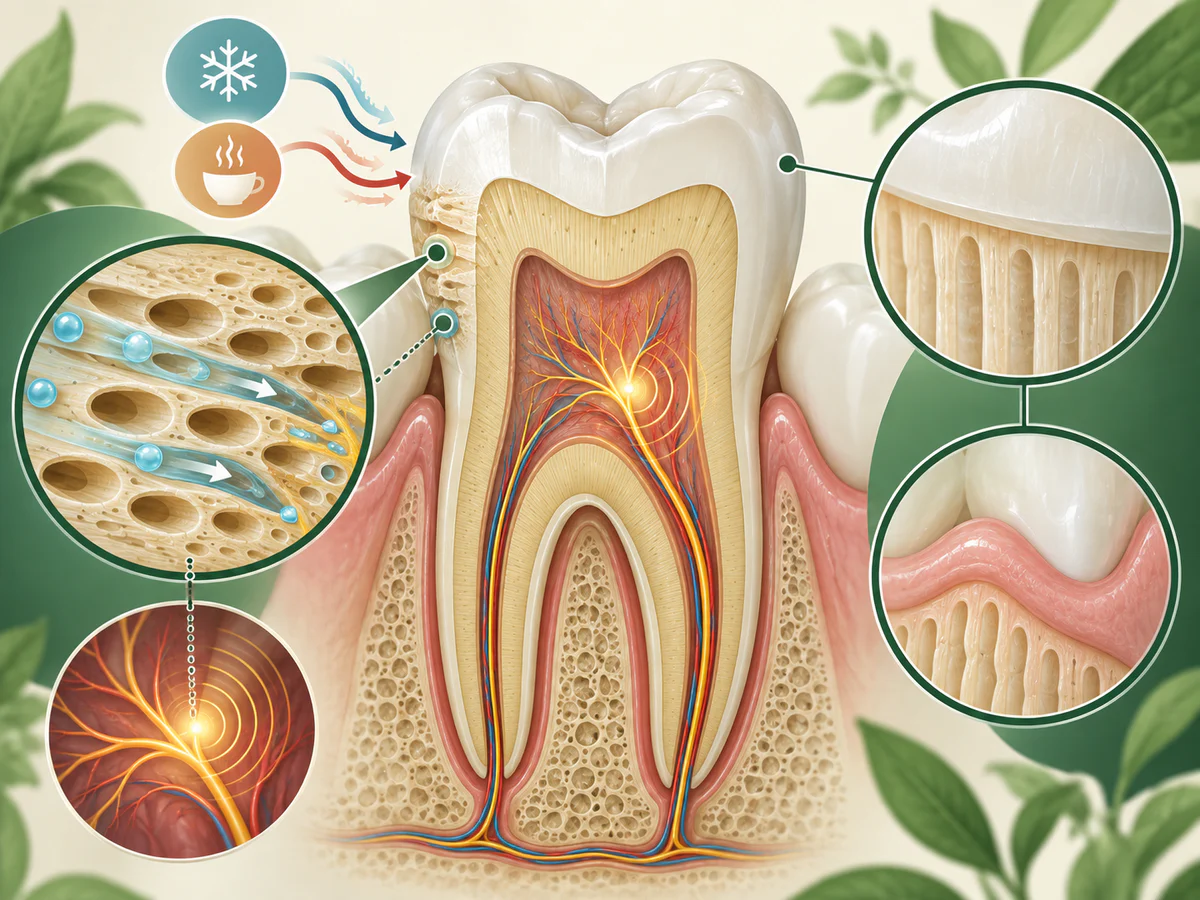
Contrary to a widespread idea, cold or heat does not directly “reach” the nerve, and dentin itself does not “feel.” According to the hydrodynamic theory, described by Brännström and taken up by the 2020 review (PMC), it is the movement of the fluid inside the tubules that transmits the pain. A stimulus, especially cold and air, displaces that fluid; this displacement mechanically stimulates the nerve fibers at the junction between the dentin and the pulp, which triggers the sharp, fleeting pain.
Three conditions must come together for a tooth to be sensitive, as the 2020 PMC review points out:
- the dentin must be exposed;
- the openings of the tubules must be open at the surface;
- these tubules must be connected to a living pulp.
This logic directly explains why treatments aim to seal the tubules or to calm the nerve: by reducing the movement of the fluid, the pain is reduced. Covering exposed dentin with a varnish, a sealant or a restoration works on the same principle.
What causes tooth sensitivity?
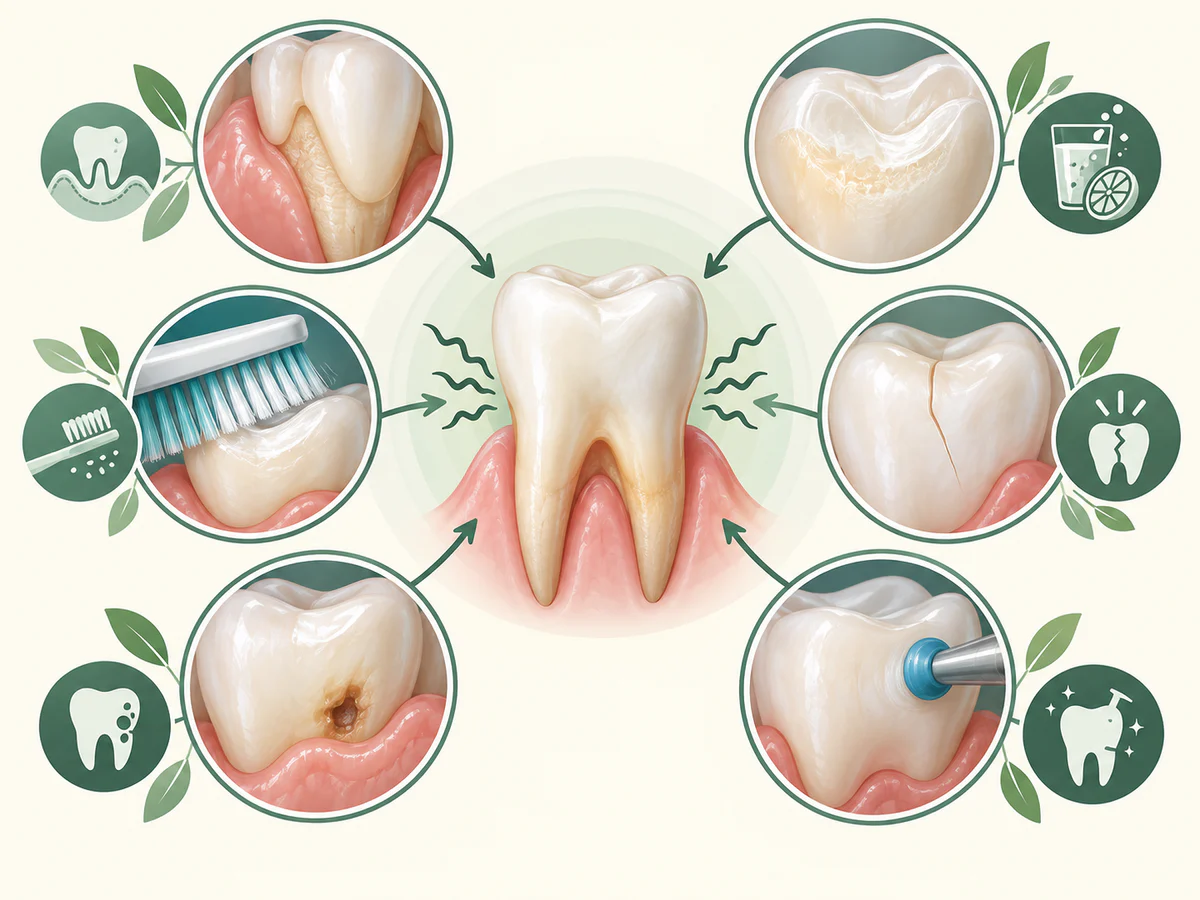
Dentin becomes exposed in several ways. According to the 2020 review (PMC), the main causes are the following.
Gum recession
When the gum pulls back, it uncovers the root of the tooth. But the root is not covered by enamel; it is covered by a thin layer of cementum that wears away quickly and leaves the dentin exposed. Brushing too hard, tartar and gum disease all encourage this recession. If your gums bleed or are receding, the subject is covered in detail in our article on bleeding gums, causes and what to do.
Acid erosion
Acidic foods and drinks gradually dissolve the enamel: sodas, including “diet” ones, citrus juices, sports and energy drinks, white wine. Acid reflux, which brings acid back into the mouth, acts in the same way. Over time, the enamel thins and the dentin is exposed.
Abrasion and mechanical wear
Brushing too vigorously, a hard-bristled brush or an aggressive horizontal technique wear down the enamel and the cementum, especially at the neck of the tooth. Wear linked to tooth grinding (bruxism) also contributes to exposing the dentin. When the enamel wears down in this way, it does not grow back, so limiting the cause matters as much as relieving the sensitivity.
Tooth whitening
Peroxide whitening frequently causes sensitivity. According to the American Dental Association, this sensitivity is generally mild and transient, and subsides within a few days; it is more common with high peroxide concentrations. It should not be confused with sensitivity that has become established over the long term.
After a scaling or a dental procedure
Temporary sensitivity after a scaling is possible, particularly when the root was already partially exposed. It most often eases on its own. If the discomfort lasts, it is best to mention it at the next visit.
Why does cold water after eating cause tooth sensitivity?
Many people notice the twinge at a precise moment: a glass of cold water at the end of a meal. Two things combine. Cold is the stimulus that most readily moves the fluid in open dentinal tubules, so a tooth with exposed dentin reacts to it first. And a meal often includes acidic foods and beverages, such as citrus fruit, vinegar, sodas or fruit juice, which temporarily soften the enamel surface and can leave the tubules more open for a while. Sugary foods can set off the same brief twinge, since sweetness is one of the stimuli that provoke dentin hypersensitivity.
The water itself is rarely the problem. It reveals an area where the dentin is already exposed: enamel wear at the neck of the tooth, exposed roots due to receding gums, or erosion from repeated acid exposure. A few adjustments usually help. Choose cool rather than ice-cold drinks while the sensitivity lasts, rinse with plain water after acidic foods, wait before brushing, and use a soft-bristled toothbrush with a gentle technique. If the same tooth hurts every time, or the pain lasts after the water is gone, have it examined: a cavity, a crack or a leaking filling can cause the same twinge.
Heat sensitivity in a tooth: what it can mean
Heat sensitivity in a tooth can have the same cause as sensitivity to cold: exposed dentin, whose open tubules let the heat move the fluid inside. In that case, the pain is brief and stops once the hot drink is gone. Heat triggers dentin hypersensitivity less often than cold does, though, so a tooth that reacts mainly to heat deserves a closer look.
A few clues help you describe it to your dentist:
- Brief or lingering? A twinge that fades at once fits exposed dentin. Pain that lasts after the hot drink, or that throbs, points more toward an irritated pulp, the living tissue inside the tooth.
- Eased by cold? Pain from heat that a sip of cold water calms is a classic sign of pulp inflammation, not of simple sensitivity.
- One tooth or several? Teeth with heat sensitivity spread across the mouth often share a general cause, such as wear or receding gums. A single tooth points more toward a local problem: a deep cavity, a crack or a large filling.
Hot and cold sensitivity in the same tooth
When a tooth reacts to both hot and cold with a short twinge, exposed dentin remains the usual explanation, and the measures below often help. When it reacts to both and the pain lingers after each sip, comes back on its own or wakes you at night, the pulp itself may be involved. These signs call for a prompt examination, because the nerve may need treatment.
How can you relieve teeth that are sensitive to cold and heat?
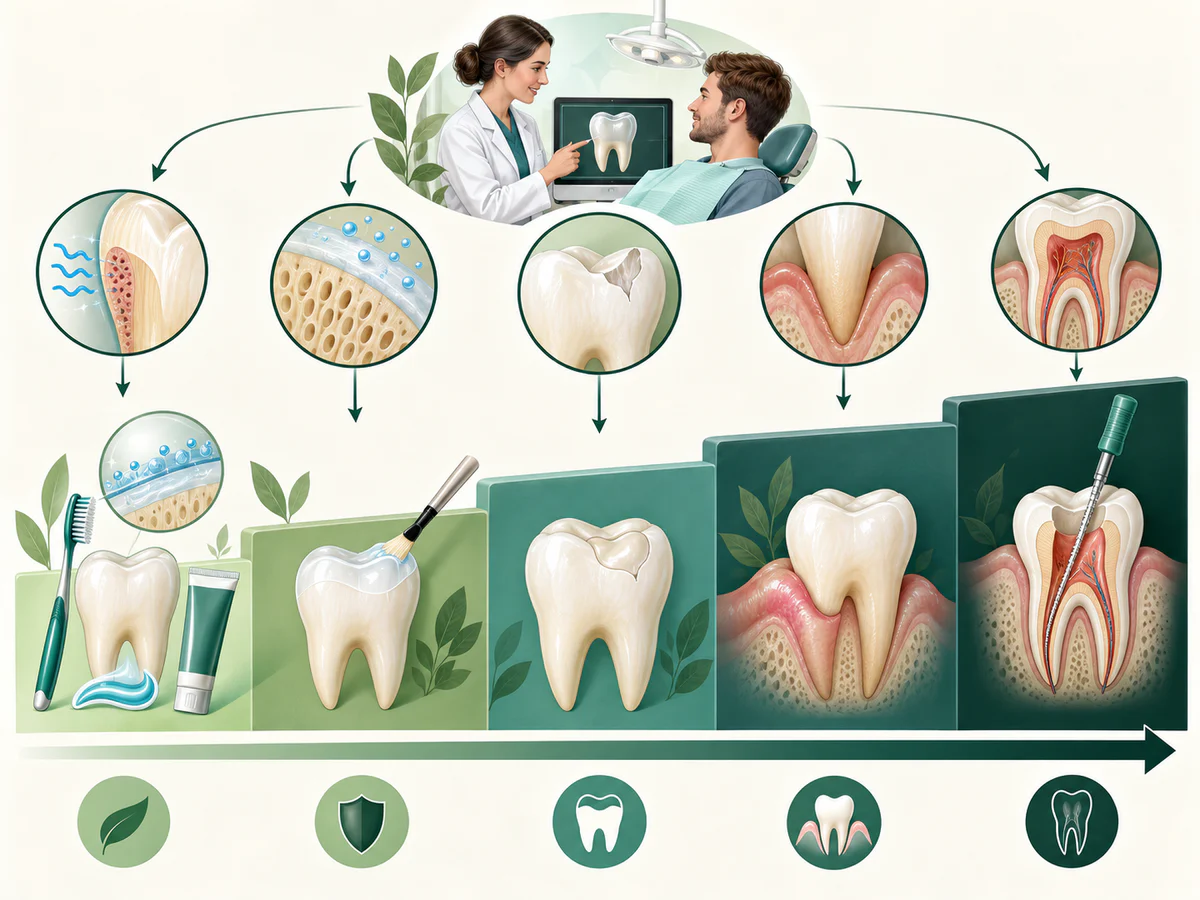
The approach is graduated: you start with at-home measures, and move on to the office when these are not enough or when tissue loss is significant.
At-home solutions
The first thing to try is toothpaste for sensitive teeth. According to the American Dental Association, desensitizing toothpastes reduce pain when they are used twice a day over time. How they work depends on the active ingredient:
- stannous fluoride and arginine work by sealing the dentinal tubules;
- potassium nitrate works instead by calming the nerve.
The effect is real, but it varies from one person to another, and it builds with regular use rather than in a single application. The ADA also points out that the quality of the clinical trials on this subject remains inconsistent: you should therefore expect a reduction in pain, not a guaranteed disappearance.
A few simple complementary habits, in line with the advice from ameli.fr:
- use a soft toothbrush and a gentle technique;
- limit foods and drinks that are very hot, very cold, sugary or acidic;
- do not brush your teeth immediately after an acidic food or drink. The enamel is temporarily softened at that point; wait a while, on the order of half an hour, and rinse your mouth with water in the meantime.
In-office solutions
When at-home measures are not enough, or when the dentin is widely exposed, the practice has several options described by the 2020 PMC review:
- applying fluoride varnish to the sensitive areas;
- placing varnishes, sealants or adhesive systems that insulate the dentin;
- a restoration when a wear lesion or a cavity is the cause;
- mucogingival surgery when the sensitivity comes from recession of periodontal origin, in order to cover the exposed root.
At the office, the examination first makes it possible to reach the right diagnosis. The choice among these treatment options then depends on the cause found and on how widely the dentin is exposed. A Cone Beam scan can be useful when a crack or deeper damage is suspected, because it clarifies what a clinical examination alone does not always show. Mucogingival surgery, when it is indicated, falls within specialized care. To understand the difference between simple inflammation and damage to the supporting tissues, our article periodontitis or gingivitis, understanding the difference offers useful landmarks.
Comparison table of the solutions
| Approach | Who it is for | How it works | Key point |
|---|---|---|---|
| Desensitizing toothpaste | Mild to moderate sensitivity | Seals the tubules (stannous fluoride, arginine) or calms the nerve (potassium nitrate) | Gradual effect, twice a day, over time |
| Soft brush and gentle hygiene | Everyone, as prevention | Limits wear of the enamel and cementum | Avoid brushing right after something acidic |
| In-office fluoride varnish | Persistent exposed areas | Strengthens and insulates the surface | Applied by the practitioner, can be repeated |
| Sealant or adhesive | Localized exposed tubules | Mechanically seals the dentin | Targeted solution |
| Restoration | Wear lesion or cavity | Rebuilds the lost tissue | After diagnosis |
| Mucogingival surgery | Recession of periodontal origin | Covers the exposed root | Specialized care |
When does a sensitive tooth hide a more serious problem?
This is the point that needs to be clear. True dentin hypersensitivity is brief: the pain appears with the stimulus and stops as soon as it goes away. It does not come on by itself and does not wake you at night. Typically, it is felt while eating or drinking something cold, hot, sweet or acidic, or when breathing in cold air.
According to the 2020 PMC review, hypersensitivity is a diagnosis of exclusion. Several situations should instead suggest something other than simple sensitivity:
- pain that persists after the cold or heat is removed;
- pain that throbs, that pulses or that comes back spontaneously, with no stimulus;
- pain that worsens when lying down or that prevents sleep;
- pain accompanied by fever, or by swelling of the cheek or the gum.
These signs point rather to a deep cavity, a crack or inflammation of the pulp, and not to hypersensitivity. According to ameli.fr, unbearable pain, pain that gets worse when lying down, or the presence of fever and swelling warrant prompt consultation. To know what to do in the meantime, see our guide what to do right away in a dental emergency.
Telling these two situations apart avoids two mistakes: overlooking an infection by taking it for sensitivity, or worrying needlessly about passing discomfort. If you are unsure which kind of tooth pain you are dealing with, visiting your dentist is the simplest way to find out.
Can the sensitivity go away for good?
Not necessarily. With a precise diagnosis and appropriate treatment, the pain can be markedly reduced. But the outcome depends on the cause and on the person. The 2019 prevalence review (PubMed) in fact describes dentin hypersensitivity as a persistent clinical problem. It is therefore honest to aim for a lasting improvement in comfort rather than to promise a guaranteed disappearance.
Prevention remains the most reliable lever: gentle brushing, a less acidic diet, treating reflux or bruxism, and monitoring the gums. Good oral hygiene does not mean brushing harder: a soft brush and a gentle technique protect the enamel and the gums better than force, and regular dental care helps spot wear or recession early. To anchor these habits, our article on daily dental hygiene, method and frequency sets out how to go about it.
Key points
- Sensitivity to cold and heat comes from exposed dentin and from the movement of the fluid in its tubules, which stimulates the nerve: this is the hydrodynamic theory (Brännström; PMC, 2020).
- The verified causes are gum recession, acid erosion, abrasion, bruxism, reflux and whitening.
- The first treatment is desensitizing toothpaste, twice a day over time, with a real but variable reduction in pain (American Dental Association).
- The office offers fluoride varnish, sealants, restorations and, if needed, mucogingival surgery.
- Pain that persists, that throbs, that comes back on its own or that is accompanied by fever or swelling is not simple sensitivity: you should seek care (ameli.fr; PMC, 2020).
Frequently asked questions
Why are my teeth sensitive to cold?
Does toothpaste for sensitive teeth really work?
Is it normal for teeth to be sensitive after a scaling?
Does tooth sensitivity go away for good?
When should a sensitive tooth really worry me?
Why is my tooth sensitive to heat?
Is pain when biting a sign of tooth sensitivity?
Sources
Medical references consulted for this article.
- 1American Dental Association, Oral Health Topics : Toothpastes (agents desensibilisants), 2023
- 2American Dental Association, Oral Health Topics : Whitening (sensibilite liee au blanchiment)
- 3PMC / NCBI, Pathogenesis, diagnosis and management of dentin hypersensitivity: an evidence-based overview, 2020
- 4PubMed, Zeola, Soares, Cunha-Cruz. Prevalence of dentin hypersensitivity, J Dent 2019 (PMID 30639724)
- 5PubMed, Brannstrom M. The hydrodynamic theory of dentinal pain, J Endod 1986 (PMID 3465849)
- 6ameli.fr (Assurance Maladie), Que faire et quand consulter en cas de mal de dent et de douleurs de la bouche
- 7Cleveland Clinic, Pulpitis: Types, Symptoms & Treatment (sensibilité au chaud ou au froid qui dure plus de quelques secondes), 2022
Contents
Share