In short: Bruxism is the repetitive clenching or grinding of the teeth, during sleep or while awake, and in an otherwise healthy person it is a behavior rather than a disease. A custom dental splint, also called a bruxism splint and most often worn at night, protects the teeth from the wear caused by clenching and grinding. Jaw pain or morning discomfort may prompt an examination, but the splint does not stop the grinding itself.
Grinding your teeth at night, or catching yourself clenching your jaw during the day: bruxism is a very common, repetitive muscle activity, and it is often the people around you, waking up with tired jaws, or the dentist who notice it before you do. The word actually covers two distinct situations, sleep bruxism and awake bruxism, which share neither the same mechanisms nor quite the same management. One point is worth making right away, because it spares a good deal of worry: according to the international expert consensus published by Lobbezoo et al. in the Journal of Oral Rehabilitation, bruxism is not, in an otherwise healthy person, a disease in itself. It is a behavior, one that can become a risk factor for certain consequences, such as tooth wear or pain.
This article explains that distinction, describes the genuinely documented associated factors (stress, sleep, certain substances and certain medications), lists the signs that should prompt attention, and details the role of the occlusal splint. On that last point, let us be clear: a splint protects the teeth, but it does not cure bruxism. Understanding this nuance changes the way you approach the problem, and that is precisely what this article aims to convey, without overpromising.
What exactly is bruxism?
Bruxism is defined as a repetitive activity of the jaw muscles, characterized by clenching or grinding the teeth, or by bracing or thrusting the mandible forward. This definition, put forward by the international consensus of Lobbezoo et al. in 2013 and then refined in 2018 (Journal of Oral Rehabilitation), has one merit: it describes a muscle behavior without presuming a disease.
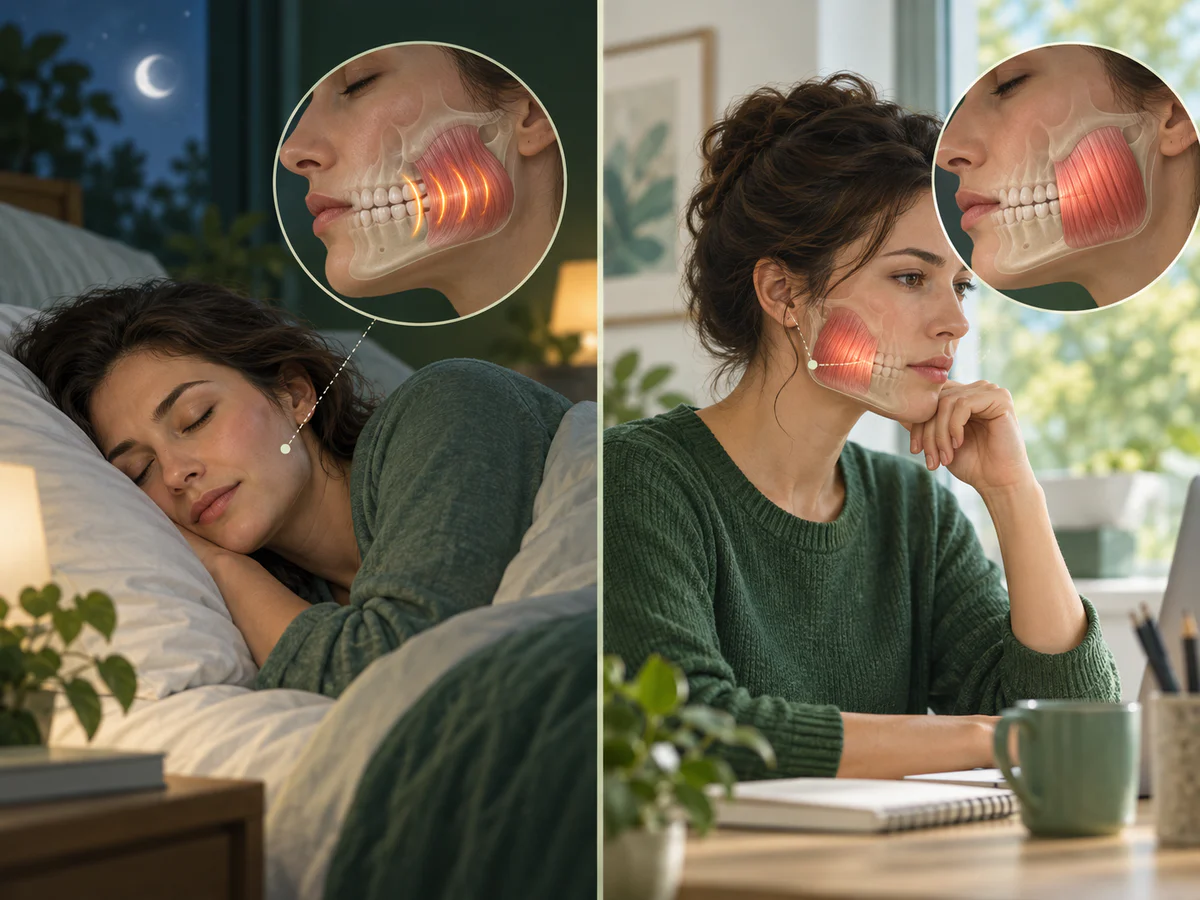
This is the key to the whole article. According to that same 2018 consensus, in an otherwise healthy individual, bruxism should not be regarded as a disorder, but as a behavior that may constitute a risk factor (and sometimes a protective factor) for certain clinical consequences. In other words, grinding or clenching is not in itself a pathology; it becomes one through its effects, when it damages the teeth or causes pain.
Sleep bruxism and awake bruxism: two different realities
The consensus clearly distinguishes two forms according to when the activity occurs.
- Sleep bruxism is an activity of the masticatory muscles during sleep, either rhythmic (phasic) or non-rhythmic (tonic). According to the 2018 consensus, it is neither a movement disorder nor a sleep disorder in an otherwise healthy person. It is the form associated with the nighttime grinding sound that a partner sometimes hears.
- Awake bruxism is an activity of the masticatory muscles during wakefulness, characterized by repeated or sustained tooth contact, or by bracing or thrusting the jaw. It often takes the form of silent clenching, without grinding, common during periods of concentration, stress, or the tensions of the day.
This distinction is not merely theoretical. Sleep bruxism appears to be linked more to central phenomena and nighttime micro-arousals, whereas awake bruxism is more closely tied to psychological and emotional factors. The levers for action are therefore not the same, as we will see.
What are the causes and associated factors?
We should be honest about the state of knowledge: it is more accurate to speak of associated factors than of single causes. Bruxism is described as multifactorial. Several elements do, however, come up consistently in the literature.
Stress and anxiety
The link with stress and anxiety is the one most often reported, particularly for awake bruxism. According to the review Current Treatments of Bruxism (Guaita & Högl, Current Treatment Options in Neurology, 2016), a sensitivity to stress is frequently described by patients, as are higher levels of anxiety. The MSD Manual, in its professional edition, likewise lists stress and anxiety among the contributing factors. This is a robust association, which does not mean that stress alone explains every case.
Sleep and micro-arousals
In sleep bruxism, grinding episodes often occur in connection with micro-arousals, those brief lightenings of sleep. This is one of the reasons sleep hygiene has a place in management. Certain conditions, such as snoring or sleep-related breathing disorders, are also frequently found in people who brux, which sometimes warrants a specialist opinion.
Certain substances and certain medications
Tobacco, alcohol, and caffeine are associated with sleep bruxism. According to the systematic review by Bertazzo-Silveira et al. published in the Journal of the American Dental Association in 2016, the risk of sleep bruxism is roughly doubled in people who drink alcohol, increased about one and a half times beyond eight cups of coffee a day, and more than doubled in smokers. The authors emphasize that these associations rest on evidence that is still limited, but the signal is consistent.
Certain medications can also promote bruxism. The 2016 review (Current Treatment Options in Neurology) mentions in particular some antidepressants of the selective serotonin reuptake inhibitor class, as well as other molecules acting on the nervous system. This point is important: if bruxism appears after starting a treatment, you should never stop it on your own, but rather discuss it with the prescribing physician.
What are the signs of bruxism?
Because bruxism is often silent for the person themselves, it is its consequences that reveal it. According to the MSD Manual and the StatPearls article on bruxism management, the most telling signs are the following.
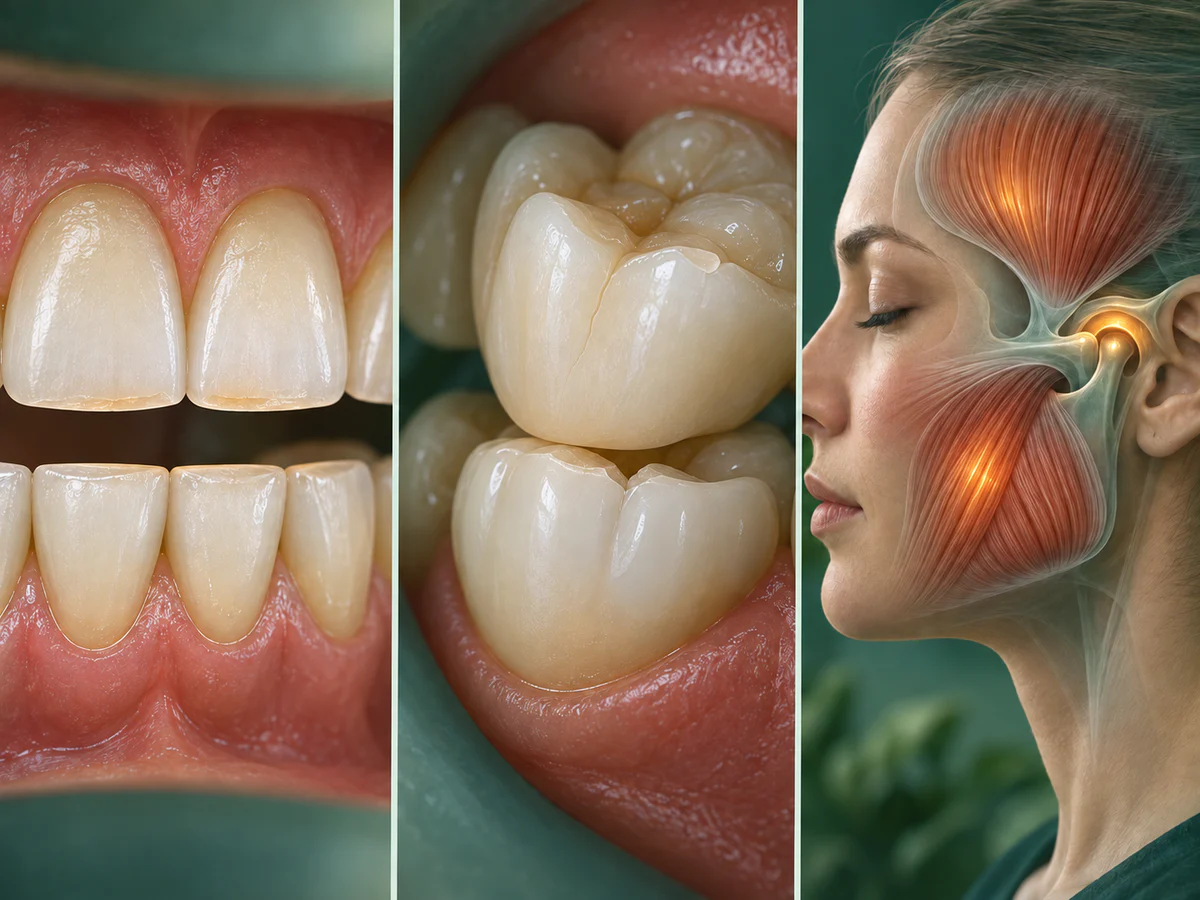
- Tooth wear. The chewing surfaces flatten, and the enamel and then the dentin wear away. This wear can be accompanied by sensitivity, a topic covered in detail in our article on tooth sensitivity to cold and hot.
- Fractures of teeth or restorations. Repeated forces can crack a tooth, dislodge a composite filling, or chip a crown.
- Muscle and joint pain. Tired jaws on waking, pain in the cheeks and temples, sometimes headaches in the temporal region, stiffness or discomfort of the temporomandibular joint.
- Enlargement of the masseter muscles. In some people, the heavily used jaw muscle thickens, which can alter the lower part of the face.
- Other signs. Loosening of teeth, tooth imprints along the edges of the tongue or on the inside of the cheeks, and a grinding sound heard by others at night.
No single one of these signs, taken in isolation, proves bruxism, and conversely their absence does not rule it out. It is the clinical examination, weighing the wear, the pain, and the reported history together, that makes it possible to raise the diagnosis with nuance. The 2018 consensus indeed points out that establishing so-called “probable” or “definite” bruxism requires combining several sources of information.
How is bruxism managed?
Management pursues two distinct goals that should not be confused: protecting the teeth from the consequences, and acting on the associated factors. No approach “cures” bruxism in the strict sense, something the literature reviews honestly acknowledge.
The occlusal splint: protecting, not curing
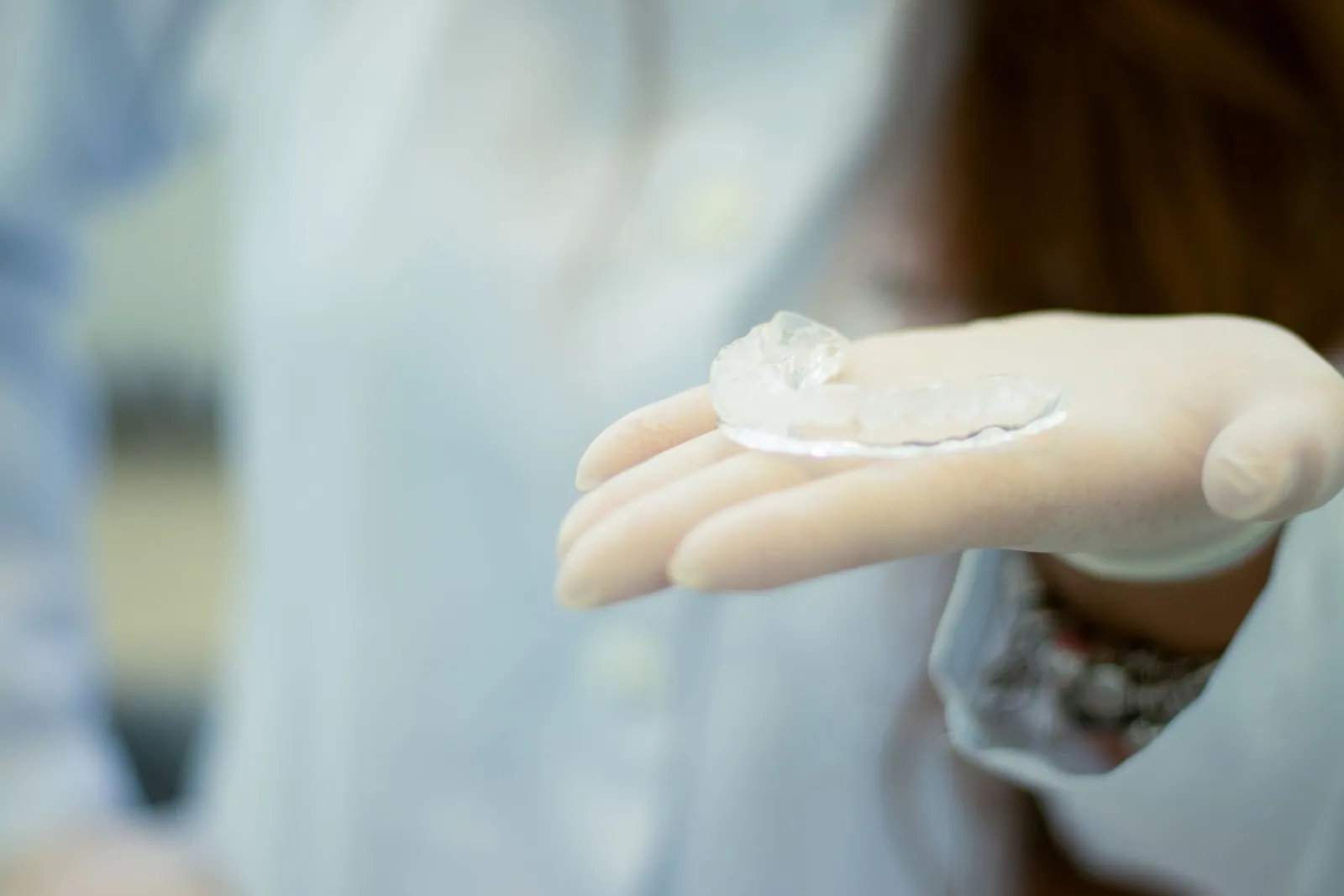
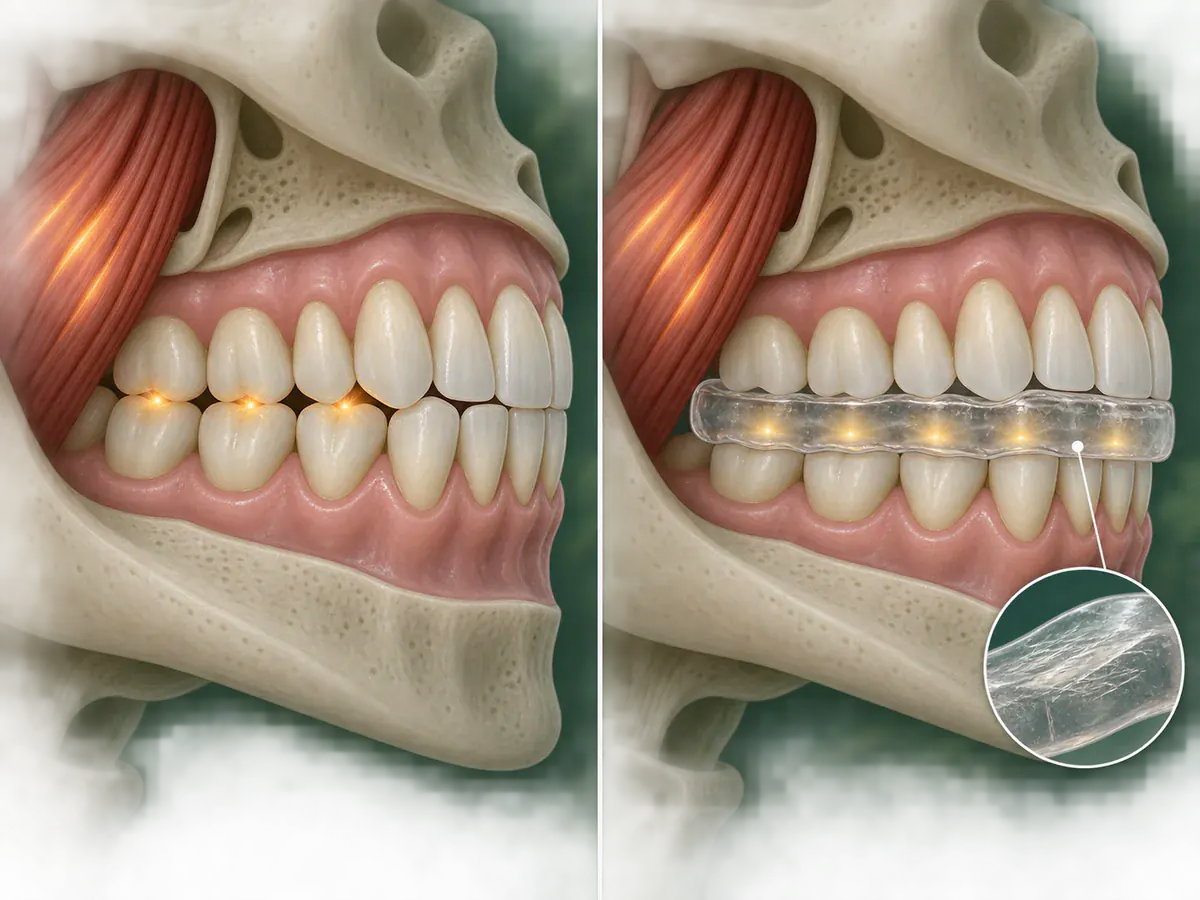
The occlusal splint, also called a protective night guard, is the most widely used tool. It is a resin appliance, most often worn at night, custom-made at the practice. At our practice in Kenitra, we make it from a digital impression, which avoids the classic impression paste and allows a precise fit. More generally, a custom splint is always shaped from a record of your own teeth, either a conventional impression or a digital scan, whether it is then made in a dental lab or at the practice.
Its principle is mechanical: it sits between the dental arches, so that it is the splint that wears down and cushions the forces, not the teeth. Here is where we need to be precise about what it does. According to the Cochrane review on occlusal splints for sleep bruxism (Macedo et al., Cochrane Database of Systematic Reviews, 2007), the available data do not allow us to state that the splint reduces bruxism activity itself; the authors do, however, note a possible benefit with respect to tooth wear. In the same vein, the review Current Treatments of Bruxism (2016) indicates that splints prevent dental damage and the grinding sound, but that their effect on reducing bruxism episodes is transient and tends to return to baseline over time.
The practical conclusion is clear, and the StatPearls article states it plainly: the splint does not reduce the frequency of bruxism, but it protects the teeth from wear and often eases the morning jaw discomfort. It is a protective device, not a curative treatment. We should therefore be wary of claims that present the splint as a definitive solution to grinding: that is not what the literature says.
Types of occlusal splints for bruxism
Occlusal splints for bruxism differ mainly by material, by how many teeth they cover and by how they are made. The dental splint usually made for bruxism is a hard resin appliance, custom-fitted and covering all the teeth of one arch. The main differences are these:
- Hard or soft. Hard resin can be adjusted precisely to your bite, which is why it is the usual choice for a custom splint. A soft guard can feel more comfortable at first, but some people tend to chew on it.
- Upper or lower arch. Both are possible. The choice depends on your bite, your comfort and any missing teeth.
- Full or partial coverage. A splint that covers only some teeth can, if worn for a long time, let the uncovered teeth shift. Covering the whole arch avoids this.
- Custom or ready-made. A store-bought guard is thicker and fits less precisely, so it can feel bulky or move during the night. A custom splint is shaped from a record of your own teeth and then adjusted in the mouth.
Whatever the type, the splint protects the teeth; it does not stop the grinding itself.
Wearing a dental splint for bruxism in daily life
For people who grind their teeth at night, the dental splint is worn during sleep, when sleep bruxism occurs. Because it is made to measure, it fits precisely over the teeth of one arch and keeps the upper and lower teeth from grinding directly against each other. The first nights can feel unusual, and the dentist adjusts the splint if it presses on a tooth or feels uneven.
A few habits help:
- Clean the splint after each use, as your dentist advises, and keep it in its case.
- Bring it to your check-ups, so that its fit and its wear marks can be examined.
- If it cracks, wears through, or no longer fits, have it checked rather than continuing to wear it as it is.
The wear marks are useful information in themselves: they show that the grinding forces are landing on the appliance rather than on the enamel. If pain in the jaw muscles or the temporomandibular joint persists despite the splint, mention it, so that the examination can look beyond the appliance at the associated factors.
Sleep hygiene and stress management
Since stress, anxiety, and sleep are among the associated factors, acting on them is logical, even if the level of evidence remains modest. According to the 2016 review, sleep-hygiene advice, changes in habits, and relaxation techniques are proposed as a first step: they are not harmful, even if their specific effectiveness against bruxism is difficult to demonstrate.
In practice, this covers simple measures: limiting alcohol, tobacco, and caffeine, especially in the evening; cutting down on screens and intense mental activity before bed; establishing a regular sleep routine; and, for awake bruxism, learning to notice the clenching during the day in order to deliberately relax the jaw. When anxiety is at the forefront, dedicated support (relaxation, psychological follow-up) can be part of the overall management.
A summary of the approaches
| Approach | What it targets | What it actually does | Key takeaway |
|---|---|---|---|
| Custom occlusal splint | Protecting the teeth | Cushions the forces, limits wear and noise | Does not cure bruxism (Cochrane, 2007) |
| Sleep hygiene | Reducing nighttime triggers | Possible effect, modest evidence, not harmful | A first step, to combine with others |
| Stress management | Acting on anxiety and clenching | Useful especially for awake bruxism | Notice and relax the jaw |
| Reviewing substances and medications | Removing a contributing factor | May reduce medication-induced bruxism | Never stop a medication on your own |
What we do not promise
It is only honest to name the limits. None of the options above eliminates bruxism in a guaranteed way. Approaches that modify the occlusion by grinding down the teeth are not recommended as a treatment for bruxism: they remove tissue irreversibly without proof of effectiveness. As for botulinum toxin injections into the masseters, sometimes proposed, they can reduce muscle strength but fall under specific indications, with a temporary effect and still-limited long-term data; this is not a first-line answer.
Bruxism, restorations, and implants: a mechanical risk factor
Bruxism does not concern only the natural teeth. It also bears on prosthetic work, and this is useful to know before embarking on treatment. Repeated, high forces can weaken a crown, fracture a ceramic, or loosen a restoration.
The matter is particularly sensitive in implantology. Unlike a natural tooth, cushioned by its ligament, an implant is fused to the bone: it transmits overloads more directly to the components and to the bone-implant interface. According to the systematic review with meta-analysis by Ionfrida et al. (Dentistry Journal, 2024), bruxism is a probable risk factor for mechanical complications of implant-supported prostheses, and higher failure rates have been reported in patients who brux.
This does not mean that someone who bruxes cannot benefit from implants or crowns. It means that bruxism must be identified and taken into account in the treatment plan: choice of materials, adjustment of the occlusion, and wearing a protective splint over the restorations. To understand what can compromise an implant and the signs to watch for, our article on the symptoms of dental implant failure offers useful markers, and the decision between an implant, a bridge, or a denture takes this kind of constraint into account, among others.
When should you see a dentist?
Mild bruxism, with no wear or pain, does not necessarily call for treatment: monitoring may be enough. Certain signals, however, warrant seeing a dentist without delay: visible or rapid tooth wear, fractures of teeth or restorations, persistent pain in the jaw, muscles, or temples, headaches on waking, or nighttime grinding reported by those around you.
The examination makes it possible to gauge the severity, to look for consequences on the teeth and the joint, and to discuss a custom splint if one is indicated. It is also an opportunity to address the associated factors, from sleep to any medications, within an overall approach rather than one focused on the appliance alone.
Key takeaways
- Bruxism is a repetitive muscle activity (clenching or grinding) that comes in two forms, sleep bruxism and awake bruxism (international consensus, Lobbezoo et al., J Oral Rehabil).
- In an otherwise healthy person, it is not a disease in itself, but a behavior that can become a risk factor for the teeth and muscles (2018 consensus).
- The documented associated factors include stress and anxiety, sleep, as well as tobacco, alcohol, caffeine, and certain medications (JADA, 2016; Curr Treat Options Neurol, 2016).
- The custom occlusal splint protects the teeth from wear but does not cure bruxism (Cochrane, 2007; StatPearls).
- Bruxism is a probable mechanical risk factor for restorations and implants, to be factored into the treatment plan (Dentistry Journal, 2024).
Frequently asked questions
Is bruxism a disease?
What is the difference between sleep bruxism and awake bruxism?
Does an occlusal splint cure bruxism?
Is stress responsible for bruxism?
Can bruxism damage my implants or crowns?
Can certain medications cause bruxism?
Do I need a splint if I only clench my teeth during the day?
Is a dental splint for bruxism the same as a sports mouthguard?
Sources
Medical references consulted for this article.
- 1Lobbezoo F, et al. International consensus on the assessment of bruxism: Report of a work in progress, J Oral Rehabil 2018;45(11):837-844 / PMC
- 2Lobbezoo F, et al. Bruxism defined and graded: an international consensus, J Oral Rehabil 2013 (PMID 23121262)
- 3Macedo CR, et al. Occlusal splints for treating sleep bruxism (tooth grinding), Cochrane Database of Systematic Reviews 2007 (CD005514)
- 4Guaita M, Högl B. Current Treatments of Bruxism, Curr Treat Options Neurol 2016 / PMC
- 5Bertazzo-Silveira E, et al. Association between sleep bruxism and alcohol, caffeine, tobacco, and drug abuse: A systematic review, J Am Dent Assoc 2016 (PMID 27522154)
- 6Murali RV, et al. Bruxism Management, StatPearls (NCBI Bookshelf)
- 7Ionfrida JA, et al. Dental Implant Failure Risk in Patients with Bruxism: A Systematic Review and Meta-Analysis, Dent J (Basel) 2024 / PMC
- 8Manuel MSD, édition professionnelle, Bruxisme (Hennessy BJ)
Contents
Share