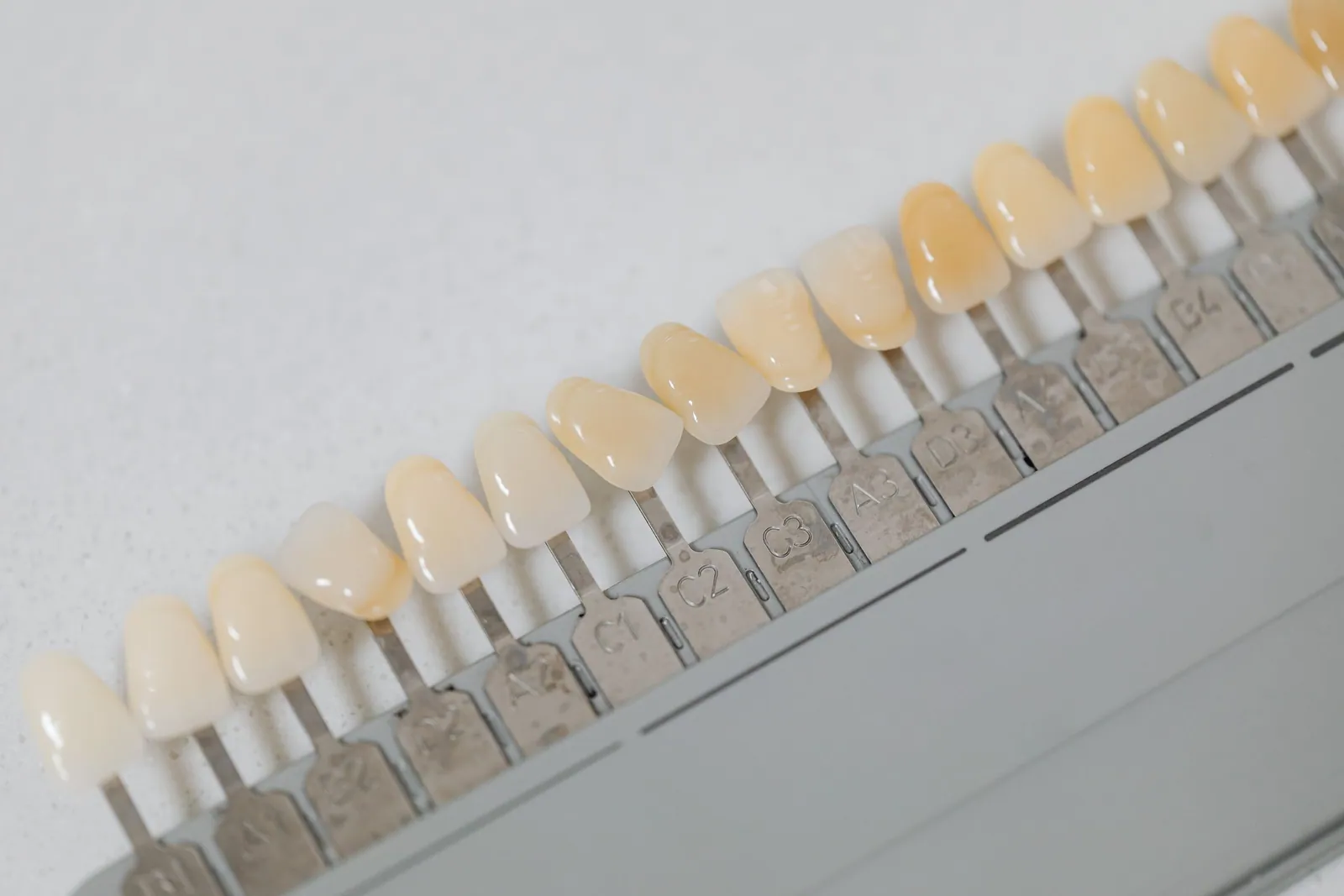
Teeth whitening, more accurately called bleaching, is one of the most common cosmetic requests at the practice. The principle is simple to state: a peroxide-based agent, placed in contact with the enamel, oxidizes the colored molecules trapped within the tooth and lightens its shade. The result can be real and visible. But the topic deserves some honest nuance, because between a session performed at the practice, a custom-made tray, and products bought at the pharmacy or on social media, the effectiveness, safety, and legal framework are not at all the same.
This article explains how whitening works, compares the three main approaches (in-office, supervised at-home, and over-the-counter products), clarifies what bleaching can and cannot do, details the question of sensitivity, and reviews the regulatory framework that makes whitening a procedure within the scope of the dental surgeon. It promises neither a precise shade nor a guaranteed duration: both of these depend on each individual mouth.
How does teeth whitening work?
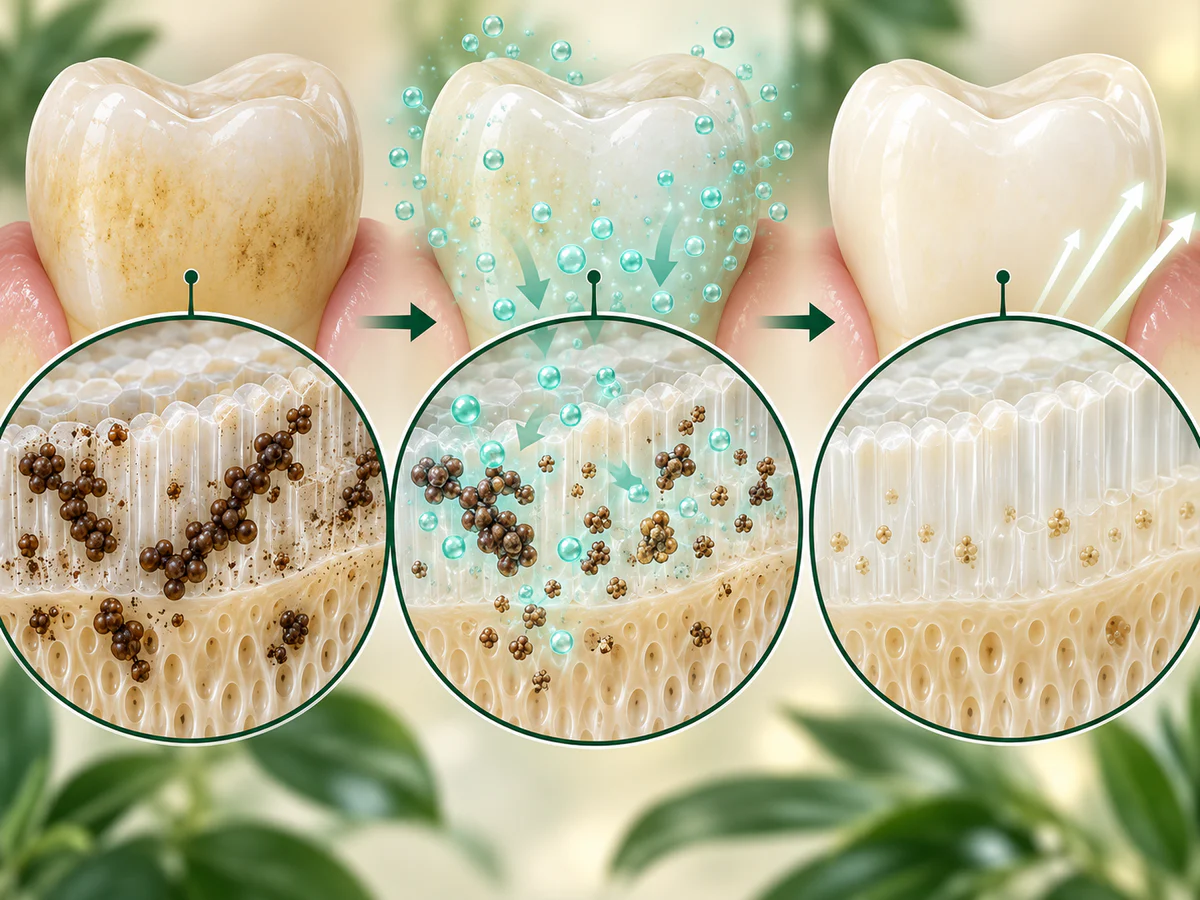
Teeth whitening relies on a chemical oxidation reaction. The active agent is hydrogen peroxide, used as such or released by carbamide peroxide. According to the critical review of modern whitening concepts published on PMC in 2019 (Kwon & Wertz), hydrogen peroxide oxidizes the chromophores, that is, the colored organic molecules responsible for the dark shade, and transforms them into non-colored compounds; light is then no longer absorbed in the same way, and the tooth appears lighter.
Carbamide peroxide is not a different active ingredient: it is a combination of urea and hydrogen peroxide that gradually releases the latter. According to the American Dental Association, carbamide peroxide releases about one-third of its content as hydrogen peroxide. In practical terms, this means that a gel of 16% carbamide peroxide corresponds to roughly 6% hydrogen peroxide. This equivalence is not a minor detail: it is what serves as the reference point for European regulation.
One point is worth stating from the outset. According to the 2019 PMC review, peroxide acts by producing free radicals that attack the pigments. The review article on whitening procedures and their controversial effects, published on PMC in 2014, describes these same hydroxyl and perhydroxyl radicals that break the double bonds of pigmented molecules. This mechanism is effective on pigments, but it is not without consequences for the tissues, which explains the precautions detailed below.
In-office, at-home, or over-the-counter whitening: which to choose?
There are three main ways to lighten teeth. They differ in peroxide concentration, method of application, and, above all, level of supervision.
In-office whitening
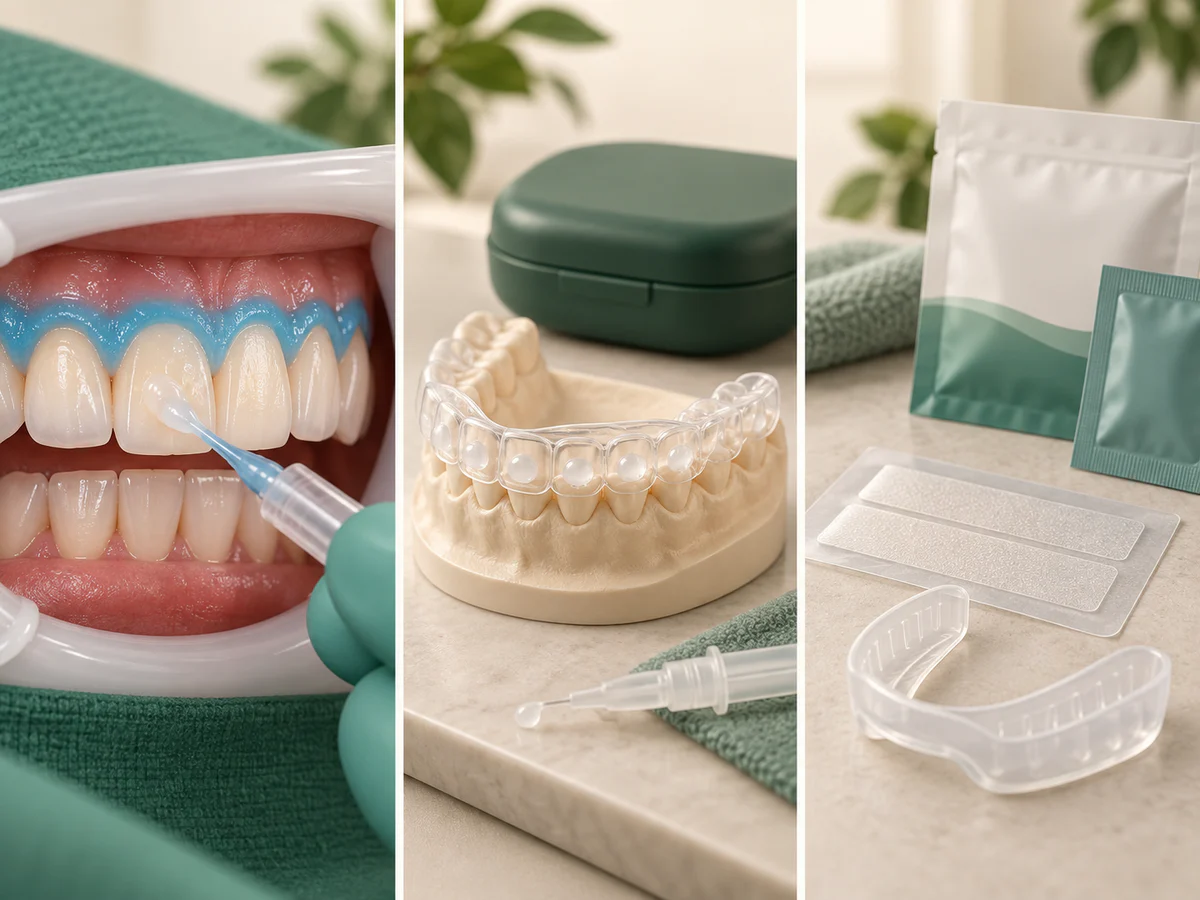
In-office whitening is performed at the practice by the practitioner, with high concentrations. According to the 2019 PMC review, in-office whitening typically uses concentrated hydrogen peroxide solutions, on the order of 35%, applied for 20 to 30 minutes with protection of the gums. The 2025 PMC review on whitening agents places professional concentrations between 18 and 40% depending on the protocol. The advantage is speed and control; the trade-off is an increased risk of pulp irritation and sensitivity, all the more pronounced when the concentration is high.
Supervised at-home whitening
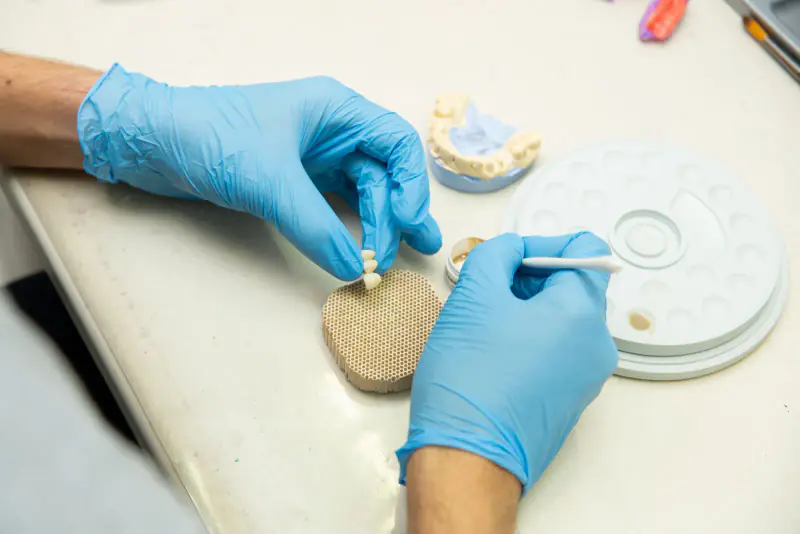
At-home whitening, or supervised home whitening, relies on custom thermoformed trays that the practitioner makes after taking an impression. The patient places a lower-concentration gel in them and wears them for a set time, over several days or weeks. According to the American Dental Association, these trays dispensed by the dental surgeon generally use carbamide peroxide of 10 to 38%, with the 10% carbamide peroxide gel having been validated by the ADA. The custom tray has a specific benefit: it keeps the product in contact with the teeth while limiting overflow onto the gums. The effect is more gradual than in-office, but supervision remains ensured by a professional.
Over-the-counter and social media products
The strips, gels, pens, and kits sold freely, at the pharmacy or online, contain low concentrations. According to the ADA, these over-the-counter products generally offer lower effectiveness. The main problem is not only their low strength: it is the absence of a prior examination. An untreated cavity, fragile gums, a visible restoration, or a stain of internal origin completely changes the appropriateness of whitening, and no kit can make this diagnosis. Standard trays, not adapted to your mouth, also expose you to prolonged contact of the product with the gums.
As for services offered outside the practice, for example in a salon or through social media offers, they raise a fundamental question: according to the positions of European professional dental bodies, whitening falls within the practice of dentistry and must be carried out by a dental surgeon or under their direct supervision. We return to this in the regulatory section.
What whitening can do, and what it cannot do
This is probably the most important point of this article, because it prevents disappointment. Whitening lightens natural enamel; it acts neither on every type of stain nor on artificial materials.
External and internal stains: a major difference
Two families of stains must be distinguished. According to the 2019 PMC review, external (extrinsic) stains come from the surface, deposited by coffee, tea, wine, or tobacco: they respond well to mechanical cleaning and to peroxide. Internal (intrinsic) stains are incorporated into the enamel or dentin during the formation of the tooth or after trauma; whitening does not remove them completely.
Among intrinsic stains, those linked to tetracycline (an antibiotic taken during the formation of the teeth) are known to be difficult. According to the 2014 PMC review, the gray-blue stains linked to tetracycline are the slowest to respond to whitening, whereas the yellowish stains linked to age most often respond quickly. Fluorosis, linked to an excess of fluoride during development, is also among the situations where whitening alone reaches its limits. In these cases, other solutions should be discussed.
Restorations and crowns do not whiten
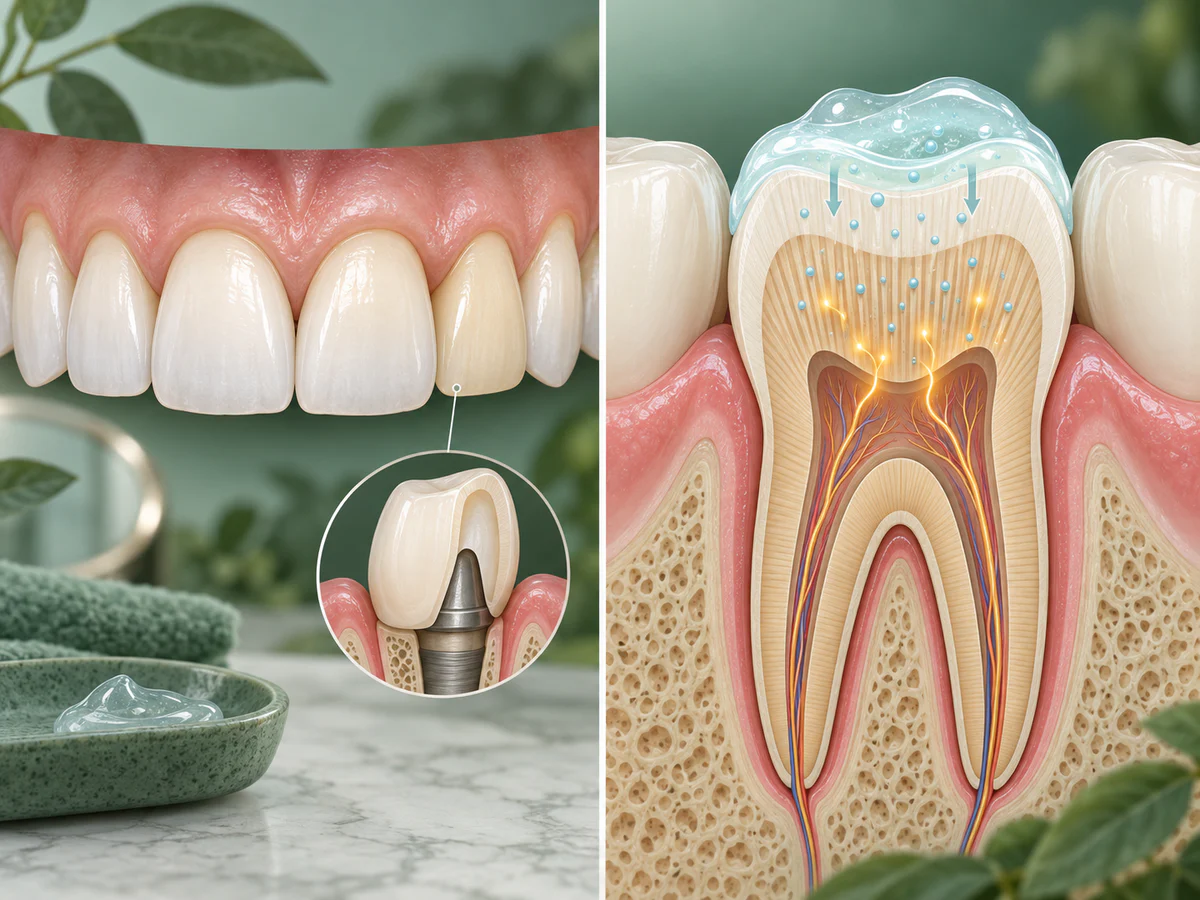
This is an absolute limitation, to be aware of before any treatment. According to the American Dental Association, only natural teeth can be lightened, not tooth-colored restorations: crowns, veneers, composites, and other restorations keep their original shade. If you have a crown or a veneer on a visible tooth, whitening the neighboring teeth may create a shade mismatch with that restoration, which will not change. This is one reason to plan the order of care: you whiten first, then choose the shade of future restorations. When the cosmetic project involves heavily stained teeth or existing restorations, ceramic veneers offer a different approach, to be discussed on a case-by-case basis.
The following table summarizes these approaches and their limitations.
| Approach | Concentration and application | Supervision | Key point |
|---|---|---|---|
| In-office | High hydrogen peroxide (approx. 18 to 40%), short sessions | Performed at the practice | Fast; sensitivity more frequent |
| Supervised at-home | Custom trays, lower peroxide, several days | Prescribed and monitored by the practitioner | Gradual; gums better protected |
| Over-the-counter / social media | Low concentrations, standard trays | No prior examination | Limited effect; no diagnosis |
| On restorations | No effect | Not applicable | Crowns and veneers do not whiten |
Safety and sensitivity: what to expect
Peroxide whitening is generally considered a safe procedure when properly supervised, but it is not without effect. Its most common side effect is tooth sensitivity.
Transient tooth sensitivity
According to the American Dental Association, temporary tooth sensitivity and gum inflammation are the most common side effects of whitening vital teeth, and the sensitivity generally subsides around the fourth day after treatment. The 2025 PMC review reports sensitivity in about 10 to 40% of patients depending on the protocol, described as transient. The 2014 PMC review confirms that sensitivity and gingival irritation are the most reported effects, and that any soft-tissue burns during in-office whitening are reversible without lasting consequences when the exposure is limited.
This sensitivity is more frequent with high concentrations. It is usually reversible and can be reduced by simple measures, such as the use of a desensitizing toothpaste. If you are already prone to sensitive teeth, this point should be discussed before starting; our article on tooth sensitivity to cold and heat details the mechanism and the solutions.
Effects on enamel and restorations
The data on enamel are nuanced. According to the 2014 PMC review, studies give mixed results: some find no surface change, others describe microporosities or a decrease in microhardness, the effect depending on the concentration and the pH. The 2025 PMC review reports that a 35% hydrogen peroxide gel was able to induce a reduction in microhardness on the order of 18%, which argues for controlled protocols rather than escalating concentration; it further notes that higher concentrations do not systematically produce better results. On restorative materials, this same review is reassuring: home-use carbamide peroxide does not cause significant degradation of composites, ceramics, or amalgams.
As a precaution, whitening is not indicated in pregnant or breastfeeding women by default, for lack of sufficient data, nor in the presence of untreated cavities or active gum disease: these situations must be addressed before any whitening.
The duration of results: an improvement, not a guarantee
The duration of whitening varies from one person to another and cannot be guaranteed. According to the 2025 PMC review, whitening is not permanent: the shade tends to regress over time, and periodic maintenance is necessary to maintain the result. Lifestyle habits directly affect this duration: coffee, tea, red wine, and tobacco gradually re-stain the enamel.
It is therefore more accurate to present whitening as an improvement in shade, whose stability depends on diet, hygiene, and possible touch-ups, than as a definitive result. No serious source allows us to announce a fixed number of shades gained or a precise duration valid for everyone.
The regulatory framework: a supervised procedure
Teeth whitening is not a simple cosmetic product left to free choice. Within the European Union, its regulation is precise. According to Council Directive 2011/84/EU, which regulates hydrogen peroxide in tooth whitening or bleaching products, three thresholds apply.
- Below 0.1% hydrogen peroxide present or released, products may be sold freely to the public.
- Above 0.1% and up to 6% hydrogen peroxide present or released, products are sold only to dental surgeons; for each cycle of use, the first application must be carried out by the dental surgeon or under their direct supervision before the product can be given to the patient; they must not be used on persons under 18 years of age.
- Above 6% hydrogen peroxide, products are not authorized for cosmetic teeth whitening.
This framework is confirmed by professional dental bodies. According to Dental Protection, the 6% hydrogen peroxide limit also applies to carbamide peroxide via the equivalence (a 16% carbamide peroxide gel releases at most about 6% hydrogen peroxide), a prior clinical examination and informed consent are required, and whitening falls within the practice of dentistry.
Two practical consequences follow. First, a prior examination is not a commercial formality: it verifies the absence of cavities, the condition of the gums, the presence of restorations, and the nature of the stains, all of which determine whether the procedure is appropriate. Second, services performed outside this framework, by non-professionals or with products exceeding the authorized limits, fall outside the regulation and the safety it is meant to guarantee. Morocco has its own framework, but the medical logic is the same: whitening is a procedure decided upon after an examination.
In practice, before getting started
Successful whitening starts with a diagnosis, not with a product. A few useful points of reference:
- have the absence of cavities and the health of the gums checked before starting;
- identify the origin of the stains, since internal stains and tetracycline respond poorly;
- spot visible crowns and veneers, which will not match the new shade;
- anticipate transient sensitivity, especially if teeth are already sensitive;
- accept the idea of maintenance, since the result is not permanent.
Key points
- Whitening works by oxidation: hydrogen peroxide, whether or not released by carbamide peroxide, decolorizes the pigments of the enamel (PMC, 2019).
- Three approaches coexist: in-office (high concentration), supervised at-home (custom trays), and over-the-counter (limited effect, without a prior examination).
- Whitening does not act on deep internal stains, on tetracycline, or on crowns, veneers, and composites (ADA; PMC, 2014).
- Tooth sensitivity is the most common side effect, generally transient and subsiding within a few days (American Dental Association).
- The result is not permanent and its duration is not guaranteed; maintenance may be necessary (PMC, 2025).
- In Europe, above 0.1% and up to 6% hydrogen peroxide, whitening is a procedure reserved for the dental surgeon, prohibited before age 18, and above 6% it is not authorized (Directive 2011/84/EU).
The protocol used at the practice, its real limits and its fees are set out on the teeth whitening in Kénitra page.
Frequently asked questions
Is teeth whitening dangerous for the enamel?
How long does teeth whitening last?
Can a crown or a veneer be whitened?
Are whitening kits sold online effective and safe?
Why must whitening be done by a dental surgeon?
Does whitening make teeth sensitive?
Sources
Medical references consulted for this article.
- 1Kwon SR, Wertz PW. A Critical Review of Modern Concepts for Teeth Whitening, J Esthet Restor Dent / PMC, 2019
- 2Alqahtani MQ. Tooth-bleaching procedures and their controversial effects: A literature review, Saudi Dent J / PMC, 2014
- 3Tooth-Whitening Agents and Polymer-Based Carriers: Efficacy, Safety, and Clinical Perspectives, PMC, 2025
- 4American Dental Association, Oral Health Topics : Whitening
- 5Council Directive 2011/84/EU amending Directive 76/768/EEC concerning hydrogen peroxide in tooth whitening products, EUR-Lex
- 6Dental Protection, Tooth Whitening (legal limits and supervision under EU peroxide rules)
- 7Societe francaise de chirurgie buccale, Blanchiment dentaire au peroxyde : est-ce sans danger pour les dents ?
Contents
Share