In short: Ceramic veneers, often called porcelain veneers, are thin shells made entirely of ceramic, produced in a laboratory and bonded to the front surface of the teeth to change tooth color, shape or apparent alignment. Placing them usually means removing a thin layer of enamel, so the procedure is partly irreversible, and how long they last depends largely on bonding to enamel, on hygiene and on regular check-ups.
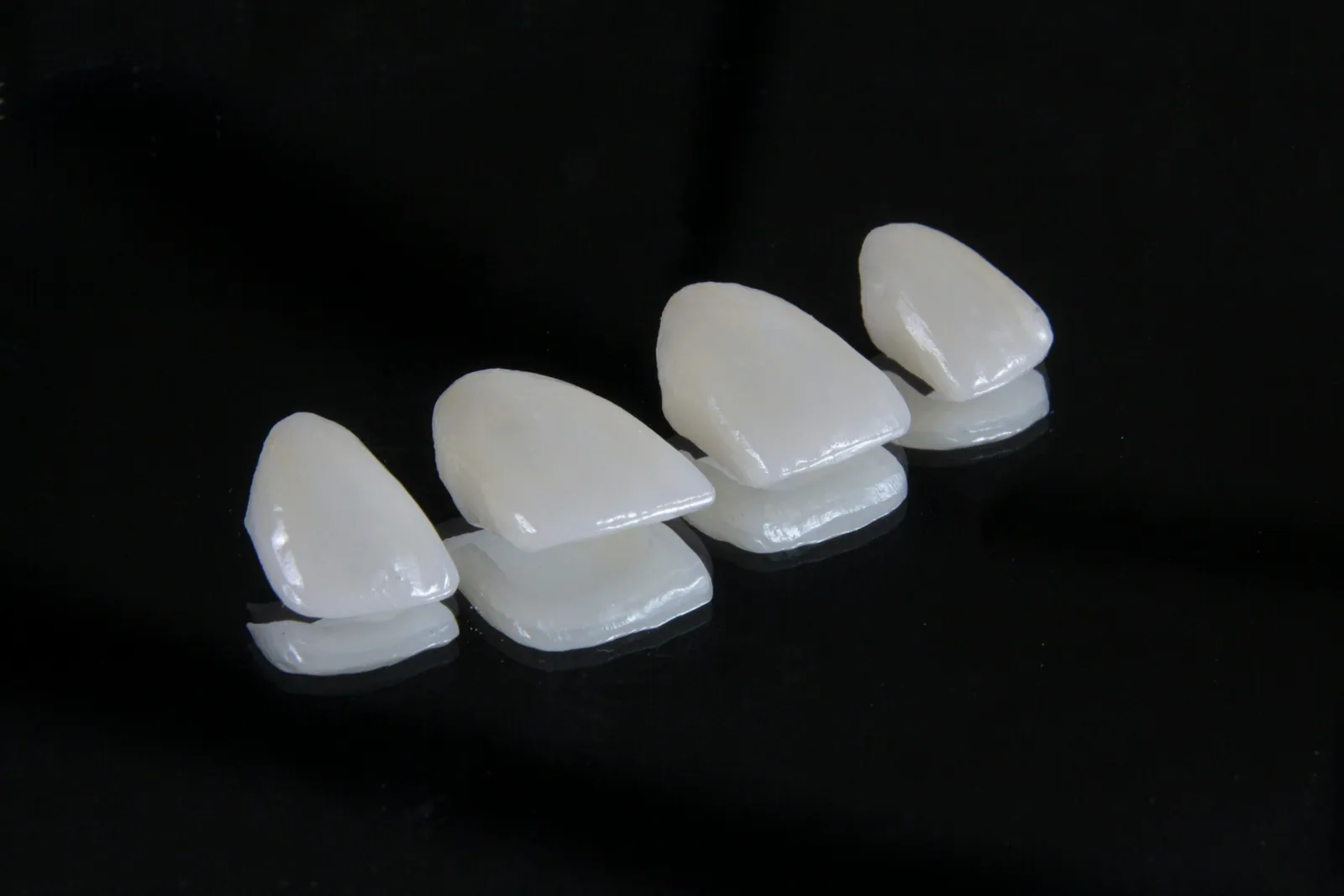
A dental veneer is a thin shell, made of ceramic or composite, bonded to the visible surface of a tooth in order to change its shade, its shape or its apparent position. It does not replace the tooth: it covers it. In that sense, a veneer belongs to smile aesthetics rather than to replacement surgery. Placing one usually means reducing a thin layer of enamel to make room for the shell, which makes the preparation partly irreversible. This article describes what a veneer really is, in which cases it is indicated, what the literature says about its longevity, and which alternatives, sometimes more conservative, deserve to be discussed before making a decision.
The aim here is not to present veneers as a universal answer for the smile. They are a reliable treatment in specific indications, but one that carries a biological cost: once enamel has been reduced, there is no going back. That nuance is part of the information every patient is entitled to before committing, with no promise of a guaranteed result and no promise that it will last forever.
What is a dental veneer?
A veneer is a partial restoration: it covers the front surface of the tooth, unlike a crown, which envelops it entirely. This difference matters, because it determines how much tooth tissue is sacrificed.
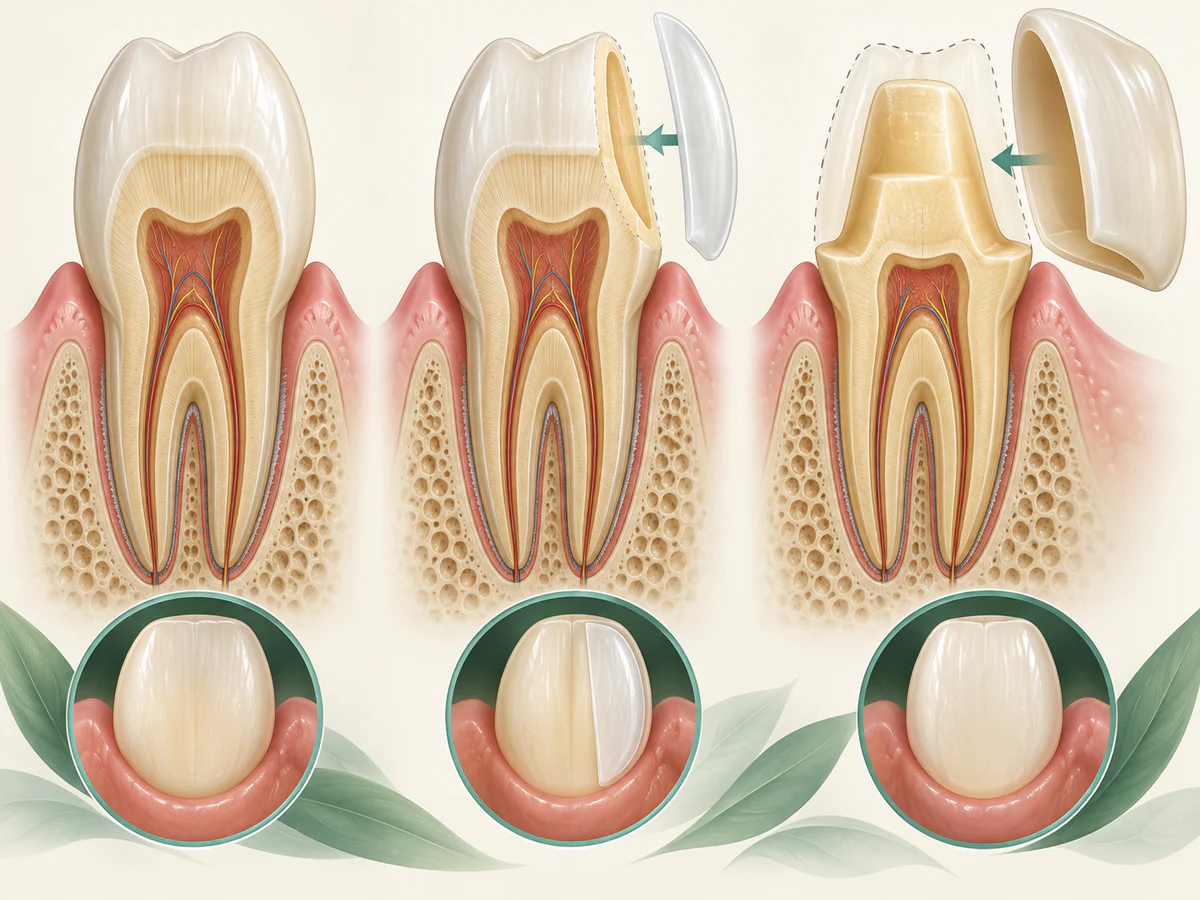
In the study by Edelhoff and Sorensen (J Prosthet Dent, 2002), veneer preparations were among the least invasive designs, removing roughly 3 to 30% of coronal tissue by weight, compared with roughly 63 to 72% for all-ceramic or metal-ceramic crown preparations on anterior teeth. As a general rule, then, a veneer is clearly more conservative than a crown, but it remains a procedure that affects the enamel.
Ceramic or composite?
There are two broad families of veneers, and they are not equivalent on every point.
A composite veneer can be made directly in the mouth, in a single visit, by layering resin. It spares more tissue and can be repaired, but its surface stains and wears down more over time.
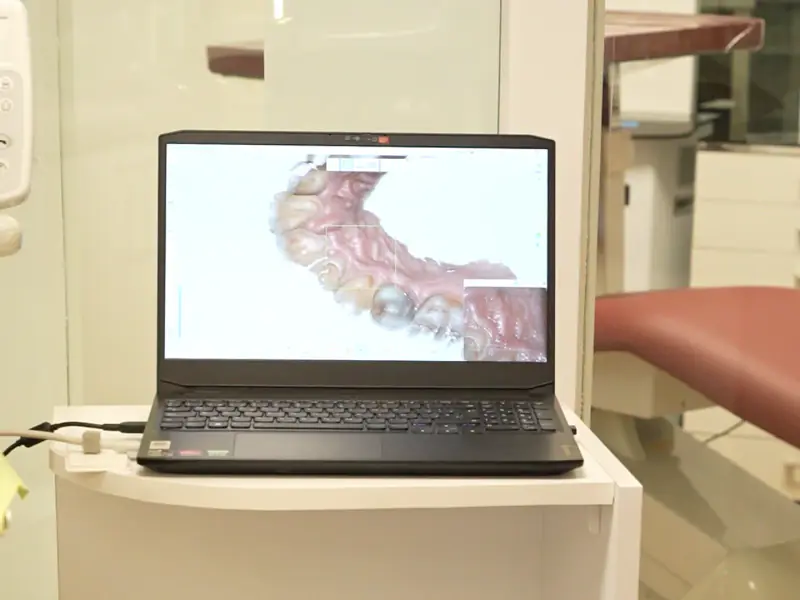
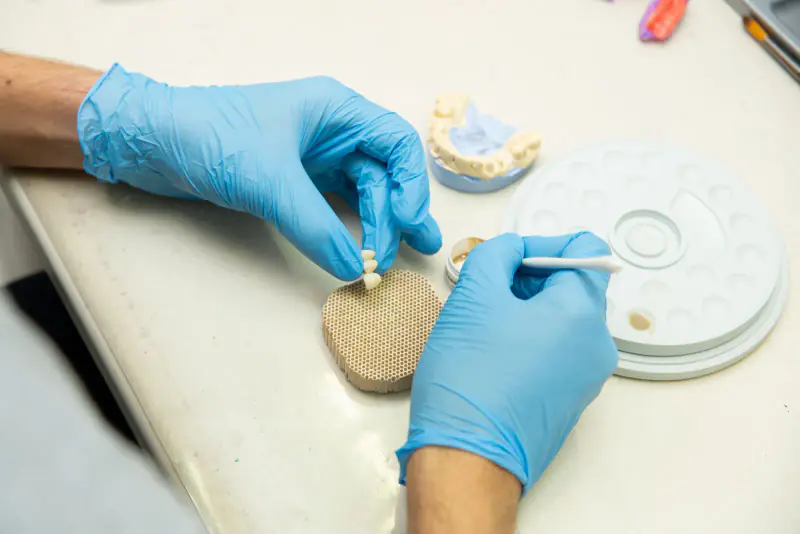
A ceramic veneer is made in a laboratory from an impression, then bonded in place. According to the UFSBD advice sheet on veneers, ceramic is more aesthetic and more durable than composite, but placing it involves taking impressions and removing a thin layer of enamel, on the order of 0.3 to 0.7 mm, under local anesthesia. At the practice, the impression is taken digitally, and the veneer is designed with CAD/CAM before being produced in the laboratory.
In which cases is a veneer indicated?
Veneers address clearly identified aesthetic problems. The UFSBD advice sheet sums up their indications: lightening teeth whose shade does not respond sufficiently to whitening, changing the shape of teeth that are too narrow or chipped, improving the appearance of slightly misaligned teeth, or closing small gaps between teeth (diastemas).
In practical terms, a veneer may be considered for:
- stains or discoloration that resist whitening;
- a shape felt to be unattractive, a worn or chipped tooth;
- a small diastema or slight alignment defects, in selected cases;
- an overall harmonization of the smile across the visible teeth.
What a veneer does not do, on the other hand, is treat significant malposition: actually moving teeth is a matter for orthodontics, not for bonding. A veneer creates the illusion of alignment by covering the visible surface; when the discrepancy is marked, masking rather than correcting leads to more mutilating preparations. The choice between correcting the position and covering the tooth is discussed case by case, after examination, and is one of the questions addressed in adult orthodontics in Kénitra.
How are ceramic veneers placed?
Among the types of veneers, composite veneers can be built up directly in the mouth in a single visit, whereas ceramic veneers are made outside the mouth. Their placement therefore takes several steps:
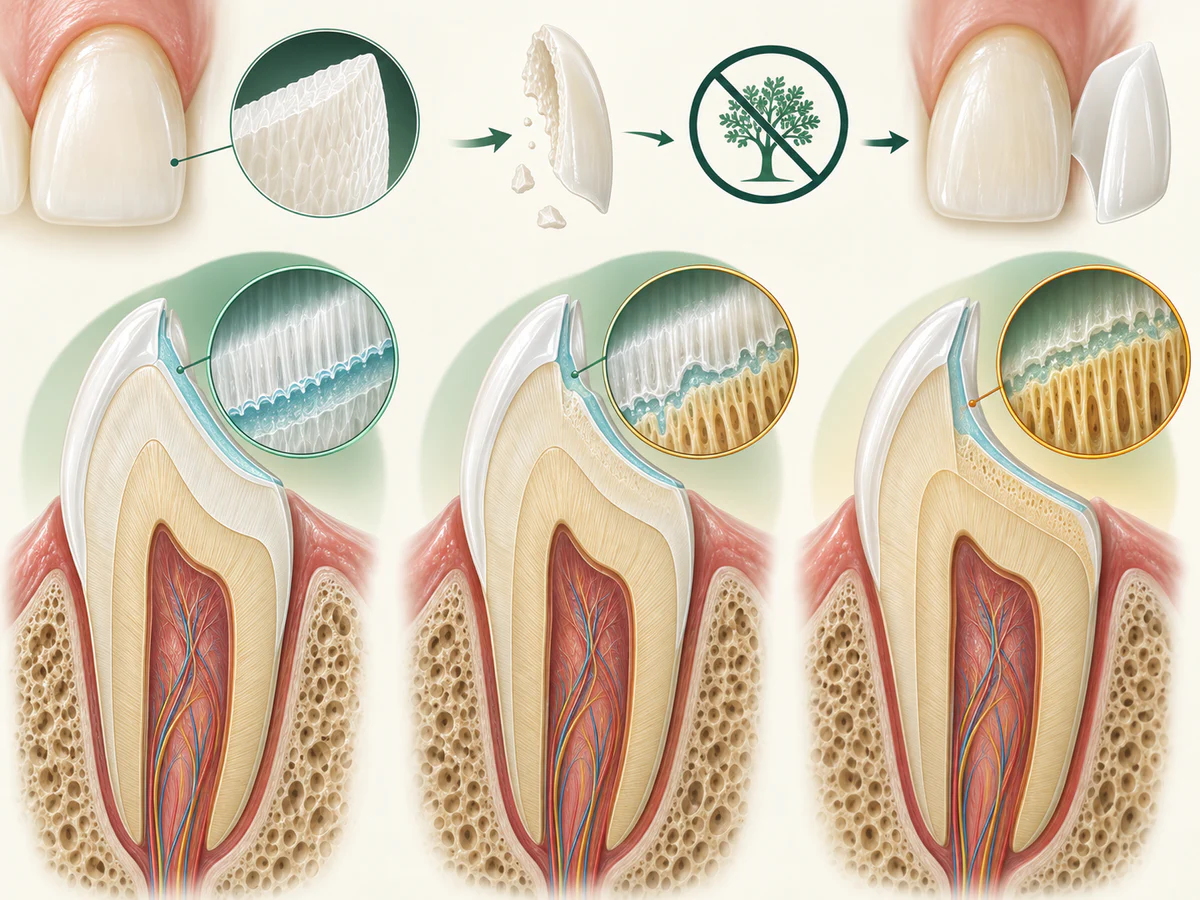
- Examination and planning. The dentist checks that the indication is sound: the condition of the teeth and gums, the enamel available, any grinding habit, and whether a more conservative option, such as whitening or orthodontics, would be enough. The desired shade and shape are discussed at this stage.
- Preparation. Under local anesthesia, a thin layer of enamel, on the order of 0.3 to 0.7 mm according to the UFSBD, is reduced to make room for the veneer. Veneers that need this step are sometimes called prep veneers. Veneers placed with little or no preparation add thickness to the tooth, so they suit only selected situations.
- Impression and fabrication. An impression of the prepared teeth is taken, and the laboratory makes the veneers from it.
- Bonding. Each veneer is bonded to its tooth. The more the bond stays within enamel, the better the prognosis reported in the literature, as the next section explains.
Why is this described as a partly irreversible procedure?
This is the most important point to understand before deciding. For a veneer to fit without adding bulk and to bond durably, a thin layer of enamel usually has to be reduced. And enamel does not regenerate: what is removed is gone for good. In the great majority of cases, a tooth that has received a veneer will remain a tooth that needs a restoration for life, one that will have to be renewed or replaced when the time comes.
This irreversibility is not merely a matter of principle: it has a direct consequence for the reliability of the bond, and therefore for the prognosis. The quality of the surface the veneer is bonded to weighs heavily on its survival.
In the meta-analysis by Petridis et al. (J Prosthet Dent, 2024), veneers bonded to enamel showed near-perfect survival and success rates, around 99%. When bonding was done to composite or to limited exposed dentin, survival dropped to around 94 to 95%, and severe dentin exposure brought it down to about 91%, with a markedly lower success rate. The clinical message is clear: staying within the enamel is a factor for success, and the deeper the preparation, the more the prognosis deteriorates.
The retrospective study by Gurel et al. (Int J Periodontics Restorative Dent, 2013), covering 580 veneers followed for up to 12 years, points in the same direction: survival was around 99% for preparations confined to enamel and 94% when only the margins remained in enamel, with veneers bonded to dentin being roughly ten times more likely to fail. It is precisely in order to preserve that enamel that planning matters so much: a preparation that is too ambitious in trying to mask a significant defect may undermine the very result it claims to secure.
What does the literature say about longevity?
Honest information means promising neither a lifelong result nor a guaranteed lifespan. Ceramic veneers have a high longevity in the right indications, but they are not permanent, and the figures vary depending on the material and the length of follow-up.
The systematic review and meta-analysis by Klein et al. (J Esthet Restor Dent, 2025) compared several ceramics. The table below sets out its pooled long-term survival rates.
| Veneer material | Long-term survival (mean follow-up ~10 years) |
|---|---|
| Feldspathic ceramic | ~96.1% (95% CI: 91.3 to 98.9) |
| Leucite-reinforced glass-ceramic | ~93.7% (95% CI: 82.8 to 99.8) |
| Lithium disilicate | ~96.8% (95% CI: 94.8 to 98.3) |
In that analysis, lithium disilicate stood out mainly for lower long-term complication rates than feldspathic or leucite-reinforced glass-ceramic. Survival is indeed not the same thing as freedom from complications: a veneer that is still in place may show staining at the margins, a small chip, a fit defect or a partial debonding, without being lost.
A degree of uncertainty also has to be accepted. The systematic review by AlJazairy (Eur J Dent, 2020) points out that the reported survival rates vary widely from one study to another, and that beyond twenty years the data remain insufficient to draw firm conclusions. In the longest follow-up examined, fracture of the ceramic was the most frequent cause of failure. In other words, one can speak of a longevity of several years, often more than ten under good conditions, but no reliable source allows a fixed figure to be guaranteed for any given person.
Maintenance and factors for success
A veneer is not a device you place and then forget. How well it holds up depends largely on the oral environment and on habits.
The UFSBD points out that after veneers are placed, maintaining good oral hygiene and having regular check-ups remain essential, because the risk of decay on the supporting tooth is not eliminated. Underneath the shell, the tooth is still your own: it needs the same daily care as your other natural teeth. A few points shape the prognosis:
- careful daily hygiene, described in detail in everyday dental hygiene;
- gum health, since gingival inflammation weakens the margins of restorations;
- keeping mechanical stresses under control: unmanaged bruxism or biting into very hard foods exposes the veneer to chipping or fracture;
- regular follow-up, which allows staining at the margins or a fit defect to be picked up early.
These factors are not minor details: they explain why two people may experience different outcomes with apparently identical veneers.
What alternatives, more conservative or more restorative?
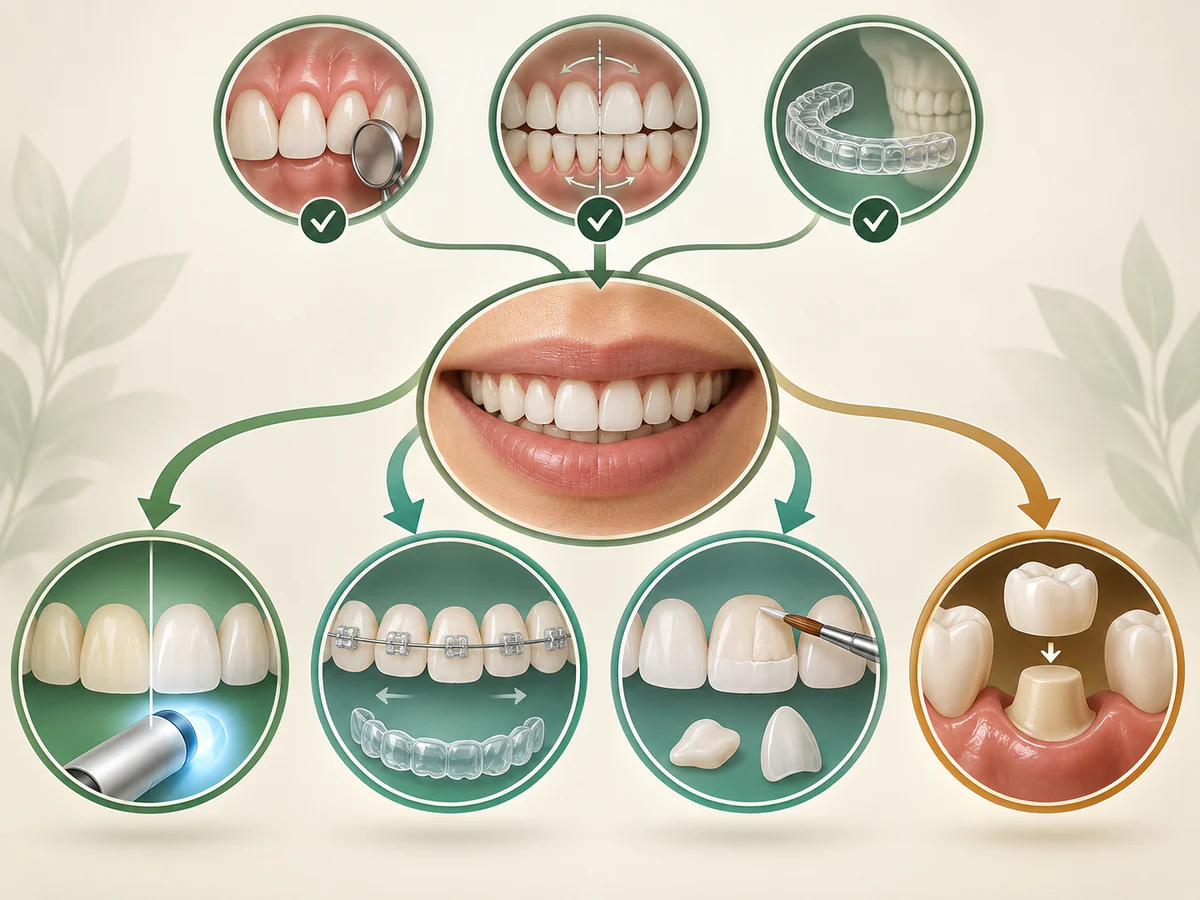
Before reducing enamel, it is legitimate to ask whether a less invasive treatment would be enough, or, on the contrary, whether the tooth calls for a more complete restoration. Veneers sit between these two poles.
The more conservative options
When the request concerns color alone, tooth whitening deserves to be considered first, since it removes no tissue. The Cochrane review by Eachempati et al. (2018) concludes that home whitening products do lighten teeth compared with a placebo over short periods, but with a low to very low level of evidence, and that the most frequent adverse effects, tooth sensitivity and irritation, remain mild and transient. Whitening has its limits, but it has the advantage of being reversible in principle; its indications and its safety are developed in teeth whitening: effectiveness and safety.
When the problem is alignment or a gap, actually moving the teeth with orthodontics treats the cause rather than masking it, without touching the enamel. For malpositions, this is often the option that respects the tissues most, including in adults.
The more restorative option
Conversely, when a tooth is heavily damaged, root-treated and weakened, or when the loss of structure is significant, a veneer is bonded to an inadequate foundation and its prognosis deteriorates. In such cases a crown, which envelops and protects the whole tooth, may be more appropriate, at the cost of a broader preparation. The choice between these solutions is set out in ceramic or zirconia dental crowns.
The right treatment, then, is not the most spectacular one, but the one that matches the actual condition of the tooth and the patient’s request, with the least tissue sacrificed for a reliable result.
In summary
Ceramic veneers are a reliable aesthetic solution for correcting a shade, a shape, small gaps or slight alignment defects on the visible teeth. Their success rests on a sound indication and, above all, on preserving the enamel: the literature shows high survival rates when bonding stays within enamel, and a prognosis that deteriorates as soon as the preparation reaches into the dentin.
It is also a partly irreversible procedure, whose longevity is counted in years and cannot be guaranteed for life. Before deciding, it is sensible to look at the more conservative alternatives, such as whitening or orthodontics, and to reserve heavier solutions, such as a crown, for the teeth that genuinely warrant them. This careful approach, based on an examination and on data, is what makes it possible to choose with full knowledge of the facts.
Frequently asked questions
Do veneers damage the teeth?
How long does a ceramic veneer last?
Ceramic or composite veneers: what is the difference?
Should whitening be preferred over veneers?
Can a veneer replace orthodontic treatment?
Why does bonding to enamel matter so much?
When are ceramic veneers not the right choice?
Sources
Medical references consulted for this article.
- 1Klein et coll., Survival and Complication Rates of Feldspathic, Leucite-Reinforced, Lithium Disilicate and Zirconia Ceramic Laminate Veneers, J Esthet Restor Dent 2025 (PMC)
- 2Petridis et coll., Clinical survival and complication rate of ceramic veneers bonded to different substrates, J Prosthet Dent 2024 (PubMed)
- 3Gurel et coll., Influence of enamel preservation on failure rates of porcelain laminate veneers, Int J Periodontics Restorative Dent 2013 (PubMed)
- 4Edelhoff & Sorensen, Tooth structure removal associated with various preparation designs for anterior teeth, J Prosthet Dent 2002 (PubMed)
- 5AlJazairy, Survival Rates for Porcelain Laminate Veneers: A Systematic Review, Eur J Dent 2020 (PMC)
- 6Eachempati et coll., Home-based chemically-induced whitening (bleaching) of teeth in adults, Cochrane 2018 (PMC)
- 7UFSBD, fiche conseil « Retrouver un beau sourire : à quoi servent les facettes ? »
Contents
Share