Digital Smile Design (DSD), sometimes referred to as a digital smile project, is a planning method that makes it possible to design and view a patient’s future smile on screen before any esthetic treatment begins. In practical terms, working from photographs, video and often a scan of the teeth, the practitioner digitally draws the shape, position and proportions of the teeth, then presents that simulation to the patient. The core idea is simple: see a preview of the possible result, discuss it, and decide on your smile together before a single tooth is touched.
This article offers a measured overview of the approach: what DSD really is, how it fits into an esthetic treatment plan, what the scientific literature says about its benefits, and above all where its limits lie. The most important point to keep in mind from the outset is this: a simulation, however attractive it looks on screen, remains a projection. It is not a contractual guarantee of the final result, and the literature itself is a reminder that a digital image alone is not enough to decide on a treatment.
What is Digital Smile Design?
The concept of Digital Smile Design was formalized by Christian Coachman and Marcelo Calamita in a landmark article published in 2012 (Quintessence of Dental Technology). The authors describe it as “a multi-use conceptual treatment planning tool, intended to strengthen diagnostic vision, improve communication and increase predictability throughout treatment”. It is therefore not a device or a single brand, but a methodological approach that can be supported by a range of different software.
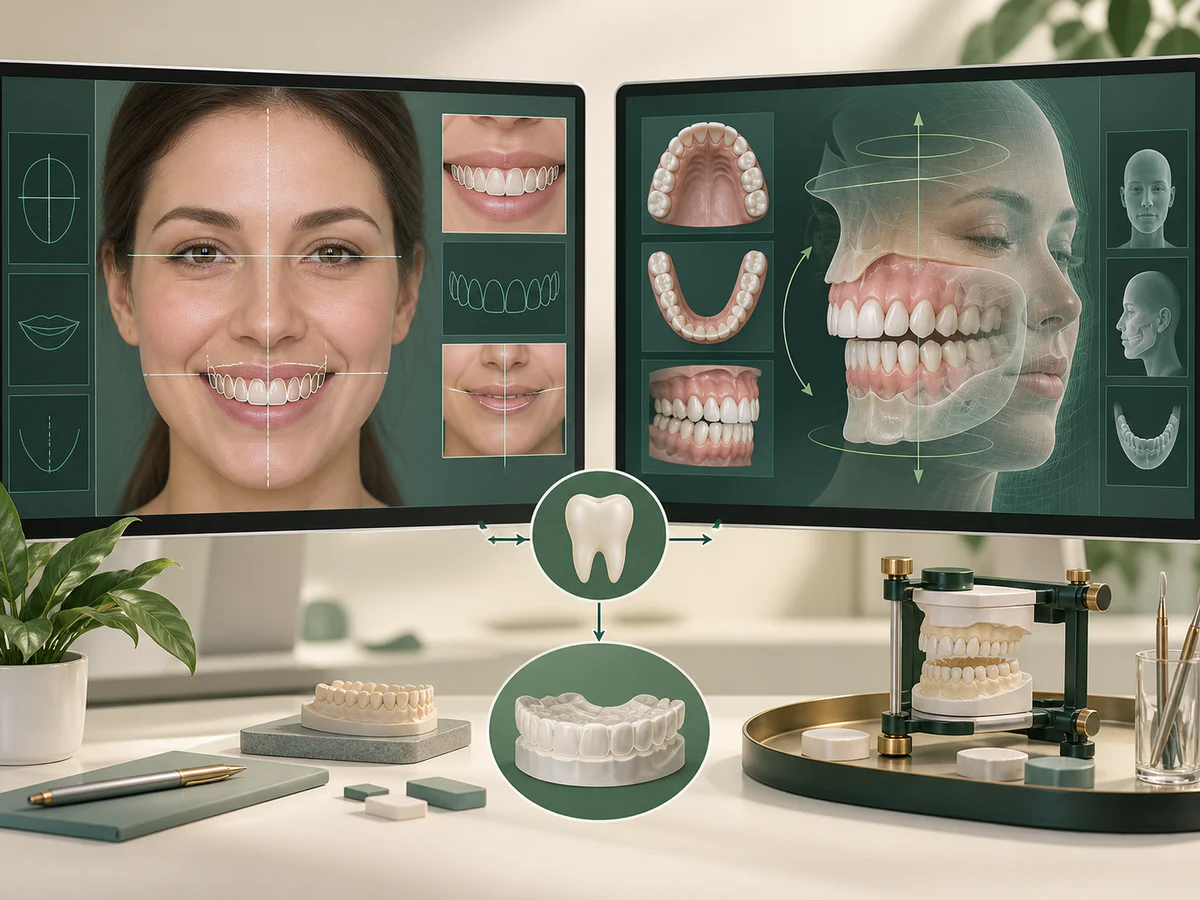
In its most common form, DSD starts with photographs of the face and the smile. On these images, the practitioner draws reference lines — midline, lip line, horizontal plane — then sketches the ideal shape and proportions of the teeth while taking the whole face into account, rather than the mouth in isolation. This is an important difference from a purely dental approach: the smile is analyzed in relation to the lips, the chin, the eyes and overall facial harmony.
One technical distinction is worth knowing. “2D” DSD works from flat photographs: it is quick and easy to grasp, but it only assesses the smile from the angle at which the picture was taken. “3D” DSD incorporates a scan of the dental arches, and sometimes a facial scan, to build a volumetric model. Work by Ortensi and colleagues (Clinical and Experimental Dental Research, 2022) has in fact shown that linear measurements taken on a 2D plan differ significantly from those of a 3D plan for certain teeth: a 2D preview conveys an esthetic intention, but does not replace three-dimensional analysis when it comes to fabrication.
Virtual smile design: the same idea under another name
Virtual smile design is another name for this approach: your future smile is designed and viewed on a screen before any treatment. You may also see it called smile simulation or a digital smile project. The principle stays the same: photographs, and often a scan, serve as the base for a drawing that you discuss with your dentist.
Some apps and websites also offer an instant “virtual smile” made from a selfie. These images can help you put your wishes into words, but they are not a dental plan. They take no account of your bite, your gums, the real size of your teeth or what the materials can achieve.
Seeing the result before you start: what it is really for
The main value of a digital smile project comes down to a single sentence: it makes visible — and therefore open to discussion — what until then stayed in the practitioner’s head. Several benefits are regularly described in the literature.
- Communication. A systematic review by Jain and colleagues (Cureus, 2024), covering ten studies, concludes that DSD is useful “for improving communication, reducing working time, limiting errors and increasing patient satisfaction”. Seeing a shared image avoids misunderstandings between what the patient imagines and what the practitioner has in mind.
- Shared decision-making. The patient is no longer a spectator: they take part in choosing the shape, the length and the alignment of their teeth. This involvement is at the heart of the approach.
- Motivation and buy-in. Several studies report better acceptance of the treatment plan when it has been visualized in advance.
- Predictability. In rehabilitations using veneers or crowns, the project acts as a road map for the laboratory and guides the later stages.
A more recent systematic review by Alwabel and colleagues (Cureus, 2025), covering seven studies including randomized controlled trials, points in the same direction: compared with conventional approaches, DSD “consistently improves patient satisfaction, treatment acceptance, communication and perceived predictability”. These findings are encouraging, but we will see below why they should be read with caution.
From the drawing to the mouth: the decisive role of the mock-up
This is where the honesty of the whole approach is decided. A drawing on a screen is not a clinical experience. Garcia and colleagues (Journal of Conservative Dentistry, 2018) put it plainly: “DSD simulation is not sufficient for the patient to genuinely understand and observe the changes”. That is why the digital project is very often transferred into the mouth in the form of a mock-up — a resin model placed over the teeth without preparing them, which temporarily gives physical form to the project.
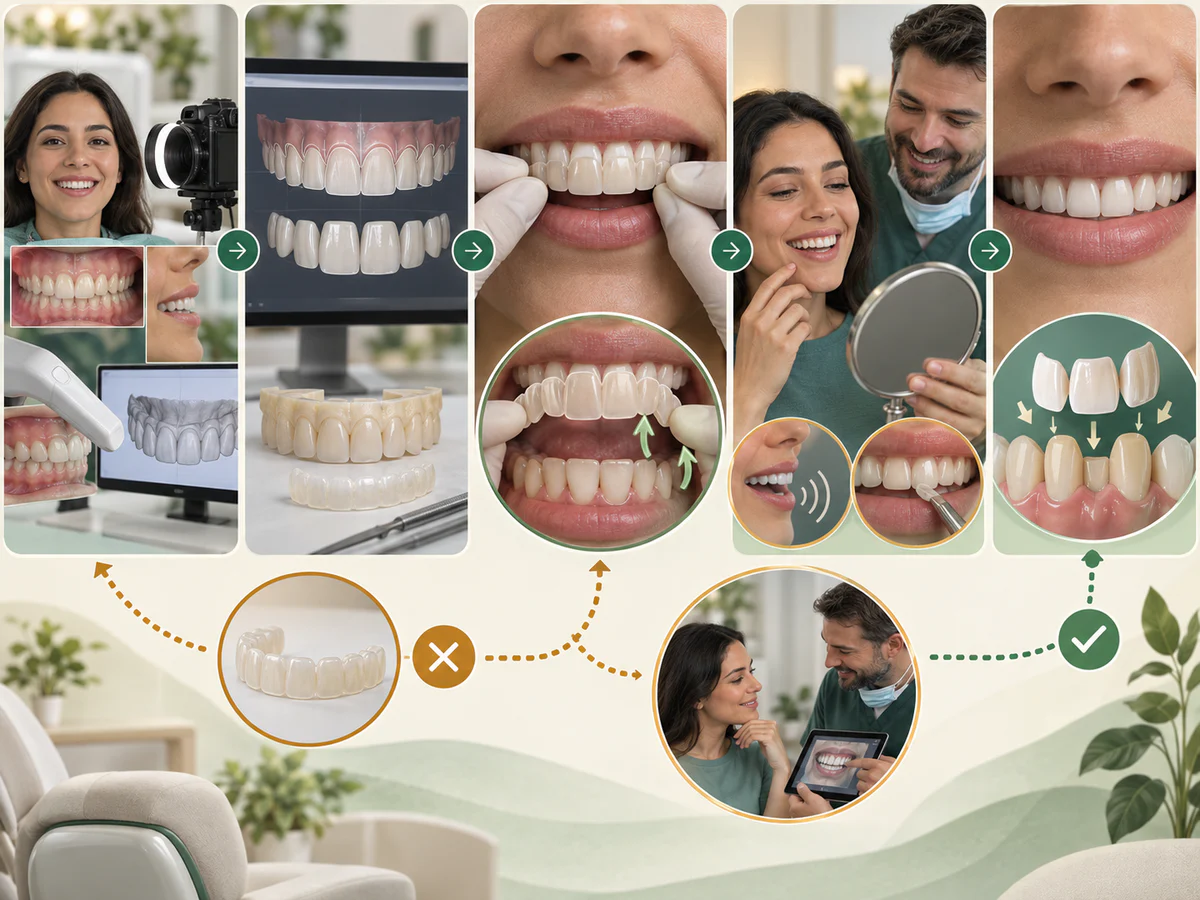
The mock-up is a reversible trial. The patient can see, feel, speak and smile with the project in place, then have it removed. It is the step that turns an image into an informed decision. Cattoni and colleagues (International Journal of Dentistry, 2016), who described a fully digital planning technique with CAD/CAM-fabricated mock-ups, observed that patients found the trial model considerably more convincing than a purely digital preview. In other words: the screen motivates, but it is the mock-up in the mouth that allows the project to be validated.
The mock-up is also a precision tool for the practitioner. Once it has been validated, it can serve as a guide for tooth preparations that are as conservative as possible, which is in line with the thinking behind ceramic dental veneers, where the aim is to remove as little enamel as possible. The digital project and the mock-up therefore form an inseparable pair: the first designs, the second puts it to the test.
What Digital Smile Design does not provide
Honest information means clearly naming the limits of this technology, because it is sometimes presented in excessive terms.
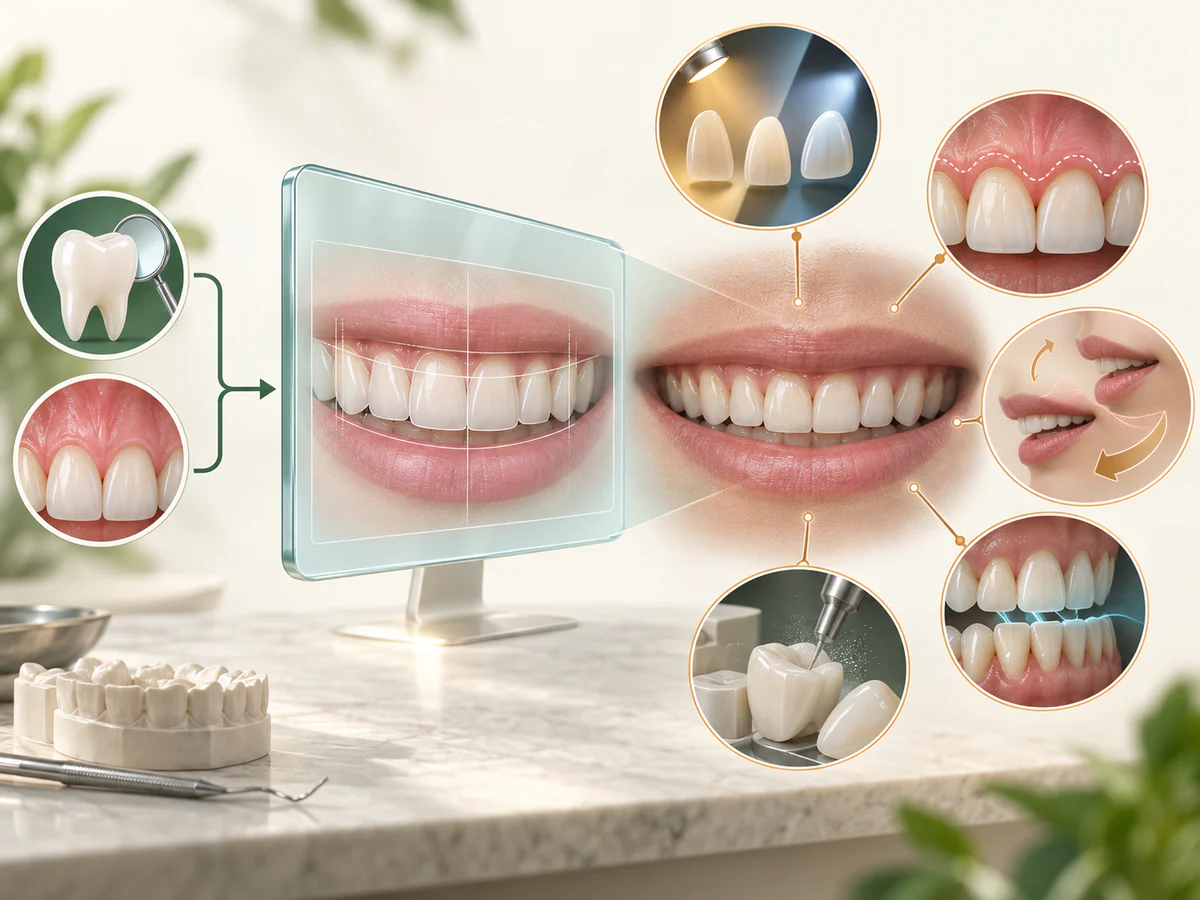
A simulation is not a guarantee of the result. The final outcome depends on the material used, the actual shade of the ceramic, the light, the gums, the occlusion and the laboratory’s work. A smoothed image on a screen reproduces neither the translucency of real ceramic nor the dynamics of a smile in motion. Presenting the digital rendering as a guaranteed result would be an over-promise.
The precision of the drawing has its limits. As Ortensi and colleagues (2022) have shown, measurements from a 2D plan can differ significantly from three-dimensional reality. 2D DSD guides the esthetics but is not enough on its own to fabricate a well-fitting restoration; it is the move to 3D, to the mock-up and to the digital impression with an intraoral scanner that brings the project closer to clinical reality.
DSD does not treat anything. It is an esthetic planning tool, not a treatment. It corrects neither a cavity, nor gum disease, nor an occlusal problem. A smile cannot be rebuilt to last on unhealthy foundations: inflamed gums or periodontitis must be taken care of before any esthetic project, as we explain on the subject of scaling and root planing.
The level of evidence remains limited. The available systematic reviews acknowledge this honestly. Jain and colleagues (2024) and Alwabel and colleagues (2025) both point to samples that are often small, wide variation between protocols, a limited number of randomized trials and insufficient long-term follow-up. The benefits described relate mainly to satisfaction and communication; there is less solid data on the longevity of DSD-guided restorations. The satisfaction figures reported in these studies are group averages, not an individual promise.
| What DSD provides | What DSD does not provide |
|---|---|
| A preview of the future smile that can be discussed | A guarantee of the final esthetic result |
| Better practitioner-patient communication | A substitute for the mock-up in the mouth |
| Support for shared decision-making and motivation | Treatment for cavities, gums or occlusion |
| A road map for the laboratory | Absolute precision, especially in 2D |
| Satisfaction that is often improved (studies) | Well-established long-term evidence |
For which patients and which treatments?
A digital smile project is useful above all in esthetic treatments of the anterior region: veneers, esthetic crowns, smile rehabilitations, and sometimes as a complement to an alignment treatment. It is particularly helpful for patients who find it hard to picture the outcome, who are hesitant, or who have specific esthetic expectations that are better clarified before anything is done.
It is, on the other hand, less relevant — even unnecessary — for an isolated procedure with no overall esthetic stake. And it never removes the need for a full assessment: the health of the teeth, the gums and the occlusion. DSD is part of an esthetic care pathway, but it comes after the diagnosis, not in its place. The right sequence remains: restore health first, then plan, simulate, try it in the mouth, and only then treat.
Finally, DSD does not replace the relationship or clinical judgment. No software decides, in place of the practitioner and the patient, what is reasonable, durable and suited to a particular face. The technology serves the conversation; it does not replace it.
Digital Smile Design or veneers: not a choice between the two
Digital Smile Design and veneers are not alternatives. DSD is a planning step; veneers are one of the treatments it can help plan, along with crowns, alignment or work on the gum line. So the real question is not which one to choose, but whether a smile project is useful before your treatment.
The design can also change the plan itself. In some cases it shows that aligning the teeth first would allow thinner veneers, or that whitening or a few small bonded repairs would meet your wishes without veneers at all. The mock-up in the mouth then lets you check the proposed shapes before any tooth is prepared.
In summary
Digital Smile Design is a digital smile project: a planning method that makes it possible to design and visualize the future smile before starting, and to decide on that smile together with your practitioner. The literature (Coachman and Calamita, 2012; Jain et al., 2024; Alwabel et al., 2025) credits it with real benefits in terms of communication, motivation and satisfaction, provided three things are kept in mind: a simulation remains a projection and not a guarantee of the final result; the digital image is not enough on its own and must be tested with a reversible mock-up in the mouth (Garcia et al., 2018; Cattoni et al., 2016); and the level of evidence, still limited, calls for caution. Used well, DSD is an excellent tool for dialogue and shared decision-making — not a promise of results.
Frequently asked questions
What is Digital Smile Design (the digital smile project)?
Is the smile simulation a guarantee of the final result?
What is a mock-up and why is it essential?
Does Digital Smile Design really improve satisfaction?
Does DSD replace a complete dental assessment?
What is the difference between 2D DSD and 3D DSD?
Sources
Medical references consulted for this article.
- 1Coachman C, Calamita M, Digital Smile Design: A Tool for Treatment Planning and Communication in Esthetic Dentistry, Quintessence of Dental Technology, 2012 (article de référence définissant le concept)
- 2Alwabel LK et al., Digital Smile Design and Patient-Centered Outcomes in Esthetic Restorative Dentistry: A Systematic Review, Cureus, 2025 (satisfaction, communication, prévisibilité ; limites de l'evidence)
- 3Jain R et al., The Recent Use, Patient Satisfaction, and Advancement in Digital Smile Designing: A Systematic Review, Cureus, 2024 (10 études, bénéfices et limites)
- 4Garcia PP et al., Digital smile design and mock-up technique for esthetic treatment planning with porcelain laminate veneers, Journal of Conservative Dentistry, 2018 (la simulation seule ne suffit pas ; rôle du mock-up)
- 5Cattoni F et al., A New Total Digital Smile Planning Technique (3D-DSP) to Fabricate CAD-CAM Mockups for Esthetic Crowns and Veneers, International Journal of Dentistry, 2016 (mock-ups numériques, perception patients)
- 6Ortensi L et al., Digital planning of composite customized veneers using Digital Smile Design: Evaluation of its accuracy and manufacturing, Clinical and Experimental Dental Research, 2022 (écarts entre plans 2D, 3D et pièces finales)
Contents
Share