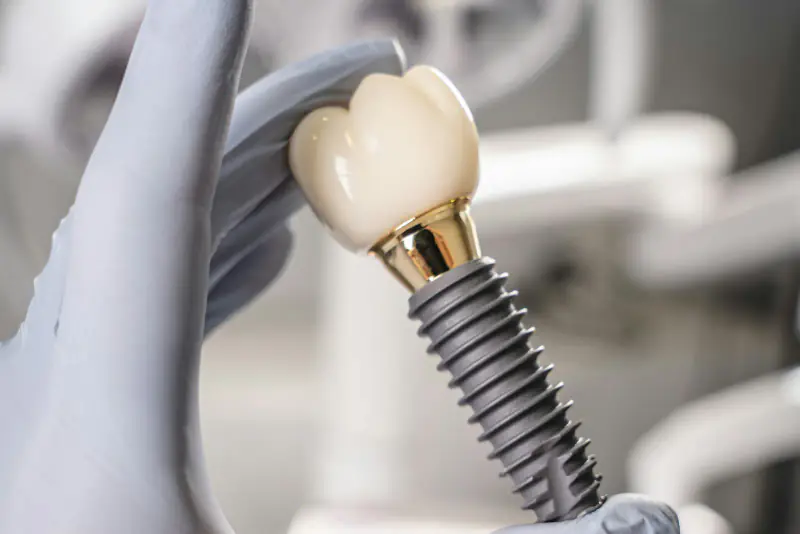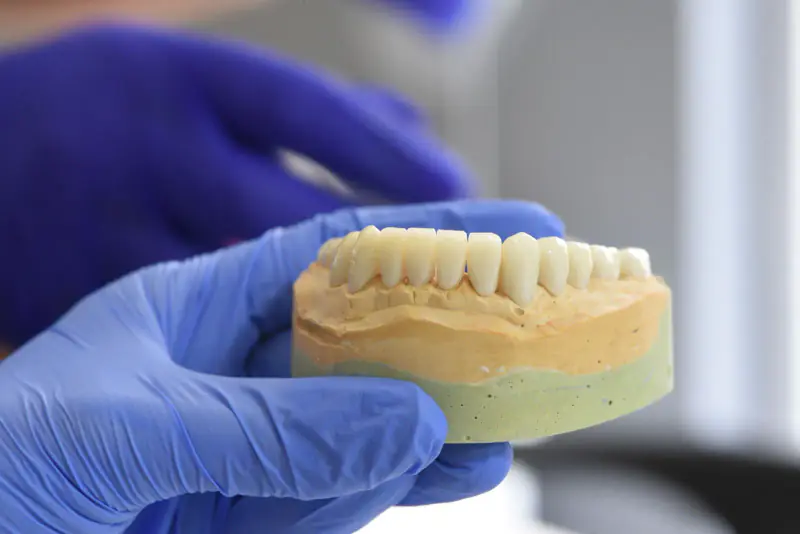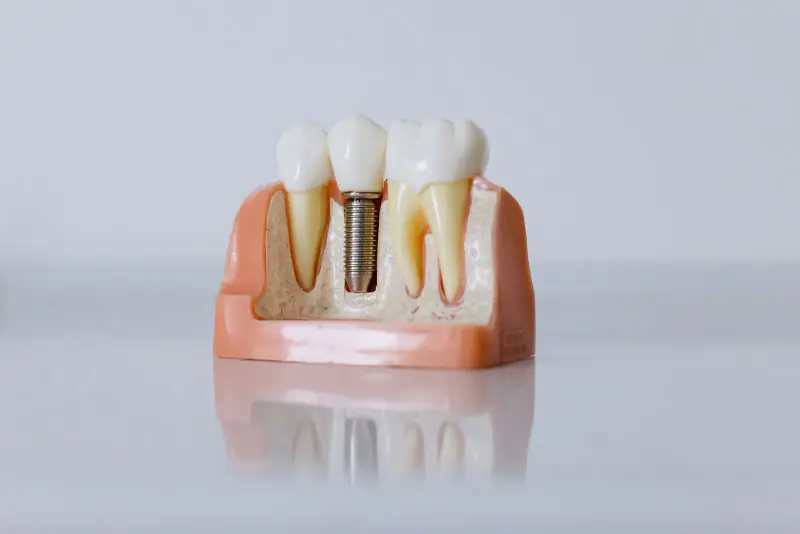
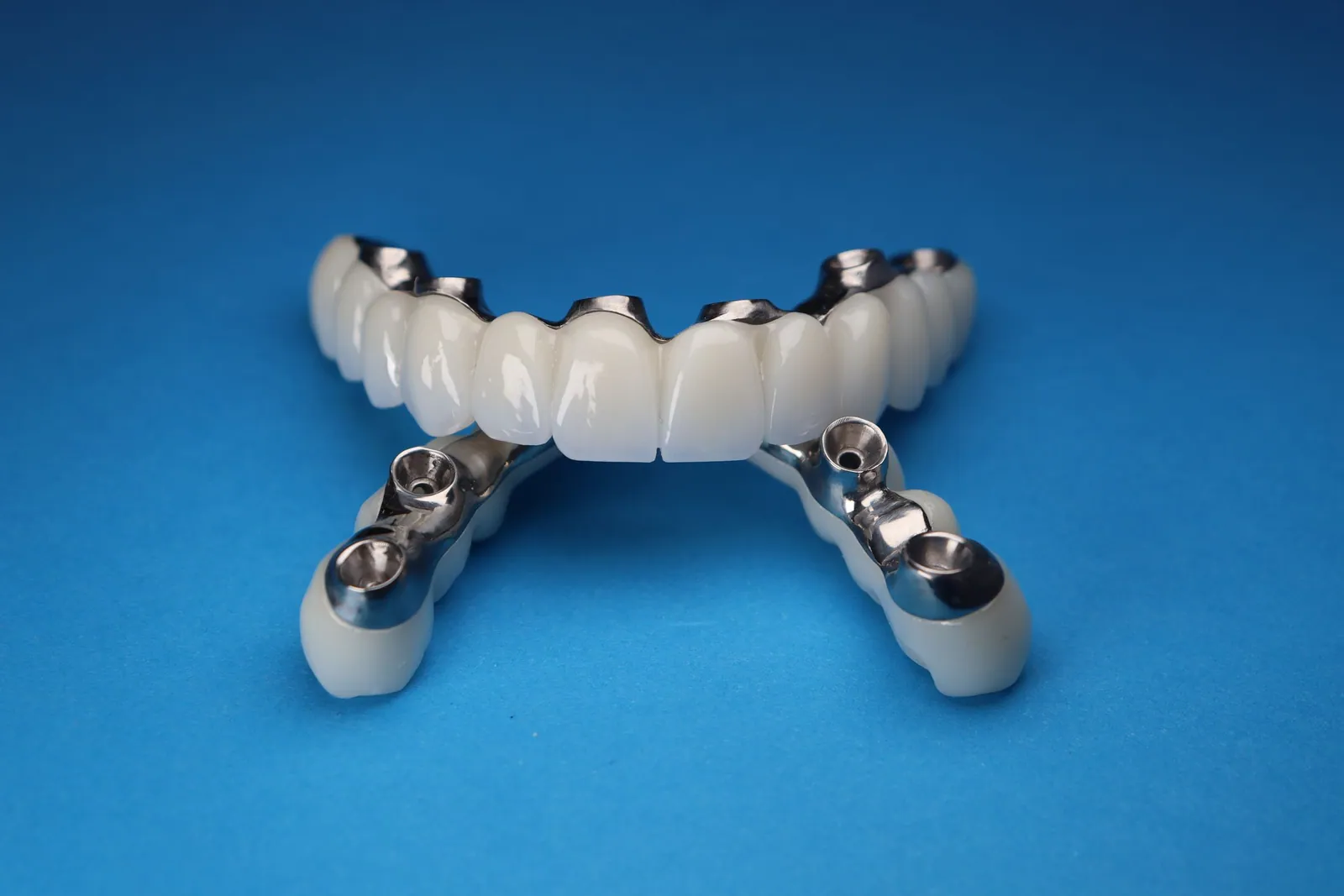
Full-arch implant rehabilitation replaces an arch of teeth with a fixed bridge supported by several implants. All-on-4 and All-on-6 refer to concepts using four or six implants. Patients do not remove the bridge themselves; professional removal may be needed in specific circumstances. Selection requires assessment of teeth that can be preserved, alternatives, risks and follow-up.
The aim is not to present the full-arch implant bridge as a permanent set of new teeth with no trade-offs. It is a major rehabilitation, reliable when properly indicated, but it remains a device placed in a living environment, involving surgery, a recovery period, lifelong upkeep and possible complications. That nuance is part of the information every patient is entitled to before deciding.
An illustrated pathway: interpret the images carefully
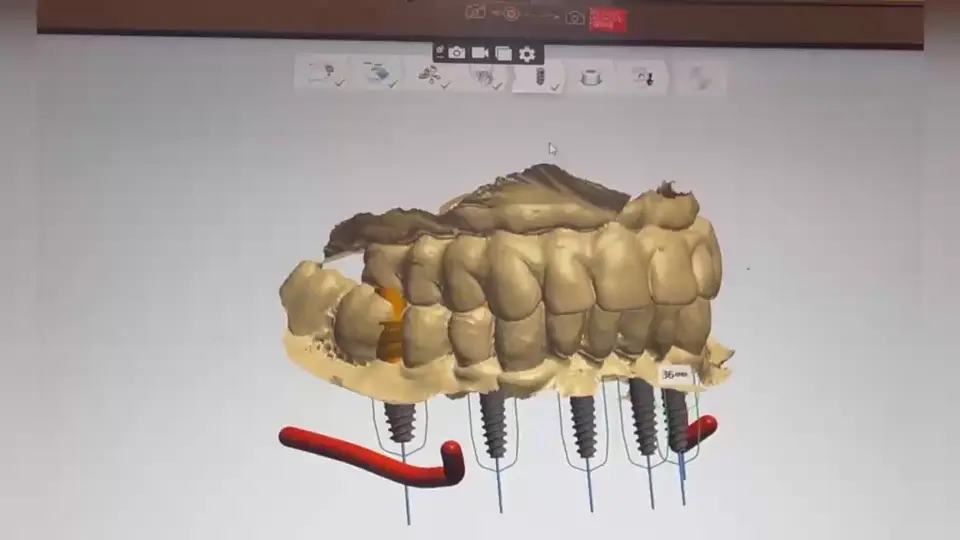
All-on-4 describes a treatment concept. Counting visible components in a clip is not enough to attribute it to a case. Implant number and prosthetic choices follow the assessment. This video combines several sequences; it is not proof of a confirmed protocol or long-term outcome.
Sensitive surgical images
This video contains blood and surgical procedures. You can read the descriptions without watching it. Copy without an audio track.
What the sequences show
| Time in V08 | Factual description | What it does not establish |
|---|---|---|
| 00:00 | Digital model with implant components under an arch. | Validation of a patient’s plan or the number of implants actually placed. |
| 00:10 | Operative sequences in the mouth, instruments and blood. | The exact procedures and continuity between shots need clinician confirmation. |
| 00:55 | Panoramic image with implant and prosthetic components. | Healing or absence of complications. |
| 00:59 | Components in the mouth during prosthetic preparation. | That every shot concerns the same case. |
| 01:11 | Handling and placement of a prosthesis. | Long-term function or subsequent follow-up. |
The stages beyond the video
- Plan: assess remaining teeth, bone, tissues and the prosthetic project; discuss alternatives before extracting teeth.
- Place and check: follow the chosen surgical plan, then assess healing and loading conditions.
- Design and try the prosthesis: check records, shape, contacts and cleaning access; distinguish temporary from definitive restorations.
- Follow up: arrange maintenance and clinical checks. This stage is not documented by V08 and cannot be assumed.
Leeds Teaching Hospitals also describes prosthetic care and follow-up. Read the Cone Beam guide and dental implant prices in Morocco, without treating a single-implant price as a full-arch price.
What is a fixed full-arch implant bridge?
A full-arch bridge is designed to remain stable during chewing and speech. It is attached to implants rather than supported only by the gums and may avoid palatal coverage, depending on its design. Abnormal movement, pain or loosening require assessment; they are not impossible.
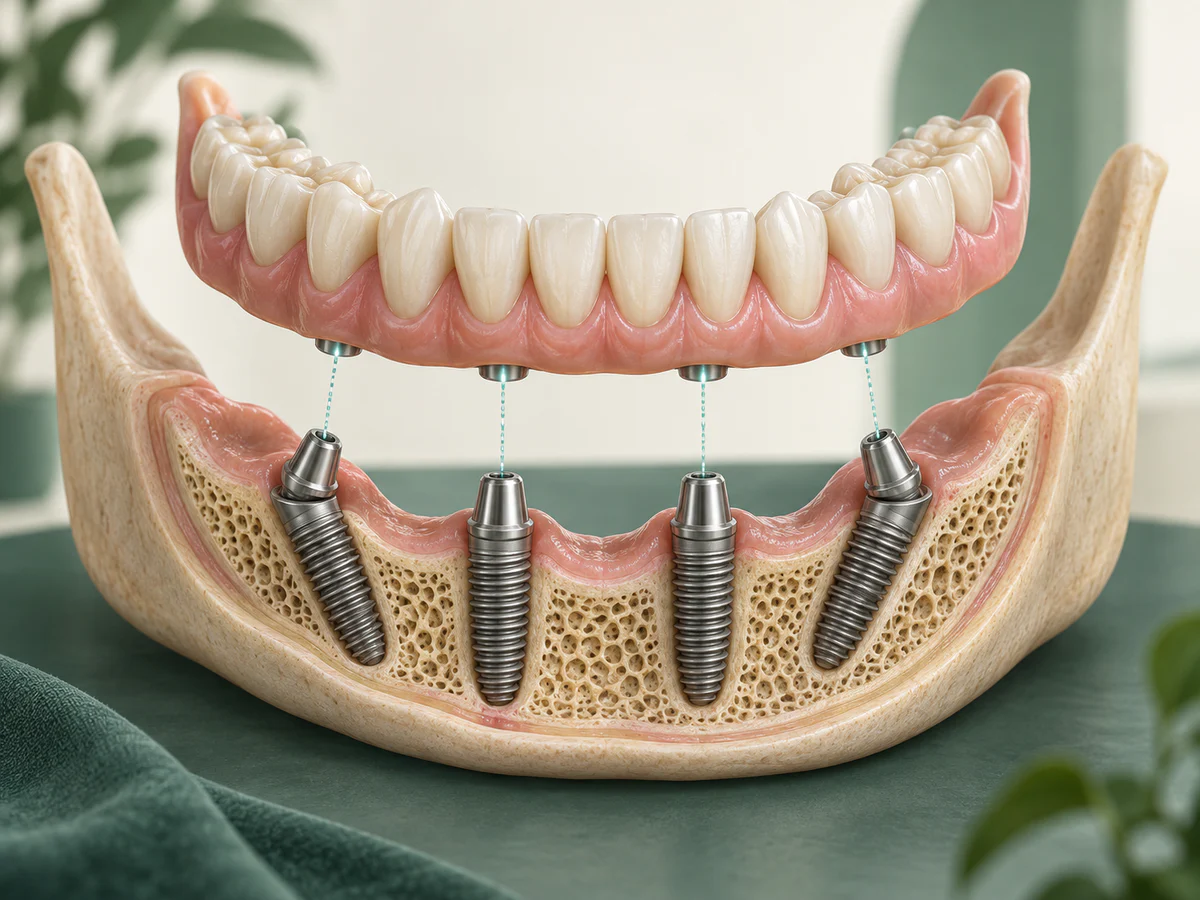
In the All-on-4 and All-on-6 concepts, the complete arch rests on four or six implants. To compensate for bone volume that is sometimes limited towards the back of the jaws, the two posterior implants are often placed at an angle. In many cases, this tilting makes it possible to avoid or reduce the need for a bone graft or a sinus lift, while extending the prosthesis support further back.
The prosthesis is generally screw-retained rather than cemented: a screw-retained prosthesis can be removed by the practitioner for cleaning, inspection and repair, which makes maintenance easier.
Who is this solution for?
Full-arch implant rehabilitation concerns two main profiles:
- people who have already lost all the teeth in one or both arches, who cope poorly with a removable denture or would like a fixed solution;
- people who are about to lose their remaining teeth, condemned by advanced decay or severe periodontitis, and for whom a comprehensive rehabilitation is being planned.
Before full-arch rehabilitation, remaining teeth and their prospects for preservation are assessed. A preservable tooth should not be extracted merely to fit a commercial protocol. Compare implants, bridges and dentures.
The fixed full-arch bridge is not the only route for someone who has lost their teeth. A removable denture stabilized on implants can remain a relevant compromise, particularly when bone or budget limit the fixed options (see the comparison further down). The aim is not to push towards the most extensive solution, but towards the one that suits the situation.
The practice page explains the assessment for dental implants in Kénitra.
How many implants: four, six, or depending on the case?
The number of implants is not a fixed rule. The figures four and six correspond to documented protocols, not to a universal requirement.
The ITI 2018 consensus found no statistically significant survival difference between groups with fewer than five implants and those with five or more in either jaw studied. This does not prove all protocols equivalent. Number and distribution depend on anatomy, prosthetic planning, cleanability and the consequences of complications.
The choice between All-on-4 and All-on-6 is made case by case, according to the arch, the bone and the chewing forces. More implants is not automatically better: what matters is the overall planning.
How does treatment proceed in Kénitra?
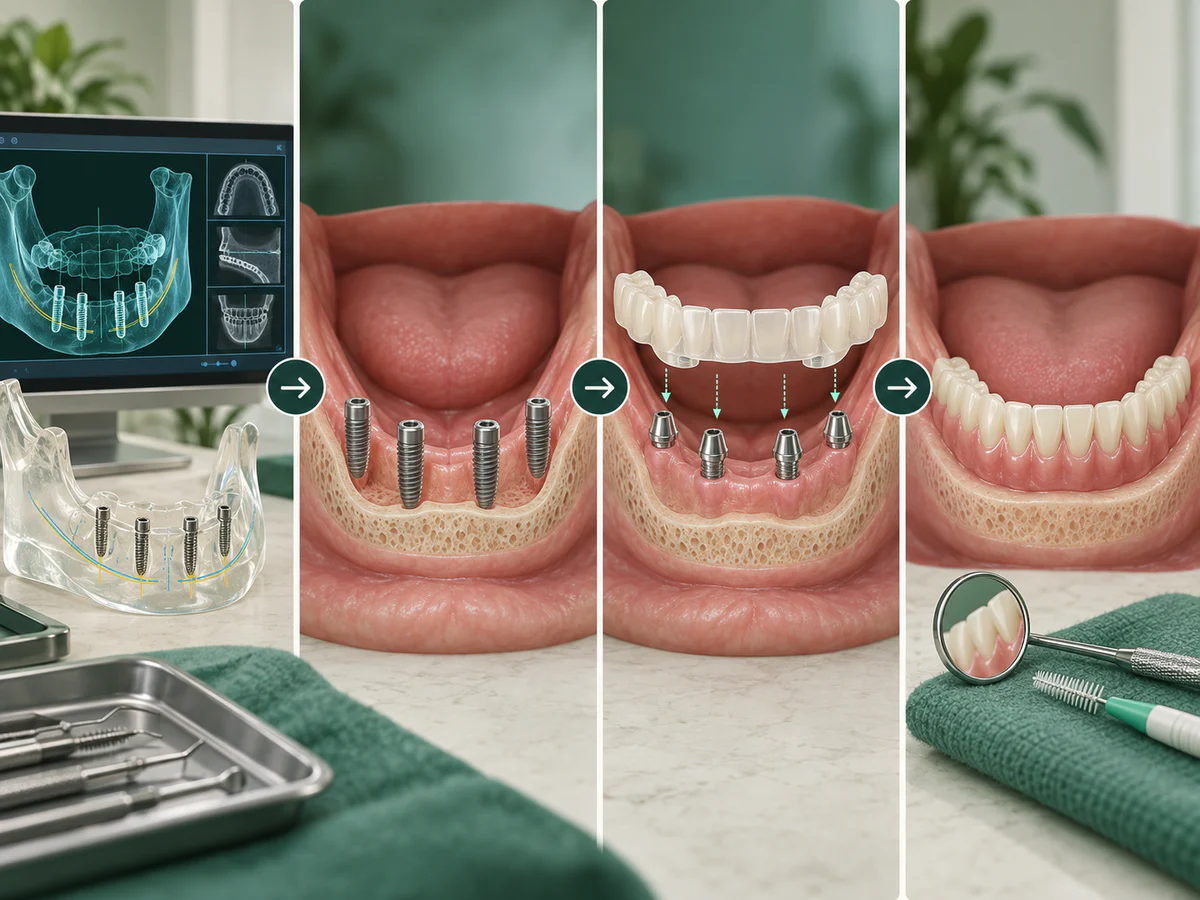
Full-arch implant rehabilitation is a structured pathway, never a single procedure.
The assessment
The first step is not surgical. It is a full assessment: medical history, examination of the gums and remaining teeth, analysis of the bite and of oral hygiene. Periodontal health is decisive, because untreated inflammation compromises healing and the long-term stability of the implants.
CBCT provides information about bone volume and anatomy. It complements examination and prosthetic planning; it does not independently determine grafting, extraction or implant number. Impression and design tools and their purpose are explained during assessment.
When bone is lacking despite tilting the implants, reconstruction options and alternatives are covered in Dental implants when there is not enough bone: what are the options.
The surgery
Anaesthesia arrangements, the timing of extractions and placement, and any temporary restoration are determined during assessment and confirmed according to operative conditions. They are not the same for every patient.
Ultrasonic instrumentation also has limitations and anatomical risks. PRF findings after extraction do not prove a benefit for every full-arch rehabilitation or guarantee success. Ask which measures are actually planned for your case.
Loading: immediate or delayed
One appeal of the concept is the possibility, in selected cases, of fitting a fixed temporary prosthesis shortly after surgery: this is immediate loading. It is not routine: according to the ITI consensus statements, it requires the primary stability of each implant to be confirmed at the time of placement. When that stability is insufficient, loading is delayed to let the bone heal.
One point is often misunderstood: a temporary prosthesis fitted in a single day is not the final prosthesis. The definitive one is made after healing and osseointegration, that is, once the implant has anchored into the bone. The choice between immediate and delayed loading, and the conditions involved, is detailed in Immediate or delayed loading of a dental implant.
To distinguish surgery, healing and the restoration, see the stages of dental implant placement.
The timeline for a full arch
The stages of a single implant still apply. For a full arch, three things change: the remaining teeth are often extracted on the day the implants are placed, a fixed provisional arch can be fitted very quickly, and the final arch only comes after healing. The durations below are benchmarks taken from studies; your own timeline is set during the assessment.
- Before surgery: assessment, imaging, gum treatment if needed and design of the prosthetic plan, over a period that depends on the preparatory care required.
- The day of surgery: extractions, placement of the implants and then, if the stability of each implant allows, fitting of a provisional arch. In the studies gathered by Soto-Peñaloza et al., this provisional arch is fitted between a few hours and 48 hours after the procedure.
- Healing, most often four to six months: you wear the provisional arch while the implants anchor into the bone. Most studies in this review fit the final arch after four to six months; a few do so earlier.
- The final teeth, over a few appointments: impressions, try-ins, adjustment of the bite, then fitting of the final arch and first check-ups.
If stability does not allow immediate loading, or if a bone graft must come before the implants, the timeline is extended by that additional healing.
The day of the procedure: what changes for you
A full-arch session is longer than a single implant placement: it often combines extractions, the placement of several implants, then the preparation and fitting of the provisional arch. In the study by Uesugi et al., the procedure is carried out under local anaesthesia and the provisional arch is fitted the same day. Local anaesthesia aims to limit pain during the procedure; pressure or vibration may be felt. In the following days, swelling and discomfort may appear, and a soft diet is generally advised during healing.
Under local anaesthesia, you remain awake. If you feel very apprehensive, say so at the assessment: the possible options and their limits are discussed before the date is set. Conscious sedation aims to relax you without putting you to sleep; it is not general anaesthesia. The surgery itself is described in how dental implant placement works.
What does the survival data say?
Full-arch implant rehabilitation shows high survival rates in the literature, but these figures need to be read with caution.
Soto-Peñaloza et al. (2017) describe encouraging but heterogeneous evidence with follow-up and methodological limitations. No single survival percentage predicts an individual’s result; these are published study findings, not measured outcomes from this practice.
Uesugi et al. (2023) report about 98.9% implant survival in the mandible and 97.4% in the maxilla in a Japanese cohort with individual follow-up of 3–17 years; patient-level figures are 96.7% and 94.4%. Not everyone was followed for seventeen years. Differences describe this cohort, not a universal rule.
Finally, the systematic review by Kwon, Bain and Levin (2014, Journal of Dentistry) on hybrid fixed full-arch bridges reports high short-term survival (5 to 10 years), of the order of 93.3 to 100% for the prostheses and 87.9 to 100% for the implants, but points out how few studies extend beyond 10 years, which prevents firm conclusions about real-world lifespan.
| Source | Concept studied | Reported survival | Follow-up |
|---|---|---|---|
| Soto-Peñaloza 2017 | All-on-4 | Encouraging results; limited, heterogeneous evidence | Variable follow-up; interpret cautiously |
| Uesugi 2023, lower jaw | All-on-4 | ≈ 98.9% (implant) / 96.7% (patient) | 3 to 17 years |
| Uesugi 2023, upper jaw | All-on-4 | ≈ 97.4% (implant) / 94.4% (patient) | 3 to 17 years |
| Kwon 2014 | Fixed full-arch bridge | 93.3 to 100% (prosthesis); 87.9 to 100% (implants) | 5 to 10 years |
Two cautions are needed. First, survival at implant level is not the same as survival at patient level: a patient can lose an implant without losing the whole rehabilitation. Second, survival is not success.
Survival is not success
An implant or a prosthesis that is still in place is not necessarily problem-free. The 2017 World Workshop consensus (Berglundh et al., 2018, Journal of Clinical Periodontology) defines peri-implantitis as a plaque-associated condition, marked by inflammation of the peri-implant mucosa followed by progressive bone loss around the implant. A full-arch rehabilitation can therefore remain functional while developing this complication, which is why lifelong follow-up is warranted. The warning signs are described in Implant failure and peri-implantitis: signs to watch for.
What if one of the implants is lost?
A full-arch rehabilitation rests on several implants linked by a single prosthesis. If one of them fails, what happens next depends on the number of remaining implants, their position and the available bone. The prosthesis can sometimes be kept, possibly adapted, while a new implant is placed; in other cases it has to be modified or remade. This is why the 2018 ITI consensus recommends considering, when choosing the number of implants, the consequences of a future loss for the support of the prosthesis.
In the series by Maló et al. (2019), followed for 10 to 18 years in the lower jaw, prosthesis survival remained higher than implant survival: losing an implant most often did not mean losing the prosthesis. This result describes one series of patients, not a promise. How long an implant lasts and what influences it are covered in How long does a dental implant last?.
Technical complications: an often underestimated point
Beyond biological complications, a fixed full-arch prosthesis is subject to significant mechanical stress, and technical complications are common. This is one of the aspects least highlighted in commercial presentations of these treatments.
Sailer et al. (2022) note that technical complications cannot be completely avoided. Bidra’s 2017 zirconia bridge review includes layered restorations and ceramic veneer fractures; its figures do not apply indiscriminately to all modern monolithic prostheses. Loosening, fracture and wear remain possible.
These complications can usually be repaired, especially when the prosthesis is screw-retained, but they have a cost and require appointments. Bruxism — grinding and clenching the teeth — increases these mechanical risks; its management is covered in Bruxism and teeth grinding: what to do.
Day-to-day upkeep and hygiene
A fixed prosthesis is not taken out at night, which changes the hygiene routine. The patient must clean daily under and around the prosthesis, where plaque builds up, using interdental brushes, floss or suitable brushes, as the UFSBD patient information sheets point out. This hygiene is decisive, plaque being the central factor in peri-implantitis.
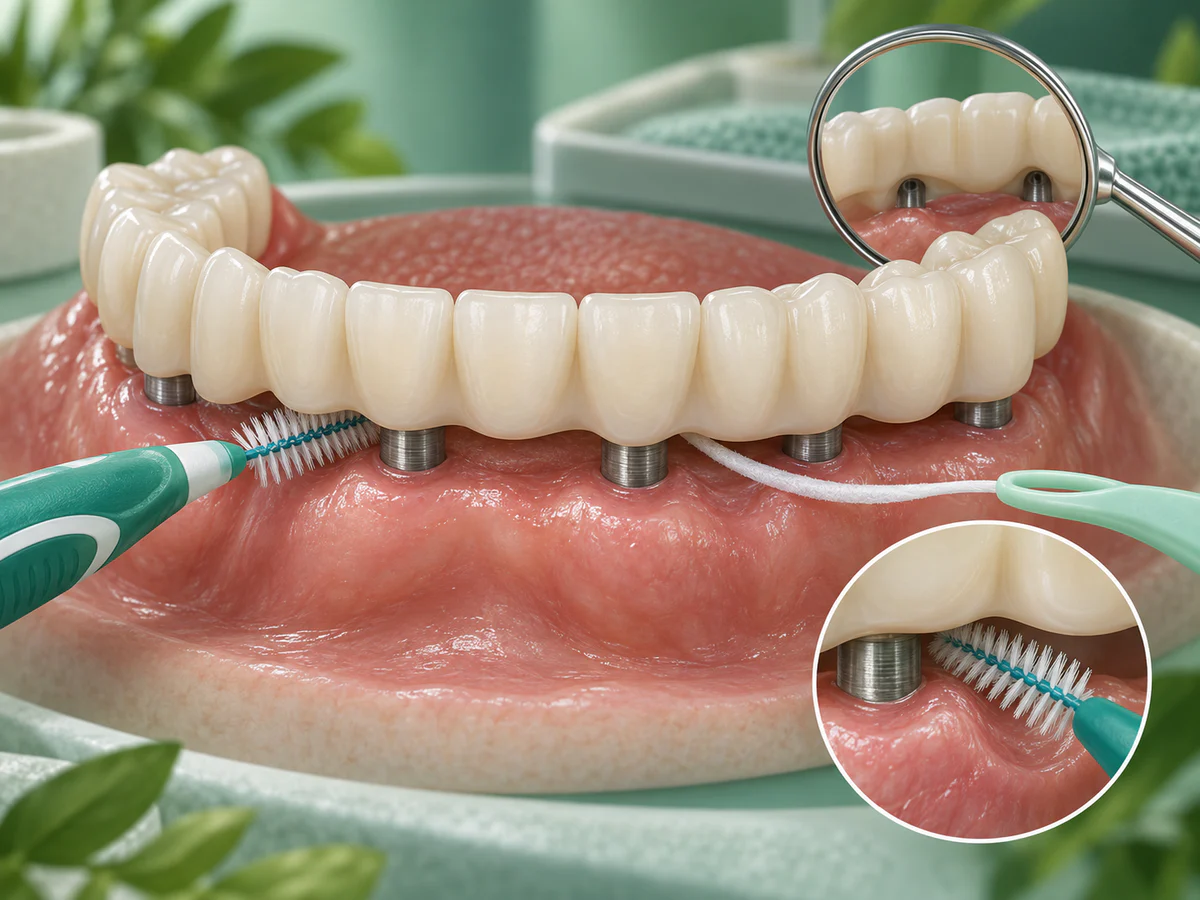
Check-ups look for inflammation, loosening and bone loss. Professional removal may be needed for examination, cleaning or repair, but is not automatic at every visit. Daily cleaning is adapted to bridge design: oral hygiene.
An honest comparison with the removable denture
Faced with tooth loss, the choice often lies between a fixed implant solution and a removable denture, possibly stabilized on a few implants. Both have their place.
The fixed solution offers greater stability, is not taken out, and generally does a better job of restoring the feel of natural teeth. In return, it involves more extensive surgery, more implants, a higher cost and more demanding hygiene, since the prosthesis is not removed each day.
An implant-retained removable denture is removed by the patient, allowing cleaning access. The McGill consensus (2002) concerns particularly the two-implant lower denture. Retention can improve without making it a fixed bridge; comfort, maintenance and preferences also matter.
There is therefore no single answer. The right choice depends on the bone, general health, hygiene habits, expectations and means. Honest information presents both families with their advantages and their constraints.
What a full-arch quote should itemise
A single overall amount does not let you compare or decide. A quote for a full-arch rehabilitation should set out, line by line:
- the preliminary examinations and imaging;
- any preparatory care, including gum treatment and extractions;
- a bone graft or reconstruction, if one is planned;
- the number of implants and the components that connect them to the prosthesis;
- the provisional arch;
- the final arch and its material;
- the check-ups and maintenance planned after fitting.
Two quotes for similar amounts can cover different procedures: one includes the provisional arch and the check-ups, the other does not. The article Two quotes, two different opinions helps you read them side by side. The practice’s price benchmarks are on the fees page; the amount for your situation is set after the assessment, in a detailed quote.
Limits and points to watch
To decide with full knowledge of the facts, several limits should be kept in mind:
- Studies report high but variable survival according to device, patient group and follow-up. An implant or bridge still in place may need care or repairs. No percentage guarantees an individual outcome.
- the survival of an implant or a prosthesis does not guarantee the absence of peri-implantitis or of mechanical complications;
- technical complications (ceramic fracture, screw loosening) are common and involve repairs over time;
- immediate loading requires sufficient primary stability, and the prosthesis fitted on the day of surgery remains temporary;
- daily upkeep and regular follow-up determine the long-term outlook, and no lifespan can be guaranteed.
Fixed full-arch rehabilitation on 4 to 6 implants is a well-established solution for giving fixed teeth back to someone who has lost their teeth or is about to, provided there is a thorough assessment, an indication suited to the arch concerned and follow-up over time. It is this careful, evidence-based framework that makes it possible to choose between this option and the alternatives, aware of both the benefits and the limits.
Frequently asked questions
What is the difference between All-on-4 and All-on-6?
Can you really have fixed teeth in a single day?
What is the survival rate of a full-arch implant bridge?
Is a bone graft always necessary for an All-on-4?
How do you look after a fixed full-arch implant bridge?
Fixed solution or removable denture: which to choose?
How long does it take to get the final teeth?
If an implant fails, do you lose the whole prosthesis?
Sources
Medical references consulted for this article.
- 1Soto-Peñaloza et coll. 2017, The all-on-four treatment concept: Systematic review, J Clin Exp Dent (PMC)
- 2Kwon, Bain & Levin 2014, survie et succès des bridges complets fixes hybrides, Journal of Dentistry (PubMed)
- 3ITI, 6e Conférence de Consensus 2018, nombre d'implants pour bridges complets fixes
- 4Uesugi et coll. 2023, All-on-4 recul 3–17 ans, maxillaire vs mandibule, Int J Implant Dent (PMC)
- 5McGill Consensus Statement 2002, overdenture mandibulaire à deux implants (PubMed)
- 6Berglundh et coll. 2018, consensus péri-implantaire, World Workshop 2017, J Clin Periodontol (PubMed)
- 7Bidra, Rungruanganunt & Gauthier 2017, bridges complets fixes en zircone, Eur J Oral Implantol (PubMed)
- 8Sailer et coll. 2022, Prosthetic failures in dental implant therapy, Periodontology 2000 (PMC)
- 9UFSBD, fiches patients (Union Française pour la Santé Bucco-Dentaire)
- 10Maló et coll. 2019, All-on-4 à la mandibule, suivi de 10 à 18 ans, Clin Implant Dent Relat Res (PubMed)
Contents
Share