When periodontitis has been treated and the gums look calm again, it is tempting to consider the case closed. Yet this is precisely the moment when the long-term result is decided. Periodontitis is a chronic disease driven by bacterial biofilm: active treatment halts the destruction and stabilizes the situation, but it does not remove the underlying susceptibility that allowed the disease to take hold. Without organized follow-up, the biofilm reorganizes, inflammation returns, and bone loss can start again. The phase that follows active treatment has a name: supportive periodontal therapy (SPT), or maintenance.
This article explains why this phase is decisive, what a maintenance visit actually involves, how often to schedule it depending on your risk profile, and what research really shows about its long-term effect. The core message is simple, and it is an honest one: maintenance guarantees nothing on its own, but it is by far the best-supported way to keep your teeth after periodontitis. We close by drawing the parallel with implant follow-up, which follows the same logic.
Why do we talk about relapse after periodontitis?
Periodontitis is not a one-off infection that is cured once and for all. It is a chronic inflammatory disease, triggered and sustained by bacterial biofilm in a person whose terrain is susceptible to it. Active treatment, as described in the EFP S3-level guideline for stages I to III (Sanz et al., Journal of Clinical Periodontology, 2020), aims to control that biofilm, reduce pocket depths and halt progression. It often achieves that goal. But it does not durably change individual susceptibility.
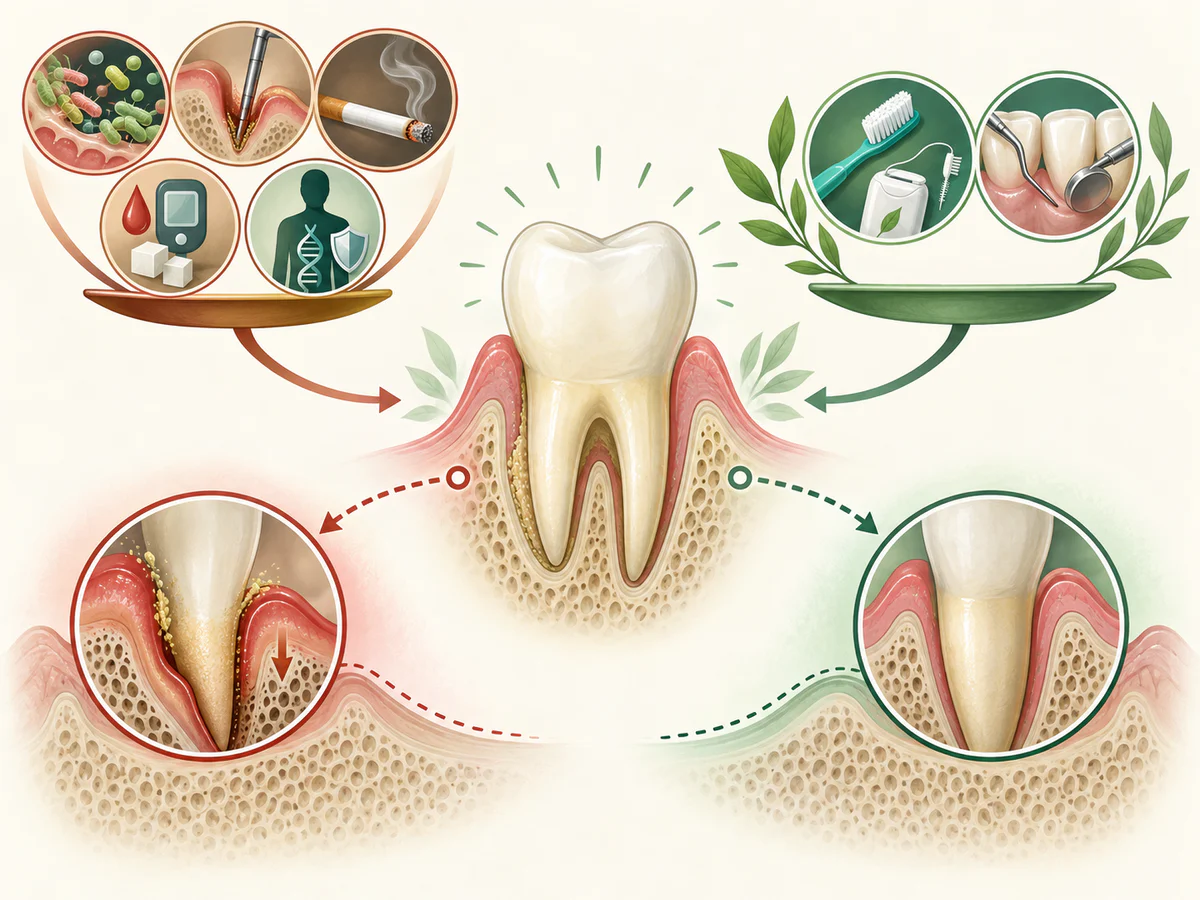
That is why we speak of stabilization rather than cure. The distinction between simple gingivitis, which is reversible, and periodontitis, which leaves permanent bone loss, is detailed in our article on the difference between periodontitis and gingivitis. Once that loss has occurred, the goal is no longer to repair but to prevent the situation from deteriorating again.
What happens when follow-up stops
The consequences of dropping out of follow-up are not theoretical. A study by Atarbashi-Moghadam et al. (2020) assessed patients who had been treated for periodontitis but had not subsequently followed any maintenance program. Among the participants who still had teeth, a large majority showed disease recurrence, and some of them a severe form. The authors identified two factors associated with this relapse: high initial severity and the time elapsed since treatment. In other words, the further you get from treatment without monitoring, the more the risk of relapse increases, and initially severe cases are the most exposed.
This finding should not be read as a foregone conclusion, but as a clear indication: active treatment and maintenance form a whole. The first without the second means risking the loss, over time, of the benefit that was gained.
What does a periodontal maintenance visit involve?
An SPT visit is not simply a comfort cleaning. It is a structured appointment that combines assessment, prevention and targeted treatment. The EFP S3-level guideline devotes an entire stage, its step 4, to this supportive care phase, which should be offered to every patient after active treatment.
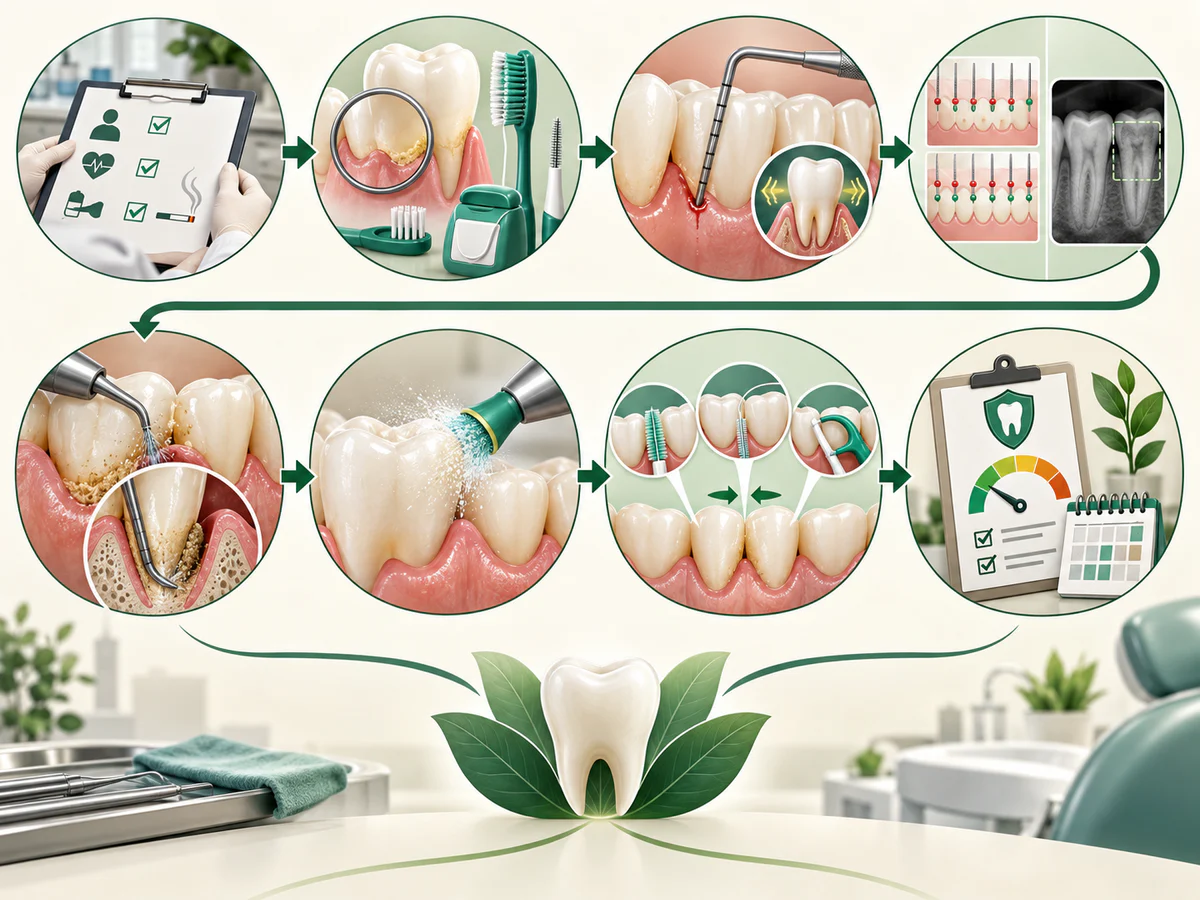
A complete visit usually includes the following elements:
- An update on your general health and risk factors, in particular smoking and control of any diabetes.
- A periodontal examination with pocket probing and a check for bleeding, which makes it possible to spot a site that is becoming active again.
- A review of oral hygiene and a fine-tuning of technique: brushing, and above all cleaning between the teeth with suitable interdental brushes.
- Professional removal of biofilm and calculus, together with targeted treatment of the sites that need it.
- A decision on the interval until the next appointment, based on the risk observed that day.
Root planing of residual sites is part of the toolkit when certain pockets become active again; the principle of subgingival cleaning is explained in our article on scaling and root planing. The key point to remember is that maintenance is not passive: it detects relapses early and acts before bone loss resumes.
Your role between visits
Professional maintenance does not replace daily plaque control, it complements it. Between appointments, it is home hygiene that keeps the biofilm below the threshold at which inflammation restarts. Our guidance on daily dental hygiene sets out the method and the decisive place of interdental cleaning. No visit, however well conducted, makes up for insufficient plaque control on the other 89 days of the quarter.
How often should you come back?
This is the most common question, and the honest answer is that there is no universal interval that works for everyone. The EFP S3-level guideline places recall intervals between 3 and 12 months, with the interval to be tailored individually to the risk of recurrence or progression. In clinical practice, for treated periodontitis of moderate to advanced severity, a 3- to 6-month rhythm is most often chosen.
We should be transparent about the quality of the evidence behind these figures. The systematic review by Farooqi et al. (Journal of Evidence-Based Dental Practice, 2015) concluded that the evidence supporting a specific fixed interval — every three months, for instance — for all patients after periodontal treatment is weak: it rested on cohort studies, with no randomized trial. Shorter intervals, of 3 to 6 months, tended to favor better tooth retention, and notable differences in tooth loss appeared mainly when the interval stretched toward 12 months. The authors’ conclusion pointed toward risk-based recommendations rather than a uniform schedule.
One clarification is useful here to avoid a common misunderstanding. The Cochrane review by Lamont et al. (2018) on routine scale and polish found little or no difference between intervals in adults without severe periodontitis who were seen regularly. That result concerns prevention in people with healthy gums; it does not apply to patients who have already had periodontitis, for whom the rationale of closer follow-up remains justified.
How is the interval set in practice?
The interval is decided from a risk assessment, not from a fixed rule. One reference tool, the periodontal risk assessment (PRA) proposed by Lang and Tonetti (Oral Health & Preventive Dentistry, 2003), formalizes this approach. It combines several parameters to classify the patient as low, moderate or high risk, and to guide how often visits should take place:
| Factor assessed | What it reflects |
|---|---|
| Bleeding on probing (%) | Level of residual inflammation |
| Number of pockets ≥ 5 mm | Sites still active or unstable |
| Number of teeth lost | Extent of the damage already sustained |
| Bone loss relative to age | Rate of disease progression |
| General factors (e.g. diabetes) | Terrain that favors relapse |
| Smoking | Major environmental risk factor |
A low-risk patient who does not smoke, with little bleeding and few residual pockets, may be seen at longer intervals. A patient who smokes, has diabetes or still has persistent pockets will need closer follow-up. This is also why smoking cessation and diabetes control are an integral part of maintenance: they shift the risk dial.
What does research show about the long-term effect?
This is where maintenance finds its strongest justification. Long-term follow-up data show that a regular supportive program makes it possible to keep the great majority of teeth, even in patients susceptible to periodontitis.
The foundational work of Axelsson and Lindhe established this principle. In their 15-year longitudinal study (Axelsson, Lindhe and Nyström, Journal of Clinical Periodontology, 1991), adults following a plaque-control program combining personal hygiene, fluoride and regular professional cleaning showed a very low incidence of caries and almost no additional loss of periodontal support. Recall frequency there was already individualized according to risk.
More recent data confirm and refine this result over an even longer period. The study by Agudio et al. (Journal of Clinical Periodontology, 2023) followed 154 patients with periodontitis for 30 years, on a strict maintenance program every 3 to 6 months. Over that period, the overall tooth loss rate was about 0.04 teeth per patient per year; loss attributable specifically to periodontal causes was only about 0.01 teeth per patient per year. Across three decades, that represents remarkable retention of the dentition in a population that was nonetheless at risk.
These figures deserve a cautious reading. They come from highly compliant patients, followed under optimal conditions, and do not amount to a promise that can be transposed to everyone: the result depends on the risk profile, on compliance and on the control of aggravating factors. But the direction is consistent from one study to the next: regular, well-conducted maintenance substantially reduces long-term tooth loss.
The parallel with implant follow-up
The same logic applies to implants. An implant is not immune to a biofilm-related disease: peri-implant mucositis, which is reversible, can progress to peri-implantitis, which destroys the supporting bone. The signs to watch for and the role of follow-up are described in our article on the symptoms of implant failure.
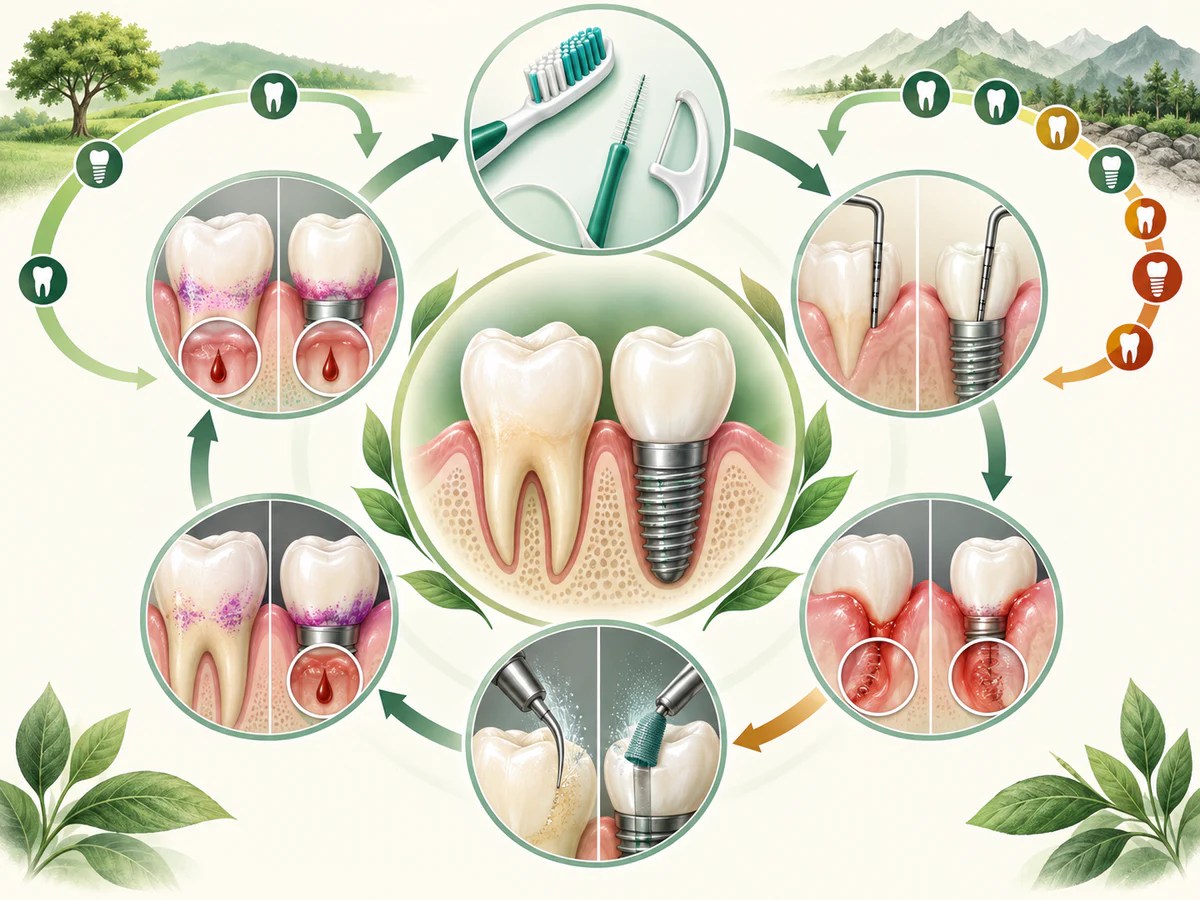
The review by Armitage and Xenoudi (Periodontology 2000, 2016) in fact addresses supportive care for the natural dentition and for implants together, because the approach is a shared one: review of the medical history, careful examination, analysis of risk factors and periodic biofilm removal, all on a personalized schedule. For someone with a history of periodontitis, this point is central: a history of periodontitis is among the best-established risk factors for peri-implantitis. Organized periodontal and peri-implant follow-up is therefore not an optional extra, it is a condition of stability over time.
The periodontal pathway at the practice, from assessment to maintenance; and to start from what you notice: a loose tooth: where to begin.
Key takeaways, and our limits
Periodontal maintenance is not the optional epilogue to a successful treatment: it is what makes that treatment last. Because periodontitis is chronic, it is stabilized rather than cured, and susceptibility persists after active treatment. Supportive visits detect relapses early and act before bone is lost, on a personalized rhythm most often between 3 and 6 months, set according to individual risk rather than a uniform schedule.
We remain measured about what we promise. No maintenance program removes the risk of relapse entirely, and the striking results of long-term studies rest on high compliance and rigorous control of smoking and diabetes. What research does establish, however, is clear: regular, well-conducted follow-up is the best-supported way to keep your teeth after periodontitis. At the practice, in Kénitra, this is the approach we apply — organized follow-up based on risk assessment — to the natural dentition and to implants alike.
Frequently asked questions
How often should I come back for periodontal maintenance?
If my gums are fine, can I stop the follow-up?
Does maintenance really help you keep your teeth longer?
Is a maintenance visit just a cleaning?
Is follow-up just as necessary after implants are placed?
I smoke: does that change my follow-up?
Do I need a new X-ray at every check-up?
Sources
Medical references consulted for this article.
- 1Sanz et coll., Treatment of stage I–III periodontitis — The EFP S3 level clinical practice guideline, J Clin Periodontol 2020
- 2EFP, Step 4: Supportive periodontal care (SPC), chapitre de la S3-level CPG sur le traitement de la parodontite
- 3Agudio et coll., Longevity of teeth in patients susceptible to periodontitis: 30 years of supportive periodontal care, J Clin Periodontol 2023 (PubMed)
- 4Axelsson, Lindhe & Nyström, On the prevention of caries and periodontal disease: 15-year longitudinal study in adults, J Clin Periodontol 1991 (PubMed)
- 5Lamont et coll., Routine scale and polish for periodontal health in adults, Cochrane Database of Systematic Reviews 2018 (PMC)
- 6Farooqi et coll., Appropriate Recall Interval for Periodontal Maintenance: A Systematic Review, J Evid Based Dent Pract 2015 (PubMed)
- 7Lang & Tonetti, Periodontal Risk Assessment (PRA) for patients in supportive periodontal therapy, Oral Health Prev Dent 2003 (perio-tools.com)
- 8Atarbashi-Moghadam et coll., Recurrence of periodontitis in previously treated patients without maintenance follow-up, J Adv Periodontol Implant Dent 2020 (PMC)
- 9Armitage & Xenoudi, Post-treatment supportive care for the natural dentition and dental implants, Periodontol 2000, 2016 (PubMed)
- 10ADA Council on Scientific Affairs et U.S. FDA, Dental Radiographic Examinations: Recommendations for Patient Selection and Limiting Radiation Exposure (révision 2012)
- 11Berglundh T et coll., Peri-implant diseases and conditions: Consensus report of workgroup 4 of the 2017 World Workshop, J Clin Periodontol 2018
Contents
Share