The dental crown is one of the most common restorations — and also one of the most misunderstood. It is not just a “cosmetic cap”: it is a covering that fully encases a damaged tooth to rebuild and protect it. The useful question is therefore not so much “which crown looks best” as “does my tooth need a crown, and with which material, for what trade-off between strength and esthetics.”
As a dental surgeon in Kenitra, I offer here an honest, well-sourced overview: when a crown is truly indicated, what the different materials are worth (porcelain-fused-to-metal, feldspathic ceramic, lithium disilicate known as E-max, monolithic zirconia), what the literature says about their longevity, how to care for them, and how the crown relates to bridges and implants. Every clinical statement links to a verifiable source, and lifespans are presented as probabilities — never as a guarantee.
What is a dental crown, and what is it for?
A crown is a fixed prosthesis that covers the visible part of a tooth after it has been prepared to make room for it. It is custom-made, cemented or bonded onto the remaining tooth, and restores its shape, chewing function, and appearance all at once.
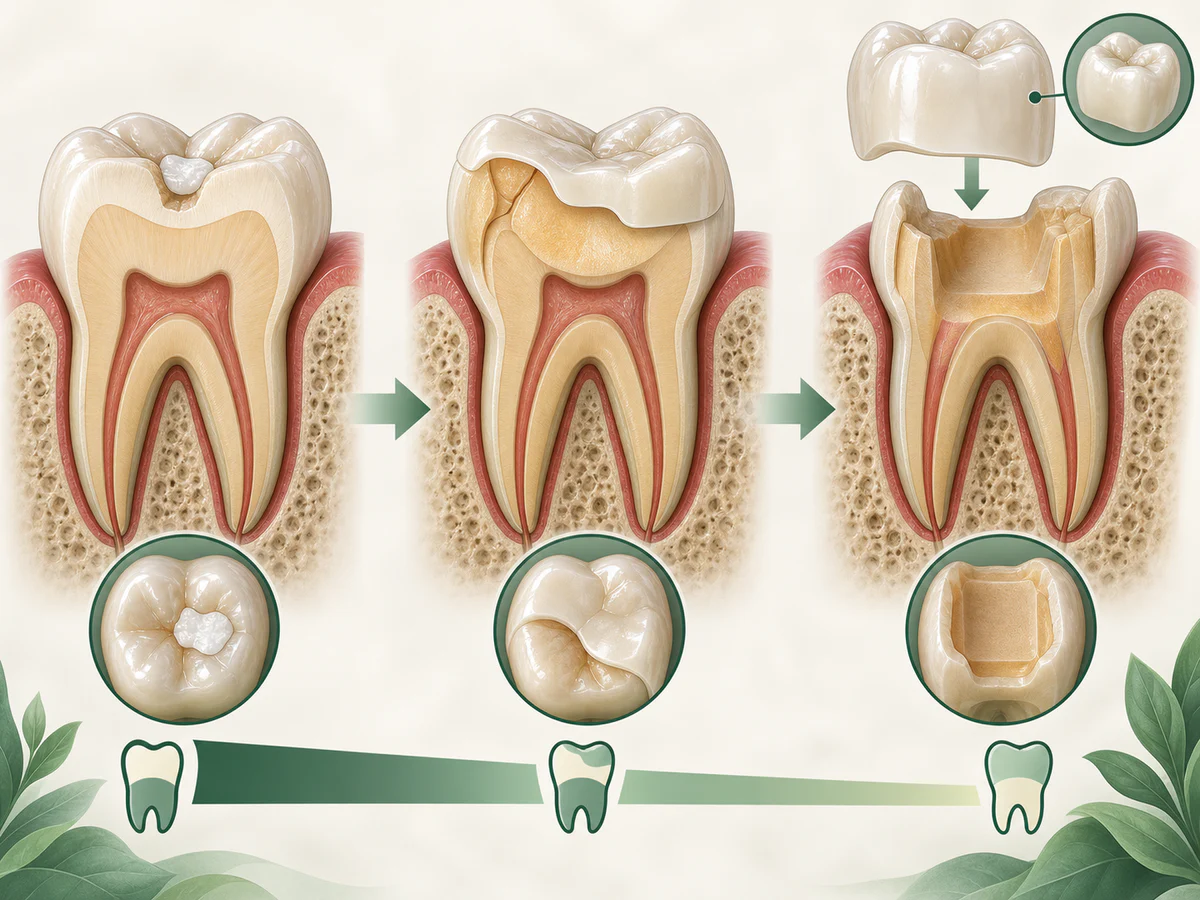
Its primary role is mechanical: encircling a weakened tooth to distribute chewing forces and reduce the risk of fracture. This is different from a filling or an inlay/onlay, which replace only part of the missing tissue. A crown is therefore reserved for situations where the tooth is too damaged for a partial restoration to be enough.
When is a crown indicated?
The indication is not decided on esthetics, but on the structural condition of the tooth. The most common situations are the following.
A tooth severely damaged by decay
When decay has destroyed a large part of the natural crown, not enough healthy tissue remains to hold a conventional filling. Covering the tooth then makes it possible to rebuild it and protect it against fracture. The French national health insurance service (ameli.fr) describes this principle: when the damage is extensive, “a build-up anchored in the root or roots is placed first to reinforce the tooth,” which is then rebuilt “using a prosthetic crown in metal or ceramic.”
A fractured or badly cracked tooth
A cracked or broken tooth that can still be saved can be encircled by a crown, which holds the walls together and keeps the crack from spreading. This is a mechanical indication before it is an esthetic one.
A root canal-treated tooth
This is one of the most important cases. A tooth that has had a root canal loses its internal blood supply and becomes more fragile; according to the UFSBD (the French oral health organization), it fractures more easily and often needs to be protected. The crown (or a solid build-up, depending on the remaining tissue) largely determines the lifespan of the treated tooth, particularly for molars and premolars subjected to chewing forces. This link is covered in detail in our article on root canal treatment and pain. A crown is not automatic after every root canal, however: the decision depends on how much tooth structure remains.
Supporting a bridge or restoring an implant
A crown also serves as an abutment for a bridge, or as the visible part screwed or cemented onto an implant. The material and the mechanical constraints are then not quite the same as for a single crown on a natural tooth.
Materials: what trade-offs between esthetics and strength?
There is no single “best” material in absolute terms. Each family strikes a different balance between strength, esthetic result, and preservation of the tooth. Here are the main options.
Ceramic dental crowns: one name, several materials
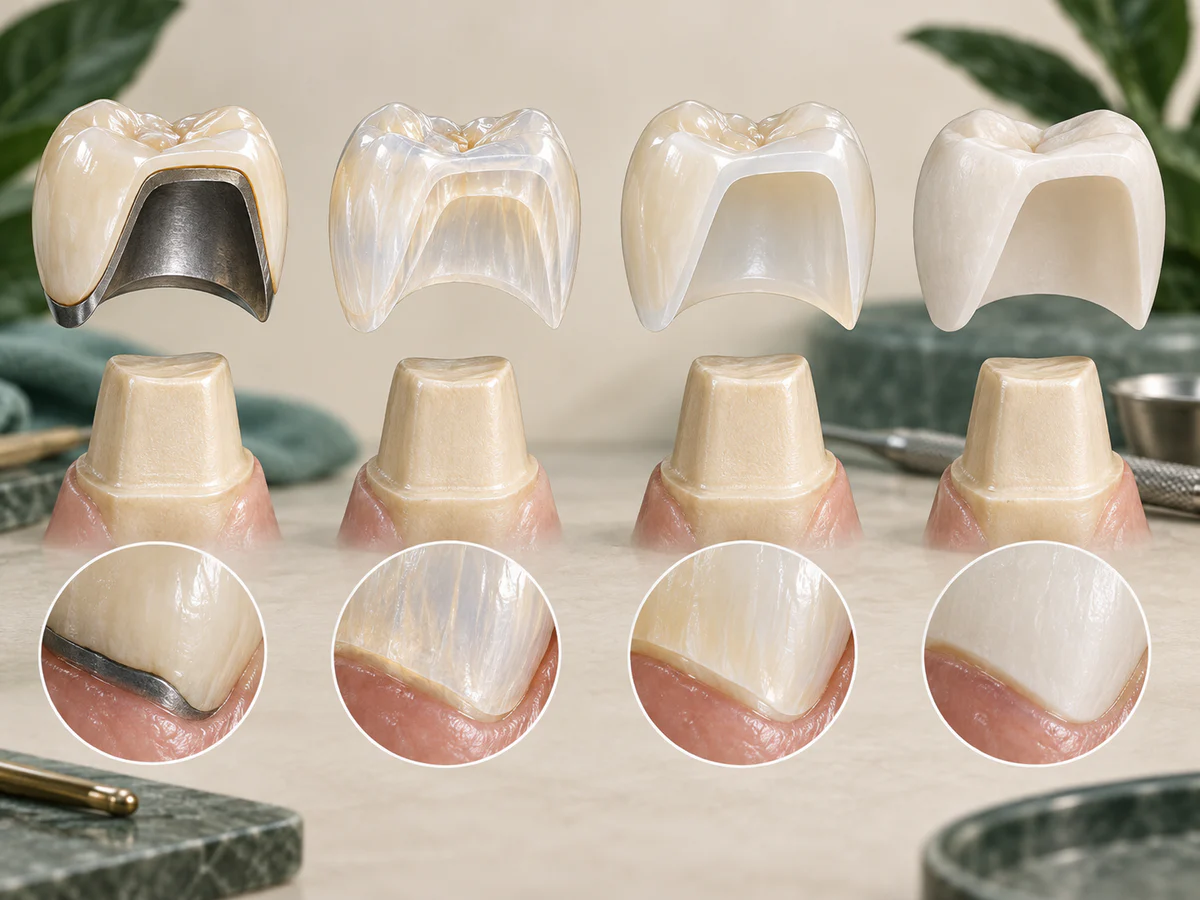
A ceramic dental crown is a crown made entirely of ceramic, with no metal framework underneath. The term covers several materials with different strengths: feldspathic ceramic, lithium disilicate (E-max) and zirconia, each described below. A porcelain-fused-to-metal crown also contains ceramic, but only as an outer layer over a metal core. So when a ceramic crown is suggested, it is worth asking which ceramic, because that choice matters more than the word itself.
Porcelain-fused-to-metal crowns
This is the historical benchmark: a metal framework covered with a cosmetic ceramic layer. It is sturdy, and its clinical track record is considerable. Its limitation is esthetic: the metal margin can show through at the gum line, especially if the gum recedes, and the surface ceramic can chip. It remains a very sound choice for back teeth.
Feldspathic ceramic
This is the most esthetic ceramic, but also the most mechanically fragile. It is mainly reserved for front teeth under low chewing load, or used as a veneering ceramic. For very thin restorations on front teeth, the alternative is often a veneer rather than a crown; this is covered in our article on ceramic dental veneers.
Lithium disilicate (E-max)
Lithium disilicate, marketed notably under the name E-max, is a reinforced glass-ceramic. It combines good esthetics with sufficient strength for many single crowns, on front teeth as well as premolars. It is now a material of choice when esthetics matter.
Monolithic zirconia
Zirconia is a ceramic based on zirconium oxide, and it is extremely strong. In its “monolithic” form (milled from a single block, with no veneering ceramic), it eliminates the risk of chipping of the cosmetic layer and offers great strength — at the cost of esthetics that have historically been slightly less natural than lithium disilicate, a gap that recent translucent zirconias have narrowed. It is a frequent option for molars and for patients who clench or grind their teeth.
The safety of zirconia and the question of allergies are covered in the biocompatibility of zirconia.
| Material | Esthetics | Strength | Typical indication | Main limitation |
|---|---|---|---|---|
| Porcelain-fused-to-metal | Fair | High | Back teeth, bridge abutments | Metal margin, possible chipping |
| Feldspathic ceramic | Excellent | Low | Front teeth under low load | Mechanical fragility |
| Lithium disilicate (E-max) | Very good | Good | Front teeth, premolars | Less suited to long bridges |
| Monolithic zirconia | Good (translucent: very good) | Very high | Molars, bruxism | Esthetics sometimes less natural |
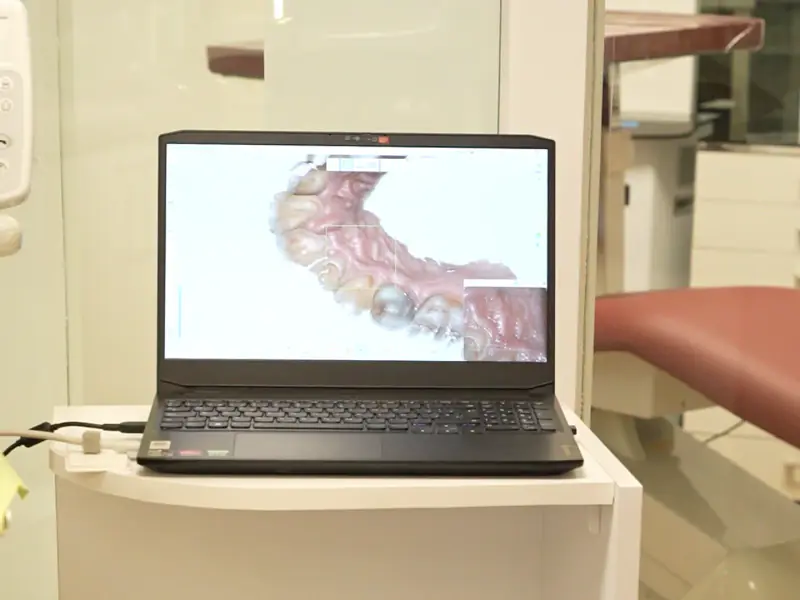
The choice is made with your practitioner, weighing the tooth’s position, chewing forces, your habits (bruxism), and your esthetic expectations. At our practice, digital impressions and computer-aided design (CAD/CAM) allow the shape and occlusion of the prosthesis to be adjusted with precision.
What is a Ceramage crown?
Ceramage is the trade name of a laboratory composite: a tooth-colored resin reinforced with fine ceramic particles. Despite its name, a Ceramage crown is not a ceramic crown. It belongs to the family of composite resins, like the material used for white fillings, but it is shaped and hardened in a laboratory.
A composite crown is easier to adjust or repair in the mouth. In return, resin is generally softer than ceramic: it can wear, lose its shine or pick up stains more readily over the years. If a Ceramage crown is suggested to you, ask how it compares with a ceramic or zirconia crown for that particular tooth.
Why zirconia can cost more than porcelain-fused-to-metal
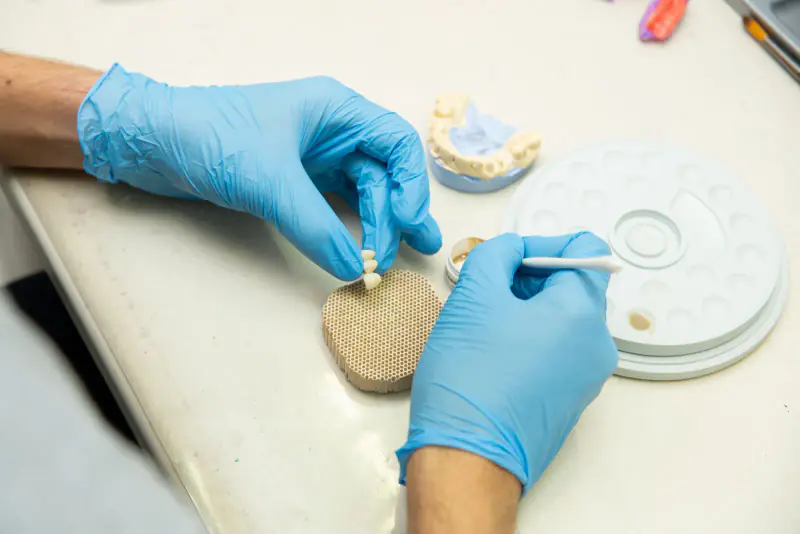
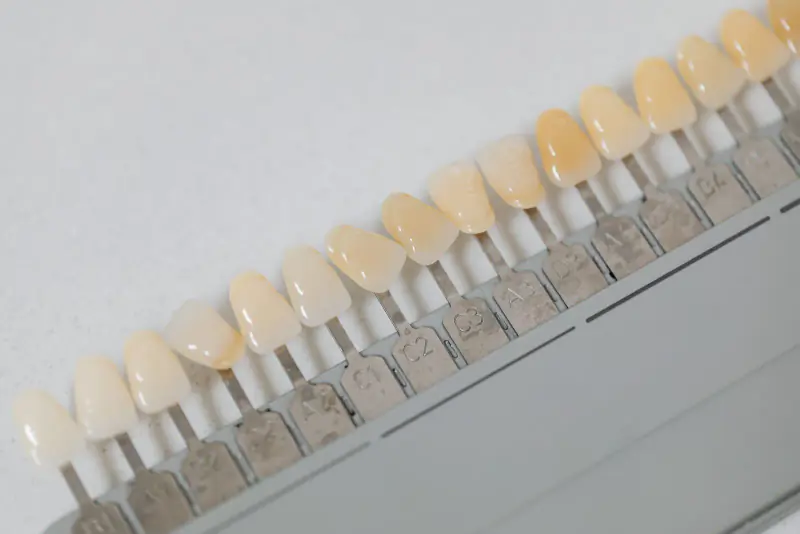
Depending on the practice and the laboratory, a zirconia crown is priced higher than a porcelain-fused-to-metal crown, or at the same level. When there is a difference, it comes from the material, the digital fabrication (computer design, milling from a block, then high-temperature firing called sintering) and the shading work that blends the crown into your smile. Price alone does not tell you which material suits your tooth.
The difference makes most sense when appearance matters, on a visible tooth or thin gum that could reveal a dark line, when you know you react to a metal, or when tooth grinding raises the risk of the surface ceramic chipping. On a molar that is hardly visible, porcelain-fused-to-metal keeps a long clinical track record and remains a reasonable option. The practice’s price benchmarks are on the fees page.
What does the literature say about lifespan?
This is the question patients ask most, and the one that calls for the most caution: the figures below are survival rates drawn from studies, not a promise for any given tooth.
A recent systematic review by Pjetursson and colleagues (International Journal of Prosthodontics, 2026), covering 3,509 porcelain-fused-to-metal crowns and 8,051 all-ceramic crowns, compared five-year survival. The rates were close: approximately 97.1% for porcelain-fused-to-metal, 98.5% for monolithic lithium disilicate, 96.8% for densely sintered monolithic zirconia, and 97.3% for densely sintered zirconia veneered with ceramic. In other words, at five years, modern all-ceramic crowns achieve survival comparable to the porcelain-fused-to-metal benchmark.
The review by Pjetursson and colleagues (Clinical Oral Implants Research, 2018) had already confirmed this overall equivalence between zirconia and porcelain-fused-to-metal, while pointing out a nuance: more material fractures on the zirconia side in certain configurations, and a rate of cosmetic-ceramic chipping of the same order in both families. On this specific point of chipping, another review by the same team (Clinical Oral Implants Research, 2021) showed, for implant-supported crowns, a markedly higher rate of veneering-ceramic chipping for veneered crowns (1.65% per year) than for monolithic crowns (0.39% per year). This is one of the arguments in favor of monolithic designs in areas under heavy load.
For lithium disilicate specifically, the review by Pieger, Salman, and Bidra (Journal of Prosthetic Dentistry, 2014) reported cumulative survival of single crowns of approximately 100% at two years and 97.8% at five years. Encouraging figures — but to be read as study averages, not as individual certainty.
Over the longer term, a retrospective cohort study published in the Journal of Prosthetic Dentistry (2025) on posterior crowns estimated ten-year survival at approximately 86.0% for monolithic zirconia, versus approximately 71.0% for ceramic-veneered zirconia; the difference did not reach the threshold of statistical significance, and the study identified two risk factors for complications: a molar (rather than a premolar) and an upper tooth (rather than a lower one). Here again, this is a favorable probability, modulated by the tooth’s position and local stresses — not a guarantee of longevity.
Two honest caveats are in order. First, a crown’s survival depends as much on the tooth that carries it (its vitality, the remaining tissue, hygiene, bruxism) as on the material itself. Second, the clinical track record of the most recent zirconias remains shorter than that of porcelain-fused-to-metal: we are therefore extrapolating from medium-term data.
Caring for a crown
A crown does not exempt you from oral care; it actually makes it essential. The crown itself cannot decay, but the junction between the crown and the tooth (the marginal seal) and the underlying root remain vulnerable. A cavity can develop under or at the edge of a crown if hygiene is insufficient.
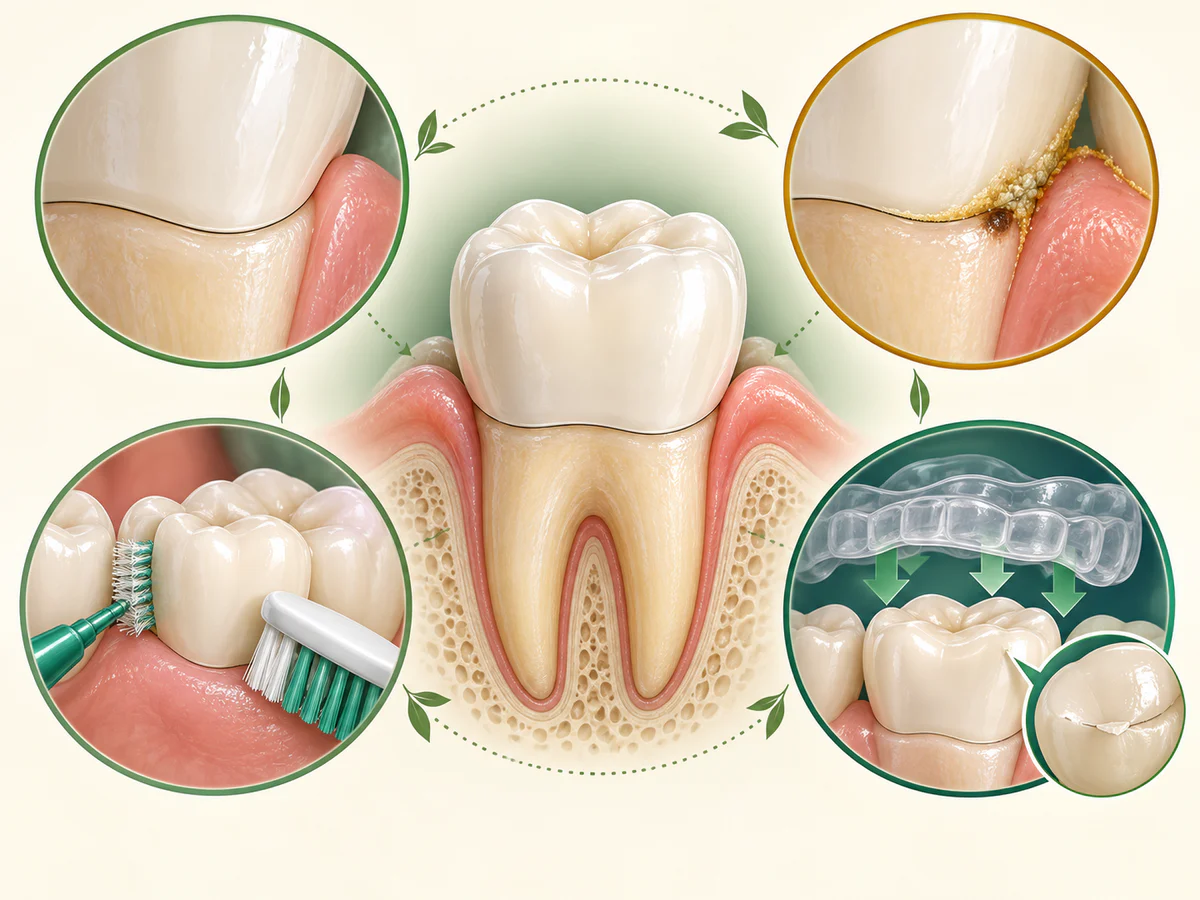
The principles are those of rigorous daily oral hygiene: careful brushing, interdental cleaning with floss or interdental brushes at the gum line, and regular professional cleanings. If you clench or grind your teeth, a protective night guard can extend the life of the prosthesis by limiting overload. Any crown that becomes loose or sensitive, or comes with persistent gum bleeding, warrants a check-up.
A crown on an implant or on a natural tooth: what changes
On a natural tooth, the crown is cemented onto the prepared tooth, which keeps its root and the ligament around it. On an implant, there is no tooth any more: the crown is screwed or cemented onto an abutment, a small part that is itself fixed into the implant anchored in the bone. This difference changes several things in daily life.
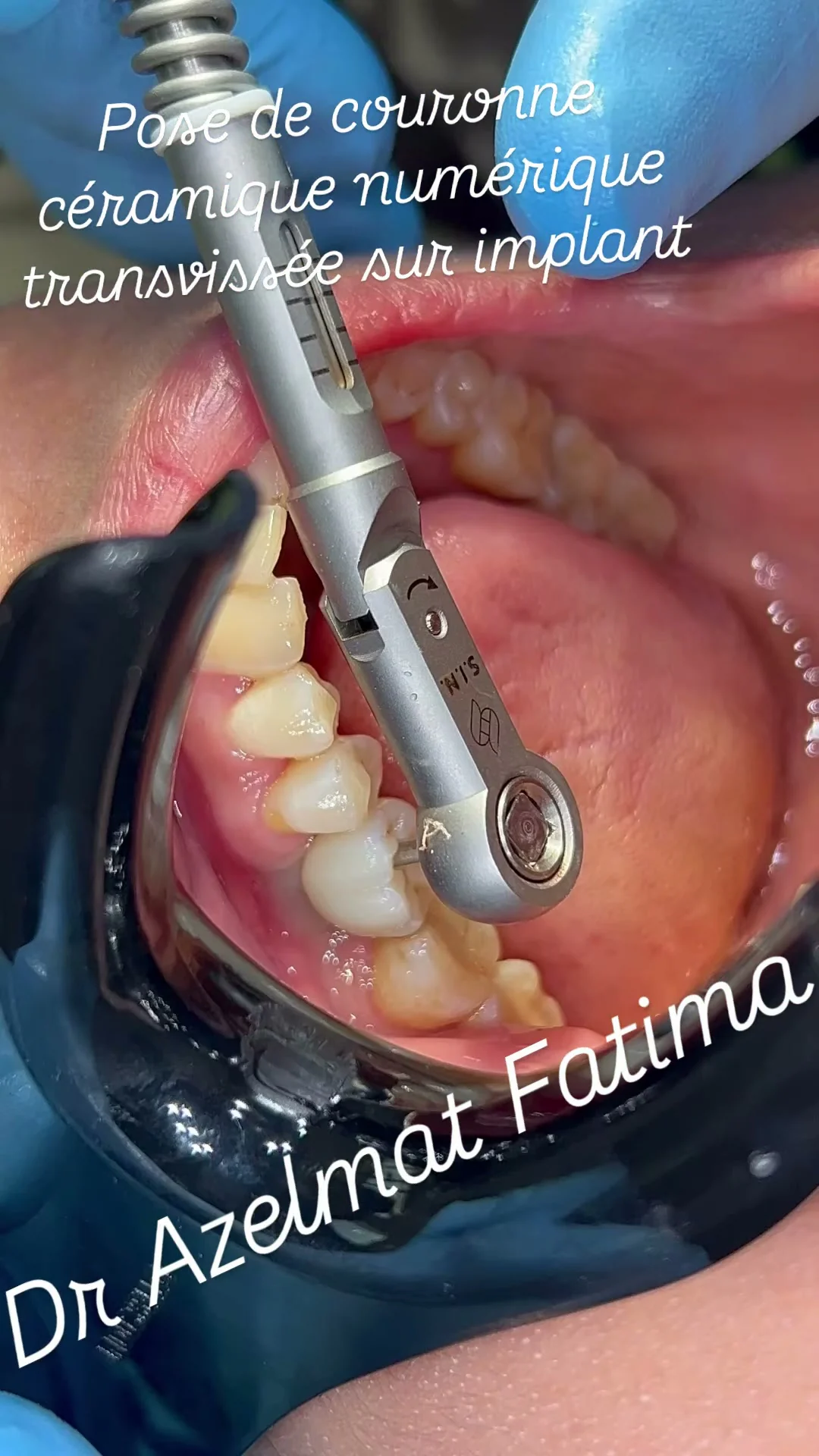
- Decay. A crown on an implant cannot decay, since there is no tooth beneath it. On a natural tooth, decay remains possible at the edge of the crown.
- The gum. Around an implant, plaque can inflame the gum (mucositis), then reach the bone (peri-implantitis), according to the 2017 World Workshop consensus. Cleaning at the gum line therefore matters as much as it does on a tooth.
- Sensation. Without a ligament, an implant senses pressure less finely: in the study by Hämmerle et al. (1995), the threshold for tactile perception was clearly higher on implants than on natural teeth. You chew with it, but the sensation is not quite the same.
- Follow-up. Brushing, cleaning between the teeth and regular check-ups apply to both. On an implant, check-ups also examine the gum around the implant and, if the crown is screwed, whether the screw is still secure.
The material of the crown is then chosen as for a natural tooth, according to the position of the tooth and the forces involved.
Crown, bridge, or implant: where does the crown fit in?
Two situations that are often confused need to be distinguished. A crown restores a tooth that still exists. A bridge or an implant, on the other hand, replaces a tooth that is missing.
If the tooth can be saved, it is crowned. If it is lost or beyond repair, the question becomes one of replacement, and the crown reappears as the visible part of a bridge (cemented onto the prepared neighboring teeth) or of an implant (screwed or cemented onto the artificial root). These options, their benefits, and their limits are compared in our article on implant, bridge, or denture: how to choose. When replacement involves an implant, the full process is described on our page about dental implants in Kenitra.
The right reflex is therefore to ask the question of preservation first. Crowning a tooth that is still sound is almost always preferable to extracting and replacing it, because no prosthetic solution matches a well-restored natural tooth.
In summary
A crown is indicated when a tooth is too damaged, fractured, or weakened — particularly after root canal treatment — for a partial restoration to be enough. The choice of material is a trade-off: porcelain-fused-to-metal for its proven sturdiness, lithium disilicate (E-max) for its balance of esthetics and strength, monolithic zirconia for areas under heavy load and for patients who grind. At five years, these materials show comparable survival, around 97 to 98% according to Pjetursson and colleagues (2026), and monolithic zirconia maintains a survival of approximately 86% at ten years on molars in recent cohort data. These are favorable probabilities, not guarantees: longevity depends on the tooth, on hygiene, and on your habits as much as on the material. A clinical evaluation makes it possible to choose the option best suited to your case.
Frequently asked questions
When is a dental crown really necessary?
Is a crown always needed after a root canal?
Zirconia or E-max ceramic: which one should you choose?
How long does a dental crown last?
Can a tooth decay under a crown?
Does a crown damage the tooth underneath?
Is zirconia dangerous?
Why choose zirconia as a crown material?
Sources
Medical references consulted for this article.
- 1Pjetursson BE et al., Survival, failure and complication rates of metal-ceramic, veneered and monolithic all-ceramic tooth-supported single crowns (revue systématique et méta-analyse), Int J Prosthodont, 2026
- 2Pjetursson BE et al., Survival and complication rates of zirconia-ceramic and metal-ceramic single crowns (revue systématique), Clinical Oral Implants Research, 2018
- 3Pjetursson BE et al., Survival, failure and complication rates of veneered and monolithic all-ceramic implant-supported single crowns (revue systématique et méta-analyse), Clinical Oral Implants Research, 2021
- 4Pieger S, Salman A, Bidra AS, Clinical outcomes of lithium disilicate single crowns and partial fixed dental prostheses (revue systématique), Journal of Prosthetic Dentistry, 2014
- 5Long-term clinical outcomes of posterior monolithic and porcelain-fused zirconia crowns (étude de cohorte rétrospective), Journal of Prosthetic Dentistry, 2025
- 6ameli.fr (Assurance Maladie), Traitement des caries (reconstitution ancrée et couronne prothétique)
- 7UFSBD (Union Française pour la Santé Bucco-Dentaire), Fiche Conseil : Pourquoi ai-je besoin d'une couronne ?
- 8Kunrath MF et al., Oral Tissue Interactions and Cellular Response to Zirconia Implant-Prosthetic Components: A Critical Review, Materials (2021)
- 9Berglundh T et al., Peri-implant diseases and conditions: consensus report of workgroup 4 of the 2017 World Workshop, J Clin Periodontol (2018)
- 10Hämmerle CH et al., Threshold of tactile sensitivity perceived with dental endosseous implants and natural teeth, Clin Oral Implants Res (1995)
- 11Chockattu SJ, Suryakant DB, Thakur S, Unwanted effects due to interactions between dental materials and magnetic resonance imaging: a review of the literature, Restorative Dentistry & Endodontics (2018)
- 12Bohner L et al., Artifacts in magnetic resonance imaging caused by dental materials: a systematic review, Dentomaxillofacial Radiology (2022)
- 13NHS (service de santé britannique), MRI scan : préparation et pièces métalliques à signaler
- 14Cleveland Clinic, Nickel Allergy (allergie au nickel)
- 15Ordyniec-Kwaśnica I et al., Metal Alloys Used in Dental Prosthetics and Their Impact on the Oral Microbiome: Narrative Review, Dentistry Journal (2026)
Contents
Share