
In short: In a dental emergency, the first step is to sort out the situation. Difficulty swallowing or breathing, fever, or swelling that spreads to the face or neck call for immediate care, and a knocked-out permanent tooth should be replanted or kept in milk straight away. For a toothache, a broken tooth or a broken crown, simple holding measures such as a cold compress on the cheek help until a prompt dental appointment.
Faced with a dental emergency, the first thing to do is to sort out the situation: pain that settles in, an abscess with swelling, a broken tooth or a knocked-out permanent tooth do not call for the same response or the same timeframe. The general rule is simple. Some signs call for immediate care, and sometimes a call in Morocco to 141 for medical emergencies or 15 for Civil Protection; others allow for a few holding measures before seeing a practitioner promptly. If there is marked swelling of the face or neck, fever, difficulty swallowing or breathing, or intense throbbing pain, you should not wait: according to the Assurance Maladie (ameli.fr), these signs may reflect a spreading infection and warrant care without delay.
This article offers a situation-by-situation triage, with the useful first steps, the common mistakes to avoid and the severity thresholds that change what you should do. It does not replace an examination. Emergency care aims to relieve pain and limit complications, without promising a complete absence of pain or a guaranteed result.
To call the practice and check availability and fees, see the dental emergency in Kénitra service page.
What counts as a true dental emergency?
Not every toothache is an emergency in the strict sense, but some clearly are. Unexpected dental problems are common. Knowing how to sort them helps you decide when seeking immediate dental care is needed. Until the dental treatment itself, the aim is to avoid preventable harm: preventing further damage to the tooth and acting early to prevent potential complications. In practice, three levels can be distinguished.
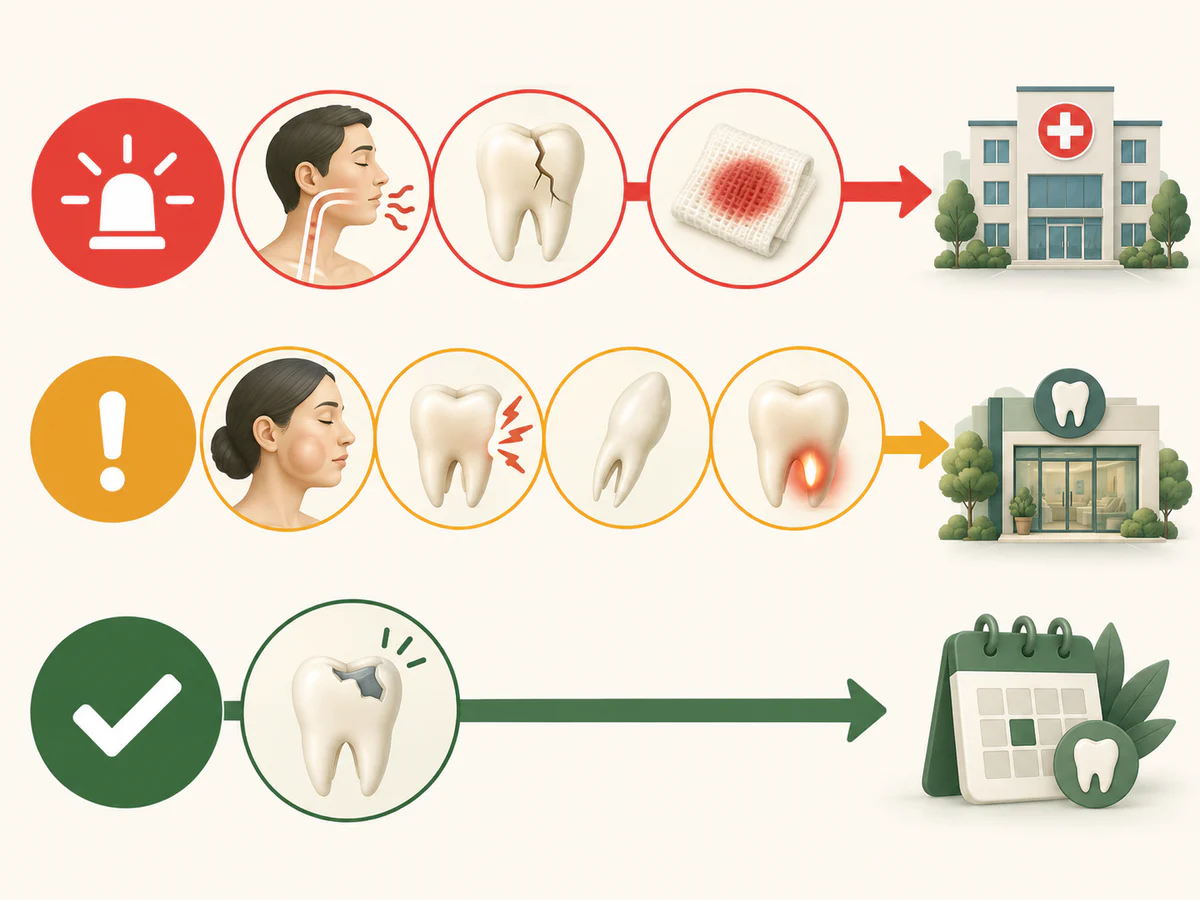
- Immediate emergency: signs of spreading infection or of general repercussions (see below), or trauma with a knocked-out permanent tooth. Care is counted in minutes or hours.
- Prompt emergency: intense, continuous pain, a localised abscess without general signs, a broken tooth with an exposed nerve, pain appearing after a recent extraction. An appointment the same day or the next day is advisable.
- Not urgent but still to be treated: passing sensitivity to cold or heat, mild discomfort without swelling or fever. A scheduled appointment is enough.
This triage is meant to guide what you do, not to make a diagnosis at home. When in doubt, it is better to call a practice or an on-call service and describe the symptoms. Whether you call your usual practice or another dental clinic, say where it hurts, since when, and whether there is swelling or fever.
Severe toothache: what to do while waiting for the appointment?
Throbbing pain that beats in time with the heart, wakes you at night and sometimes radiates towards the ear or the jaw is a frequent reason for consulting. According to the Assurance Maladie (ameli.fr), intense throbbing pain should be taken seriously; it may be a sign of deep involvement of the tooth or of a starting infection. It warrants a prompt appointment. The same applies to dental pain that keeps coming back or gets in the way of your daily activities.
In the meantime, several simple measures help you get through, again according to ameli.fr:
- Take paracetamol following the package leaflet, unless it is contraindicated for you.
- Apply cold to the cheek, through a clean cloth, in short intervals rather than continuously.
- Avoid foods and drinks that are very hot, very cold, sugary or acidic, which often reawaken the pain.
- Sleep with your head raised, which may ease the feeling of pressure.
Two reflexes should be avoided. Do not start an antibiotic on your own initiative: the Assurance Maladie points out that the indication is a matter for the professional. And do not turn to non-steroidal anti-inflammatory drugs if an infection is suspected, a point developed below. If the pain comes with marked sensitivity to hot or cold without any other sign, our article on tooth sensitivity to cold and heat sets out the possible causes and what to do.
Dental abscess: why avoid ibuprofen?
An abscess is a collection of pus linked to an infection, most often of dental or periodontal origin. It shows up as pain, sometimes swelling of the gum or the cheek, and an unpleasant taste if the abscess drains.
The most important safety point concerns self-medication. Many people take an anti-inflammatory such as ibuprofen or ketoprofen out of habit. Yet, according to the Assurance Maladie (ameli.fr), these non-steroidal anti-inflammatory drugs are contraindicated in the case of a dental abscess. The ANSM, for its part, states that NSAIDs may promote or worsen serious infectious complications, and recommends favouring paracetamol for pain or fever in the context of an infection. In practice, faced with an abscess or any sign of infection, paracetamol is the first-line painkiller, unless contraindicated, and a professional opinion is necessary.
It should also be remembered that a painkiller does not treat the cause. Over-the-counter pain relievers, chosen as described above and taken as directed on the label, can alleviate pain for a while, but that pain relief does not mean the infection has gone. An abscess requires a local procedure: drainage, treatment of the tooth concerned or, depending on the case, extraction. An antibiotic is decided on only by the practitioner, and only when it is indicated. When the abscess is endodontic in origin, treatment often involves root canal treatment of the tooth, which removes the source of infection.
Which signs call for immediate care?
Certain signs mean that the infection is moving beyond its local boundaries and may be spreading. According to the Assurance Maladie (ameli.fr), they call for immediate care and, if needed, a call in Morocco to 141 for medical emergencies or 15 for Civil Protection:
- difficulty swallowing or breathing;
- fever;
- marked swelling on one side of the face or neck;
- red, hot facial skin;
- intense throbbing pain that does not let up.
These signs may herald cervicofacial cellulitis, that is, the spread of the infection into the tissues of the neck and face. The ANSM lists cellulitis and mediastinitis among the serious infectious complications that can follow a poorly managed infection. This is an emergency. Better a consultation that turns out to have been unnecessary than a delay in the face of a spreading infection. Do not wait for a routine appointment: seek emergency dental care, or go to a hospital emergency room or call the numbers above if breathing or swallowing is affected.
Broken or cracked tooth: what should you do?
A tooth broken after a knock, a fall or biting on something hard calls for assessment. What to do depends on the extent of the fracture. Broken teeth do not always hurt, but even a fracture without pain deserves a check.
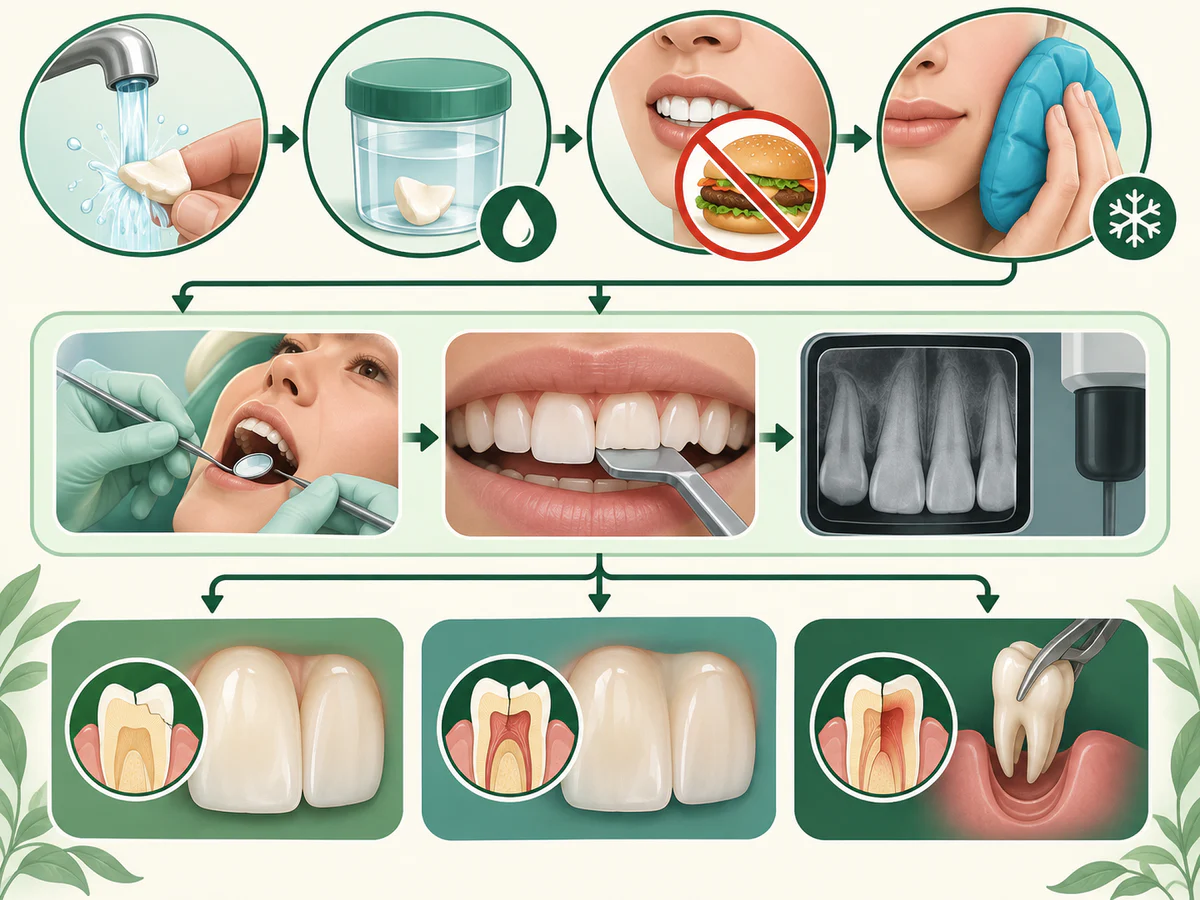
- A small chip of enamel, painless: the situation is not urgent, but an appointment is still useful to smooth the edge and check the tooth.
- A fracture with pain, or a red-coloured fragment in the centre: the nerve may be exposed. A prompt appointment is needed to protect the tooth and limit the risk of infection.
- A piece of the tooth available: keep it, if possible in milk or saline solution, and bring it with you; it can sometimes be bonded back on.
In the meantime, rinse your mouth gently with lukewarm water, apply cold to the cheek if there is swelling, and avoid chewing on the affected side. Cold can help reduce swelling, and sparing the tooth helps prevent further damage until it is examined. If the fracture is deep or if the tooth is badly damaged, saving it is not always possible. The practitioner will assess the options for restoration or, where appropriate, for replacement. To understand the choices for replacing a tooth, our comparison of implant, bridge or denture sets out the decision criteria.
Broken crown or lost filling: immediate care at home
A crown that comes loose or breaks, or a filling that falls out, is rarely dangerous, but it leaves the tooth less protected. Left exposed for too long, the tooth is open to potential complications such as decay or a further break. While you wait for the appointment:
- Keep the crown or the pieces in a clean, closed container and bring them with you. An intact crown can sometimes be cemented back if the tooth underneath is sound.
- Rinse your mouth with warm water to remove debris, and keep the area clean with gentle brushing.
- Do not glue the crown back yourself with household glue: it can damage both the tooth and the crown.
- Avoid chewing on that side, as well as very hot, very cold or sugary foods if the exposed tooth is sensitive.
- If the area hurts or swells, apply a cold compress to the cheek, through a clean cloth, in short intervals.
If a sharp edge irritates your tongue or cheek, or if pain sets in, ask for a prompt appointment. Pain with swelling or fever follows the warning signs described above.
Knocked-out tooth: the step that changes everything
The complete loss of a permanent tooth, or avulsion, is one of the rare true emergencies where the immediate response determines the outcome. According to the IADT, the best chances of saving the tooth are obtained through immediate or very rapid replantation; the viability of the ligament cells drops sharply beyond about one hour of dry time outside the mouth. The Cleveland Clinic likewise indicates that teeth managed within thirty minutes to one hour have the best chances of success.
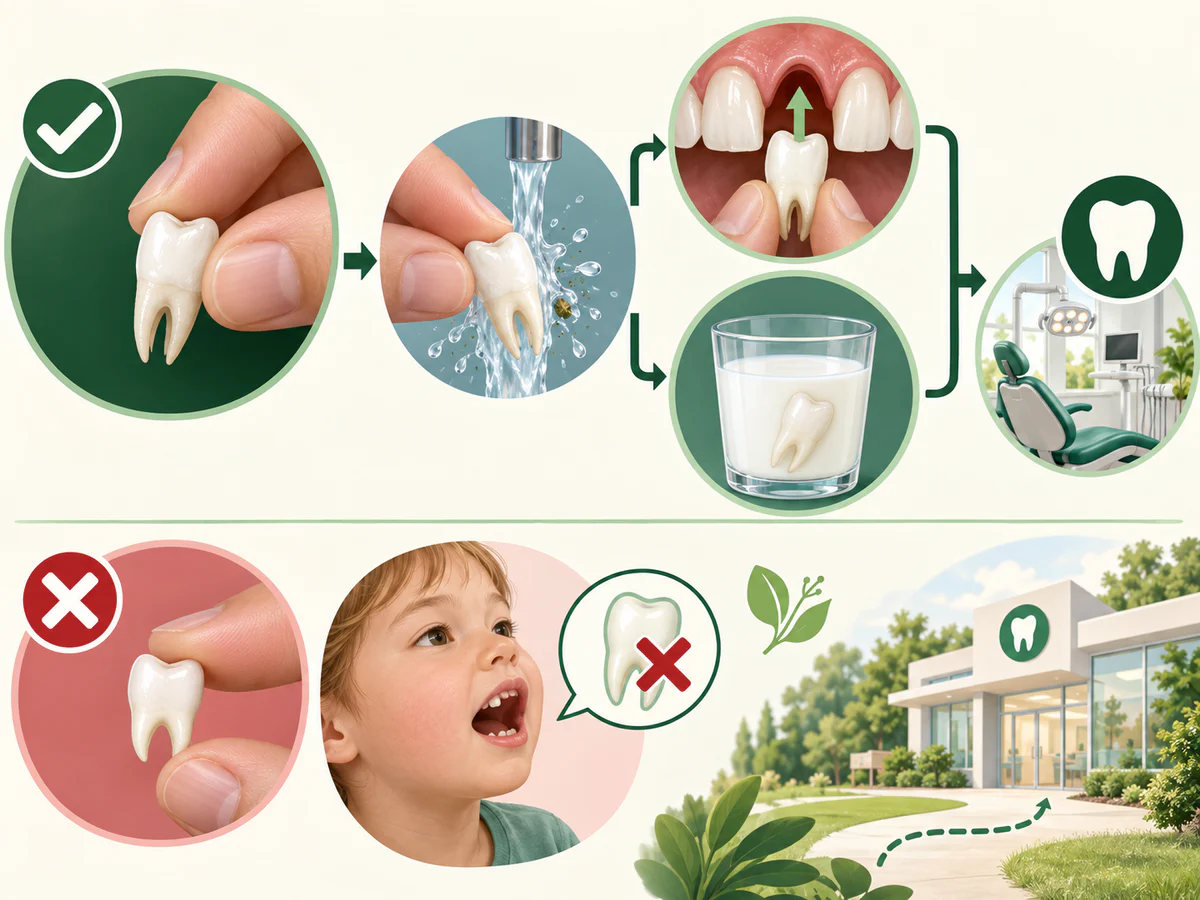
The steps recommended by the IADT and the Cleveland Clinic are precise:
- Hold the tooth by the crown, the white part usually visible in the mouth, and not by the root.
- Do not rub or brush the root, and do not let it dry out.
- If the tooth is dirty, rinse it gently for a few seconds.
- Put it back in place in its socket if possible, then bite down gently on a clean cloth to hold it there.
- If immediate replantation is not possible, keep the tooth in milk, never in water.
The choice of storage medium is not a minor detail. According to the IADT, water, because of its low osmolarity, causes rapid destruction of the root cells and compromises replantation. Milk is a good holding medium; saline solution or saliva, for example by keeping the tooth in the cheek in a conscious adult, are alternatives. Then you must get to a practice or an emergency service without delay.
One important point concerns children. The Cleveland Clinic points out that a knocked-out baby tooth should not be replanted, as this could harm the germ of the permanent tooth. What to do therefore differs depending on whether the tooth is a baby tooth or a permanent one; if you are unsure about the nature of the tooth in a young child, seek care without attempting replantation. The subject of baby teeth and their care is covered in our article on tooth decay in children.
Quick emergency triage table
| Situation | First steps | Indicative timeframe |
|---|---|---|
| Knocked-out permanent tooth | Hold by the crown, do not rub the root, replant or keep in milk | Immediate, within minutes |
| Abscess with fever or marked swelling | Paracetamol, cold, avoid NSAIDs, do not self-medicate with antibiotics | Immediate; in Morocco, 141 or 15 if severe |
| Intense toothache without general signs | Paracetamol, cold, avoid heat, cold and sugar | Prompt appointment |
| Broken tooth with exposed nerve | Keep the fragment, avoid chewing on the affected side | Prompt appointment |
| Pain a few days after an extraction | See your dentist again for an examination and local care | Prompt appointment |
This table is a decision aid, not a treatment protocol. The definitive step always depends on an examination.
Pain after an extraction: consider dry socket
Pain sometimes appears or intensifies a few days after an extraction, when the first hours had gone well. This pattern suggests dry socket, a complication in which the clot protecting the socket breaks down, leaving the bone exposed. This is not a normal course of healing.
Published data on wisdom tooth extractions identify several risk factors, notably smoking, insufficient oral hygiene and a more complex surgical extraction. These factors increase the likelihood of dry socket according to the observational study cited. The percentages reported in that work relate specifically to third molars and do not represent the frequency of dry socket for extractions as a whole; they should not be generalised. What matters in practice is to recognise the picture and see your dentist again, since local care relieves the pain and speeds up healing. The aftermath of complex extractions is detailed in our article on wisdom tooth extraction.
What the surgical setup brings to an emergency
At the practice, assessing an emergency benefits from a clinical examination and, where useful, from three-dimensional imaging. The Cone Beam makes it possible to visualise the extent of an infection, the position of a fractured root or the relationship of a tooth with neighbouring structures, which helps to establish the most appropriate indication. The surgical suite and piezosurgery are called upon for emergency procedures requiring a surgical approach, such as draining a collection of pus or extracting a tooth that cannot be saved. These resources serve the quality and safety of the procedure; they are no substitute for the speed of care, which remains the decisive factor in situations such as avulsion.
How can dental emergencies be prevented?
The best emergency is the one you avoid. Without guaranteeing that nothing will ever happen, a few habits clearly reduce the risk.
- Regular daily hygiene, brushing and interdental cleaning, limits decay and gum infections.
- Periodic check-ups make it possible to treat a cavity or an inflamed gum before the painful stage.
- Wearing a mouthguard during contact sports lowers the risk of dental trauma.
- Stopping smoking improves gum health and reduces certain post-operative complications.
A bleeding gum or recurring pain are signals not to be ignored. Bleeding is often an early sign of gum disease, and good oral hygiene, together with regular dental visits, protects your oral health well beyond emergencies. Our articles on everyday dental hygiene and on bleeding gums set out the preventive steps and the reasons to seek care early.
In summary
Faced with a dental emergency, what to do comes down to a few landmarks. Identify the warning signs, namely difficulty swallowing or breathing, fever, marked swelling of the face or neck and intense pain, and seek care without delay if one of them is present. Favour paracetamol and avoid anti-inflammatory drugs in the case of infection. Do not self-medicate with antibiotics. And, faced with a knocked-out permanent tooth, act within minutes, holding the tooth by the crown and keeping it in milk if replantation is not possible. These simple steps, based on the recommendations of the Assurance Maladie, the ANSM, the IADT and the Cleveland Clinic, and on the emergency numbers published by Morocco’s Ministry of Health, do not replace an examination, but they give treatment the best chances of being effective.
The practice takes emergencies during opening hours: see the dental emergency in Kénitra page for what is treated, how the appointment runs and the fees.
Frequently asked questions
Can I take ibuprofen to ease a severe toothache?
A permanent tooth has come out after a knock, what should I do straight away?
How do I know whether my toothache is an emergency?
Can I take an antibiotic while waiting for the appointment?
I have sharp pain a few days after an extraction, is that normal?
My tooth took a knock but looks fine: should it be checked?
Sources
Medical references consulted for this article.
- 1Assurance Maladie (ameli.fr), Abces dentaire : soulager la douleur et consulter, 2024
- 2Assurance Maladie (ameli.fr), Mal de dent et douleurs de la bouche : que faire et quand consulter, 2024
- 3ANSM, Anti-inflammatoires non steroidiens (AINS) et complications infectieuses graves, 2019
- 4IADT, Guidelines for the Management of Traumatic Dental Injuries : Avulsion of Permanent Teeth, 2020
- 5Cleveland Clinic, Avulsed Tooth (knocked-out tooth), 2023
- 6PMC, Dry Socket Prevalence and Risk Factors in Third Molar Extractions, 2024
- 7Ministère de la Santé et de la Protection sociale (Maroc), Qui contacter en cas d'urgence médicale ?
- 8Ministère de la Santé et de la Protection sociale (Maroc), Médecine d'urgence préhospitalière
Contents
Share