The distinction comes down to a single sentence. Gingivitis is an inflammation confined to the gum, reversible once dental plaque is removed; periodontitis additionally reaches the deep supporting tissues and the bone, with a loss of attachment and a loss of bone that do not repair themselves spontaneously. In other words, gingivitis that is properly managed returns to normal, whereas periodontitis can be stabilized but leaves permanent damage to the bone. This dividing line, emphasized by France’s Assurance Maladie (ameli.fr), is not a matter of vocabulary: it determines the treatment, the prognosis and the follow-up.
Together, these two conditions make up what is known as periodontal disease, that is, the diseases of the tissues that surround and support the tooth. Understanding where one ends and the other begins helps you seek care at the right moment, ideally while the damage is still reversible.
If your gums bleed or recede, or a tooth feels loose, the periodontics in Kénitra page explains the assessment, available treatments and booking.
Gingivitis or periodontitis: what exactly is the difference?
Healthy gum tissue is pink, firm, and does not bleed when you brush. When dental plaque, a bacterial biofilm, builds up at the neck of the teeth, it triggers inflammation. That is gingivitis.
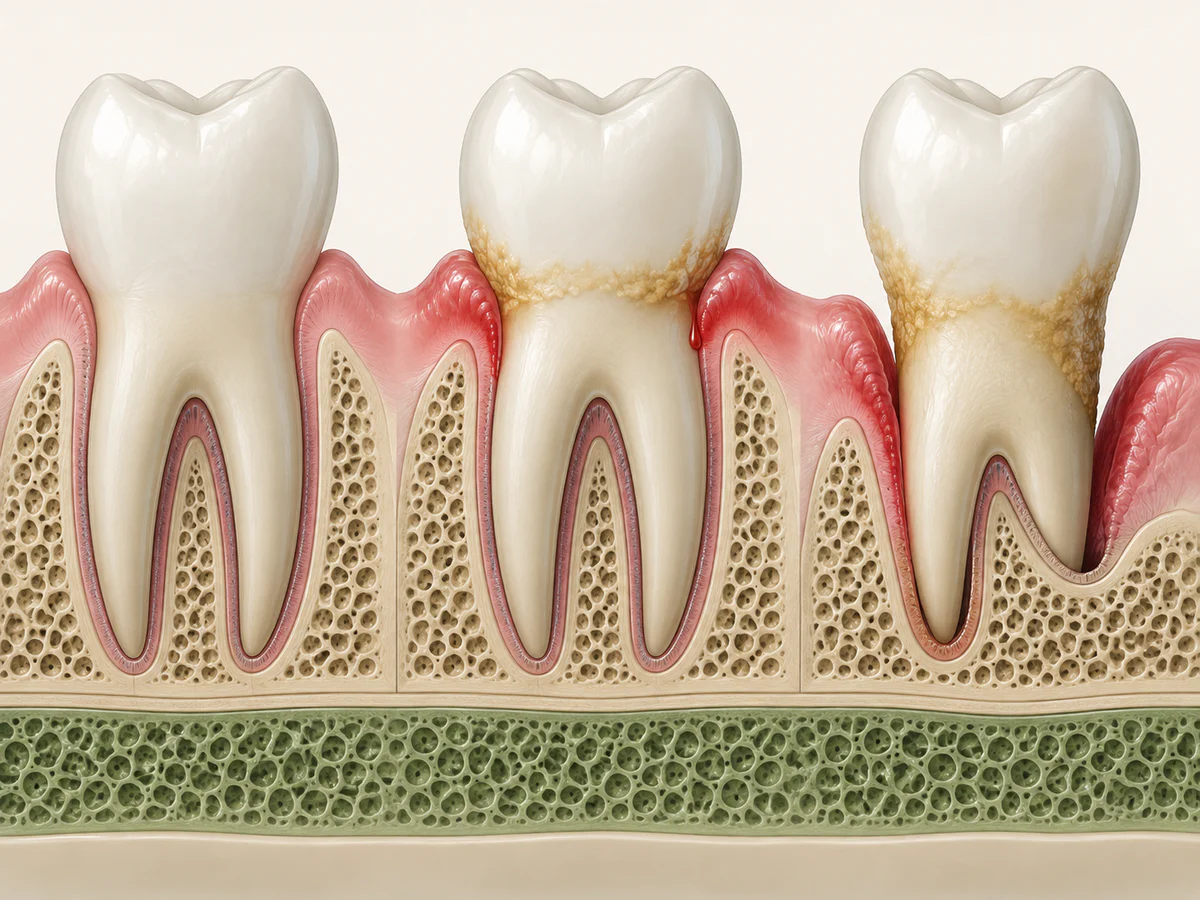
At this stage, the involvement remains superficial. The gum is red, swollen, and bleeds easily, but the bone and the ligament that hold the tooth in place are not affected. According to ameli.fr, at the gingivitis stage the disease is reversible: if the cause, the plaque, is removed, the gum heals.
Periodontitis corresponds to a more advanced stage. The inflammation spreads deeper and reaches all of the supporting tissues, what dentists call the periodontium: gum, periodontal ligament, cementum and alveolar bone. Again according to ameli.fr, the bone supporting the teeth then begins to deteriorate, which can eventually lead to tooth loss through the breakdown of the bone.
What makes periodontitis irreversible
This is where the key difference lies. Gingivitis destroys no structure: it is reversible. Periodontitis, on the other hand, causes a loss of attachment and a loss of bone. Alveolar bone does not rebuild itself once it has been resorbed. Treatment therefore aims to halt the destruction and stabilize the situation, not to spontaneously rebuild what has been lost.
This is also why overly optimistic wording deserves caution. Saying that gums or bone grow back after treatment is inaccurate as a general rule. In selected cases, regenerative techniques may allow a partial gain, for example on certain bone defects or certain recessions, but this is neither routine nor a natural regrowth.
The periodontal pocket, the distinguishing sign
In the absence of disease, the sulcus between the gum and the tooth is shallow. When the attachment breaks down, this sulcus deepens and forms a periodontal pocket, measured by the practitioner during probing. The presence of deep pockets, together with bone loss on the radiograph, signals periodontitis. Gingivitis, for its part, can create a false impression of a pocket through swelling of the gum, but without any real loss of attachment.
Does gingivitis always progress to periodontitis?
No, and this is a point that is often misunderstood. Periodontitis most often results from untreated gingivitis: according to ameli.fr, when gingivitis is not treated, it can progress to periodontitis. But not every case of gingivitis progresses to periodontitis.
Gingivitis precedes periodontitis without being an obligatory step toward it. Progression depends on individual susceptibility: genetic background, immune response, smoking, diabetes, oral hygiene. Two people with the same gingivitis may follow different courses. This calls for a measured view in both directions: there is no need to dramatize an isolated case of gingivitis, but it should not be neglected either, because there is no way of knowing in advance who will tip over.
To understand the earliest warning signs in practical terms, our article on bleeding gums and what to do about them sets out the situations that warrant seeking advice without delay.
What are the risk factors for periodontal disease?
The main triggering factor is dental plaque. But several elements increase the risk or worsen the way the disease develops.
- Insufficient oral hygiene. The WHO lists poor hygiene among the main risk factors.
- Tobacco. Smoking is a major risk factor, mentioned by the WHO, and it also complicates healing after treatment.
- Diabetes. Poorly controlled diabetes promotes and aggravates periodontitis.
- Other factors. Assurance Maladie cites in particular alcohol, certain forms of immunosuppression, certain medications, and hormonal or nutritional imbalances.
Tobacco deserves particular attention in periodontal surgery. It sometimes masks bleeding, which can give a false impression of healthy gums, while accelerating bone loss in the background.
Good biofilm control remains the foundation of prevention. Our guide to everyday dental hygiene sets out brushing technique and frequency, as well as cleaning between the teeth, which is decisive here.
How is the diagnosis made?
The diagnosis does not rest on appearance alone. It combines a clinical examination and, in periodontitis, imaging.
Periodontal probing measures the depth of the pockets around each tooth and checks for bleeding. The radiograph assesses the bone level. When a precise assessment is needed, particularly before a surgical or implant decision, three-dimensional imaging provides a detailed reading of bone volumes. At the practice, in Kénitra, we have a Cone Beam Durr Dental unit that allows this fine analysis when the case warrants it.
One important point: periodontitis is often silent in its early stages. Pain is not a good early indicator. The first signs are more likely to be bleeding, a gum that is receding, persistent bad breath or a feeling that the teeth are moving. Bad breath and its oral causes can in fact accompany periodontal disease and warrant an examination.
Reading your own exam: pocket depths in mm, bleeding, X-ray terms
After a periodontal assessment, you sometimes leave with a chart full of numbers, or with an X-ray report written in technical vocabulary. Here is how to read them. The values below are a fictitious example, not a real result.
Probing, in practice
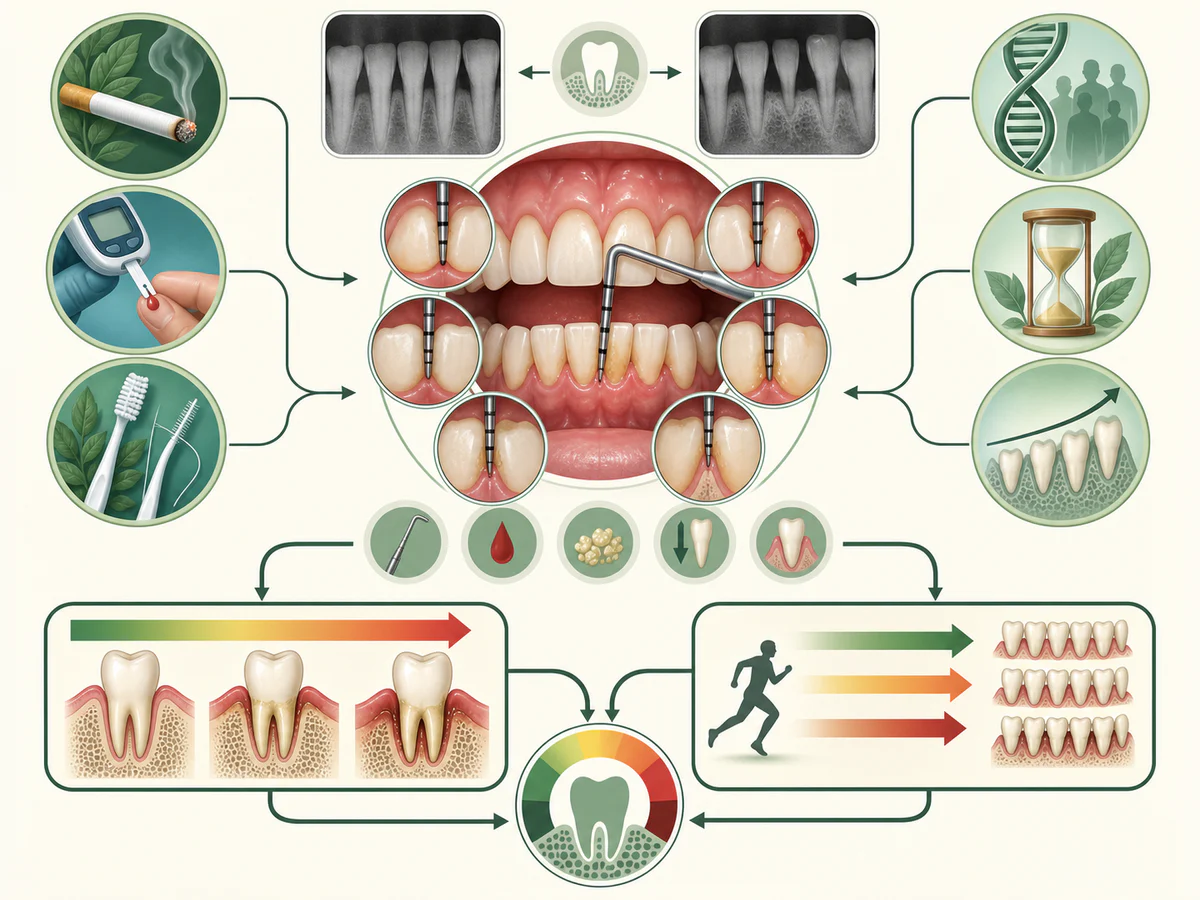
The periodontal probe is a thin instrument, graduated in millimetres, with a rounded tip. The practitioner slides it gently between the gum and the tooth at several points around each tooth and notes the depth measured. It mostly feels like pressure. Where the gum is inflamed, it may be more tender and bleed a little: that is precisely what the examination is looking for. If it bothers you, say so.
The probing chart: an example to compare with yours
Teeth are identified by two digits: the first indicates the quarter of the mouth, the second the position of the tooth counting from the middle. Tooth 36 here is a lower molar on the left.
| Tooth 36 (fictitious example) | Point 1 | Point 2 | Point 3 |
|---|---|---|---|
| Cheek side | 3 | 5 + | 4 + |
| Tongue side | 4 | 6 + | 3 |
In this example, the + sign marks bleeding on probing, mobility is recorded as 1 and the recession on the cheek side measures 2 mm.
- The numbers are depths in millimetres. After treatment, the goal adopted by the European Federation of Periodontology (EFP) is stability: pockets of 4 mm or less, no 4 mm pocket that bleeds, and bleeding at fewer than one in ten measured points.
- A 5 mm pocket is above this threshold. A pocket of 6 mm or more is a deep pocket, one of the complexity criteria for stage III in the 2018 classification.
- Bleeding on probing, often marked with a red dot or a + sign, indicates active inflammation at that spot.
- Recession measures how far the gum has moved down the root. Added to the pocket depth, it gives the attachment loss, which is used to set the stage: 1 to 2 mm for stage I, 3 to 4 mm for stage II, 5 mm or more for stages III and IV.
- Mobility is recorded in degrees: the higher the number, the more the tooth moves. Mobility of degree 2 or more is one of the features pointing towards stage IV.
Reading the example: two points exceed the stability goal (5 and 6 mm) and one 4 mm point bleeds. This tooth needs treatment, then a new measurement.
The terms in the X-ray report
- Alveolar bone loss (in French, alvéolyse): loss of the bone surrounding the roots. The socket is the bony housing in which the tooth is held.
- Horizontal bone loss: the bone level has dropped fairly evenly across several teeth.
- Vertical, or angular, bone loss: the bone has been hollowed out along a root, forming a kind of crater also called an intrabony defect. Vertical loss of 3 mm or more is one of the criteria for stage III.
- Furcation involvement: bone loss between the roots of a molar.
- Coronal third, middle third: where the bone loss stops, relative to the length of the root. Loss limited to the third nearest the crown corresponds to stages I and II; loss reaching the middle third of the root or beyond, to stages III and IV.
Which images, and why
According to France’s Assurance Maladie, the assessment may combine a panoramic X-ray, which gives an overview of both dental arches, and a series of long-cone images, the small periapical X-rays, which show the extent and severity of bone loss more precisely. Cone Beam, or CBCT, is not a routine examination for assessing supporting bone: European guidelines reserve it for selected cases, such as certain bone defects or furcation lesions, when the clinical examination and conventional X-rays are not enough to decide on treatment. A bacterial test is requested only in some cases; it is not among the criteria that set the stage and grade.
Stage and grade, in plain words
The stage answers the question “how far has the disease gone?”. It is read from attachment loss, bone loss, teeth already lost and the complexity of treatment. The grade answers the question “how fast, and with which aggravating factors?”. It takes into account bone loss relative to age, smoking and diabetes. The definitions are detailed in the next section.
What you should understand when you leave
At the end of a periodontal assessment, you should be able to answer four questions: which teeth are affected, and how much; what the stage and grade of the disease are, put in simple words; which factors weigh in your case; which steps are proposed, and in what order. If any of these points remains unclear, ask to go over it again. What the assessment at the practice includes is described on the dental assessment page.
The 2018 EFP/AAP classification: stages and grades
The reference classification was revised at the 2017 international workshop and published in 2018 by the EFP and the AAP. It replaced the former categories of chronic and aggressive periodontitis with a two-axis system, presented in French by L’Information Dentaire based on the work of Caton et al.
- The stages, I through IV, describe the severity and the complexity of management. Stage I corresponds to early periodontitis; stage IV to advanced involvement with significant functional consequences.
- The grades, A, B and C, describe the rate of progression and the risk of further progression. Grade A corresponds to slow progression, grade C to rapid progression, incorporating indicators such as smoking and diabetes.
This dual reading is useful day to day: two patients at the same stage may fall into different grades, and therefore call for follow-up that is more or less closely spaced.
Summary table
| Criterion | Gingivitis | Periodontitis |
|---|---|---|
| Tissues involved | Gum only | Gum, ligament and supporting bone |
| Bone loss | No | Yes |
| Reversibility | Reversible | Irreversible (can be stabilized) |
| Periodontal pockets | No (swelling possible) | Yes, with loss of attachment |
| Classification | Based on the extent of the inflammation | Stages I to IV and grades A to C (EFP/AAP 2018) |
| Goal of treatment | Return to normal | Halt progression and stabilize |
Periodontal disease and general health: what does the research say?
The mouth is not isolated from the rest of the body. Two links are well documented today, but they need to be presented accurately.
The link with diabetes
According to the EFP, the relationship between periodontitis and diabetes is bidirectional. People with diabetes are roughly three times more likely to develop periodontal disease and, conversely, periodontitis can complicate diabetes control. The WHO also describes this link as reciprocal. The EFP further indicates that periodontal treatment may help improve glycemic control. This improvement is described qualitatively; we do not quote a precise figure, in the absence of a verified primary source on this point.
The link with cardiovascular disease
The EFP and the World Heart Federation, in their 2020 report, describe a strong and independent association between severe periodontitis and cardiovascular disease. It is worth being precise about the status of this finding: it is an association, not a demonstrated causal relationship. Periodontitis is associated with an increased risk, which does not mean that it alone causes a heart attack or a stroke.
Finally, the WHO points out that severe periodontal diseases are very common, with more than a billion cases worldwide, and that they are among the leading causes of tooth loss. That is what makes it worth taking them seriously early.
How are gingivitis and periodontitis treated?
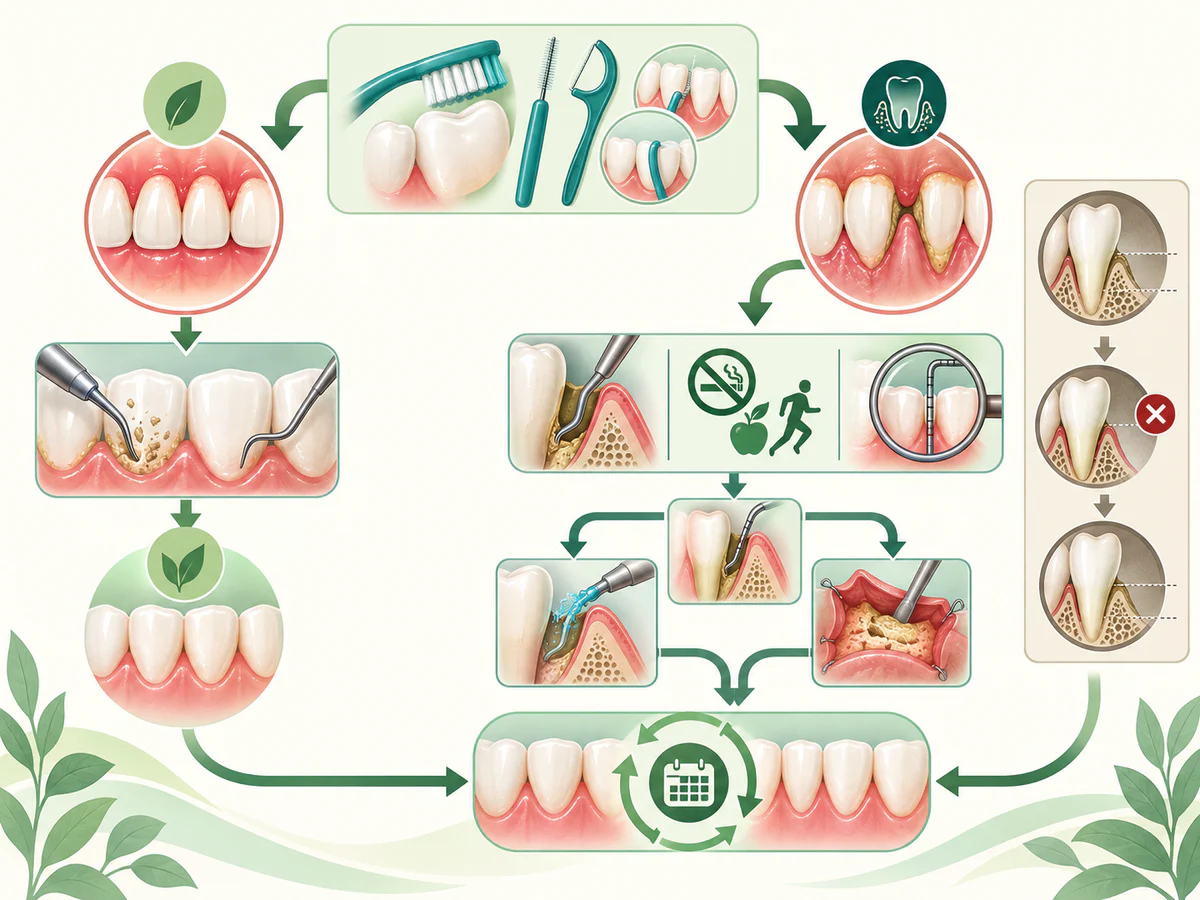
The two situations are not treated in the same way, but they share a common foundation: biofilm control.
Gingivitis
The treatment is simple in principle. It combines rigorous hygiene, learning how to brush and clean between the teeth, and the removal of tartar through scaling. Because the lesion is reversible, the gum generally returns to a healthy state.
Periodontitis
Management follows a step-by-step approach, as described in the EFP treatment guideline, in its version dedicated to stages I to III published in 2020.
- Control of the biofilm and of risk factors. Hygiene, motivation, smoking cessation, diabetes control.
- Non-surgical subgingival instrumentation. Scaling and root planing clean the root surfaces beneath the gum. The procedure is carried out under local anesthesia; discomfort is generally moderate and limited, sometimes with passing sensitivity afterward.
- Surgery for residual pockets, when some pockets persist despite the previous phase. Our surgical setup, which includes piezosurgery, allows a precise approach in these selected cases.
- Supportive periodontal therapy. Regular maintenance, at a personalized interval often between three and six months depending on risk, to prevent the disease from returning.
A clarification is needed regarding certain promises heard elsewhere. The laser is sometimes presented as a painless alternative to surgery. According to the EFP guideline, the basis of treatment remains biofilm control and subgingival instrumentation; the laser is, at best, an adjunct whose additional benefit remains uncertain. Likewise, no treatment can be described as painless in absolute terms.
A realistic goal: stabilize, not cure
Periodontitis is a chronic disease. The goal is not a cure in the strict sense but lasting stabilization, which requires long-term follow-up. Properly understood, this is good news: with appropriate care and consistent maintenance, it is possible to keep your teeth for a long time despite periodontitis, provided you stay regular with follow-up.
When teeth have already been lost and a replacement is being considered, periodontal status directly determines the options. Periodontitis must be stabilized before any implant project, and bone quality comes into play, as we explain in our article on the dental implant in Kénitra and how it unfolds.
In summary
Gingivitis and periodontitis are not two names for the same thing. The first is a reversible inflammation of the gum; the second is a deep involvement, with irreversible bone loss, classified by stages and by grades since 2018. The common triggering factor is dental plaque, and factors such as smoking and diabetes weigh heavily on how it develops. The earlier the diagnosis, the better the chances of acting while everything is still reversible. If you have bleeding gums, receding gums or loose teeth, an examination makes it possible to establish precisely where things stand and to avoid a loss that could have been prevented.
Frequently asked questions
Can gingivitis heal completely?
How do I know whether I have gingivitis or already periodontitis?
Is periodontitis contagious?
Does diabetes have anything to do with my gums?
Once treated, can periodontitis come back?
I was told I have aggressive periodontitis: what does that word mean today?
Sources
Medical references consulted for this article.
- 1OMS, Santé bucco-dentaire, aide-mémoire, 17 mars 2025
- 2EFP, Guideline on treatment of stage I-III periodontitis (S3-level CPG, Sanz et al. 2020)
- 3EFP, Perio & Diabetes (information patients)
- 4World Heart Federation & EFP, Report on the link between periodontal and cardiovascular diseases, 2020
- 5ameli.fr (Assurance Maladie), Comprendre la maladie des gencives : gingivite et parodontite
- 6L'Information Dentaire, La nouvelle classification des maladies parodontales (EFP/AAP 2018, d'après Caton et al.)
- 7AAP et EFP, Staging and Grading Periodontitis : tableaux de la classification 2018, d'après Tonetti, Greenwell et Kornman
- 8Herrera et coll., Treatment of stage IV periodontitis : the EFP S3 level clinical practice guideline, J Clin Periodontol 2022 (PubMed)
- 9ameli.fr (Assurance Maladie), Gingivite et parodontite : consultation et traitement
- 10Commission européenne, Radiation Protection n° 172 : Cone beam CT for dental and maxillofacial radiology, lignes directrices SEDENTEXCT, 2012
Contents
Share