Bleeding gums most often reflect an inflammation called gingivitis, sustained by the dental plaque that builds up where it meets the gum. This is by far the most frequent cause. According to ameli.fr, bleeding that occurs during brushing, even slight bleeding, is an early sign that should not be dismissed. The good news is that at the gingivitis stage, the condition is reversible once plaque is properly controlled. Isolated bleeding may also be purely mechanical, following overly vigorous brushing or floss used incorrectly. But bleeding that keeps coming back always deserves to be assessed, because if it is left unmanaged it can progress to deeper involvement that is, for the most part, irreversible.
This article takes stock of the causes of gum bleeding, the factors that make it worse, the signals that should raise concern, and the point at which it becomes worth seeing a dentist. The aim is to help you tell an ordinary incident from an early sign of gum disease.
Why are my gums bleeding? Dental plaque, the leading cause
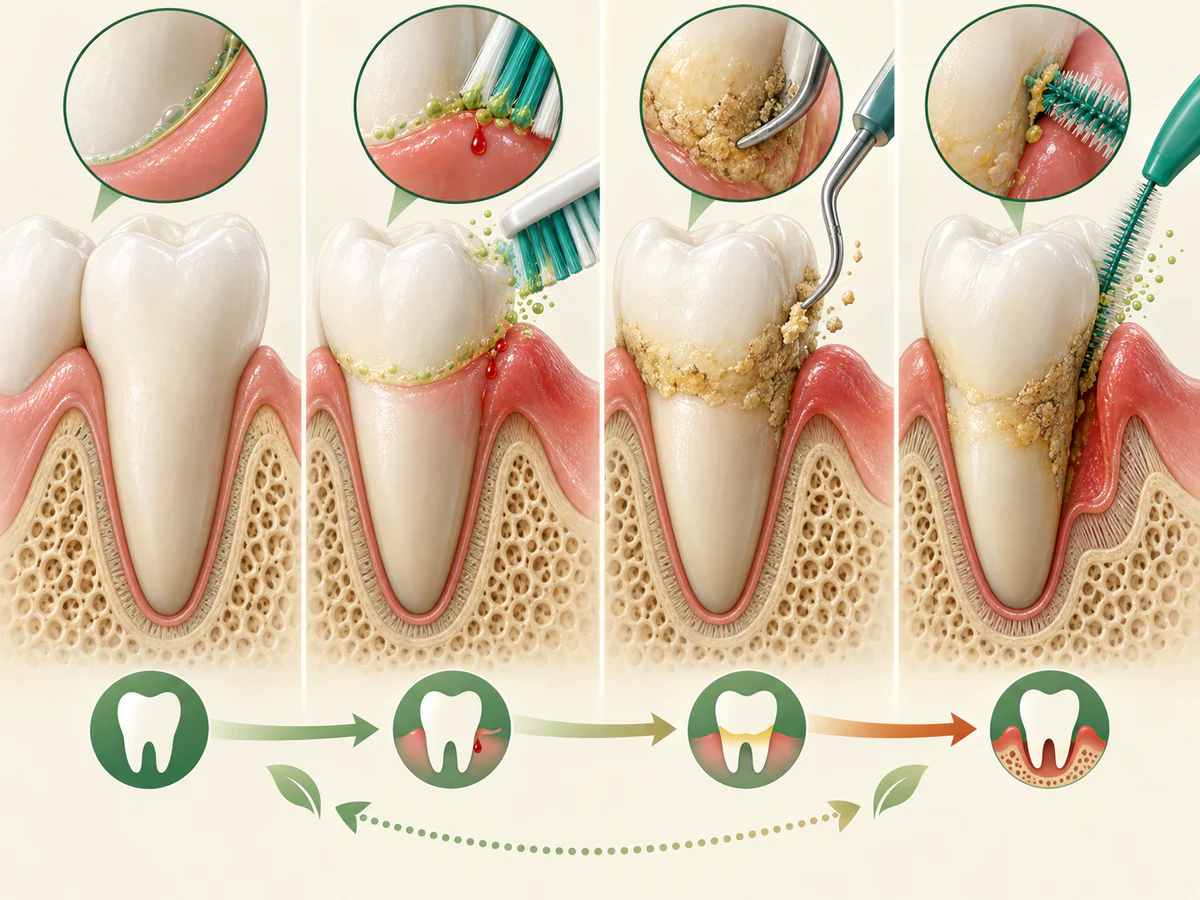
Dental plaque is a deposit that forms continuously on the teeth. According to ameli.fr, it is made up of salivary proteins, food debris and bacteria. When it is not removed regularly, these bacteria trigger an inflammatory reaction in the gum. The gum then becomes red, swollen and fragile, which explains why it bleeds at the slightest contact, particularly during brushing.
This inflammation has a name: gingivitis. It is the first stage of gum disease.
From plaque to tartar
If plaque is not removed by brushing, it gradually calcifies and turns into tartar. Ameli.fr specifies that tartar adheres strongly to the tooth surface and cannot be removed by brushing alone. Its rough surface traps even more plaque, which sustains and amplifies the inflammation. Only a scaling carried out at the practice can remove it.
Bleeding that often starts between the teeth
A significant share of plaque and inflammation settles in the spaces between the teeth, where the brush reaches poorly. It is often in these areas that bleeding appears first. That is also why daily interdental cleaning, with floss or suitably sized interdental brushes, holds a central place in prevention, alongside brushing. For a detailed method, see our article on daily dental hygiene.
Is gingivitis reversible?
Yes, and this is an essential point. According to ameli.fr, at the gingivitis stage the disease is reversible. When plaque is removed regularly and effectively, the inflammation subsides and the gum returns to a healthy appearance. That is what makes this stage so important to recognize: acting early prevents what comes next.
Gingivitis does not, however, go away on its own if nothing changes in your oral hygiene. As long as plaque is still present, the inflammation persists. A scaling and support from your dentist speed up and secure the resolution, especially once tartar has already formed.
When gingivitis goes untreated
Without care, the inflammation can spread deeper. Ameli.fr indicates that it can then reach the supporting tissues of the tooth, namely the ligament and the alveolar bone. This is what is called periodontitis. At this stage, the loss of supporting tissue is largely irreversible, even though the disease can be stabilized. Periodontitis often progresses silently and generally remains fairly painless in its early stages, which frequently delays diagnosis. To tell the two apart clearly, read our dedicated article: periodontitis or gingivitis, understanding the difference.
The scale of the problem goes beyond the individual case. WHO estimates that severe forms of periodontal disease affect more than one billion people worldwide, making it one of the most widespread chronic conditions.
Why do my gums bleed even though I brush properly?
This is a common situation. Bleeding is not always down to poor hygiene alone. Several general and local factors can weaken the gum or amplify its inflammatory response to what is nevertheless a moderate amount of plaque.
Tobacco
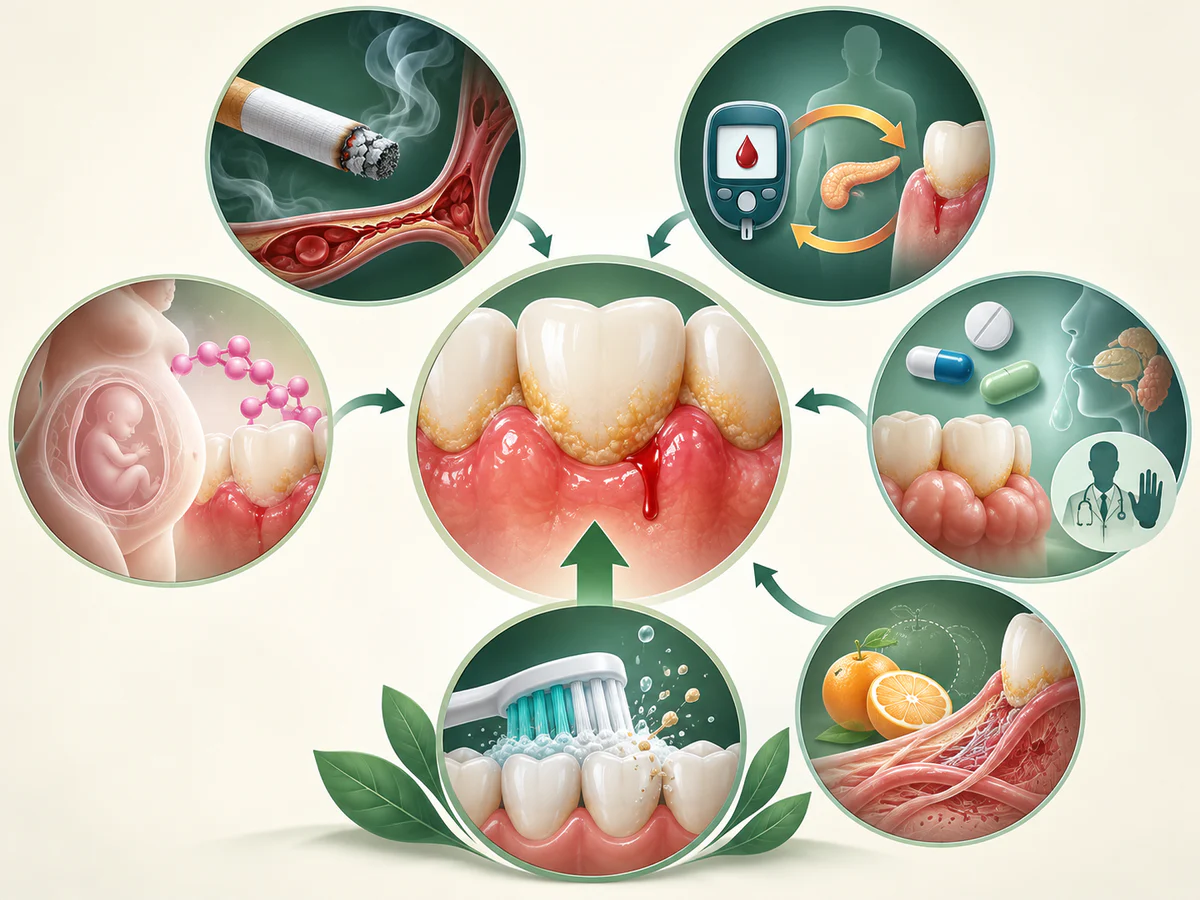
Tobacco is one of the main risk factors for gum disease. Ameli.fr indicates that it greatly increases the risk of developing it or making it worse, and WHO cites it, along with inadequate hygiene, as one of the two main periodontal risk factors. Tobacco also has a misleading effect: it reduces visible bleeding by constricting the small vessels of the gum, which can mask a disease that is nonetheless active.
Diabetes
The relationship between diabetes and gum disease is bidirectional. According to WHO, diabetes is reciprocally linked to the development and progression of periodontal disease. The EFP specifies that diabetes increases the risk of periodontitis, and that periodontitis is associated with poorer blood sugar control, measured by HbA1c. In other words, each of the two conditions can make the other worse. That is why a patient with diabetes calls for closer dental follow-up.
Hormonal changes
According to ameli.fr, the risk of gingivitis is higher during certain periods of life marked by hormonal changes: puberty, pregnancy and menopause. During pregnancy in particular, the gum reacts more strongly to the same amount of plaque. Non-surgical gum care can be carried out during this period, and stepped-up hygiene together with appropriate follow-up is recommended.
Certain medications
Several medications can promote gum disease. Ameli.fr cites in particular those that cause dry mouth, as saliva plays a natural protective role. Other classes can lead to an overgrowth of gum tissue, which makes cleaning harder: this is the case with certain antiepileptics such as phenytoin, an immunosuppressant such as ciclosporin, and certain calcium channel blockers used in cardiology. If you are taking one of these treatments, tell your dentist, and never stop your medication on your own.
Deficiencies
A vitamin C deficiency can weaken the gums. In its severe form, scurvy, it shows up as gum bleeding. According to NCBI StatPearls, this bleeding is explained by impaired collagen synthesis and fragile vessels, vitamin C being essential to the production of the collagen found in the supporting tissues. This deficiency remains rare in countries where the diet is varied; it mainly concerns situations of undernutrition or a very unbalanced diet. Ameli.fr also mentions vitamin C and D deficiencies among the factors that may play a part.
Summary table: what makes gums bleed
| Cause | Main mechanism | Course of action |
|---|---|---|
| Dental plaque | Bacterial inflammation of the gum | Daily brushing and interdental cleaning |
| Tartar | Calcified plaque, not removed by brushing | Scaling at the practice |
| Tobacco | Disease made worse, bleeding sometimes masked | Quitting or cutting down, closer follow-up |
| Diabetes | Bidirectional relationship with periodontitis | Blood sugar control and dental follow-up |
| Hormonal changes | Heightened gum response to plaque | Stepped-up hygiene, follow-up during pregnancy |
| Medications | Dry mouth or gum overgrowth | Discuss it with your practitioner, never stop on your own |
| Vitamin C deficiency | Impaired collagen synthesis | Medical assessment and dietary correction |
Bleeding gums: which signs should raise concern?
Isolated bleeding after energetic brushing generally does not carry the same weight as bleeding that settles in. Some signs, on the other hand, justify a consultation without waiting for the next routine visit. Watch in particular for:
- bleeding that recurs with every brushing or happens spontaneously;
- red, swollen or tender gums;
- a gum that recedes and gives the impression of longer teeth;
- persistent bad breath with no obvious cause;
- loose teeth or a change in the way the teeth fit together;
- the presence of pus or a localized swelling.
Stubborn bad breath can accompany gum inflammation; we go into its origins in our article on bad breath and its oral and general causes.
A taste of blood or pus on waking: what it may indicate
Waking up with a taste of blood or a bad taste in the mouth often leads to the same question: is it my gums? It may be. Inflamed gums can bleed spontaneously, without brushing, as ameli.fr points out, and the blood is then noticed on waking. A persistent bad taste is also among the warning signs of gum disease listed by the American Dental Association.
Pus is a different signal. The American Academy of Periodontology lists pus between the gum and the tooth among the signs of gum disease: it can come from an infected periodontal pocket, meaning a space that has formed between the gum and the root. A localized swelling of the gum, especially a painful one, may correspond to an abscess.
A bad taste in the morning is not always linked to the gums. If it keeps coming back, an examination helps sort things out: the practitioner measures the depth of the pockets tooth by tooth, notes the sites that bleed or release pus, checks whether teeth are loose and, when useful, checks the bone level on an X-ray.
Why not to wait
Beyond the mouth, periodontal health interacts with general health. The EFP/WHF consensus points out that there is strong epidemiological evidence of an association between periodontitis and an increased risk of cardiovascular disease. This is a documented association, not a demonstrated cause-and-effect link, but it underlines why it is worth not letting gum inflammation settle in for the long term.
Bleeding gum: what to do and how to treat it?
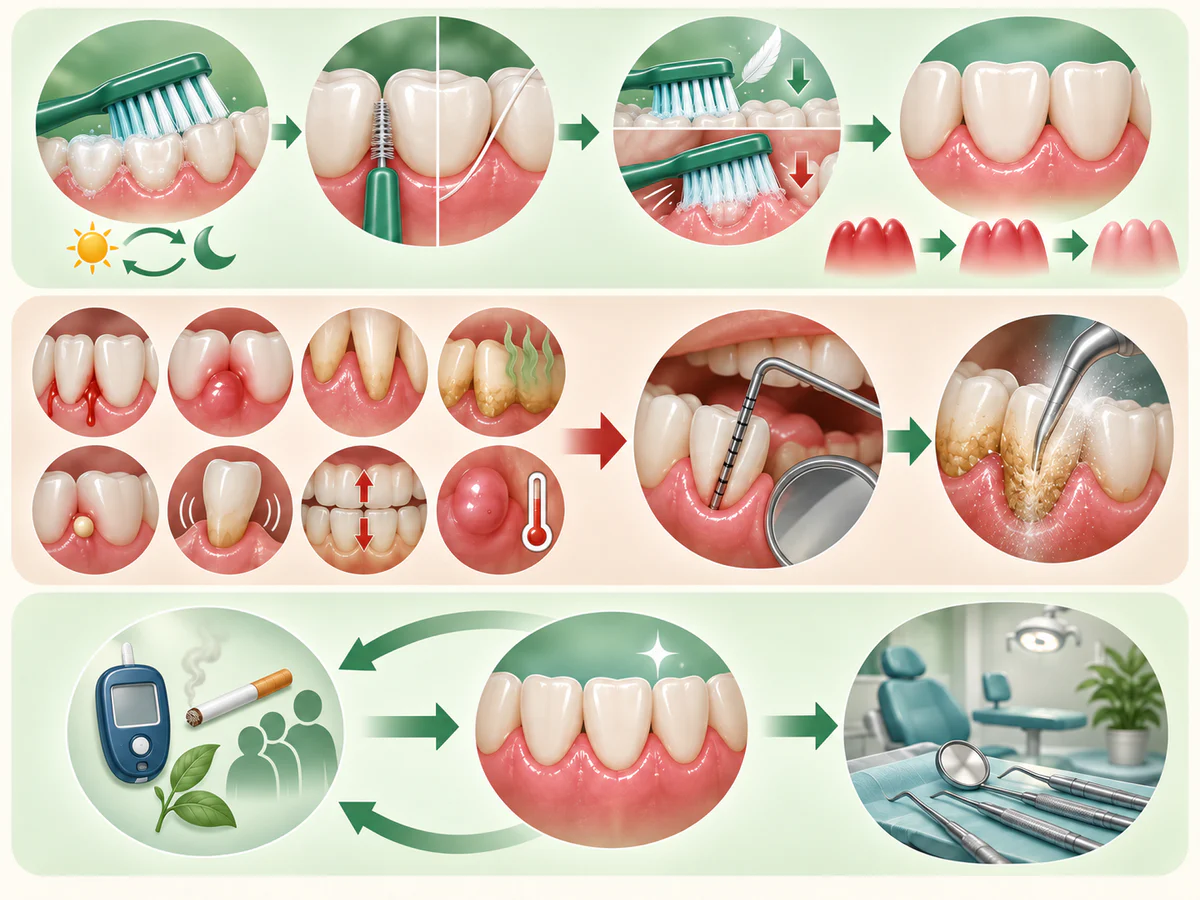
The first measure seems paradoxical: you must not stop brushing the areas that bleed. It is the build-up of plaque that sustains the inflammation, and it is by removing it that bleeding subsides, often within a few days to two weeks when early gingivitis is involved.
Everyday habits
The prevention recommendations from ameli.fr are specific and form the basis of treatment:
- brush your teeth at least twice a day, for two minutes, working from the gum towards the tooth, without skipping the evening brushing;
- clean the interdental spaces every day with dental floss or interdental brushes sized to the spaces;
- limit snacking and sugar consumption;
- have a dental examination at least once a year, and twice a year for people at risk such as those with diabetes.
Regarding interdental cleaning, the 2019 Cochrane review indicates that using floss or interdental brushes, in addition to brushing, may reduce gingivitis, while stressing that the level of evidence remains low. This practice is still recommended, without spectacular effects being expected from it on its own.
Care at the practice
When tartar is present or inflammation persists despite good hygiene, the dentist’s intervention becomes necessary. The EFP S3 recommendation for the treatment of periodontitis rests on a stepwise approach whose first step is aimed precisely at controlling the bacterial biofilm and the risk factors. In practice, this means scaling, teaching an effective hygiene technique, and managing aggravating factors such as tobacco or poorly controlled diabetes. Depending on severity, deeper debridement of the root surfaces may be proposed.
The follow-up interval is then tailored to each person’s risk level, rather than set uniformly. Bleeding that persists despite rigorous hygiene for two to three weeks should prompt a consultation.
At the practice in Kénitra
At Dr Fatima Azelmat’s practice in Kénitra, assessing a bleeding gum begins with a clinical examination and, where useful, with imaging. The Dürr Dental Cone Beam makes it possible to gauge the bone level and to distinguish simple gingivitis from established periodontitis, with involvement of the supporting bone. This assessment guides care, whether that means non-surgical management or, in advanced cases, periodontal and mucogingival surgery. When the disease has caused significant bone loss and compromised teeth, reconstruction may call on implant surgery; a full work-up remains essential to assess the available bone volume, as we explain in our article on bone grafting before an implant.
Bleeding gums: what to do depending on the situation
The right response depends on when the bleeding appears. Here are the three most common situations.
Gums that bleed when you brush or floss
This is the most frequent situation, and most often a sign of gingivitis. Keep brushing twice a day for two minutes with a soft, small-headed toothbrush, as ameli.fr recommends, working from the gum towards the tooth without pressing hard. If you are new to flossing, slight bleeding is common: ameli.fr advises easing the floss gently between the teeth and notes that this bleeding generally stops after a few days.
Gums that bleed in the morning, on waking
Blood in your saliva when you get up, sometimes a mark on the pillow, most often points to an inflamed gum that bled during the night. The steps are the same: gentle brushing and daily interdental cleaning. If the taste of blood comes back despite these steps, or a taste of pus is added to it, a gum examination is useful, as explained above.
Gums that bleed on their own, without brushing
Spontaneous bleeding generally reflects more marked inflammation, which deserves an examination without waiting for the next routine visit. It can also have a general cause: MedlinePlus cites blood-thinning medicines, clotting disorders and, more rarely, a blood disease such as leukemia. If you take an anticoagulant, tell your dentist, and never stop it on your own. Gums that bleed alongside other unexplained symptoms, such as bruises without a knock or repeated nosebleeds, call for a visit to a doctor.
What to do, in summary
To sum up when faced with bleeding gums:
- do not panic over isolated bleeding, but never dismiss bleeding that keeps coming back;
- keep up, and even step up, brushing and interdental cleaning rather than suspending them;
- correct what can be changed: brushing technique, tobacco, dietary balance, diabetes management;
- see a dentist without delay in the event of warning signs or persistent bleeding;
- keep in mind that in its early stages gum disease is reversible, and that this is precisely the moment to act.
Gum bleeding is not inevitable. It is a signal, often early and most often reversible, that invites you to review your habits and, if needed, to seek support.
Frequently asked questions
Why do my gums bleed when I brush my teeth?
Is bleeding gums always serious?
Should I stop brushing my gums when they bleed?
Can pregnancy make gums bleed?
When should I see a dentist about bleeding gums?
I have a taste of blood or pus in my mouth in the morning: is it my gums?
How long does it take for bleeding gums to stop?
Can blood thinners make my gums bleed?
Sources
Medical references consulted for this article.
- 1ameli.fr (Assurance Maladie), Maladie des gencives : définition, causes et symptômes, 2024-2025
- 2ameli.fr (Assurance Maladie), Prévenir la maladie des gencives, 2024-2025
- 3Organisation mondiale de la santé (OMS), Oral health, fiche d'information, 2023
- 4EFP, Guideline on treatment of stage I-III periodontitis (S3, 2020)
- 5EFP / WHF, Consensus report on periodontitis and cardiovascular diseases, 2020
- 6EFP, Perio & diabetes FAQ (relation bidirectionnelle parodontite/diabète)
- 7Cochrane Oral Health (Worthington et al., 2019), Home use of interdental cleaning devices
- 8NCBI/NIH StatPearls, Vitamin C Deficiency
- 9American Academy of Periodontology (AAP), Gum Disease Information (signes : saignement, pus entre la gencive et la dent)
- 10American Dental Association, MouthHealthy : Gum Disease (signes d'alerte, dont un mauvais goût persistant)
- 11MedlinePlus (National Library of Medicine, États-Unis), Bleeding gums, révision 2026
Contents
Share