

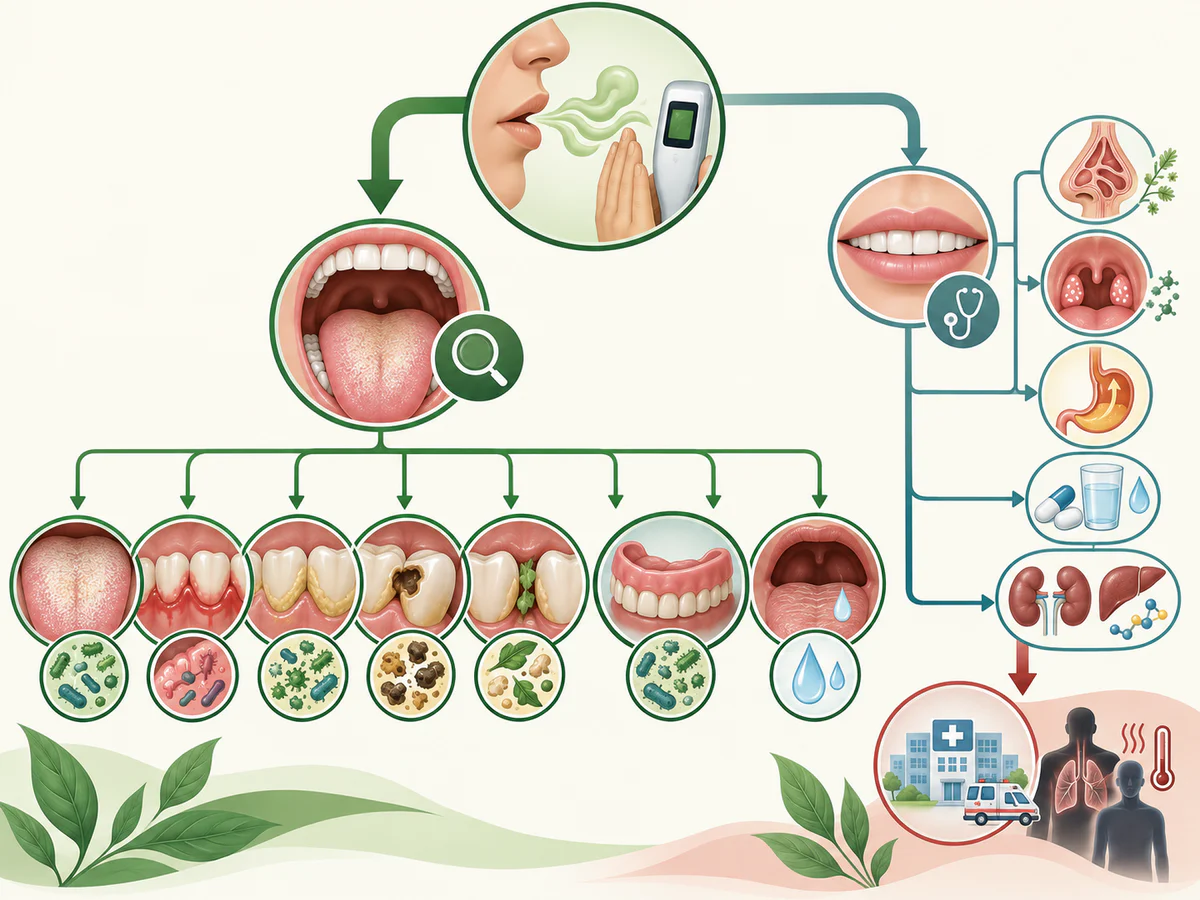
In the vast majority of cases, bad breath comes from the mouth, not from the stomach. The available data place the oral origin at around 80 to 90 % of cases (Hampelska et al., 2020; the UFSBD cites more than 80 %), while a minority of situations, on the order of 5 to 10 %, stem from an extra-oral cause: the ENT sphere, the airways, and more rarely a digestive or metabolic origin. The odor itself is no mystery: it is produced by volatile sulfur compounds, made by certain bacteria in the mouth. Understanding where they come from allows you to act in the right place, rather than piling on mouthwashes with no lasting result.
As a dental surgeon in Kénitra, I regularly see people troubled by breath they cannot correct on their own. The aim of this article is to distinguish what is a transient, ordinary phenomenon from what reflects a cause that needs treating, and to explain a structured approach for seeing things clearly.
Where does the odor come from? The role of volatile sulfur compounds
The characteristic odor of halitosis comes mainly from volatile sulfur compounds. According to Hampelska et al. (J Clin Med 2020) and Scully’s review (BMJ Clinical Evidence 2014), three molecules dominate: hydrogen sulfide, methyl mercaptan and, to a lesser degree, dimethyl sulfide. Together, they account for roughly 90 % of the volatile sulfur compounds involved.
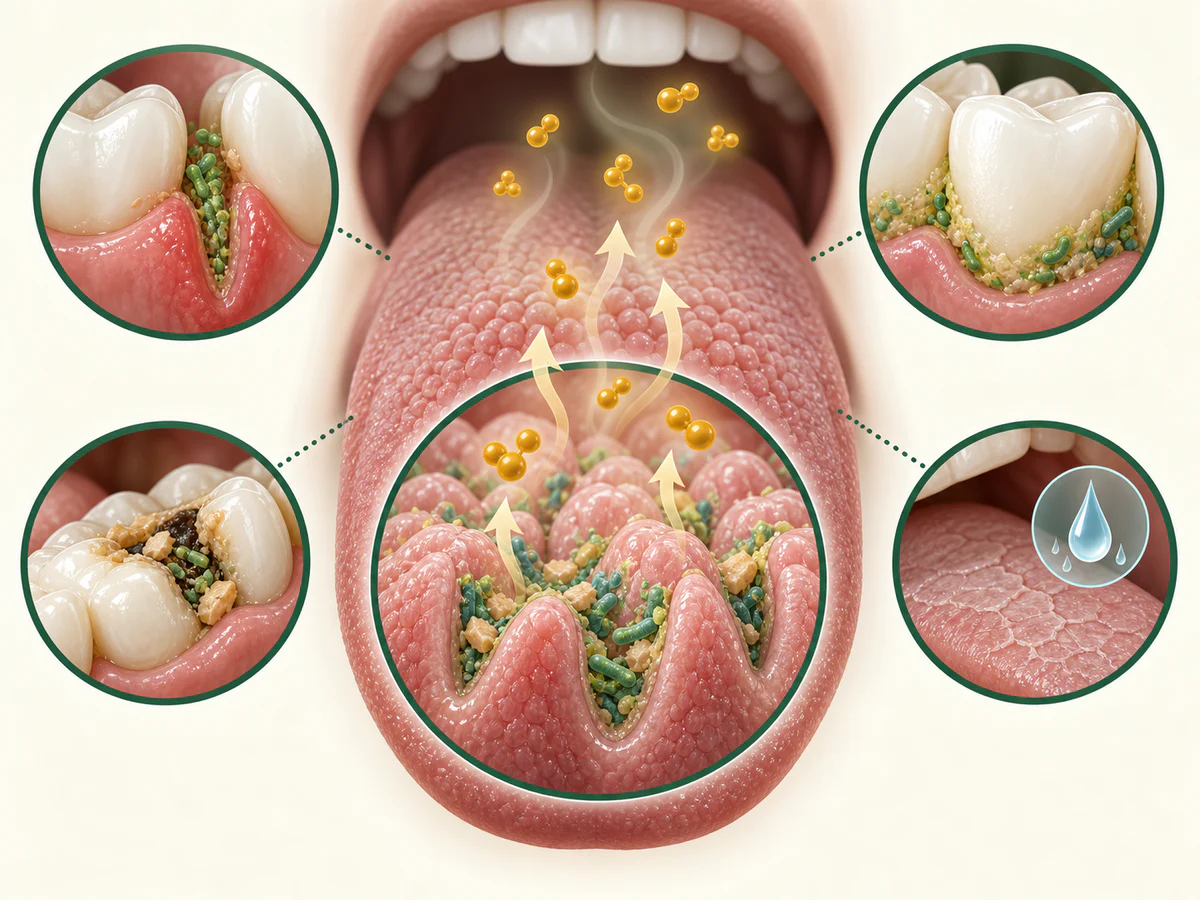
These gases are produced by Gram-negative anaerobic bacteria. They break down sulfur-containing amino acids present in saliva, food debris and shed cells, in particular cysteine and methionine. The mouth is home to a dense microbiota: Hampelska et al. mention around 700 bacterial taxa, some of which cannot even be cultured in the laboratory. The point, then, is less to “kill the bacteria” than to reduce the areas where these bacteria stagnate away from oxygen.
The conditions that favor these bacteria
Several factors create fertile ground:
- A coating on the back of the tongue, especially in its posterior part.
- Areas where plaque builds up: deep grooves, diseased gums, poorly cleaned spaces between the teeth.
- A dry mouth, since saliva plays a cleansing and protective role.
- Protein-rich food debris left in place.
What are the oral causes of bad breath?
This is the most frequent category, and the one most accessible to treatment.
A coated tongue: the most common source
The whitish or yellowish deposit on the back of the tongue, known as a coated tongue, is the intra-oral source most often identified. Hampelska et al. (2020) locate the production of foul-smelling gases “mainly in the tongue coating”, and de Leusse’s review (POSTU 2025) emphasizes the posterior dorsum of the tongue. This area, little swept by food and saliva, retains bacteria and debris.
Gentle tongue cleaning is therefore one of the logical measures. Its effectiveness should nonetheless be viewed with nuance: the 2019 Cochrane review found a very low level of evidence for the reduction of volatile sulfur compounds through mechanical tongue cleaning. It is a useful and harmless measure when done gently, not a miracle solution.
Periodontal disease: a major cause when present
Gum diseases are an important cause of halitosis, but we need to be precise. A distinction is made between gingivitis, a reversible inflammation limited to the gum, and periodontitis, which affects the supporting bone and creates deep pockets. These pockets are oxygen-free spaces where precisely those anaerobic bacteria that produce sulfur compounds thrive (Hampelska et al., 2020; Merck Manual; de Leusse, POSTU 2025).
Contrary to a widespread idea, periodontal disease is not automatically “the number one cause”: the tongue coating remains the most frequent source. When periodontitis is present, however, it sustains the odor and calls for specific management. To understand the nuance between the two situations, you can read our article on the difference between periodontitis and gingivitis. If your gums bleed when you brush, the article bleeding gums: causes and what to do sets out the signs not to overlook.
Cavities, defective restorations and debris
Deep cavities, poorly fitted restorations or crowns, and more broadly any area that traps food, sustain bacterial proliferation. The Merck Manual lists dental disorders among the common oral causes. A tooth whose pulp is affected can also generate an odor; the subject is covered in our article on root canal treatment.
Dry mouth
A reduction in salivary flow worsens the odor. Saliva cleanses, dilutes and limits bacterial activity. Its decrease therefore favors the production of sulfur compounds. Several situations are involved: certain medications, dehydration, mouth breathing, stress, or nighttime rest. This is one of the mechanisms behind morning breath.
Tobacco
Tobacco contributes to the odor in itself and favors periodontal damage. The Merck Manual mentions it among the common factors. Its effect therefore often adds to a pre-existing local cause.
Is morning breath pathological?
Most often, no. There is a so-called physiological bad breath, transient and with no disease significance. Scully’s review (BMJ Clinical Evidence 2014) reports, in a cross-sectional study, that a notable proportion of the people examined had physiological bad breath. On waking, the drop in saliva during the night explains the odor, which fades quickly after brushing, tongue cleaning and hydration.
Likewise, certain foods produce passing breath odor: garlic, onion, spices, coffee, alcohol. The Merck Manual points out that foods containing a volatile compound can be absorbed and then eliminated by the lungs, which explains an odor that does not yield to brushing alone. Here again, this is a temporary phenomenon, not a disease.
This distinction matters: not all bad breath is a medical problem. De Leusse’s review (POSTU 2025) and Scully’s review in fact describe a classification into three broad categories: genuine halitosis, which is measurable; pseudo-halitosis, where the person perceives an odor that those around them do not confirm; and halitophobia, a persistent fear of bad breath despite a reassuring examination. This last situation calls for a different approach, more attentive to the person’s lived experience.
And the general causes: stomach, ENT, metabolism?
These make up a minority of cases, on the order of 5 to 10 % (Hampelska et al., 2020). These causes deserve to be known, without being overestimated.
The received idea of “breath that comes from the stomach”
This is the most stubborn belief, and the one most in need of nuance. Digestive causes are uncommon. De Leusse’s review (POSTU 2025) is explicit: halitosis alone is not enough in itself to justify screening for a Helicobacter pylori infection. The Merck Manual agrees, indicating that gastrointestinal disorders rarely cause halitosis. Before looking to the stomach, then, the mouth must be examined.
ENT and respiratory causes
Some situations belong to the ENT sphere: chronic sinus infections, postnasal drip, tonsils with deposits (the well-known tonsil stones). A lower respiratory cause is rarer. These hypotheses are chiefly discussed when the dental examination is normal.
Metabolic causes
More rarely, a particular odor can accompany certain general diseases or a metabolic imbalance. These situations are uncommon and are generally accompanied by other signs. They warrant medical advice, not self-diagnosis.
Oral or general origin: a reference table
The table below summarizes the orders of magnitude and the leads, for guidance only. Only an examination can settle the question.
| Origin | Relative frequency | Examples | First point of contact |
|---|---|---|---|
| Oral | Around 80 to 90 % | Coated tongue, periodontitis, cavities, dry mouth | Dental surgeon |
| ENT / respiratory | Minority (extra-oral cause) | Chronic sinusitis, tonsil stones | ENT physician |
| Digestive | Uncommon | Reflux, gastritis | Physician, after a dental work-up |
| Metabolic | Rare | General imbalance | Physician |
How is the diagnosis made?
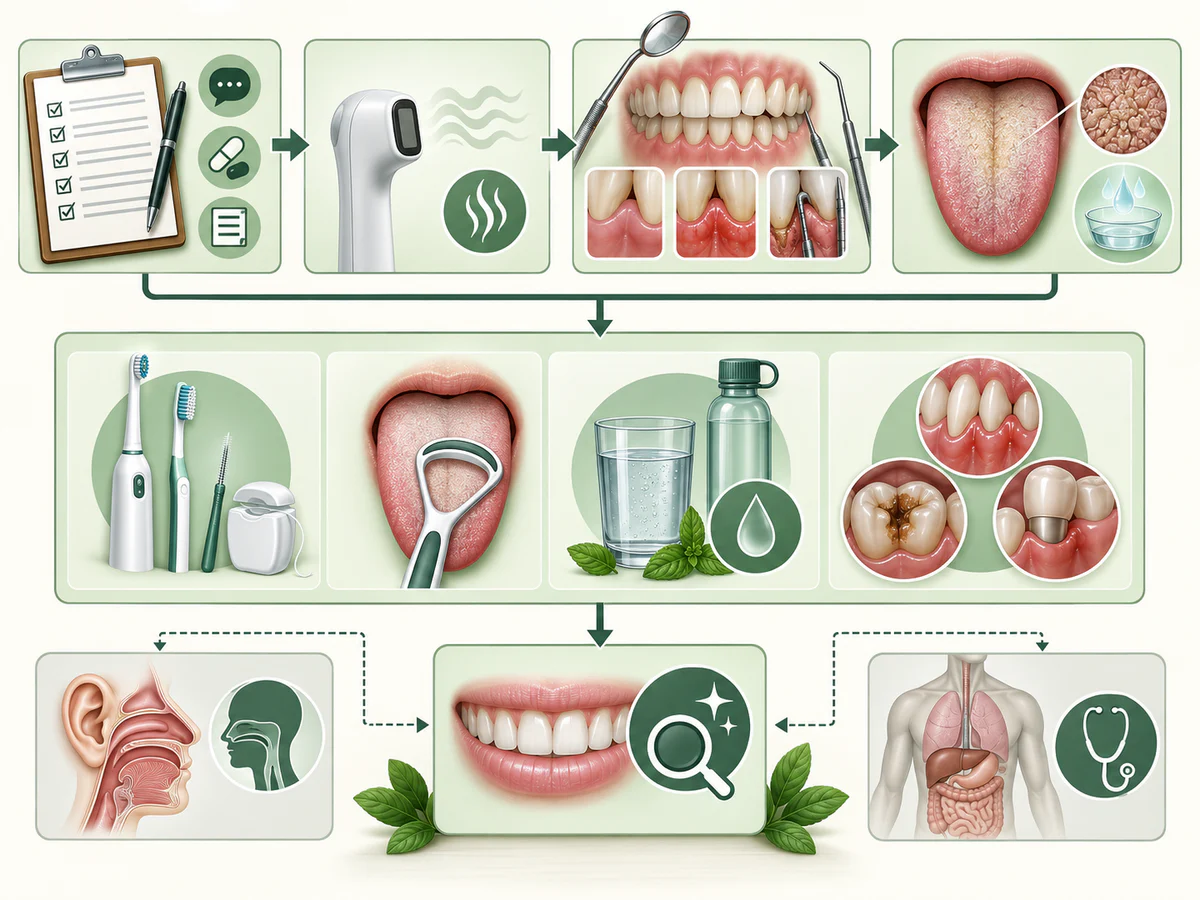
The approach is stepwise and logical. It almost always starts with the mouth.
Assessment at the practice
Assessment of the odor by an examiner, known as organoleptic measurement, remains the reference method according to de Leusse’s review (POSTU 2025). Objective tools exist for measuring volatile sulfur compounds, such as halimetry and portable gas chromatography, but they mainly belong to specialist consultations and research.
Beyond measuring the odor, the examination looks for local causes: the condition of the tongue and gums, the presence of periodontal pockets, cavities, defective restorations, dry mouth. It is this examination that guides what follows.
When the problem goes beyond the dentist
If the mouth is healthy and hygiene is adequate, and the odor persists, referral to an ENT physician or another specialist may be considered. The logic is clear: we first treat what is oral, frequent and accessible, before exploring rare causes. This approach avoids unnecessary digestive investigations, in line with the common-sense recommendations from de Leusse’s review (POSTU 2025).
What can actually be done?
When the cause is oral and properly managed, bad breath generally improves markedly. We must remain honest about the limits: the 2019 Cochrane review stresses that the level of evidence for the various interventions is low to very low, and that none has demonstrated absolute superiority. So total, permanent disappearance cannot be promised. What can be done is to act on the causes.
Basic day-to-day measures
- Careful brushing twice a day, together with cleaning between the teeth.
- Gentle cleaning of the tongue, especially its posterior part.
- Good hydration, which supports salivary flow.
- Cutting down on tobacco.
For the method and the frequency, our article on everyday dental hygiene sets out the useful steps and the common mistakes.
Care at the practice
Depending on the cause identified, management may include scaling, treatment of cavities, redoing defective restorations, or periodontal treatment when pockets are present. Root planing has its place in periodontitis, as a treatment for gum disease, and not as a “cure for halitosis” on its own.
Mouthwashes: a support, not a solution
Antiseptic mouthwashes (chlorhexidine, zinc, cetylpyridinium chloride, chlorine dioxide, essential oils) can reduce the odor, but with a low to very low level of evidence (2019 Cochrane review; Scully, 2014). They are best seen as a short-term add-on, not as a definitive treatment. Chlorhexidine, in particular, can stain the teeth and tongue with prolonged use, which limits its continuous use.
The technical facilities, for surgical situations
Most cases of halitosis are resolved through hygiene and routine care. In some cases, the local cause is part of a surgical picture: advanced periodontitis, sites of infection, a rehabilitation to plan. The practice then has a Cone Beam Durr Dental for a precise three-dimensional assessment, a surgical suite and piezosurgery for bone procedures, and Choukroun’s PRF technique to support healing. These resources are called upon only when they are genuinely useful for diagnosis or treatment. In case of pain, swelling or odor associated with a site of infection, the article dental emergency in Kénitra indicates when to seek care without delay.
In summary
Bad breath is, in the vast majority of cases, a problem of the mouth: a coated tongue first, then periodontal disease, followed by cavities, defective restorations and dry mouth. The volatile sulfur compounds produced by anaerobic bacteria are its direct cause. Digestive, ENT or metabolic origins do exist, but remain in the minority, and the idea that “it all comes from the stomach” is largely overstated. The right approach is stepwise: examine the mouth, treat what is local, then look further only if necessary. With an oral cause properly managed, the improvement is generally clear-cut, even if no method guarantees total disappearance.
Frequently asked questions
Does bad breath come from the stomach?
Is morning breath abnormal?
Is mouthwash enough to treat halitosis?
Should the tongue be scraped every day?
When should I see someone about persistent bad breath?
Sources
Medical references consulted for this article.
- 1UFSBD (Union Française pour la Santé Bucco-Dentaire), Halitose, ressource thématique professionnelle
- 2Manuel Merck, édition professionnelle, Halitose
- 3Hampelska K et coll. The Role of Oral Microbiota in Intra-Oral Halitosis. J Clin Med 2020;9(8):2484
- 4Kumbargere Nagraj S et coll. Interventions for managing halitosis. Cochrane Database Syst Rev 2019;12:CD012213
- 5de Leusse A. Prise en charge de l'halitose : quelle place pour le gastro-entérologue ? POSTU 2025, FMC-HGE
- 6Scully C. Halitosis. BMJ Clinical Evidence 2014;2014:1305
Contents
Share