“My body rejected the implant.” This sentence, which comes up often in consultation, blends together two ideas that need to be kept apart. On one hand, the titanium used in dental implants is not “rejected” the way a transplanted kidney or heart would be: for a titanium implant, there is no immunological rejection mechanism comparable to that of an organ transplant.
On the other hand, an implant can indeed fail, but for specific biological reasons that have nothing to do with this imagined “rejection.” Understanding that difference changes the way decisions are made, and it prevents both misplaced worry and false reassurance.
This article sorts out the myths from what the data actually show. It explains why titanium is considered biocompatible, what osseointegration is, how rare titanium hypersensitivity really is, what an implant failure actually involves, and what place — real but limited — zirconia holds as an alternative. Every clinical statement rests on an identified source, with no promise of longevity or guaranteed outcome.
Implant “rejection”: why the word is misleading
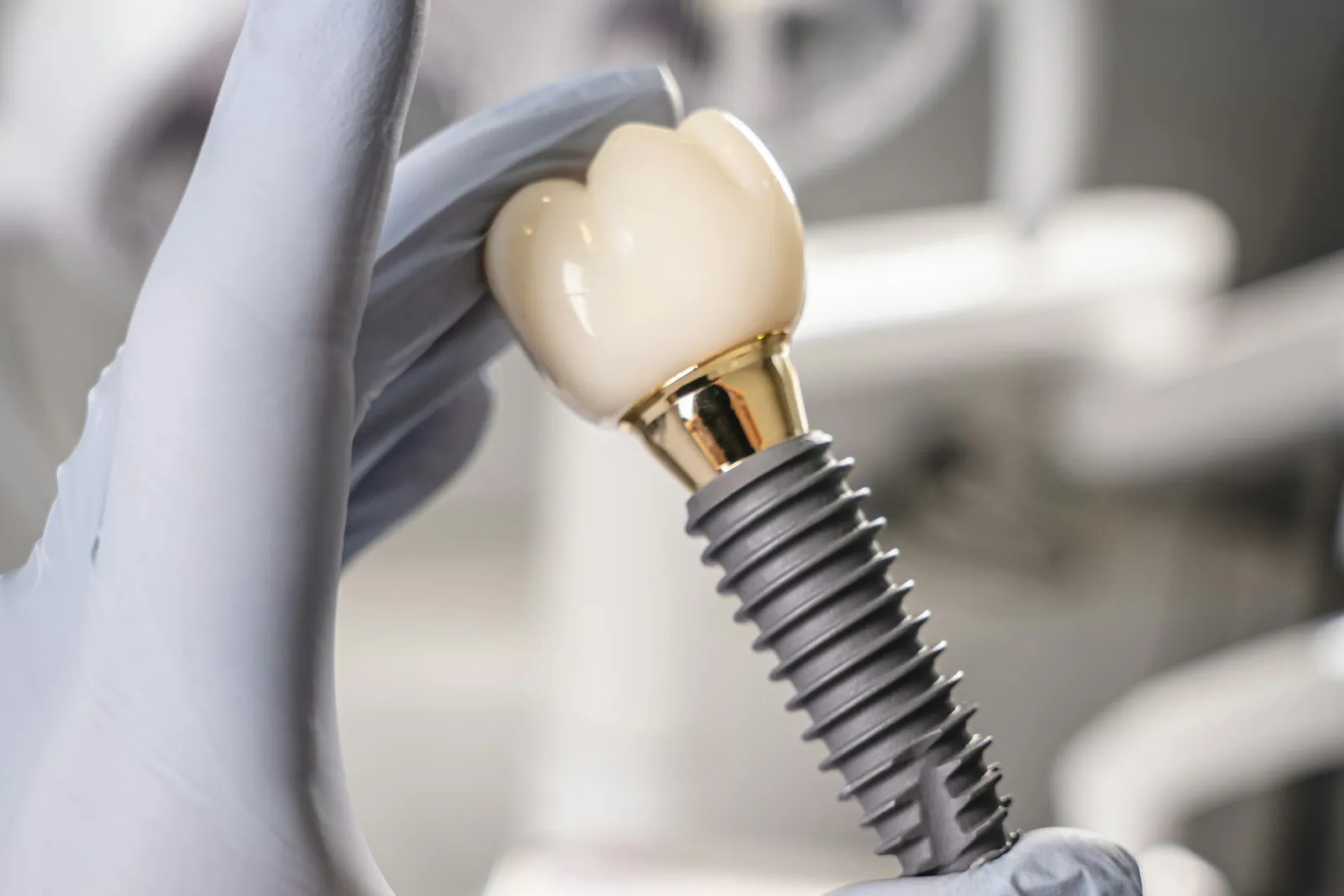
Rejection, in the strict medical sense, refers to the immune system reacting against an organ or tissue graft that comes from another individual: the body recognizes “foreign” cells and attacks them. A titanium dental implant is not living tissue — it is an inert device. It carries no cellular antigens capable of triggering that kind of graft rejection reaction. Speaking of implant “rejection” is therefore, strictly speaking, inaccurate.
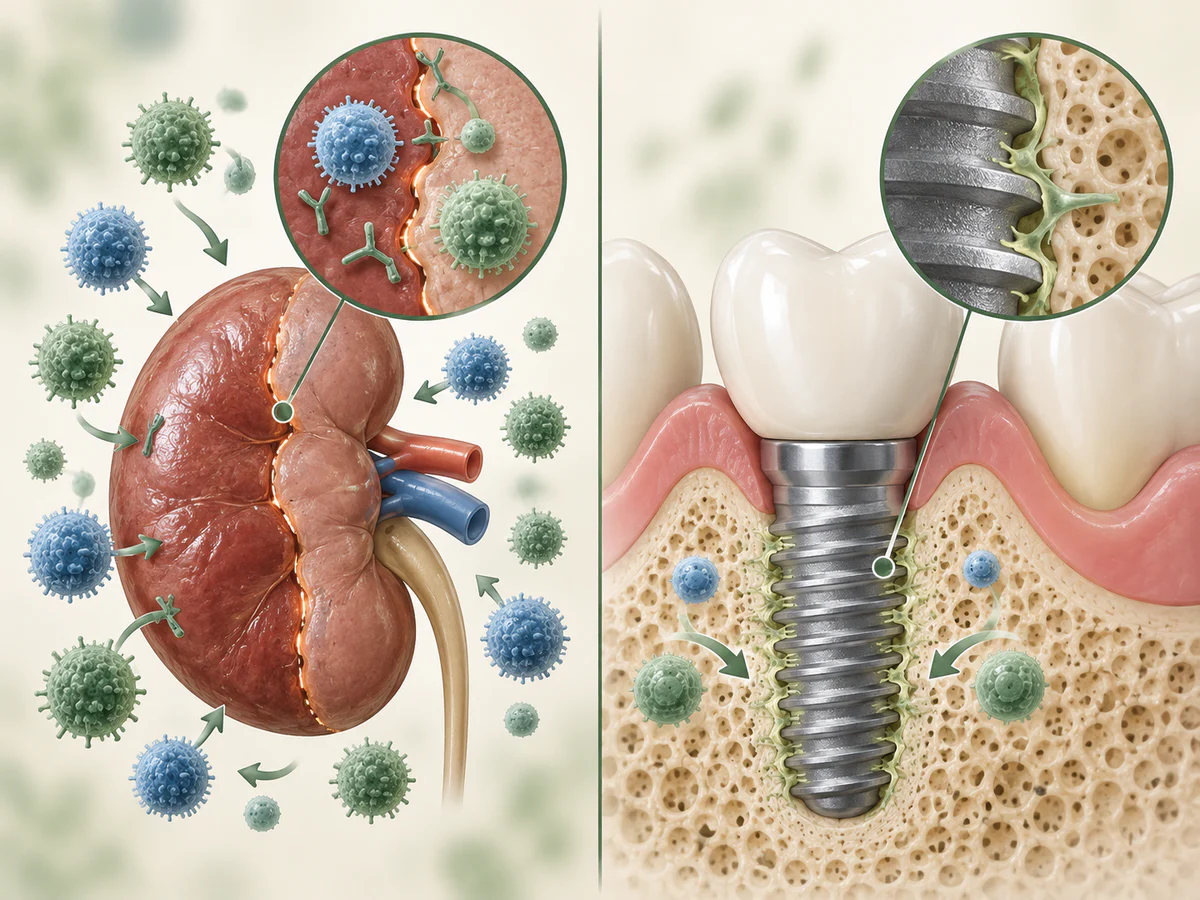
When an implant does not hold, the cause belongs to other categories: a failure of initial anchorage in the bone, or an inflammatory disease linked to the bacterial biofilm that builds up later on. These mechanisms are detailed below. The review of the international classification confirms this: the 2017 World Workshop consensus (Berglundh et al., 2018) describes peri-implant diseases as conditions associated with dental plaque, and not as an immune rejection of the implant.
This is not merely a question of vocabulary. Attributing a failure to “rejection” suggests some kind of personal fate, whereas the real causes — bone quality, technique, oral hygiene, smoking, peri-implant disease — are partly identifiable and, for some of them, modifiable.
Titanium biocompatibility and osseointegration
If titanium has become the standard in implantology, it is because of a property that was first observed by chance and later confirmed scientifically: its biocompatibility.
What Brånemark showed
In the 1950s, the Swedish researcher Per-Ingvar Brånemark was studying bone microcirculation using titanium chambers inserted into rabbit bone. He found that the bone had bonded so intimately to the metal that the chamber could no longer be removed. This chance observation revealed that pure titanium does not trigger any significant inflammatory reaction in bone or in the soft tissues, and it gave rise to the concept of osseointegration (Sharma et al., 2024, Cureus).
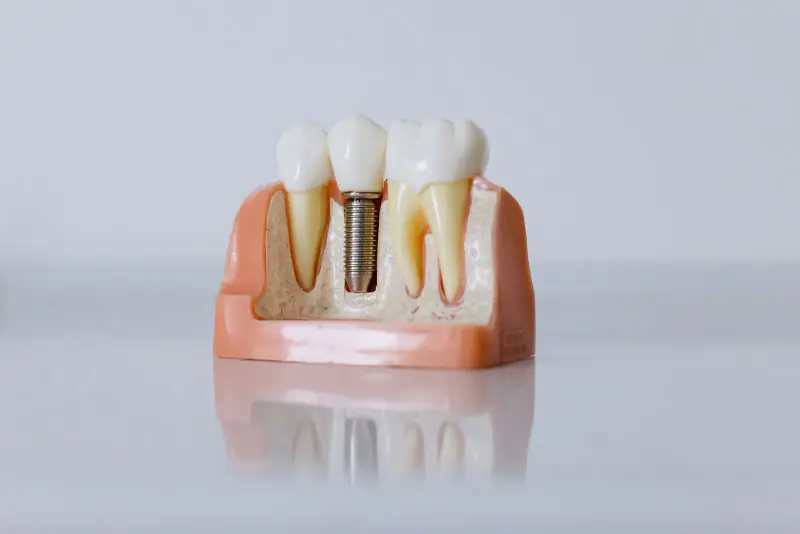
Osseointegration is defined as a direct structural and functional connection between living bone and the implant surface. It is the exact opposite of rejection: far from expelling the material, the bone attaches to it. A titanium oxide layer forms spontaneously on the implant surface and plays a key role in this tolerance.
Biocompatible does not mean “unconditional”
Biocompatibility explains why titanium is, at the population level, remarkably well tolerated. It does not mean, however, that every implant automatically succeeds. Osseointegration also depends on the quality and volume of the bone, on the initial stability of the implant, on controlling how much the bone heats up during drilling, and on healing. That is precisely the purpose of the preliminary assessment and of planning, described in our article on how a dental implant is placed, step by step.
Titanium allergy or hypersensitivity: what do the data really say?
Does titanium allergy exist? Yes, but it is rare, and it involves a different mechanism from “rejection.”
A real but uncommon phenomenon
The benchmark clinical study is still that of Sicilia et al. (2008, Clinical Oral Implants Research), carried out in 1,500 consecutive implant patients. The authors identified 9 patients with a positive test reaction, giving an estimated prevalence of 0.6%. In other words, in this large series, more than 99 patients out of 100 showed no sign of titanium allergy.
A recent systematic review (Restelli et al., 2026, Journal of Prosthodontic Research) reaches a converging conclusion: titanium hypersensitivity is “rare but clinically relevant.” The number of genuinely documented and investigated cases remains small, which calls for caution in both directions — not denying the phenomenon, but not turning it into the default explanation for every failure either.
Hypersensitivity is not rejection
When a reaction to titanium does occur, it belongs to delayed type IV hypersensitivity — that is, a contact reaction mediated by certain immune cells — and not to graft rejection (Poli et al., 2021, Materials). In principle, it is the same type of mechanism as certain contact allergies to metals. This distinction has practical consequences for diagnosis.
The problem with diagnostic tests
Here, caution is in order. A systematic review of titanium hypersensitivity tests (Müller-Heupt et al., 2022, International Journal of Implant Dentistry) concludes that the available tools — patch testing, the lymphocyte transformation test (LTT) and MELISA — give inconsistent results in terms of reliability and validity. The authors even point out that titanium dioxide cannot behave like a classic hapten, which makes these tests delicate to interpret. No test is currently validated as an indisputable reference.
The clinical consequence matters: a titanium allergy test is not offered to everyone “just in case.” The Sicilia review indicates that such testing is mainly worth discussing in patients who have already had a post-operative reaction consistent with an allergy, or who have a marked allergic background. The decision is made case by case, after examination.
| Common belief | What the data show |
|---|---|
| “The body rejects the implant like an organ” | No immunological graft-rejection mechanism exists for an inert titanium device |
| “Titanium allergy is common” | Estimated prevalence of about 0.6% (Sicilia 2008); rare but real (Restelli 2026) |
| “An allergy test is enough to settle it” | Tests give inconsistent results and are not validated as a reference (Müller-Heupt 2022) |
| “Every implant failure is an allergy” | Most failures stem from a failure of osseointegration or from peri-implantitis |
What an implant failure really is
If it is not a “rejection,” what happens when an implant fails? Two moments are classically distinguished, with different causes.
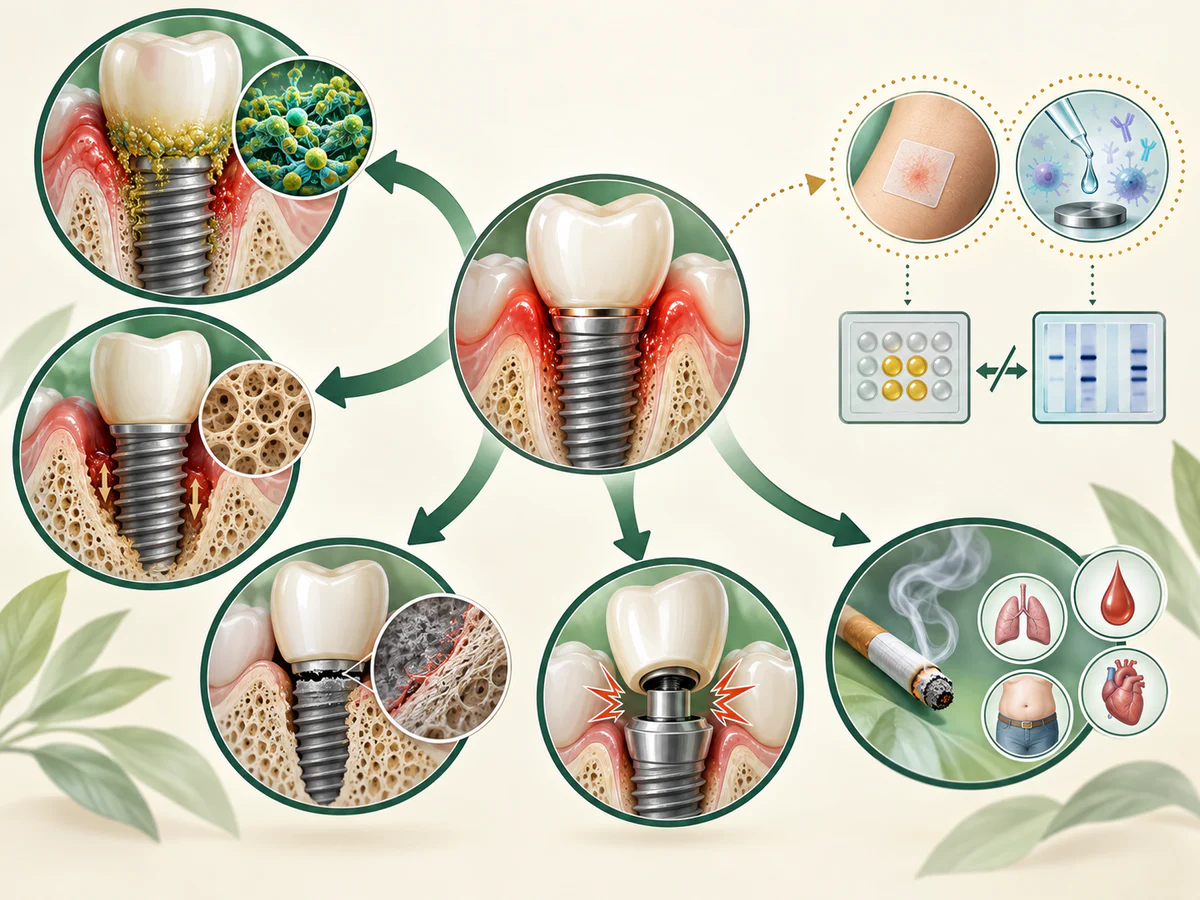
Early failure: a failure of osseointegration
Early failure occurs before or at the time of loading, when the implant has not managed to integrate with the bone. The review by Shenoy et al. (2025, Frontiers in Oral Health) describes it as a failure of osseointegration, linked in particular to insufficient initial stability, to unfavorable bone quality or to excessive heating of the bone during drilling. This is not an allergic reaction: it is bone healing that did not happen as expected.
Late failure: peri-implantitis
Late failure occurs after the implant has been put into function. Its main cause is peri-implantitis, an inflammatory disease associated with bacterial biofilm and marked by progressive loss of the supporting bone (Berglundh et al., 2018; Shenoy et al., 2025). Here again, the mechanism is not a rejection of the material, but inflammation sustained by plaque, comparable in principle to periodontitis around natural teeth.
Recognizing the signs of an implant in difficulty early — bleeding, swelling, suppuration, and, at a late stage, mobility — changes the prognosis. These signals and what to do about them are detailed in our article on the symptoms of implant failure to watch for. The distinction between “survival” and “success” is central there: an implant can still be in place (survival) while showing peri-implant disease (loss of success).
Zirconia: an alternative, with its limits
Faced with a fear of metal, some patients ask for a zirconia implant, a white, metal-free ceramic. What are these implants really worth?
What the comparisons show
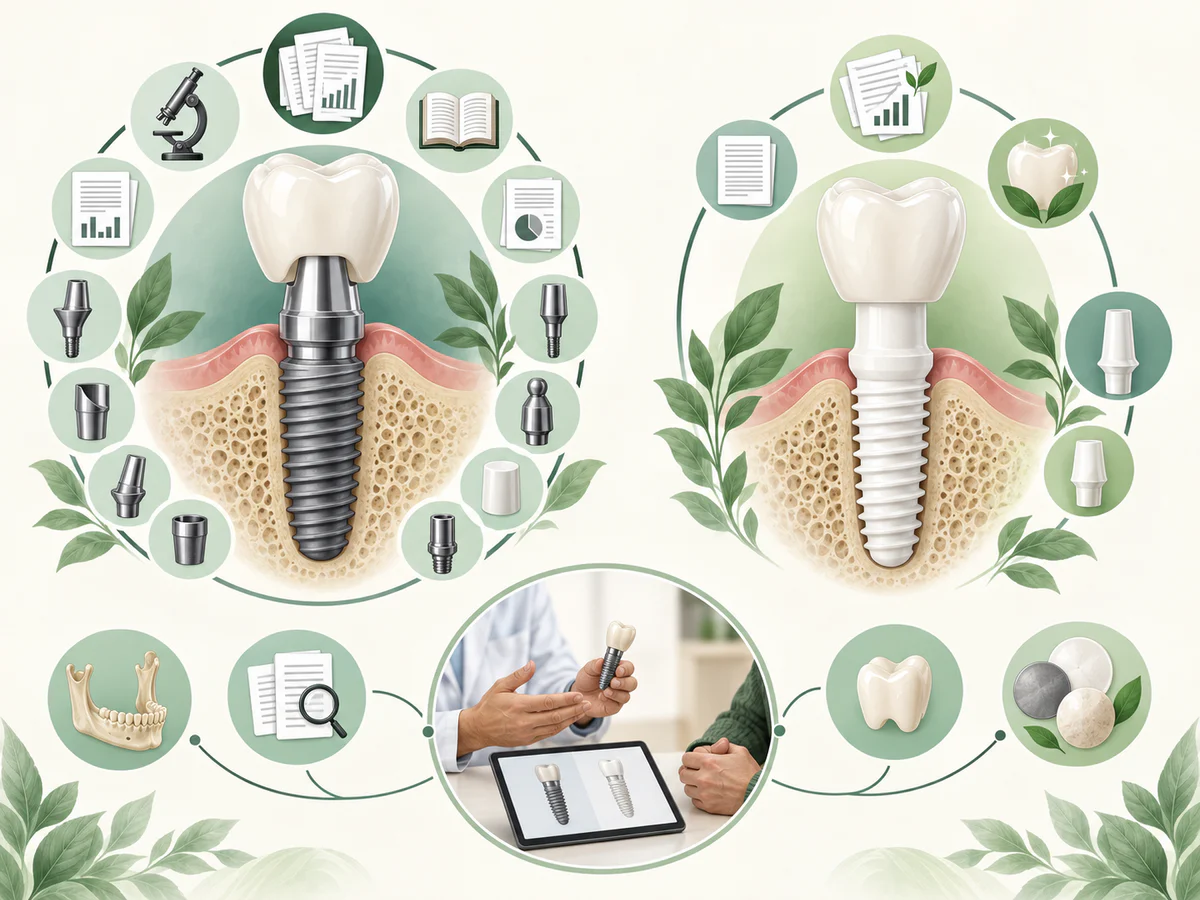
A systematic review and meta-analysis (Padhye et al., 2023, Clinical Oral Investigations) compared zirconia and titanium. In the short term, at around 12 months, survival rates were comparable, with no statistically significant difference between the two materials. The authors nevertheless stress one major limitation: the data rest on very few controlled trials, and long-term results are still lacking.
The ITI Group 3 consensus (Al-Nawas et al., 2023, Clinical Oral Implants Research) points in the same direction: zirconia is judged “a valid alternative to titanium” for comparable clinical outcomes up to five years. But the same report specifies that most of the data concern one-piece (monobloc) implants, which limits the indications, and it calls for caution with two-piece implants, for want of sufficient follow-up.
For whom, and with what reservations
Zirconia can be of interest, particularly aesthetically in the anterior region, where its light shade avoids any grayish show-through, and it is an option to discuss in a patient with documented titanium hypersensitivity. But it should not be presented as strictly equivalent to titanium: its clinical track record is shorter, its indications are narrower, and titanium remains the best-documented reference material.
The choice of material, like the choice of the overall solution, is discussed at the assessment according to the situation, and not on fear of metal alone. For a broader comparison of replacement options, see implant, bridge or denture: how to choose.
The role of the practice’s equipment in preventing failure
Since the real causes of failure are osseointegration and peri-implantitis, prevention comes from careful planning and follow-up far more than from fear of the material.
At the practice in Kénitra, three-dimensional imaging with the Dürr Dental Cone Beam makes it possible to assess the volume and quality of the bone before placement, a condition for good osseointegration.
Piezosurgery and digital impressions contribute to the precision of the procedure and of the prosthesis, while Choukroun’s PRF, obtained from the patient’s own blood, may support healing during the first few days. These tools describe equipment and a method; they do not, in themselves, constitute a guarantee of results.
Monitoring after placement remains decisive: it is what makes it possible to detect mucositis or peri-implantitis early, while the situation is still manageable.
In summary
The word “rejection” keeps a misunderstanding alive. A titanium implant is not rejected the way a transplanted organ is: there is no immunological rejection mechanism for this inert device, and titanium is on the contrary recognized for its biocompatibility and its capacity for osseointegration (Sharma et al., 2024).
Titanium allergy does exist, but it is rare — on the order of 0.6% in the Sicilia series (2008) — and it belongs to type IV hypersensitivity, not to rejection (Poli et al., 2021), with diagnostic tests that are still not very reliable (Müller-Heupt et al., 2022).
When an implant fails, it is almost always through a failure of early osseointegration or through late peri-implantitis (Shenoy et al., 2025; Berglundh et al., 2018). Zirconia is a credible alternative, but with a more limited track record and narrower indications (Padhye et al., 2023; Al-Nawas et al., 2023). Deciding on the basis of facts, rather than on fear of metal, remains the best way to approach an implant project.
Frequently asked questions
Can the body really “reject” a titanium implant?
Is titanium allergy common?
Should a titanium allergy test be done before an implant?
Are titanium allergy and “rejection” the same thing?
Is a zirconia implant safer than titanium?
If it is not a rejection, why did my implant fail?
Does a titanium implant interfere with an MRI scan or an airport security gate?
Sources
Medical references consulted for this article.
- 1Sicilia et coll., allergie au titane chez 1500 patients implantés, Clinical Oral Implants Research 2008 (PubMed)
- 2Restelli et coll., hypersensibilité au titane : revue systématique, Journal of Prosthodontic Research 2026 (PubMed)
- 3Müller-Heupt et coll., tests diagnostiques de l'hypersensibilité au titane, Int J Implant Dent 2022 (PMC)
- 4Poli et coll., allergie au titane (revue + cas), Materials 2021 (PMC)
- 5Sharma et coll., hommage à Brånemark et à l'ostéo-intégration, Cureus 2024 (PMC)
- 6Berglundh et coll., consensus péri-implantaire, World Workshop 2017, J Clin Periodontol 2018 (PubMed)
- 7Shenoy et coll., échec implantaire et techniques de dépose : revue, Frontiers in Oral Health 2025
- 8Padhye et coll., survie et succès zircone vs titane : méta-analyse, Clinical Oral Investigations 2023 (PMC)
- 9Al-Nawas et coll., Group 3 ITI Consensus Report (zircone), Clin Oral Implants Res 2023 (PubMed)
- 10Bohner et coll., artefacts en IRM causés par les matériaux dentaires : revue systématique, Dentomaxillofac Radiol 2022
- 11Chockattu et coll., interactions entre matériaux dentaires et IRM : revue de la littérature, Restor Dent Endod 2018
- 12Paknahad et coll., échauffement des restaurations à l'amalgame et des implants dentaires en IRM à 1,5 T, Front Dent 2024
- 13ACSTA (sûreté aérienne canadienne), Accessibilité et besoins médicaux : passagers ayant des implants métalliques ou des dispositifs médicaux implantés
- 14Srinivasan et coll., péri-implantite et tumeurs malignes de la bouche autour des implants : revue systématique et méta-analyse, Journal of Dentistry 2025 (PubMed)
- 15Cuevas-Nunez et coll., carcinome épidermoïde de la bouche associé aux implants dentaires : revue de la littérature, Cancers 2025 (PMC)
Contents
Share