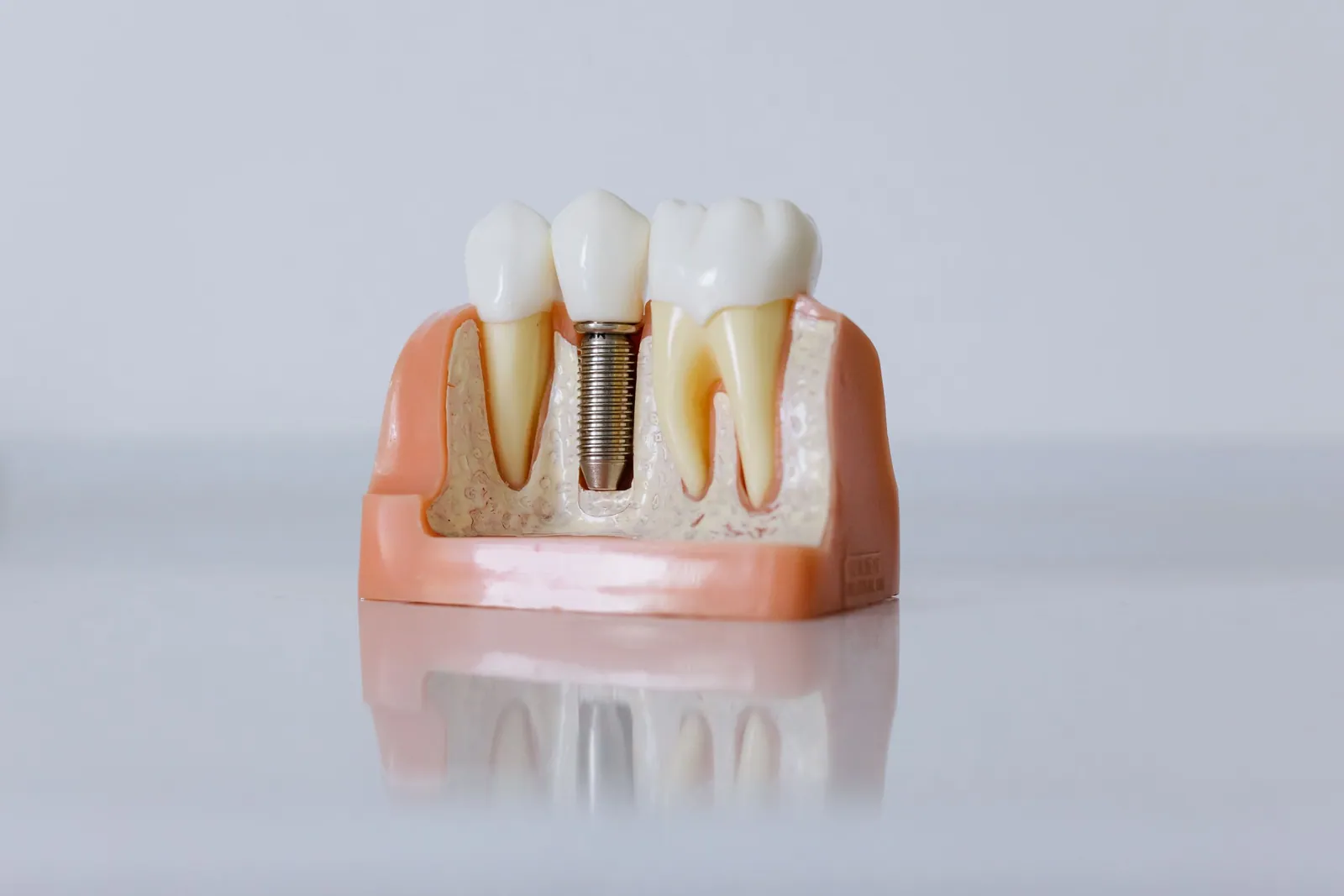
A dental implant is an artificial root, most often made of titanium, placed in the jawbone to replace a missing tooth. Once in place, it bonds with the bone through a process called osseointegration, meaning a direct connection between living bone and the implant surface. Placing a dental implant is not a single procedure but a journey in several stages: clinical and radiological assessment, planning, surgical placement, healing, and then fabrication of the restoration that restores function and appearance. This article describes each of these stages, along with the indications, risk factors and limitations, drawing on identified medical sources and without any promise of longevity or guaranteed outcome.
The aim is not to present the implant as a solution without trade-offs. It is a reliable device, but it is also a surgical procedure with real requirements, after-effects and risks. That nuance is part of the information every patient is entitled to before deciding.
For indicative fees, practice equipment and booking, see our dental implants in Kénitra service page.
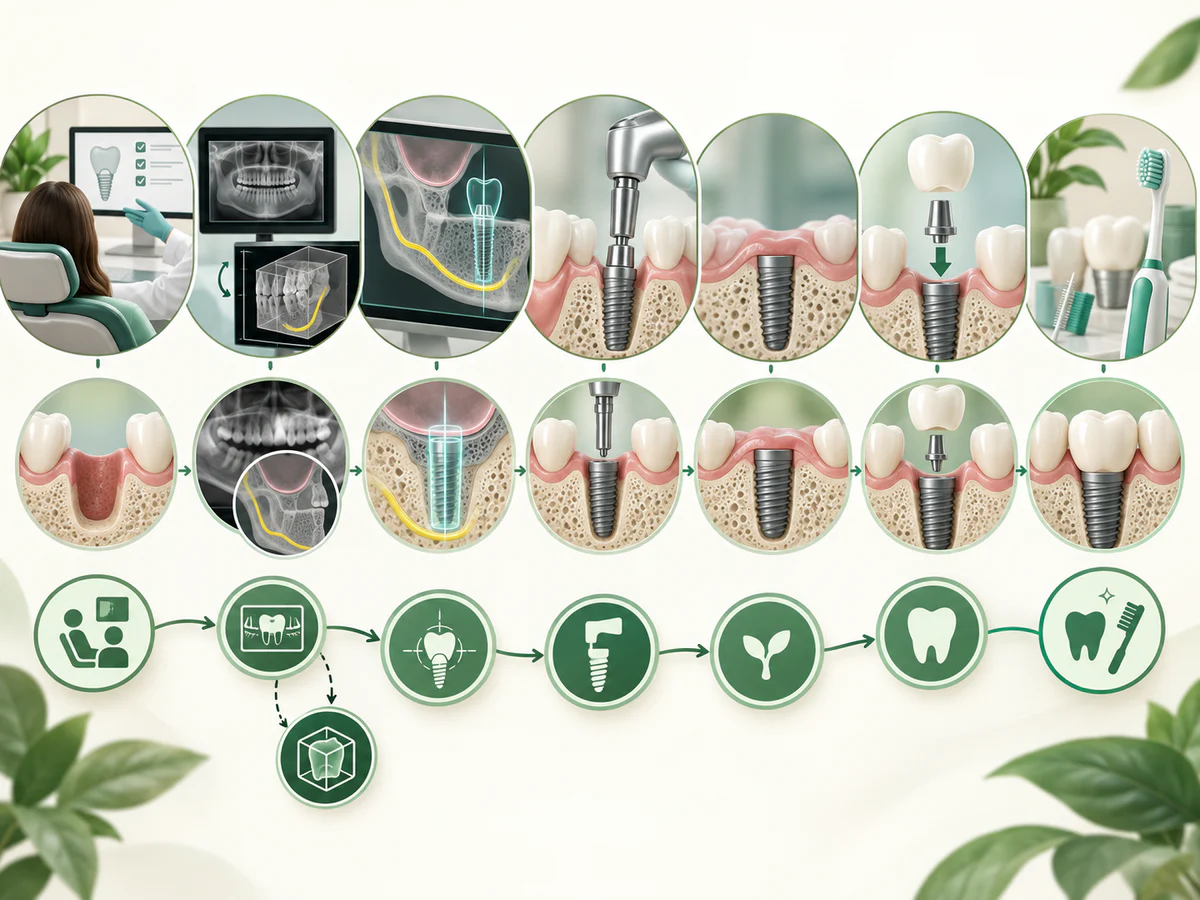
Implant placement: the steps at a glance
The planned replacement guides the treatment. Each stage has a different purpose; timing depends on the assessment, and some stages may be combined or delayed.
| Stage | What it helps decide or achieve |
|---|---|
| 01. Assessment and prosthetic plan | Examine the mouth, medical history and alternatives; identify the tooth or restoration to replace. (Guide: one or two consultations.) |
| 02. Imaging and planning | Select appropriate examinations, then assess the site and anatomy to plan placement. (Guide: at the assessment or at a following appointment.) |
| 03. Preparation and placement | Complete necessary preliminary care, then follow the agreed surgical plan. Grafting is not automatic. (Guide: a few weeks of preliminary care if needed; for one implant, surgery of about half an hour to an hour and a half.) |
| 04. Healing | Monitor recovery and assess when the implant can support the planned load. (Guide: stitches removed or checked after one to two weeks; usually two to six months before the final tooth, longer after a graft.) |
| 05. Impression and prosthesis | Record the information, make the restoration, check its fit and attach it. (Guide: a few appointments over a few weeks, the time needed for fabrication.) |
| 06. Maintenance and follow-up | Learn cleaning techniques and arrange implant and prosthesis checks. (Guide: regular check-ups, at a pace adjusted to your risk.) |
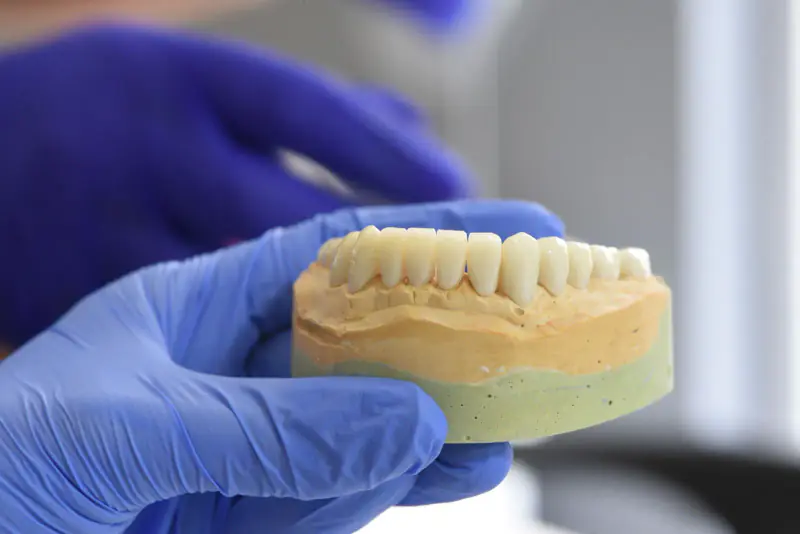
Educational illustrations are schematic, and the impression photograph alone does not document an implant case. For quotes, see dental implant prices in Morocco.
The timeline: total duration and number of appointments
The guides in the table are orders of magnitude. Your own timeline depends on the assessment and is set out in the written plan.
Without a graft, the total duration is usually counted in a few months. It adds up any preliminary care, then healing after placement, often two to six months (Leeds Teaching Hospitals). Conventional protocols leave the implant unloaded for three to eight months; earlier loading is possible in selected cases (Esposito et al., Cochrane 2013). After an extraction, the implant is placed either the same day in some situations, or after a socket-healing period set at the assessment (Buser et al., 2017).
With a bone graft or a sinus lift, add the reconstructive surgery and its own healing time, which depends on the technique. This timeline is detailed in how long bone graft healing takes.
The appointments for a single implant without a graft usually follow this order:
- the assessment, with imaging when it is indicated;
- preliminary care, only if it is needed;
- implant placement;
- the healing check and the removal of any stitches;
- depending on the protocol, a short second stage to uncover the implant;
- the impression, then the try-in and fitting of the final tooth;
- a check-up, then regular follow-up.
The exact number and order of appointments are written in the plan you receive after the assessment.
What is a titanium dental implant?
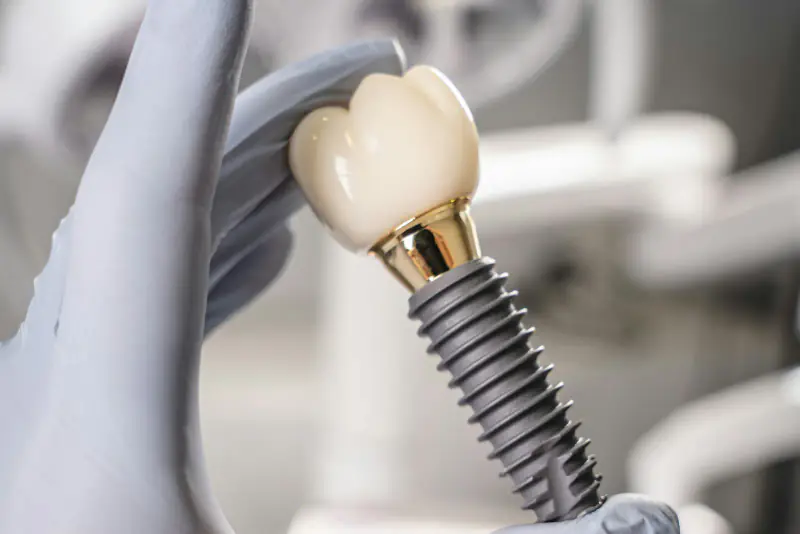
The implant replaces the tooth root. A single-tooth implant restoration usually comprises the implant in the bone, an abutment and a crown. The exact assembly depends on the system and prosthetic plan:
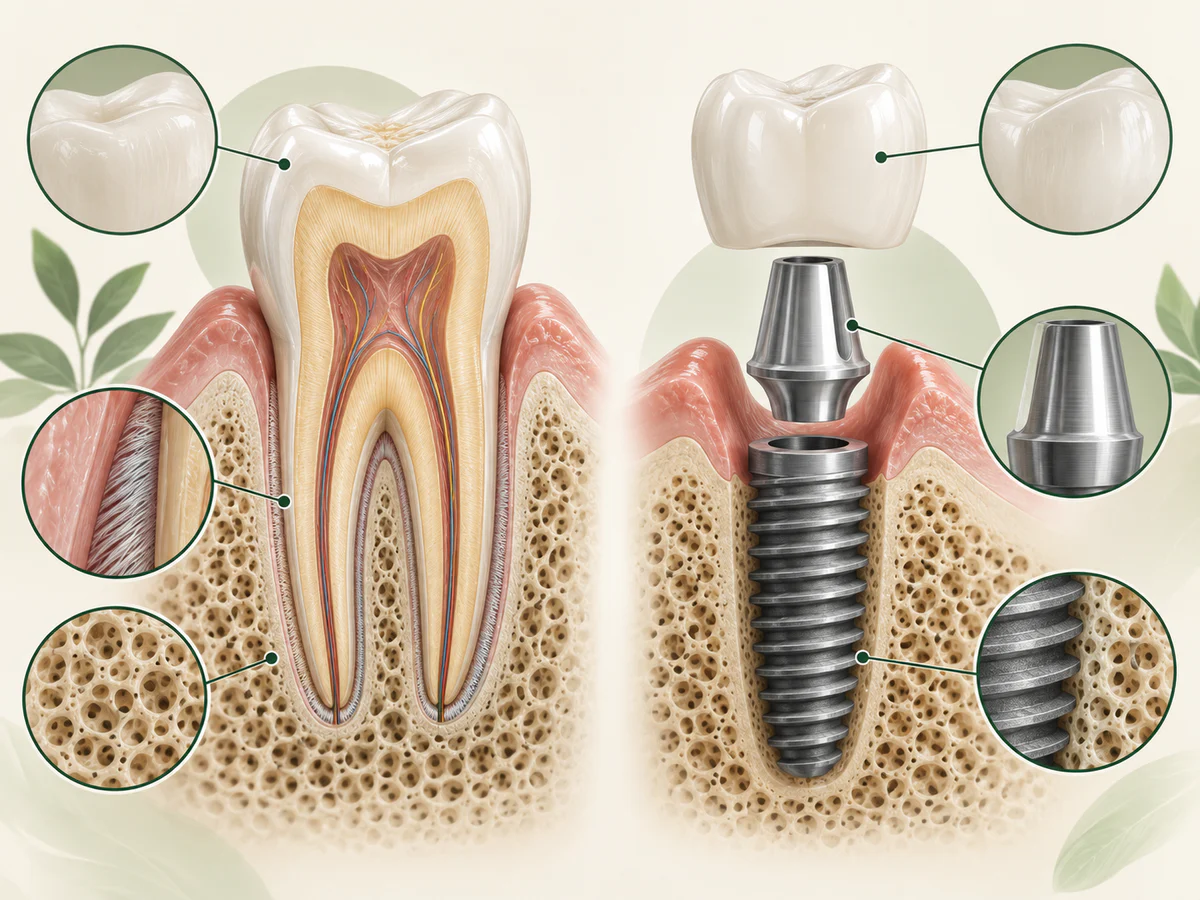
- the fixture, the part anchored in the bone, which acts as the root;
- the abutment, which connects the implant to the restoration;
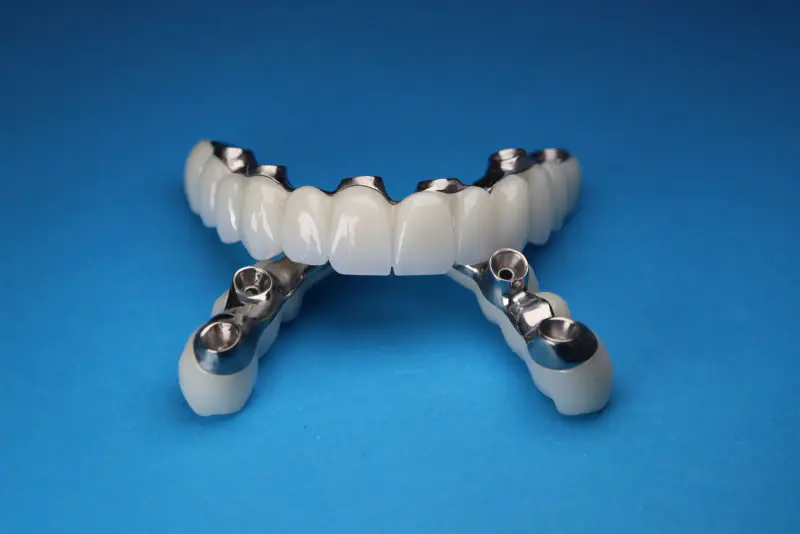
- the restoration itself, a crown, bridge or implant-stabilized removable denture, which restores function.
Titanium is the reference material for the fixture, thanks to its biocompatibility and its ability to bond with bone. Zirconia is an alternative in certain situations, but it does not have the same level of long-term clinical follow-up and should not be presented as strictly equivalent.
Why replace a missing tooth?
Losing a tooth is not simply a matter of an empty space. Over time, the neighboring teeth tend to shift and tip into the gap, which disrupts the bite. Beneath the edentulous area, the alveolar bone, no longer stimulated by chewing forces, gradually resorbs. This is a physiological tendency that varies from person to person, not a fixed, quantifiable outcome for any given patient.
From a public health standpoint, the WHO notes in its Global Oral Health Status Report 2022 that oral diseases affect close to half of the world’s population, and that severe periodontitis is a major cause of complete tooth loss. Replacing a missing tooth is therefore part of preserving function, not only appearance.
What are the indications for a dental implant?
An implant may be considered in several clinical situations:
- replacing a single tooth without involving the neighboring teeth;
- replacing several teeth with an implant-supported bridge;
- stabilizing a complete denture in an edentulous patient.
The McGill consensus (2002) concerns a removable lower denture retained by two implants, not all fixed bridges. Stabilisation can improve retention and satisfaction; expected benefits depend on the patient and restoration.
The choice between an implant, a conventional bridge and a removable denture depends on bone condition, the remaining teeth, gum health and each person’s expectations. It is decided after the assessment, not beforehand.
What does the assessment before implant placement involve?
The first step is not surgical. It is a complete assessment, essential for confirming that the implant is indicated and can be carried out under good conditions.
Clinical examination and general health
The assessment begins with a medical history and an examination of the mouth: the condition of the gums and remaining teeth, mouth opening, bite and hygiene. Periodontal status is decisive. Inflamed gums or untreated periodontitis must be managed before any placement, because they compromise healing and the long-term stability of the implant.
Cone Beam in treatment planning
Three-dimensional imaging is a central part of the implant assessment. The Cone Beam, or CBCT, provides a three-dimensional analysis of the available bone volume and the position of the anatomical structures that must be respected, in particular the inferior alveolar nerve and the maxillary sinuses.
The clinician selects imaging after the assessment and review of existing images. AAOMR 2012 and ADA/AAOMR 2026 recommendations give cross-sectional imaging an important role in presurgical implant planning. The indication, field and exposure remain patient-specific. Equipment does not guarantee the outcome.
This examination answers a key question: is there enough bone, in both height and width, to anchor the implant? When there is not, solutions exist, and they are covered further below.
Reading the images: overview and cross-sections
Why two views? The 3D volume provides an overview; sections explore a selected area. The clinician compares this information with the oral examination and prosthetic plan. A screen photograph does not replace the examination files or their interpretation. See Cone Beam and 3D dental imaging.
Implant placement: how does the surgery work?
Placement involves preparing a site in the bone and inserting the implant, usually under local anaesthesia. Operative conditions and anaesthesia arrangements are explained during the assessment.
The usual sequence includes:
- local anesthesia of the area;
- access to the bone and preparation of the implant site;
- placement of the implant;
- suturing and, depending on the case, placement of a healing screw.
Ultrasonic instruments may be used for certain bone procedures. They do not remove the need for anatomical precautions and have limitations and risks.
Al-Maawi et al. (2021, PMC8684569) reviewed PRF after tooth extraction. Their early-healing findings do not establish a benefit for every implant placement or long-term implant success.
And when there is not enough bone?
When bone volume is insufficient, immediate placement is not always possible. Several reconstruction solutions exist, sometimes performed before or during implant surgery:
- bone grafting, detailed in bone grafting before an implant: why, how and healing;
- sinus grafting, or sinus lift, presented in sinus grafting (sinus lift): indications and procedure;
- other options suited to cases of reduced volume, described in dental implant when there is not enough bone: what are the solutions.
The day of placement: what you feel, how long it takes, and how the nerve and sinus are protected
What you feel. Under local anaesthesia, you stay awake. The practitioner checks that the area is fully numb before starting, so that you do not feel pain during the procedure (NHS, local anaesthesia). You may, however, hear the instruments and feel that work is being done in your mouth. If a sensation becomes painful, raise your hand: the anaesthesia can be topped up and a pause is possible.
How long it takes. For one implant, surgery often takes half an hour to an hour and a half, depending on the site and any associated steps, according to the patient information of two UK public hospitals (Cambridge University Hospitals, Leeds Teaching Hospitals). It is an outpatient procedure: you go home the same day, and it is sensible to plan to rest for the remainder of the day. A graft or several implants lengthen the session. Surgery for a single implant is not on the same scale as an extensive bone reconstruction.
The nerve and the sinus. In the lower jaw, a nerve runs through the bone and gives sensation to the lower lip and chin. In the upper jaw, the sinus lies above the back teeth. Pre-operative imaging measures the available distance, and the implant is chosen and positioned with a safety margin from these structures (Juodzbalys et al., 2011). When it is indicated, Cone Beam provides this measurement in three dimensions, and guided implant surgery can help reproduce the planned position. None of these tools removes the risk.
What should be reported. A nerve can be irritated or bruised during placement. If tingling or numbness of the lip, chin or tongue persists after the anaesthesia has worn off, contact the practice the same day or the next day. The Juodzbalys review recommends checking sensation the day after surgery and removing the implant within 36 hours if it is in contact with the nerve canal. This altered sensation usually recovers within a few months and is rarely permanent (Cambridge University Hospitals). When a sinus lift is performed at the same time, you are usually asked not to blow your nose for about two weeks (Cambridge University Hospitals, sinus lift).
If you feel very apprehensive, say so at the assessment. The options, including conscious sedation with MEOPA, are discussed according to the planned procedure and your health.
Osseointegration: the healing phase
Once the implant is placed, a healing period follows during which the bone gradually bonds to the implant surface. This is osseointegration, the stage that determines long-term stability.
Its duration varies according to the site, bone quality and the clinical situation, and is counted in weeks to a few months. In selected cases, a temporary restoration may be placed earlier, but the definitive restoration is always made after sufficient healing. Presenting a complete, definitive restoration in twenty-four hours as a universal standard would be an over-promise.
During this phase, oral hygiene and following the post-operative instructions are essential to how well osseointegration proceeds.
The implant restoration: the final stage
Once osseointegration is confirmed, the prosthetic phase begins. The abutment is connected to the implant, impressions are taken, and then the definitive restoration is made and fitted: a single crown, a bridge or a stabilized removable denture, depending on the plan established at the outset.
It is this restoration that restores chewing, speech and appearance. The functional result depends on the type of restoration and the arch involved, which is why no single figure for chewing performance can reliably be put forward.
What is a digital impression used for?
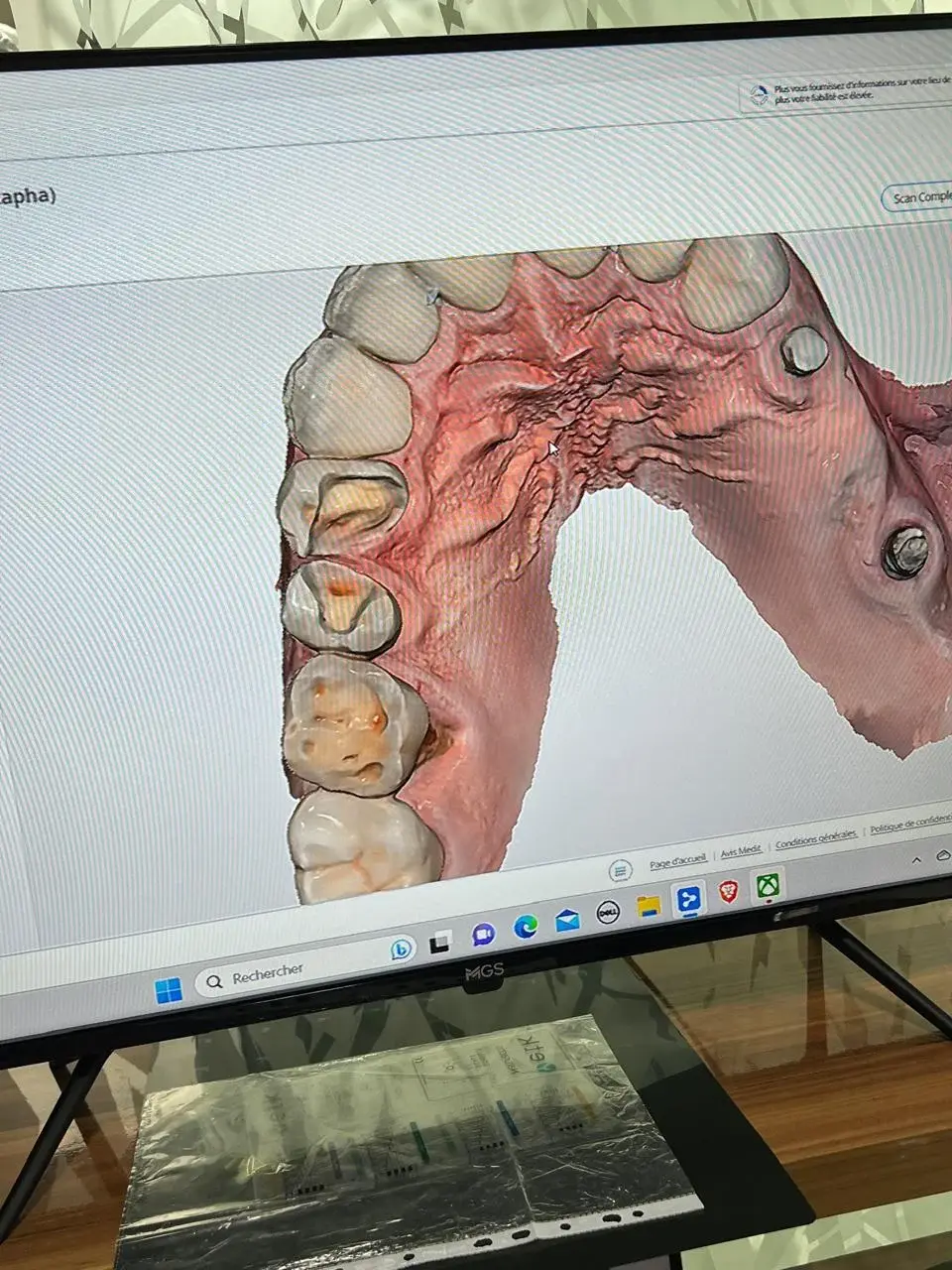
An impression records oral surfaces for prosthetic work, not the bone volume shown by Cone Beam. For implant treatment, recording and checks depend on the system and planned restoration. This image proves neither the technique used nor a clinical outcome. Leeds Teaching Hospitals distinguishes impressions, prosthesis manufacture and checks.
What are the risk factors and limitations?
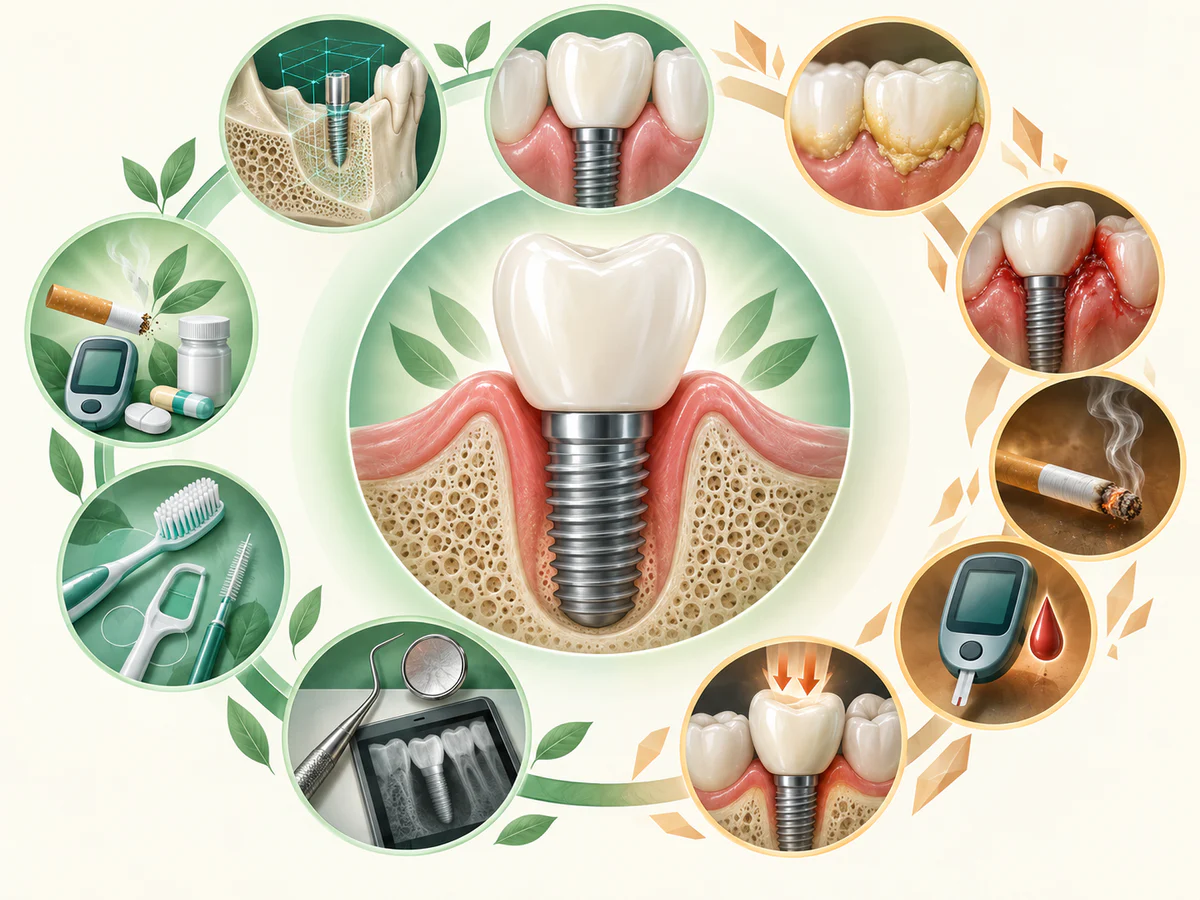
Honest information also means presenting the limitations. Implant survival is high, but it is neither absolute nor guaranteed over time.
Survival is not the same as success
According to the systematic review by Howe, Keys and Richards (2019, Journal of Dentistry), implant survival is around 96% at 10 years, and drops to around 93% in the sensitivity analysis adjusted for those lost to follow-up, with a possibly higher risk of failure in older patients. These figures describe survival, that is, the implant still being in place, and not the absence of complications.
An implant that is still in place can indeed develop a disease. The World Workshop 2017 consensus (Berglundh et al., 2018) defines peri-implantitis as a plaque-associated condition marked by progressive bone loss around the implant. Survival is therefore not the same as success: regular follow-up makes it possible to detect these complications. The warning signs are described in implant failure and peri-implantitis: signs to watch for.
Risk factors
Chen (2013) examined several associations. More recent diabetes reviews, including Wagner 2022 and Al Ansari 2022, support individual assessment rather than a conclusion based on one older finding:
| Factor | What to assess |
|---|---|
| Smoking | Association with more implant failures |
| Radiotherapy | Treatment history and irradiated site |
| Diabetes | Control, other risk factors and follow-up |
| Osteoporosis | General health and medication; diagnosis alone does not determine the outcome |
Diabetes does not automatically rule out implants. Disease control, other risks and follow-up require individual assessment; the diagnosis alone cannot predict a person’s outcome. Smoking cessation should be discussed. Insufficient bone calls for comparison of options, not automatically a graft.
Finally, the term rejection is inaccurate: titanium is not rejected by the immune system the way a transplanted organ is. When an implant does not hold, this is a failure of osseointegration or peri-implantitis, not immunological rejection.
The process in summary
To summarize, the dental implant journey follows this order:
- clinical assessment, evaluation of periodontal and general health status;
- The clinician chooses useful examinations after assessment and review of existing images. CBCT has an important role in implant planning; its indication and settings are individualised.
- where applicable, bone reconstruction (graft, sinus grafting);
- implant placement according to the agreed operative and anaesthesia plan;
- healing and osseointegration;
- fabrication of the definitive restoration;
- regular follow-up and maintenance.
The dental implant is a reliable solution for replacing one or more teeth, provided there is a thorough assessment, an appropriate indication and long-term follow-up. No stage should be presented as painless or risk-free, and no lifespan can be guaranteed. It is precisely this careful, evidence-based framing that allows an informed decision to be made.
Report current or past bisphosphonate or denosumab treatment. Dose and indication affect assessment, particularly in cancer care. Do not stop prescribed medicines yourself. ADA reference.
Frequently asked questions
Is placing a dental implant painful?
What is the success rate of a dental implant?
Can an implant be placed if you smoke?
Is a Cone Beam always needed before an implant?
How long is needed between placement and the definitive restoration?
How long does implant placement take, and do you go home the same day?
Can a nerve or the sinus be touched when an implant is placed?
Sources
Medical references consulted for this article.
- 1OMS, Global Oral Health Status Report 2022 (communiqué)
- 2Howe, Keys & Richards 2019, survie implantaire à 10 ans, Journal of Dentistry
- 3Berglundh et coll. 2018, consensus péri-implantaire, World Workshop 2017, J Clin Periodontol
- 4Chen et coll. 2013, facteurs de risque d'échec implantaire, PLOS ONE
- 5Jacobs et coll. 2018, recommandations sur le CBCT en implantologie, BMC Oral Health 18:88
- 6McGill Consensus Statement 2002, overdenture mandibulaire, Gerodontology
- 7Revue systématique PRF et cicatrisation alvéolaire, 2021 (PMC8684569)
- 8UFSBD, fiches patients (Union Française pour la Santé Bucco-Dentaire)
- 9Wagner et coll. 2022, revue systématique sur le diabète et les implants dentaires
- 10Al Ansari et coll. 2022, revue systématique et méta-analyse sur diabète et implants dentaires
- 11AAOMR 2012, imagerie en implantologie
- 12ADA/AAOMR 2026, sélection des examens d'imagerie dentaire
- 13Leeds Teaching Hospitals NHS Trust, Dental implants (information patients)
- 14Cambridge University Hospitals, Insertion of dental implants (information patients)
- 15Cambridge University Hospitals, Sinus lift procedures (information patients)
- 16NHS, Local anaesthesia
- 17Esposito et coll. 2013, délais de mise en charge des implants, revue Cochrane
- 18Buser et coll. 2017, pose immédiate, précoce ou tardive après extraction, Periodontol 2000
- 19Juodzbalys, Wang & Sabalys 2011, lésion du nerf alvéolaire inférieur lors de la pose d'implant, J Oral Maxillofac Res
Contents
Share