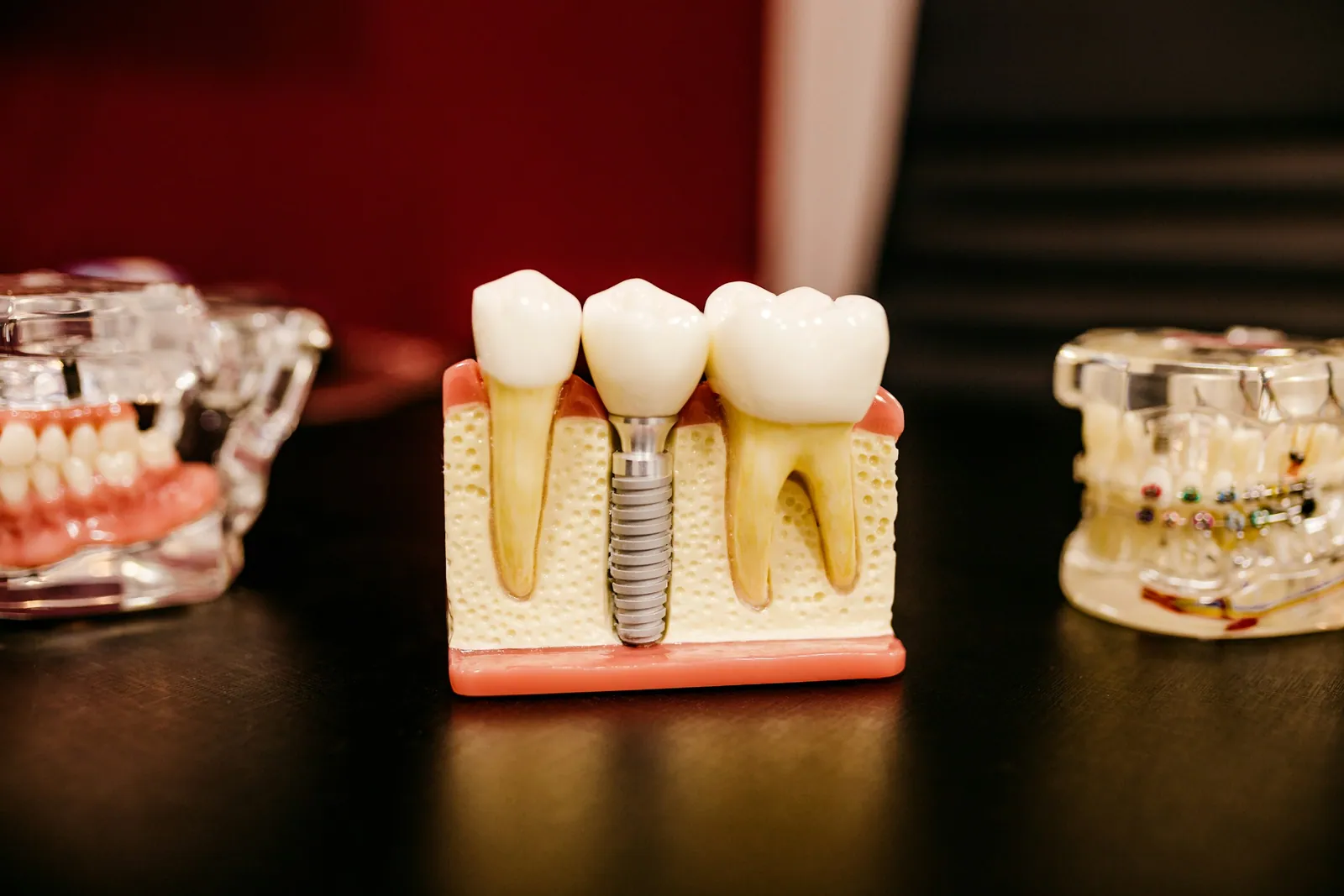
When it comes to replacing a missing tooth, there is no solution that is superior in absolute terms. The right choice between an implant, a bridge and a removable prosthesis (the denture) depends on your clinical situation: the condition of the neighboring teeth, the volume of bone available, your general health and the maintenance each option requires. The most useful figure to know is that at ten years, the survival of an implant-supported crown and that of a bridge anchored to the neighboring teeth are of the same order of magnitude, around 89%, according to the systematic review by Pjetursson and colleagues published in Clinical Oral Implants Research in 2007. In other words, these three families of treatment address different problems, and the decision is built together with your practitioner, criterion by criterion, rather than from a commercial ranking.
This article offers a balanced comparison, with no prices and no hierarchy. Every clinical statement points to a verifiable source, and the benefits are presented alongside their limits and their contraindications, because nuance is precisely what makes an informed decision possible.
Why replacing a missing tooth changes the bone picture
Before even comparing the options, it helps to understand what happens when a tooth is extracted and nothing takes its place. The bone that surrounded the root, the alveolar bone, is no longer stimulated and resorbs.
The systematic review by Tan and colleagues (Clinical Oral Implants Research, 2012) quantified this phenomenon on non-preserved human sites: the ridge loses on average close to 3.8 mm in width and 1.2 mm in height in the six months following the extraction. The loss is most marked in the first months, then slows down. It is not a sudden disappearance, but a gradual process that unfolds over months to years.
This resorption has two concrete consequences for the choice of treatment. First, the longer you wait, the more the available bone volume may become a limiting factor for an implant. Second, this remaining volume directly guides the decision: it determines whether an implant is feasible, sometimes after preparing the site. To go further on this point, you can read our article on solutions when there is not enough bone to place an implant.
Implant, bridge or denture: what each solution involves
The three options are not three versions of the same thing. They rest on different principles.
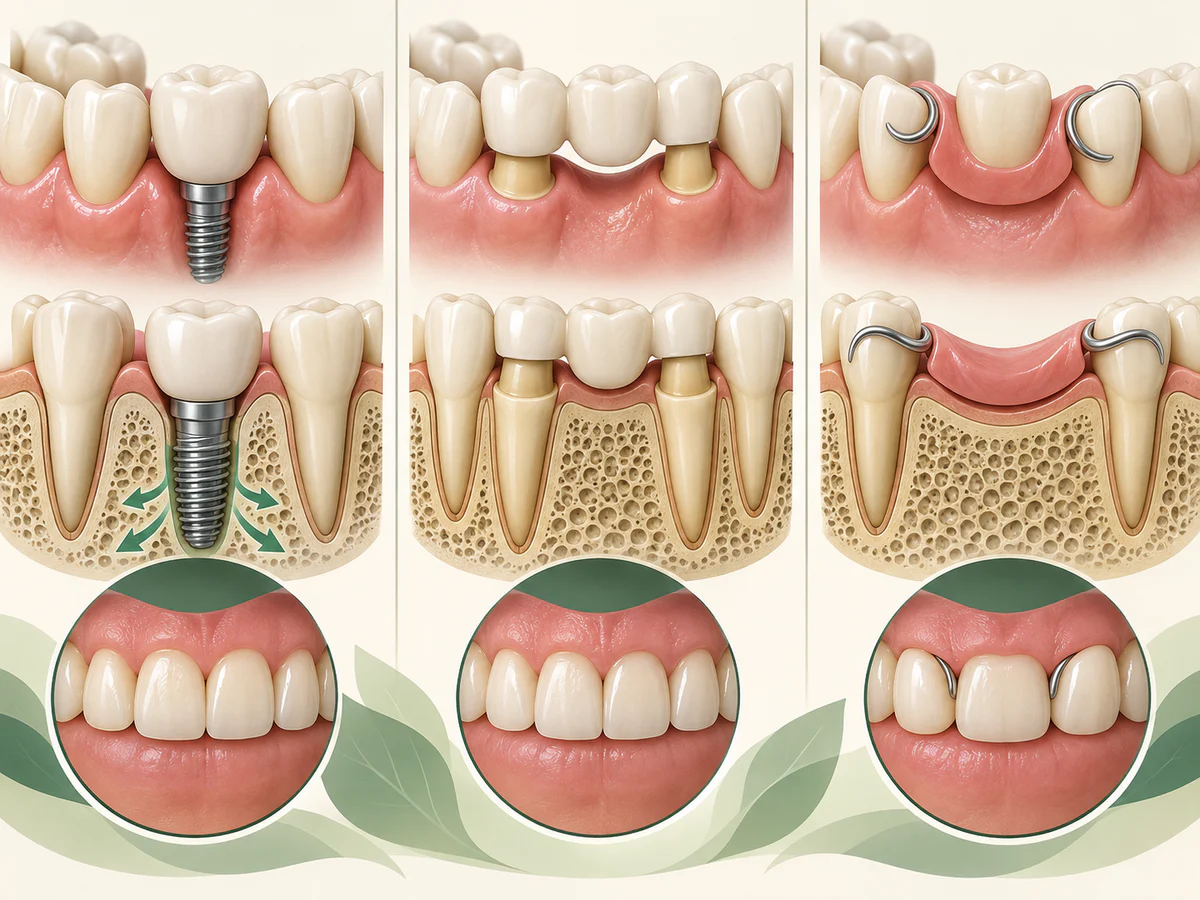
The dental implant
An implant is an artificial root, usually made of titanium, inserted into the jawbone. Once osseointegration is achieved, that is, once the bone has healed around the implant, a crown, a bridge or a prosthesis is attached to it. The main advantage is that this solution does not rely on the neighboring teeth and that it loads the bone, which contributes to maintaining it. The full process, from indications through to healing, is detailed on our page about the dental implant in Kénitra.
The bridge
A conventional bridge replaces one or more teeth by resting on the adjacent teeth, known as abutments. These teeth have to be prepared so that they can receive the crowns supporting the intermediate element. It is a fixed solution, with no implant surgery, but it comes at a biological cost to the supporting teeth.
The denture and the removable prosthesis
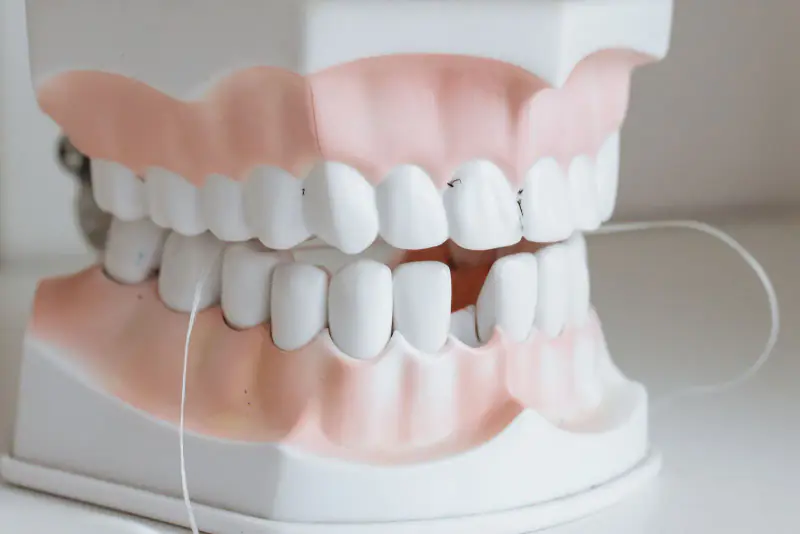
A removable prosthesis, partial or complete, rests on the gum and the underlying bone, sometimes with clasps on the remaining teeth. It is taken out for cleaning. It is the least invasive solution, but also the least stable, particularly in the case of a complete lower prosthesis.
Bridge or implant: the neighboring-teeth criterion
This is often the criterion that settles the choice between a bridge and an implant when replacing a single tooth.
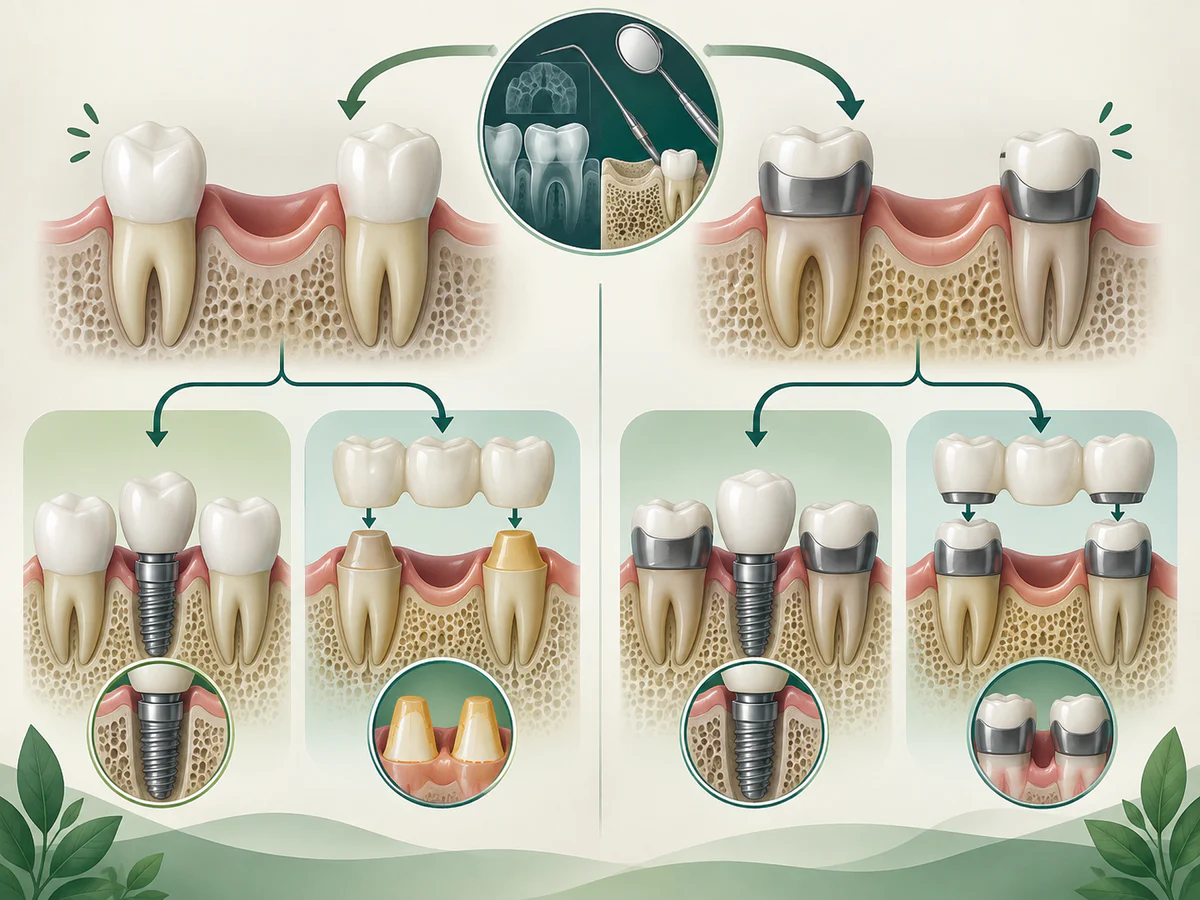
A conventional bridge requires the teeth bordering the gap to be prepared, even when they are perfectly healthy. According to Pjetursson and colleagues (2007), the most frequent complications of tooth-supported bridges are biological: caries and loss of pulp vitality in the abutment teeth. Preparing two intact teeth in order to replace one therefore carries a biological cost that has to be factored into the decision.
Two situations stand out:
- The neighboring teeth are healthy and intact. Preparing two teeth to place a bridge means permanently weakening teeth that are in good health. The implant, which leaves them untouched, offers an advantage in terms of preservation here.
- The neighboring teeth are already crowned, root-treated or heavily damaged. The biological cost of the bridge is then far lower, since those teeth would have needed a restoration in any case. The bridge becomes a logical option again.
When it comes to longevity, the figures call for moderation. Again according to Pjetursson and colleagues (2007), ten-year survival reaches around 89.2% for the conventional tooth-supported bridge and 89.4% for the single implant-supported crown. Neither solution lasts forever, and there is no guarantee of several decades. If budget is on your mind, our guide to dental implant costs in Morocco explains the determining factors and how to read a quote.
Denture or implant: stability, chewing and comfort
For extensive or complete tooth loss, the comparison shifts toward function.
A complete denture chews markedly less well than natural teeth. An in vivo study by Sharma and colleagues (J Indian Prosthodont Soc, 2017) measured an average bite force of around 63 N with a conventional denture, compared with around 132 N with a prosthesis stabilized on two implants. The implant-supported prosthesis also required fewer chewing cycles to break down a food item. These values illustrate an order of magnitude, not a universal norm, but the trend is clear: stabilizing a prosthesis on implants distinctly improves chewing.
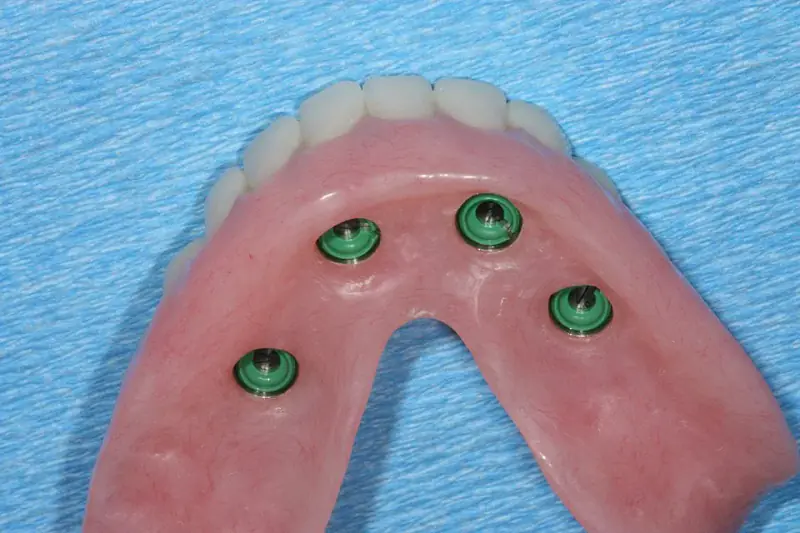
This is where an intermediate solution comes in, one too often forgotten in the denture-versus-implant debate: the removable prosthesis stabilized on implants, or overdenture. For a completely edentulous lower jaw, the McGill Consensus Statement (Gerodontology, 2002) and then the York Consensus Statement (British Dental Journal, 2009) proposed the prosthesis stabilized on two implants as the first choice of care. This is an expert consensus, and therefore a recommendation to be presented as such rather than as an absolute rule, but it offers a useful compromise between the comfort of a removable prosthesis and the hold provided by implants.
Comparison table by clinical criterion
The table below sums up the differences without establishing any hierarchy. Each row corresponds to a criterion to be weighed according to your case.
| Criterion | Implant | Bridge | Removable prosthesis |
|---|---|---|---|
| Neighboring teeth | Preserved, not prepared | Prepared, even when healthy | Not prepared, sometimes clasps |
| Bone | Loaded, contributes to maintaining it | Not loaded under the intermediate element | Not loaded, mucosal support |
| Surgical procedure | Yes, under local anesthesia | No | No |
| Stability and chewing | High | High | Limited, improved if implant-supported |
| Fixed or removable | Fixed | Fixed | Removable |
| Maintenance | Strict hygiene, regular follow-up | Hygiene under the intermediate element | Daily care, readjustments |
What an implant or a bridge changes, and does not change, for the bone
The “Bone” row of the table needs an explanation, because this is often where exaggerated promises start.
After the extraction, whatever comes next. Most of the remodelling of the ridge happens in the year after the extraction, and above all in the first months (Schropp et al., 2003; Tan et al., 2012). None of the three solutions makes lost bone grow back. When bone is missing, only a reconstruction can restore some, with its own limits.
Under the false tooth of a bridge. The pontic rests on the gum, with no root in the bone. Once the ridge has healed, the contour changes under this element remained small over ten years in a small study of 17 patients (Bienz et al., J Clin Periodontol, 2017): the bone does not suddenly disappear under a bridge, but the volume lost before the bridge was made does not come back. Two practical consequences follow. A small gap can remain under the false tooth and trap debris, which calls for suitable cleaning, for example an interdental brush or bridge floss. And if an implant is considered later at that site, the available volume will be reassessed, sometimes with a graft.
Around an implant. The implant transmits chewing forces to the bone around it. Slight remodelling accompanies healing; after that, around a healthy implant, the bone level should no longer decrease (Renvert et al., 2018). This stability is not automatic: peri-implantitis causes progressive bone loss around the implant (World Workshop 2017), hence the importance of follow-up. The implant acts on the bone around it, not on the rest of the jaw.
Under a removable prosthesis. The denture presses on the gum and bone without being anchored in them. That is why changes in the ridge call for adjustments over the years.
In short, a healthy implant can help maintain the bone around it, a bridge does not do so under the false tooth without speeding up its loss once healing is over, and no option restores bone that has already been lost.
The general-health criterion: risk factors and false contraindications
General health shapes the choice, but it rarely locks it. Genuine risk factors need to be distinguished from received ideas.
The meta-analysis by Chen and colleagues (PLoS One, 2013) provides precise data. Smoking is associated with an increased risk of implant failure, with a relative risk of 1.92. Radiotherapy to the oral region is also a risk factor. Diabetes, on the other hand, was not associated there with a significant excess risk when the analysis is conducted overall, and neither was osteoporosis. Well-controlled diabetes is therefore not a contraindication to an implant.
The right vocabulary is that of risk factors to be assessed and prepared for, rather than firm contraindications:
- Smoking increases the risk of failure and warrants support, ideally quitting before the procedure.
- Diabetes has to be well controlled, but it does not rule out an implant when it is managed.
- Medical history and certain treatments are discussed case by case with the practitioner and the treating physician.
When an implant is being considered but bone volume is insufficient, reconstruction techniques exist. Depending on the location, this may involve a bone graft before an implant or, in the posterior upper jaw, a sinus lift. These procedures broaden the indications for implants without making them the only possible answer.
When the implant requires a graft: weighing the bridge and the removable prosthesis
Sometimes the assessment concludes that an implant is possible, but only after a bone graft or a sinus lift. The question then becomes: does the expected benefit of the implant justify one more procedure? Declining the graft is a legitimate choice, and other options remain open.
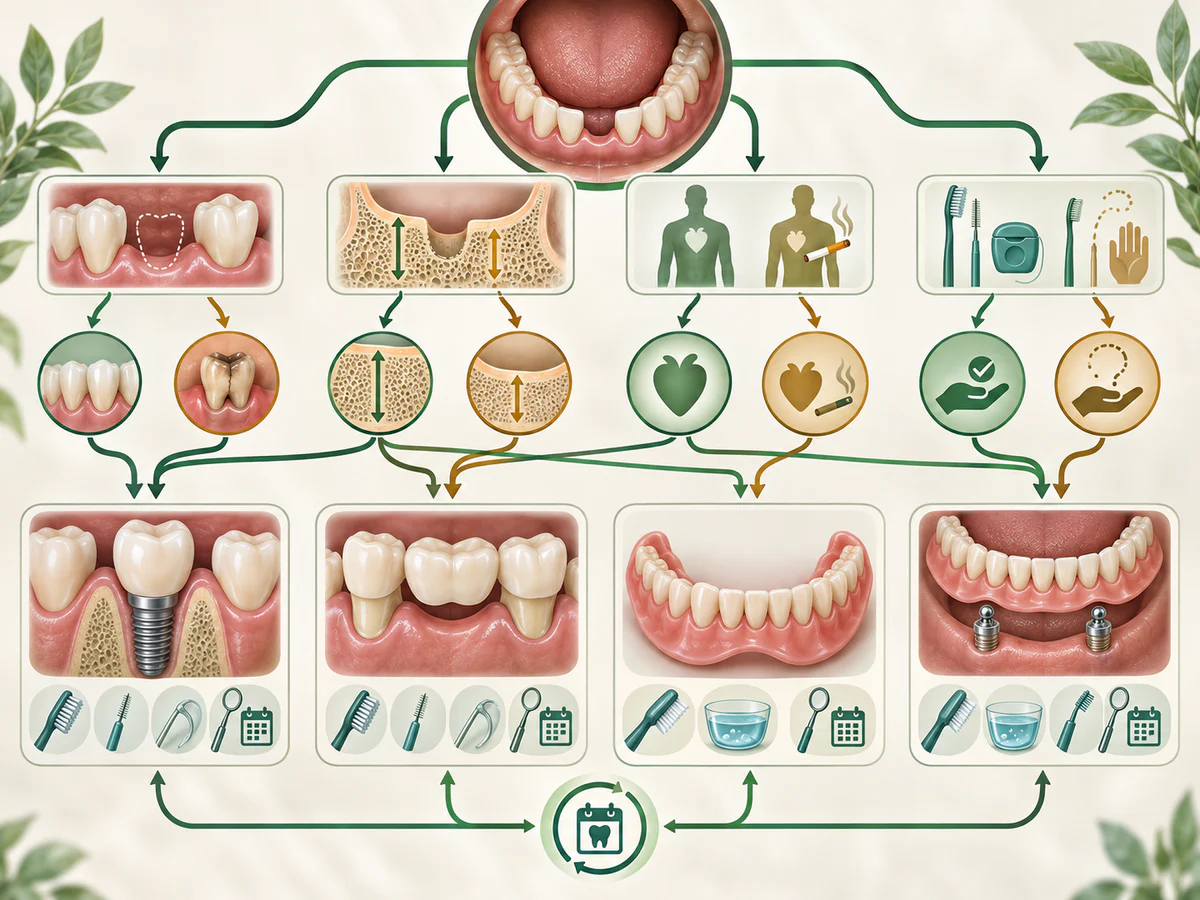
A graft adds surgery, a healing period that is often counted in months, and its own after-effects. For the sinus, the Cochrane review by Esposito et al. (2014) observes more complications at grafted sites, and does not show that a sinus lift does better than shorter implants at preventing failures when the residual bone height allows them.
The options to compare with the practitioner:
- Adapting the implant plan: a shorter implant or a different position, when the anatomy allows it.
- The bridge: it needs no bone under the false tooth, but requires the neighbouring teeth to be prepared. It becomes logical again if they are already crowned or badly damaged. In a visible area, a hollow in the gum under the false tooth may remain noticeable.
- The removable prosthesis: no surgery and no significant tooth preparation, but less stable, with adjustments over time.
- Placing nothing for now, with monitoring, when the gap affects neither chewing nor the balance of the remaining teeth.
None of these options is a foregone conclusion. The decision depends on the condition of the neighbouring teeth, the area concerned and what you accept in terms of procedures and maintenance. The course and timing of a reconstruction are described in bone graft before an implant: why, how and healing.
Maintenance: a criterion that cuts both ways
Implants are sometimes presented as a maintenance-free solution. That is not accurate. Every option calls for maintenance, and the implant has its own complications.
The review by Pjetursson and colleagues (2007) shows that at five years, around 38.7% of patients with an implant-supported bridge present at least one complication, compared with 15.7% of patients with a conventional tooth-supported bridge; these rates are calculated per patient, not per prosthesis. The 2012 review (Clinical Oral Implants Research) specifies that only 66.4% of patients with implant-supported prostheses were free of any complication at five years, the most frequent being technical complications of the veneering material, screw loosening and problems affecting the peri-implant tissues.
This does not disqualify the implant, but it does call for two honest qualifications:
- The implant procedure takes place under local anesthesia and is generally well tolerated. Describing it as painless or risk-free would be misleading.
- Inflammation of the tissues around the implant, peri-implantitis, can occur and requires follow-up. The word rejection is inaccurate: we speak of failure of osseointegration or of peri-implantitis, an inflammatory disease redefined at the 2017 World Workshop. The signs to watch for are described in our article on implant failure and peri-implantitis.
On the removable prosthesis side, maintenance involves daily care and the readjustments made necessary as the ridge changes over time. The bridge, for its part, calls for rigorous hygiene under the intermediate element in order to protect the abutment teeth.
How the choice is actually made
In practice, the decision follows a clinical logic, not a ranking. A few useful benchmarks:
- A single missing tooth, healthy neighboring teeth: the implant preserves the adjacent teeth, which is often a strong argument.
- A missing tooth, neighboring teeth already restored: the bridge becomes relevant, because its biological cost is reduced.
- Insufficient bone for an immediate implant: a graft or a sinus lift is assessed, or another solution is considered.
- Complete tooth loss, with stability as the goal: the prosthesis stabilized on implants offers a compromise between comfort and hold.
- Risk factors or a particular medical context: the choice is built after assessment, with no automatic exclusion.
The work-up rests on a clinical examination and appropriate imaging. At the practice, three-dimensional Cone Beam imaging makes it possible to gauge precisely the bone volume available, which is decisive in telling apart a site favorable to an implant from a site that needs prior preparation. It is this analysis, and not a preference on principle, that points toward one or another of the three families of treatment.
If the tooth has been missing for a long time, read a tooth that has been missing for years; for the final tooth, crown on an implant or on a tooth.
What to remember
Implant, bridge and denture cannot be ranked from best to worst. They address distinct situations, each with its own benefits and limits. At ten years, the survival of the implant-supported crown and that of the tooth-supported bridge are comparable, around 89% according to Pjetursson and colleagues (2007). The choice is built on verifiable criteria: the condition of the neighboring teeth, bone volume, general health and the maintenance you are willing to take on. A consultation makes it possible to weigh these criteria for your case and to decide with full understanding.
To go further into each option at the practice: dental implants in Kénitra and dental bridge in Kénitra.
If your denture still moves despite adjustments, also read A denture that no longer stays in place: from adjustments to implants.
Report current or past bisphosphonate or denosumab treatment. Dose and indication affect assessment, particularly in cancer care. Do not stop prescribed medicines yourself. ADA reference.
Frequently asked questions
Implant, bridge or denture: which one lasts the longest?
Do the neighboring teeth really have to be prepared in order to place a bridge?
Can a smoker or a person with diabetes have an implant?
Does a complete denture allow you to chew properly?
What happens to the bone if I do not replace the tooth?
Does the bone keep shrinking under a bridge or around an implant?
Sources
Medical references consulted for this article.
- 1Pjetursson BE et al., Survie et complications des bridges dento-portes, implanto-portes et couronnes sur implant, Clinical Oral Implants Research, 2007
- 2Pjetursson BE et al., Survie et complications des protheses fixes sur implants a 5 ans et plus, Clinical Oral Implants Research, 2012
- 3Tan WL et al., Modifications dimensionnelles de la crete apres extraction (revue systematique), Clinical Oral Implants Research, 2012
- 4Chen H et al., Tabac, radiotherapie, diabete et osteoporose comme facteurs de risque d'echec implantaire (meta-analyse), PLoS One, 2013
- 5McGill Consensus Statement on Overdentures, Gerodontology, 2002
- 6York Consensus Statement, prothese mandibulaire sur deux implants, British Dental Journal, 2009
- 7Sharma AJ et al., Efficacite masticatoire, dentier conventionnel versus overdenture sur implants, J Indian Prosthodont Soc, 2017
- 8Schropp L et al., Cicatrisation osseuse et modifications du contour apres extraction d'une dent (etude prospective a 12 mois), Int J Periodontics Restorative Dent, 2003
- 9Bienz SP et al., Modifications volumetriques sous l'element intermediaire d'un bridge, suivi a 10 ans, J Clin Periodontol, 2017
- 10Renvert S et al., Sante peri-implantaire, mucosite et peri-implantite : definitions de cas, J Periodontol, 2018
- 11Berglundh T et al., Maladies peri-implantaires, rapport de consensus du World Workshop 2017, J Clin Periodontol, 2018
- 12Esposito M, Felice P, Worthington HV, Procedures d'augmentation du sinus maxillaire, revue Cochrane, 2014
Contents
Share