

In short: A topical anesthetic gel applied to the gum before a dental injection numbs the spot where the needle enters, and a meta-analysis of randomized trials found that it reduces pain during needle penetration. It does not numb the tooth itself: it prepares for the injection without replacing it, and injecting slowly remains the most important factor for comfort.
Fear of the needle is one of the most frequently cited reasons for postponing — or avoiding altogether — a visit to the dentist. That is a shame, because dental anesthesia has come a long way, and the memory of the injection that “burns” bears less and less resemblance to the reality of a well-equipped practice. Even so, honesty matters: no serious dentist should promise absolute “zero pain.” The more accurate way to put it is that, in the vast majority of cases, the injection can be made nearly painless. This educational article explains how local anesthesia works, what modern techniques bring (topical numbing gel, computer-assisted injection), the simple steps that reduce the sensation of the needle prick, and — most importantly — what anesthesia does not take away.
Let’s start by setting the stage. Administering a local anesthetic is one of the most common procedures in dentistry: it accompanies most treatments, from filling a cavity to extracting a tooth. The American Dental Association notes that local anesthesia — based on molecules such as lidocaine, and often combined with a topical numbing gel — forms the foundation of pain control in dental care. Properly understood, it is what makes it possible to receive treatment with peace of mind.
How local anesthesia works
A tooth hurts because nerves, located in the pulp and around the root, carry pain signals to the brain. Local anesthesia involves placing a product (a local anesthetic) near these nerves to temporarily block the transmission of that signal. In practical terms, the molecule stops the nerve fibers from “conducting” the impulse: as long as the product is active, the area remains insensitive to pain, even though you are fully conscious and awake.
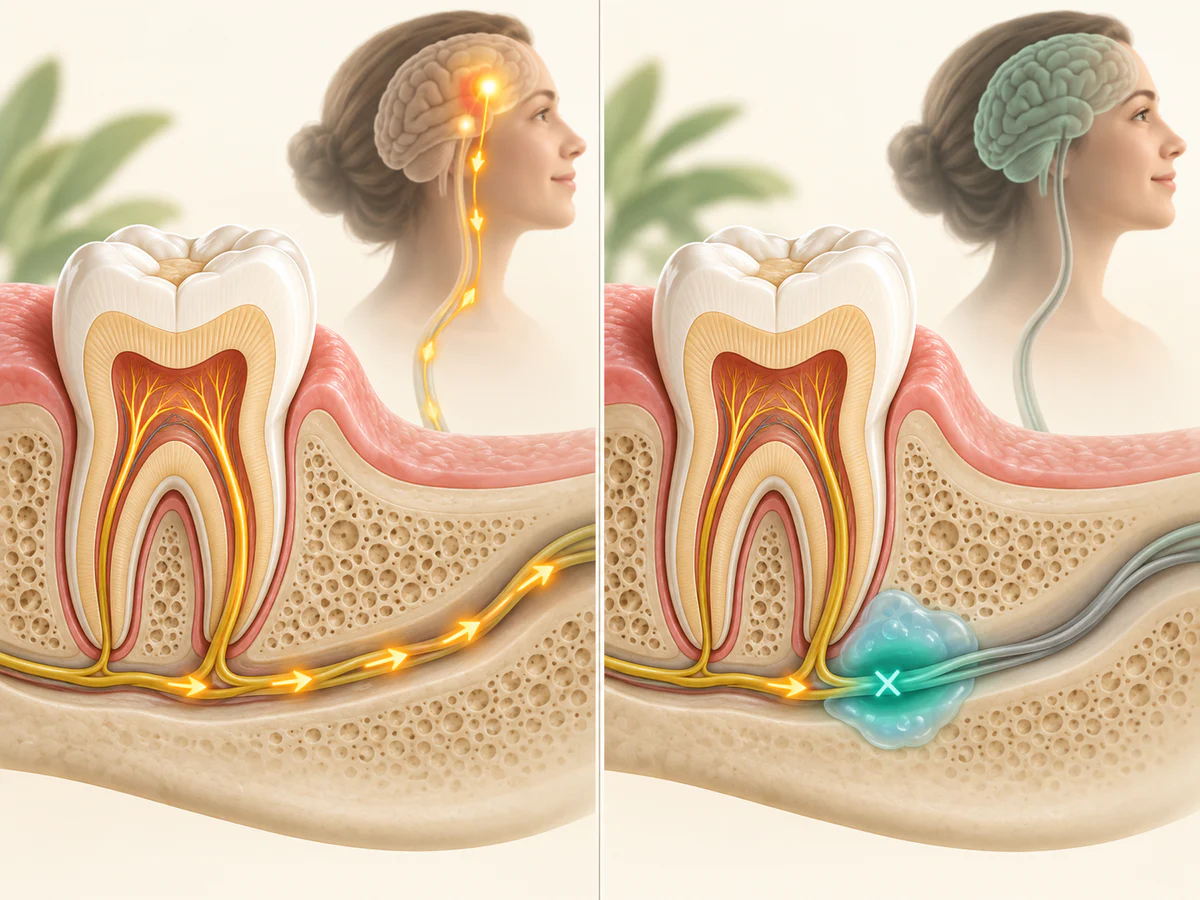
Broadly speaking, there are two main ways to numb an area. Infiltration places the product right next to the tooth being treated, through the gum; it is widely used in the upper jaw. A nerve block (for example, the inferior alveolar nerve block, in the lower jaw) numbs an entire region by targeting a larger nerve trunk: this is the one that also leaves the lip and tongue numb on one side. The product then takes a few minutes to reach full effect before treatment begins — which explains the wait you sometimes notice between the injection and the start of the procedure.
One point that often surprises people: it is not so much the needle itself that hurts. The unpleasant sensation comes mainly from two things — the needle passing through the tissues and, above all, the pressure created when the product is injected too quickly. An anesthetic pushed in too fast “stretches” the tissues and causes the burning sensation so many people dread. Modern techniques target precisely these two points.
Topical anesthesia (the gel)
The first step, simple and now nearly routine, is to apply a topical numbing gel to the gum, at the exact spot where the needle will enter. The practitioner first dries the mucosa with a gauze pad, applies a small amount of gel (often lidocaine-based, sometimes flavored for children), then waits a few moments for the surface to go numb. The needle prick that follows is then far less noticeable, because the area has already been numbed at the surface.
What does the research say? A systematic review with meta-analysis of randomized trials showed that topical anesthetics reduce pain during needle penetration, even though their effect on the deeper injection phase is more modest. In other words, the gel works exactly where you would expect it to — at the moment the needle makes contact — without solving everything on its own. Its effectiveness depends on practical details: enough application time, a properly dried area, the right product. It is a genuine comfort measure, not a gimmick, provided it is done well.
Topical anesthetic gel before a dental injection: what to expect
In most dental practices, the numbing gel has become a nearly routine first step before dental procedures that need an injection, such as a filling or an extraction. The gum is dried, a small amount of gel is placed at the injection site, and it is left for a few moments. You may notice its taste, then the surface of the gum goes numb. The gel acts only on this surface, over a few millimeters: it makes the needle prick far less noticeable, but it is the anesthetic injected next that numbs the tooth.
Because the gel needs enough time to work, it is reasonable to ask for it. If you feel nervous, you can also ask the dentist to wait until the gum feels numb and to tell you just before the injection starts. These are simple requests, and feeling in control of the situation already lowers anxiety.
Computer-assisted injection (“electronic” anesthesia)
The second advance concerns the way the injection is delivered. Some practices use systems known as computer-controlled local anesthetic delivery (CCLAD). Instead of a traditional syringe pushed by hand, a small motor delivers the product at a slow, steady flow rate, controlled electronically. It is this steadiness that largely eliminates the sensation of pressure and burning caused by an overly rapid injection.
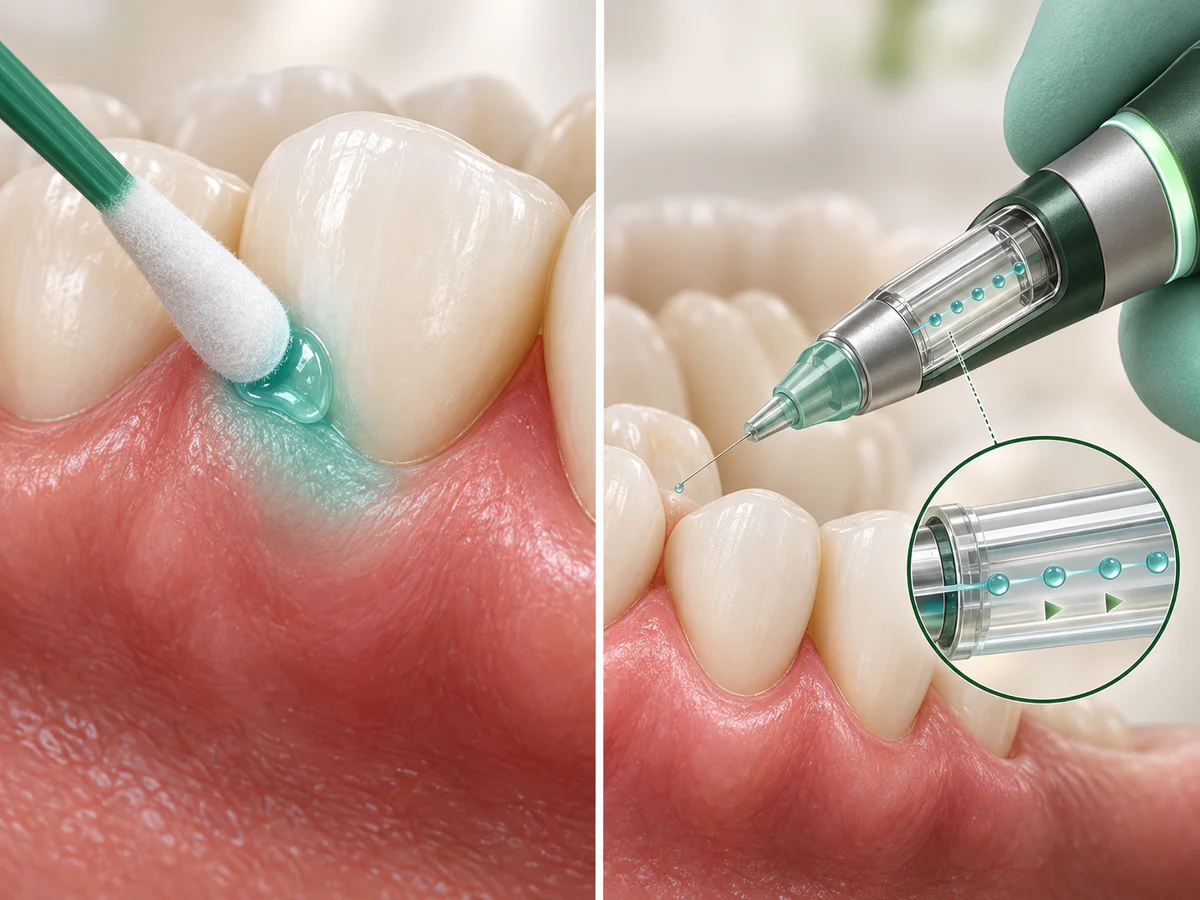
The practitioner holds a slim, lightweight handpiece that looks more like a pen than a syringe, which also makes the procedure less intimidating to watch. The device manages the flow rate, sometimes increasing the speed very gradually.
As for the evidence, the data are encouraging. A systematic review of randomized clinical trials (published in 2024 in the Journal of Dental Anesthesia and Pain Medicine) concluded that computer-controlled anesthesia systems were associated with lower pain perception and better patient behavior, particularly in children. Some perspective is still needed: “lower” does not mean “zero,” and not all studies are of equal quality. The benefit is real, especially for very anxious patients and children, but it does not turn the injection into a guaranteed non-event for everyone.
| Aspect | Traditional syringe | Computer-assisted injection |
|---|---|---|
| Flow rate | Manual, variable | Slow and steady, controlled |
| Pressure sensation | Possible if too fast | Greatly reduced |
| Look of the instrument | Visible syringe | Slim, pen-like handpiece |
| Main advantage | Standard, quick procedure | Comfort, anxious patients, children |
Simple techniques that reduce injection pain
Beyond the equipment, much of the comfort comes down to skill and details that mostly go unnoticed:
- applying the topical gel and letting it work long enough before the injection;
- injecting slowly, which remains the single most important factor, with or without a device;
- redirecting attention (getting you talking, gently stretching the lip, light vibration) to “keep the nerve pathways busy”;
- warming the anesthetic and choosing the right needle gauge and the right amount of product;
- announcing and explaining each step, which removes the element of surprise.
Some teams also use “buffered” anesthetics in an attempt to speed up onset and reduce the sensation at injection. Here, caution is warranted: a review published in Evidence-Based Dentistry concluded that buffering lidocaine does not reduce injection pain to a clinically meaningful degree, and that its effect on onset time remains limited. It is a good example of a measure often presented as “revolutionary” whose real benefit is modest: better to stick with what has been demonstrated.
What anesthesia does not take away
Here is arguably the most important point in this article, and the one most often left unsaid. Local anesthesia removes pain; it does not remove anxiety. The two are distinct, even though they intertwine.

Research shows that anxiety and pain work hand in hand: fear lowers the pain threshold, makes sensations feel more intense than they would to someone at ease, and even amplifies the painful memory afterward. A systematic review on the influence of anxiety on pain perception, particularly in endodontics, found an association: the most anxious patients tend to report more pain. A highly anxious person may therefore experience simple pressure as unpleasant — not because the anesthesia failed, but because their internal alarm system is on maximum alert.
That is why a patient can be perfectly numbed — the tooth no longer “feels” anything — and still be tense, heart pounding. Local anesthesia does not address that. For the fear itself, other tools exist. Conscious sedation with inhaled gas (MEOPA, a nitrous oxide–oxygen mixture) is designed precisely to reduce anxiety during treatment; it is worth understanding that it works alongside local anesthesia, not in its place. If fear is an obstacle for you, our article on conscious sedation (MEOPA) and fear of the dentist explains what this technique does — and, just as importantly, what it does not.
Managing the fear, not just the pain
The first and most effective step is also the simplest: say so. Mentioning your apprehension before the appointment is nothing to be embarrassed about, and it changes everything. The practitioner can then adapt their approach — take more time, explain each move, agree on a signal for a pause, split the treatment into stages. Simply feeling in control of the situation already lowers anxiety. You can mention it when booking or on arrival at the dental practice, so that whoever treats you knows before treatment begins.
A few useful pointers:
- inform, don’t surprise: ask to have each step described before it happens;
- a pause signal agreed in advance (raising your hand) is enormously reassuring;
- breathe slowly, which helps calm the stress response;
- start with a simple procedure to rebuild confidence, whenever possible.
This gradual taming of fear is built over time, and ideally starts very early. For children, establishing a relationship of trust from the first dental visit onward is the best way to prevent anxiety in adulthood. And when a procedure with an intimidating reputation is involved, such as a wisdom tooth extraction, talking it through in detail beforehand often helps take the drama out of it: we fear most what we do not understand.
A final word on honesty. Avoiding care out of fear of the needle means letting a problem get worse — a cavity that progresses, an infection that sets in — until it causes the very pain you were trying to escape. Modern anesthesia, properly performed, removes most of that obstacle. It may not erase the last trace of apprehension, but it makes treatment very largely comfortable to get through.
In summary
“Pain-free dental anesthesia” is less a slogan than a nuanced reality: thanks to topical gel, slow injection — by hand or computer-assisted — and confidence-building techniques, the injection is made nearly painless in the vast majority of cases. The evidence confirms it, without overpromising: topical anesthetics reduce pain at needle penetration, and computer-controlled systems lower pain perception, especially in children and anxious patients. But local anesthesia removes pain, not anxiety: fear is managed through listening, explanation, and sometimes conscious sedation as a complement. The best reflex is still to talk about it openly with your dentist, who will tailor the technique to your situation.
Frequently asked questions
Does dental anesthesia really mean “zero pain”?
What is computer-assisted injection?
Is the numbing gel enough on its own?
Why am I still stressed even though I’m fully numb?
I’m very afraid of the needle: what can I do?
Is there a way to numb a tooth without a needle?
Sources
Medical references consulted for this article.
- 1ADA (American Dental Association), Oral Health Topics — Anesthesia and Sedation (rôle de l’anesthésie locale, lidocaïne, gels topiques)
- 2Almeida CAS et coll. Does the use of topical anesthetics reduce the perception of pain during needle puncture and anesthetic infiltration? Systematic review and meta-analysis of randomized controlled trials. Int J Oral Maxillofac Surg, 2022 (PubMed 34391592)
- 3Efficacy of computer-controlled local anesthesia delivery system (CCLAD) on pain in dental anesthesia: a systematic review of randomized clinical trials. J Dent Anesth Pain Med, 2024;24(4):245 (PubMed 39118810)
- 4Lin GSS et coll. The influence of anxiety on pain perception and its repercussion on endodontic treatment: a systematic review. Clin Oral Investig, 2023 (PubMed 37526740)
- 5Buffered local anaesthetic and injection pain and onset time (commentaire fondé sur la revue d’Aulestia-Viera). Evidence-Based Dentistry, 2018 (PubMed 30361667)
- 6AAPD (American Academy of Pediatric Dentistry), Use of Nitrous Oxide for Pediatric Dental Patients (sédation consciente en complément de l’anesthésie locale)
Contents
Share