Conscious sedation with MEOPA is a technique designed to make dental treatment easier for anxious or phobic patients, and children in particular. In practical terms, the patient breathes in — through a small nasal mask — a gas mixture made up of half oxygen and half nitrous oxide (hence the French acronym MEOPA: an equimolar mixture of oxygen and nitrous oxide).
This gas brings on a state of relaxation and detachment while leaving the patient fully conscious, able to breathe unaided, to answer and to cooperate. The American Academy of Pediatric Dentistry (AAPD) describes nitrous oxide/oxygen as a safe and effective technique for reducing anxiety, producing mild analgesia and improving communication between the patient and the care team.
This has to be said right away, because it is the main source of confusion: conscious sedation is not general anesthesia. The patient does not fall asleep, does not lose consciousness and keeps their reflexes. That is what makes it an appealing option in a private practice — and also what sets its limits.
This article is educational in purpose: it explains what the technique is in general terms, who it is intended for, how a session unfolds, the framework it sits within, its contraindications and — an essential point, in the interest of honesty — what it does not provide.
What is conscious sedation with MEOPA?
Nitrous oxide (N₂O), sometimes nicknamed “laughing gas”, has been used in medicine since the 19th century. In dentistry it is never administered pure: it is mixed with oxygen. MEOPA is the ready-to-use form, at a fixed concentration of 50% nitrous oxide and 50% oxygen; in France it is marketed under names such as Kalinox and has the legal status of a medicinal gas.
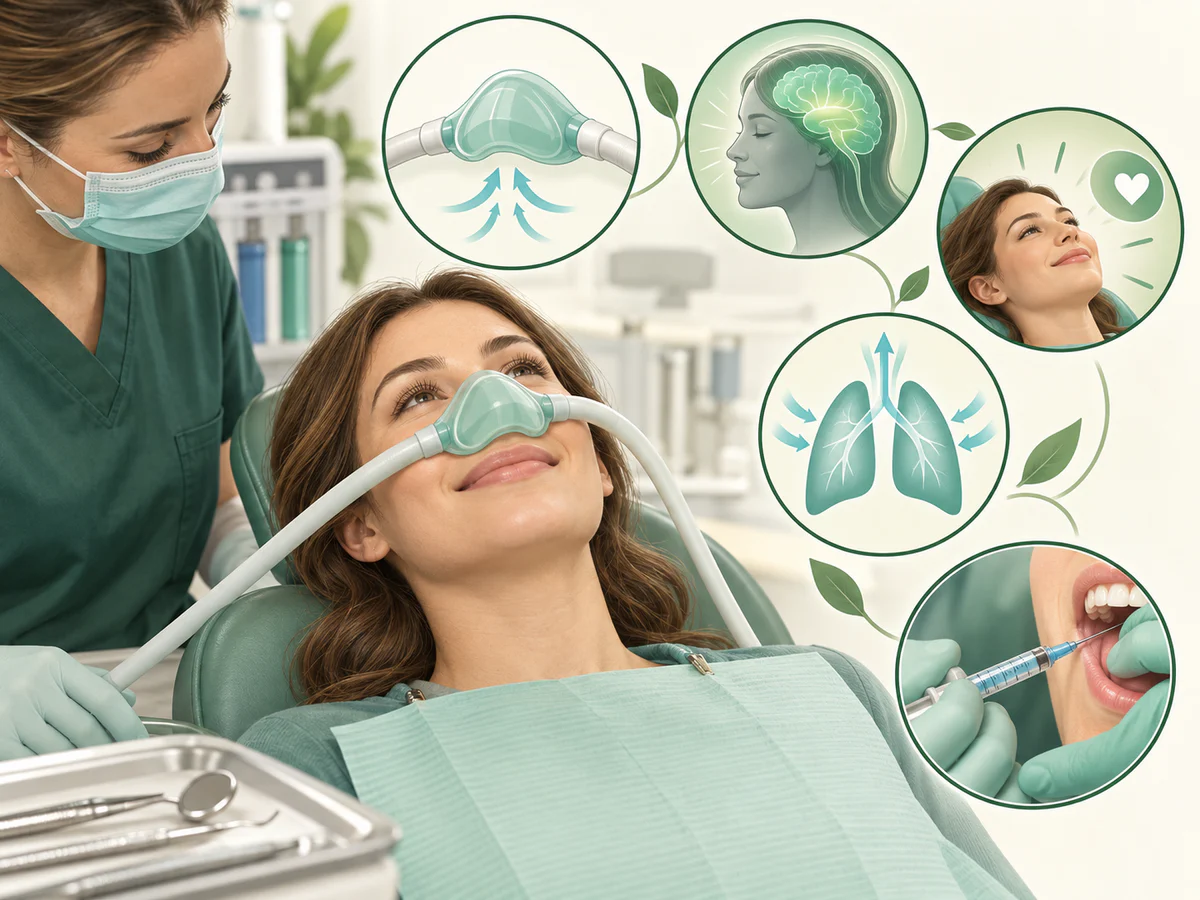
Some devices described as “titratable” allow the practitioner to adjust the proportion of N₂O up to a maximum of 50%, as the Belgian Centre for Pharmacotherapeutic Information (CBIP) points out.
Nitrous oxide acts on the central nervous system. Its effects set in quickly, within a few minutes of inhalation, and wear off just as fast once the gas is stopped. Patients generally report a feeling of warmth and lightness, sometimes tingling in the hands and feet, and a certain detachment from their surroundings and from the passing of time. Anxiety decreases and discomfort is felt less keenly, but alertness and the ability to respond are preserved.
“Conscious” sedation: what the word means
The term “conscious sedation” matters. It refers to a level of minimal to moderate sedation in which the patient:
- stays awake and aware throughout the procedure;
- breathes unaided, without assistance;
- can follow simple instructions (“open your mouth”, “turn your head”);
- keeps their protective airway reflexes.
The AAPD also stresses a point that often goes unrecognized: the effects of nitrous oxide depend in large part on psychological reassurance. The gas does not replace human support; it makes it easier. That is why the classic confidence-building techniques remain indispensable during treatment.
Who is this technique for?
Conscious sedation is intended for patients whose anxiety, fear or difficulty cooperating stands in the way of treatment, when a behavioral approach alone is not enough. The CBIP presents it precisely as an option “when a behavioral approach is not enough” to make the procedure possible.
The main situations concerned are:
- anxious or poorly cooperative children, for whom MEOPA offers an alternative to postponing treatment or carrying it out under general anesthesia;
- adults with a dental phobia, whose apprehension prevents treatment they nonetheless need;
- people with disabilities or specific needs, for whom cooperating can be difficult;
- certain one-off anxiety-provoking procedures, such as an extraction.
This approach forms part of a broader effort to help patients grow comfortable with the dental office step by step, ideally starting very early. For the youngest patients, building a relationship of trust from the child’s first dental visit onwards remains the best way to prevent anxiety; conscious sedation comes as a complement when the need arises, not as a replacement for that support.
Genuine effectiveness, but to be kept in perspective
The available data are rather favorable, without designating any absolute “winner”. A systematic review with meta-analysis published in 2025 (Piccialli et al., in the journal Medicina) compared nitrous oxide with other sedative agents during dental procedures: it found no statistically significant difference between N₂O and the other techniques on the outcomes assessed, with nitrous oxide remaining valued for its rapid onset, its titratability and its rapid elimination.
In children, greater scientific caution is called for. The landmark Cochrane review (Ashley et al., 2018, an update of an earlier review) included some fifty studies on the sedation of children during dental treatment, but pointed out that the vast majority carried a high risk of bias.
Its main finding was moderate-certainty evidence in favor of oral midazolam, and it called for future trials to compare themselves against oral midazolam or inhaled nitrous oxide. In other words: MEOPA is a credible and widely used option, but the overall level of evidence still leaves room for improvement — which is reason to discuss it without over-promising.
How does a session unfold?
The process is simple and non-invasive, which contributes to how readily it is accepted. The main steps are generally as follows:
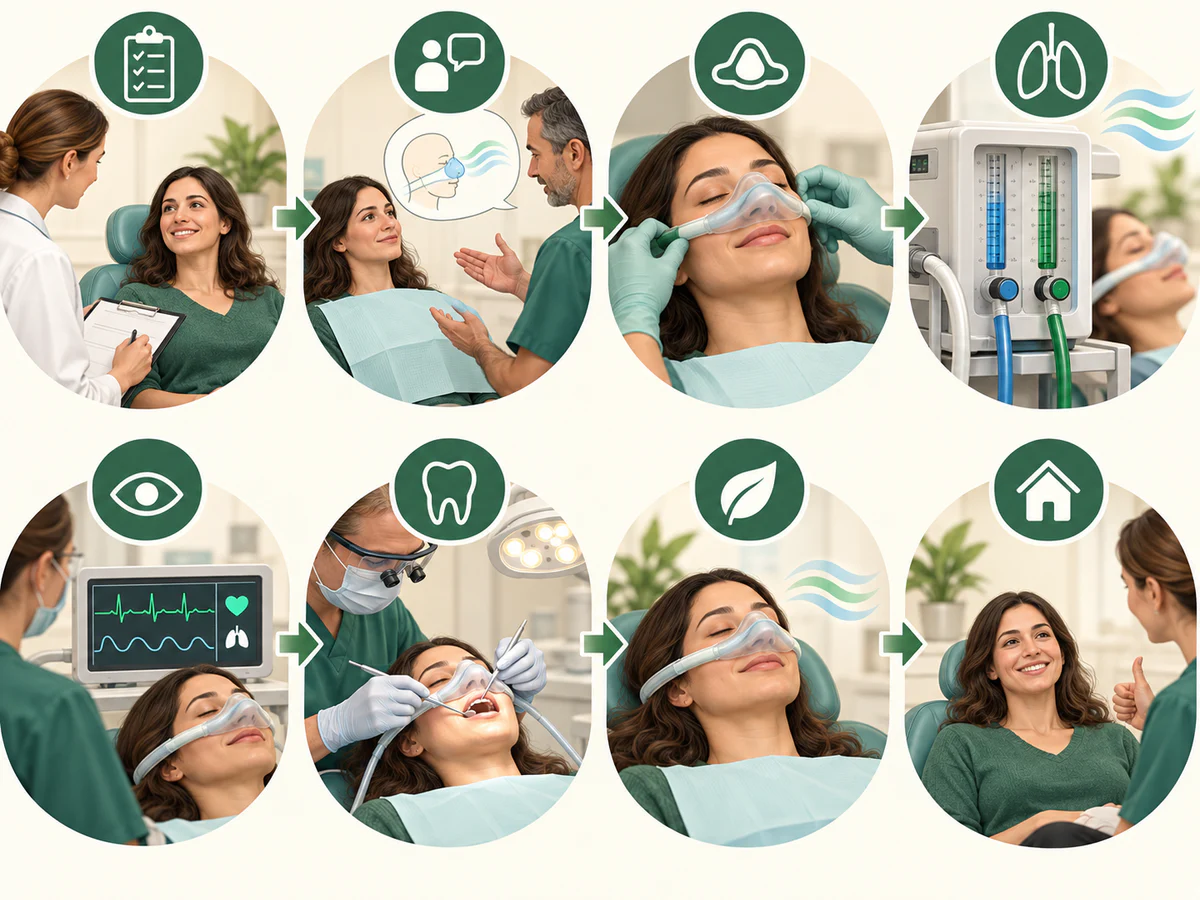
- Prior assessment. The practitioner takes the medical history, checks that there is no contraindication and explains the process to the patient (and to the parents in the case of a child). Consent is obtained.
- Fitting the nasal mask. A small mask, sometimes scented for children, is placed over the nose. The patient breathes normally through the nose.
- Onset of sedation. Within a few minutes, the sense of relaxation sets in. Local treatment (local anesthesia followed by the dental procedure) can then be carried out, MEOPA being no substitute for the usual local anesthesia.
- Continuous monitoring. Throughout, the team monitors the patient’s responsiveness, coloration and breathing, as the AAPD recommends.
- Recovery. Once the gas is stopped, pure oxygen is administered for a few minutes (the AAPD recommends 3 to 5 minutes of 100% oxygen) in order to clear the nitrous oxide. The patient must be back to their baseline state before leaving the office.
One practical advantage lies in this rapid recovery: after a few minutes the patient returns to their usual state and can, in most cases, resume normal activity.
The regulatory framework (in France)
The use of MEOPA is strictly regulated, which is a guarantee of safety. In France, the use of nitrous oxide in dentistry was first recognized and framed by the Haute Autorité de Santé (HAS), with recommendations updated subsequently. Several points structure this framework:
- Specific training. In a private practice, using MEOPA requires obtaining a certificate of competence, issued according to a training standard drawn up by the Ordre national des chirurgiens-dentistes (the French national dental association).
- The status of a medicine. MEOPA is a medicinal gas whose prescription and dispensing are regulated.
- Protecting staff. The Institut national de recherche et de sécurité (INRS) points out that chronic exposure of care providers to nitrous oxide must be kept under control: ventilation of the premises, gas scavenging systems and monitoring are among the expected measures.
This framework may seem restrictive, but it serves a twofold purpose: the safety of the patient and that of the care team. MEOPA is not a comfort “gadget” — it is a regulated medical procedure.
Contraindications and precautions
Despite a good safety profile, nitrous oxide sedation is not suitable for everyone. The contraindications and precautions described in the literature and in professional recommendations notably include:
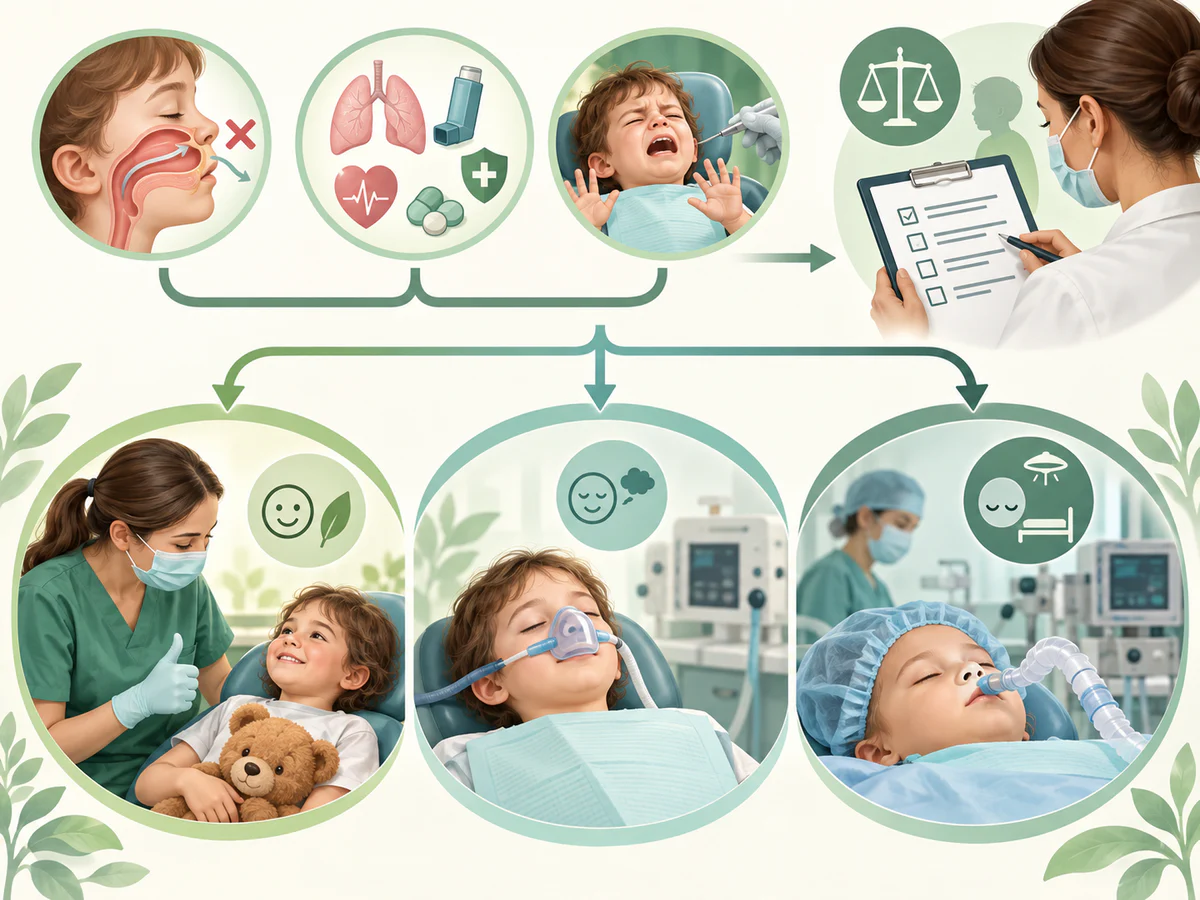
- Nasal obstruction. Since the gas is inhaled through the nose, a bad cold, severe congestion or exclusively mouth breathing can render the technique ineffective.
- The first trimester of pregnancy. Nitrous oxide is generally not advised during the first trimester, and its use in the following trimesters requires medical advice.
- Vitamin B12 or folate deficiency. Nitrous oxide interferes with vitamin B12 metabolism, which makes it a contraindication where a deficiency is known.
- Certain particular respiratory or ENT situations (for example a recent pneumothorax, certain middle-ear surgeries, closed gas-filled cavities), where the possible expansion of nitrous oxide is a problem; medical advice is then necessary.
- An inability to tolerate the mask, or conditions that prevent calm breathing through the nose.
Adverse effects, when they do occur, are most often mild and temporary: nausea, sometimes vomiting, dizziness or headache, which subside quickly once the gas is stopped and after oxygenation. The titratability of the mixture and its rapid elimination largely explain this good tolerance. That never removes the need for a prior individual assessment: it is the practitioner who judges, case by case, whether the technique is indicated.
What conscious sedation does not provide
To stay honest, we need to separate what this technique does from what it does not do. Several misunderstandings deserve to be corrected.
- It is not general anesthesia. The patient does not sleep and does not lose consciousness. For major procedures, or for patients who remain entirely unable to cooperate despite everything, general anesthesia carried out in a hospital setting is sometimes still the only option.
- It is not a local anesthetic. MEOPA eases anxiety and provides mild analgesia, but it does not remove the pain of a procedure. The usual local anesthesia remains necessary to numb the tooth.
- It is not a guarantee of success. Effectiveness varies from one person to another. In some patients, particularly very young children or highly anxious people, conscious sedation may prove insufficient, and another solution then has to be considered.
- It is not a substitute for the care relationship. As the AAPD points out, the gas’s effect rests in part on psychological reassurance; human support and confidence-building techniques remain at the heart of care.
- It does not treat the dental cause. Sedation helps the treatment go smoothly, but the underlying problem (decay, infection, a tooth that needs extracting) still has to be dealt with at its root.
This clear-sightedness matters: conscious sedation is a valuable tool for getting past the obstacle of fear, not a promise of treatment where you “feel nothing”, and not a universal remedy.
MEOPA and general anesthesia: what are the differences?
| Criterion | Conscious sedation (MEOPA) | General anesthesia |
|---|---|---|
| State of consciousness | Conscious, awake | Unconscious, asleep |
| Breathing | Spontaneous, through the nose | Often assisted |
| Setting | Private practice (trained practitioner) | Hospital setting |
| Pain during treatment | Local anesthesia also needed | Managed by the anesthesiologist |
| Recovery | Fast (a few minutes) | Longer, with extended monitoring |
| Indications | Anxiety, short procedures, poorly cooperative patients | Major treatment, failure of other approaches |
This table sums up the essentials: conscious sedation occupies a middle ground between conventional treatment and general anesthesia. It replaces neither one nor the other, but it widens the range of solutions for patients who might otherwise give up on treatment altogether.
What if fear makes treatment impossible?
Fear of the dentist is common and nothing to be ashamed of. The first step is to talk about it openly with your practitioner, who can adapt their approach: explanations, breaks, working step by step and, where indicated, using conscious sedation. Avoiding treatment out of fear, on the other hand, leaves problems free to get worse, up to the point of pain or infection.
Fear should never be allowed to lead to an avoidable emergency. In case of severe pain, swelling or trauma, it is better to seek care quickly: our page on dental emergencies in Kénitra sets out the situations that must not wait. And when a dreaded procedure such as a wisdom tooth extraction is involved, discussing it in advance often helps take the drama out of it.
In summary
Conscious sedation with MEOPA, an equal-parts mixture of oxygen and nitrous oxide, is a regulated and broadly safe technique for helping anxious patients — children and adults alike — receive their dental treatment more calmly. The patient stays conscious, breathes unaided and recovers quickly; the AAPD describes it as safe and effective for reducing anxiety and improving communication, and in France both the HAS and the INRS set a strict framework for training and safety.
The data place it as a credible option among others, with no demonstrated superiority and with an overall level of evidence in children that still leaves room for improvement (Cochrane review, Ashley et al., 2018).
Its limits do need to be understood, however: it is neither general anesthesia, nor a local anesthetic, nor a guarantee of success, and it does not remove the need to treat the underlying cause.
Properly understood, it remains a valuable tool for overcoming fear of the dentist and making possible treatment that would otherwise be put off. The best course is to discuss it with your oral surgeon or dentist, who will judge, case by case, whether it is indicated and whether any contraindications apply.
Frequently asked questions
Does conscious sedation with MEOPA really put the patient to sleep?
Does MEOPA remove the pain of treatment?
Is MEOPA suitable for children?
What are the main contraindications?
Are there any adverse effects?
Can you resume normal activity after a session?
Is sedation possible for implant placement or a bone graft?
Sources
Medical references consulted for this article.
- 1AAPD (American Academy of Pediatric Dentistry), Use of Nitrous Oxide for Pediatric Dental Patients (technique sûre et efficace, oxygène 3–5 min, surveillance)
- 2Ashley PF, Chaudhary M, Lourenço-Matharu L. Sedation of children undergoing dental treatment. Cochrane Database of Systematic Reviews, 2018 (CD003877)
- 3Piccialli V et coll. Efficacy and Safety of Nitrous Oxide (N2O) Inhalation Sedation Compared to Other Sedative Agents in Dental Procedures: A Systematic Review with Meta-Analysis. Medicina (Kaunas), 2025;61(5):929
- 4CBIP / Folia Pharmacotherapeutica, L’utilisation du protoxyde d’azote pour induire une sédation légère en cabinet dentaire (max 50 % de N₂O, approche comportementale)
- 5INRS (Institut national de recherche et de sécurité), MEOPA : réglementation et risques (exposition professionnelle, évacuation des gaz)
- 6MACSF, Sédation consciente : utilisation du MEOPA au cabinet dentaire (attestation d’aptitude, statut de médicament, cadre HAS/Ordre)
- 7Dentalcare.com (cours de formation continue CE92), Effective Nitrous Oxide/Oxygen Administration for Children — contre-indications (obstruction nasale, B12, grossesse)
- 8EAPD (European Academy of Paediatric Dentistry), Best clinical practice guidance for conscious sedation of children undergoing dental treatment, 2021 (PMC)
- 9Cambridge University Hospitals, Sinus lift procedures (information patients sur l’anesthésie et la sédation)
Contents
Share