In short: Air powder polishing uses a jet of compressed air, water, and a fine powder for teeth cleaning that removes soft bacterial plaque (biofilm) and surface staining, such as those left by coffee, tea, red wine, or tobacco. It does not remove hard, calcified tartar, which is the job of scaling, and it does not lighten the natural shade of the enamel.
You may already have heard of “air-flow” or “air polishing” during a hygiene appointment. The term refers to a cleaning technique that sprays a fine jet of air, water, and a gentle powder onto the teeth to lift away bacterial plaque (biofilm) and certain surface stains. Sometimes presented as a “miracle” treatment that whitens, sometimes as mere cosmetic polishing, air polishing deserves better than a slogan: it is a useful tool — provided you understand what it does, what it doesn’t do, and in which situations it is genuinely worthwhile.
As a dental surgeon in Kenitra, I offer here a clear, well-sourced overview, for information purposes. The goal is not to promote a device but to explain a principle: how air polishing works, how it differs from conventional scaling, what its recognized indications are, which powders are used today, and above all what its limits and precautions are. Every clinical statement links to a verifiable source, and benefits are presented as probabilities, never as a guarantee.
What is air polishing: air, water, and powder
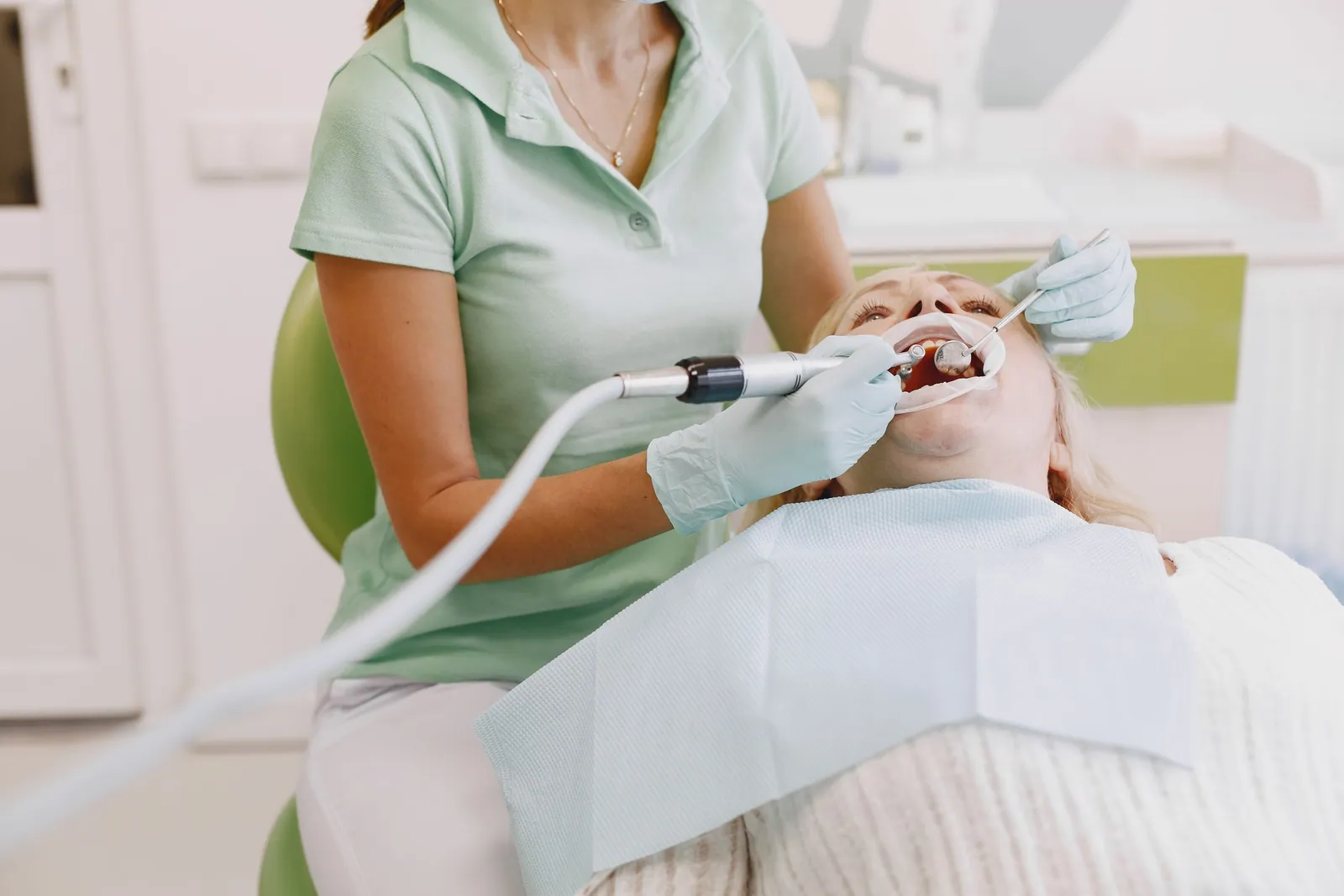
Air polishing rests on a simple principle. The device mixes three elements — compressed air, water, and a very fine powder — and sprays them together, under pressure, through a small nozzle held by the practitioner. The jet sweeps across the tooth surface and mechanically lifts away soft deposits (biofilm) and certain stains, while the water rinses continuously and a suction system removes the mixture.
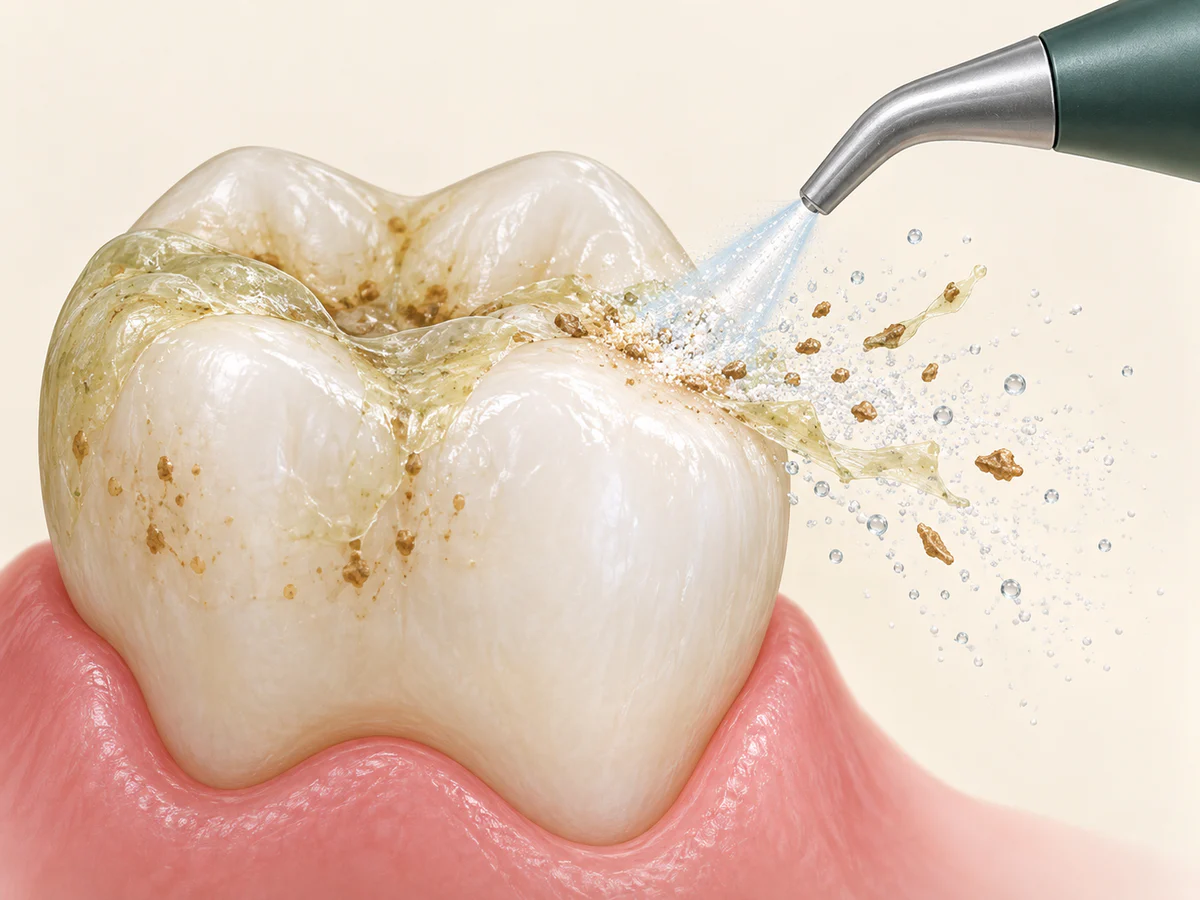
It is therefore not a “scraping”: there is no metal instrument in hard contact with the tooth, and no vibration as with an ultrasonic scaler. It is the controlled abrasion of the powder particles, carried by the flow of air and water, that does the cleaning. The sensation is often described as close to an intensive rinse, sometimes a little cool because of the water spray.
This point matters: the effectiveness and safety of air polishing depend closely on the powder used and on the settings. A fine, mildly abrasive powder, used according to the intended protocol, cleans gently; a harder powder, used improperly, can instead wear down the tissues. We will come back to this.
What does air powder polishing remove?
Air powder polishing removes deposits that sit on the tooth surface, not those that are bonded to it. In practice, it targets two things:
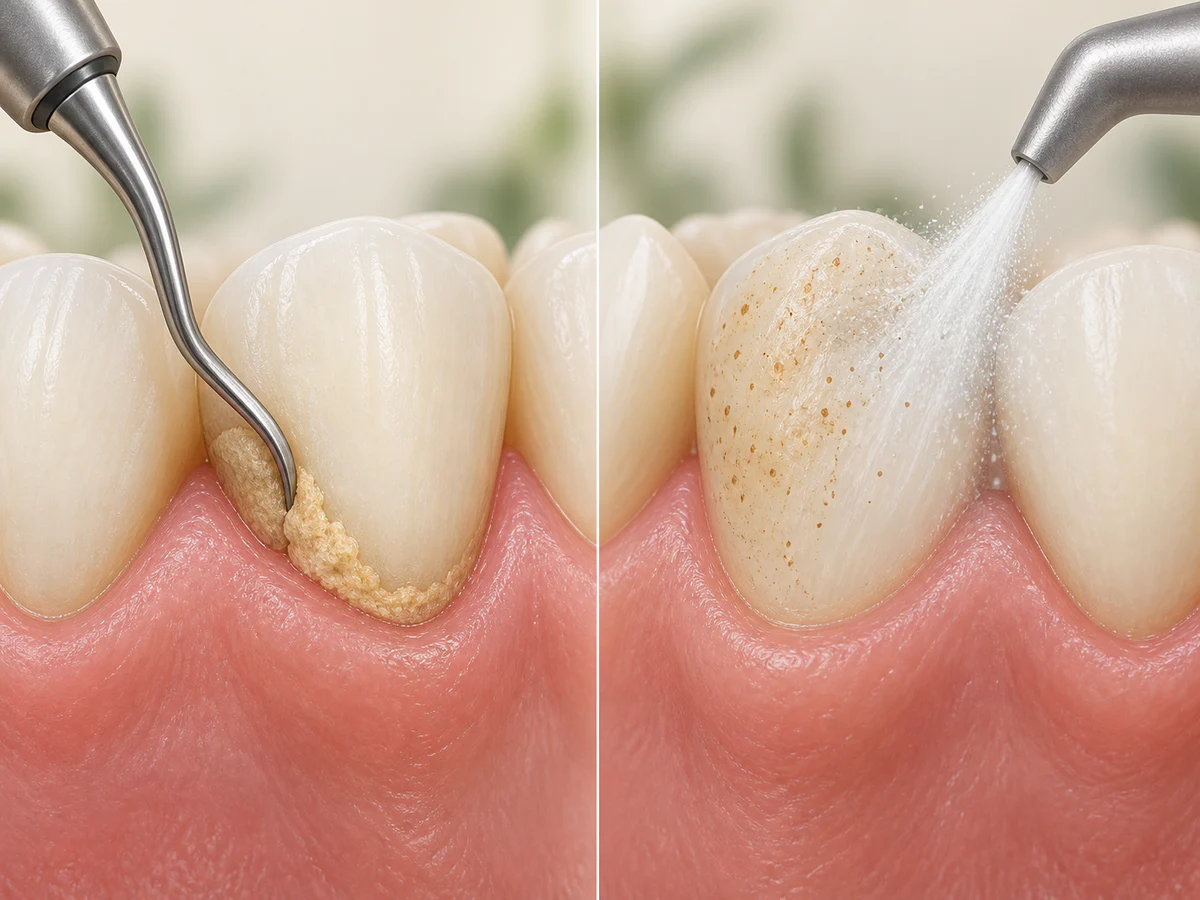
- Bacterial biofilm (soft plaque), including in hard-to-reach places: grooves, the spaces between teeth, the areas around restorations, around orthodontic brackets, and on implant surfaces.
- Surface stains left by coffee, tea, red wine, or tobacco. Stain removal is its most visible effect: once these deposits are gone, the teeth return to their own natural shade.
It leaves two things in place: hard, calcified tartar, which requires scaling, and the natural shade of the enamel, which air polishing does not lighten. Both limits are explained in more detail below.
Air polishing and traditional polishing
At a routine dental hygiene visit, the cleaning is often called a scale and polish: scaling removes the tartar, then the teeth are polished. Traditional polishing uses a small rotating rubber cup and a polishing paste. Air polishing is one of the cleaning methods that can be used for this step: the jet of air, water, and powder takes the place of the cup and paste, and no instrument rubs against the tooth. In either case, scaling generally comes first, and the polishing step completes the cleaning. How often such dental cleanings are needed varies from one person to another, depending mainly on the state of the gums and on how quickly tartar builds up.
Air polishing and conventional scaling: two complementary procedures
A common source of confusion is to pit air polishing against scaling, or to believe that one replaces the other. In reality, they do not target the same thing.
Scaling, most often performed with ultrasonic instruments, aims to remove tartar — plaque that has mineralized and hardened on the teeth. Tartar is hard, calcified, bonded to the enamel and sometimes below the gumline: firm mechanical action is needed to detach it. Air polishing, for its part, is not designed for that: it works effectively on soft deposits — bacterial biofilm — and on surface stains, but it does not remove calcified tartar.
The two procedures are therefore complementary, and that is how they are most often combined. In practice, we generally start with scaling to remove the tartar, then air polishing completes the cleaning by lifting away residual biofilm and stains, including in hard-to-reach areas. To clearly distinguish routine scaling from the deeper treatment of the roots, you can read our article on scaling and root planing.
| Scaling (ultrasonic) | Air polishing (air-flow) | |
|---|---|---|
| Main target | Hard, calcified tartar | Soft biofilm and surface stains |
| How it works | Vibration / instrument | Jet of air, water, and powder |
| Removes hard tartar? | Yes | No |
| Lifts away biofilm and stains? | Partially | Yes — that is its purpose |
| Role | Essential baseline care | Complement to scaling |
In other words, air polishing does not replace scaling: it extends it. Presenting one as a substitute for the other would be misleading.
In which situations is air polishing useful?
The scientific literature recognizes several indications for air polishing, provided expectations remain measured.
- Surface stains. This is its most visible use: air polishing is effective at removing extrinsic stains linked to coffee, tea, red wine, or tobacco. It restores the teeth’s natural shade by eliminating what dulls them — without lightening them beyond that (see below).
- Biofilm removal. Several systematic reviews show that fine-powder air polishing removes biofilm effectively, including in hard-to-reach spaces: grooves, interdental spaces, and areas around restorations.
- Periodontal maintenance. In patients followed for gum disease, a systematic review with meta-analysis (Ng et al., BMC Oral Health, 2022) concluded that air-polishing devices gave results comparable to hand or powered instruments for reducing pockets and bleeding, with less pain and better acceptance by patients. Air polishing can therefore be an alternative within a well-conducted program of periodontal maintenance.
- Cleaning around implants (peri-implant care). On implant surfaces, where conventional metal instruments should be avoided, fine sprayed powders are of real interest. A systematic review (Delucchi et al., Int J Dent Hyg, 2025) highlights that erythritol air polishing removes biofilm effectively without damaging the implant surface or the surrounding tissues.
- Orthodontics. Around orthodontic brackets and attachments, where brushing struggles to reach certain areas, air polishing makes it easier to remove accumulated biofilm.
These indications must always be assessed case by case. Air polishing is a complement to good oral hygiene, never a replacement for it: it does not do away with daily brushing and interdental cleaning, detailed in our article on daily oral hygiene.
Which powders are used? Glycine and erythritol
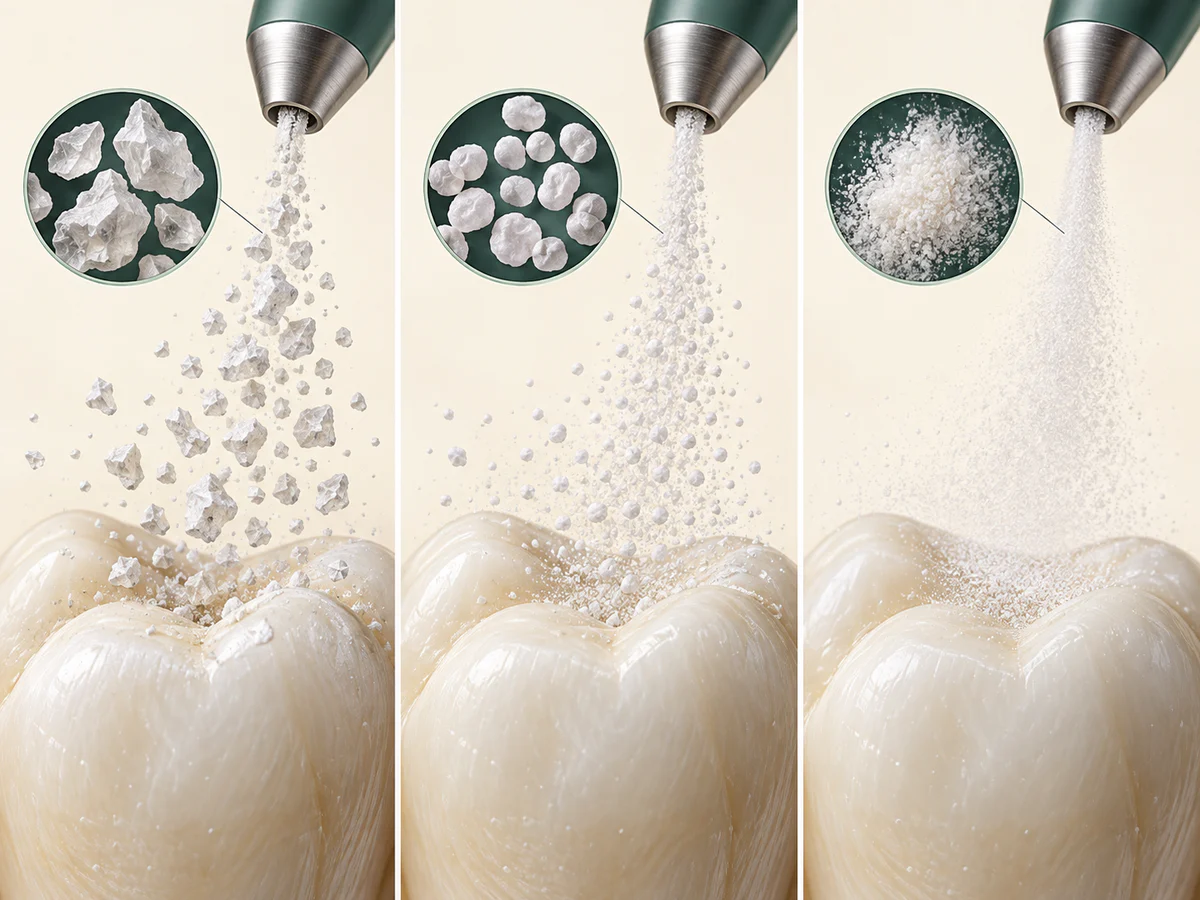
Powders have evolved considerably. A polishing powder is characterized mainly by the size and hardness of its particles, which determine how abrasive it is. The earliest ones, based on sodium bicarbonate, were relatively abrasive: because of their hardness, their crystalline structure, and their larger particle size, they are now reserved for healthy enamel and not recommended on exposed dentin or root surfaces (Janssens et al., and converging in vitro studies).
Modern powders are much finer and gentler. Two have become the standards:
- Glycine, an amino acid, whose particles are markedly smaller and less abrasive than bicarbonate.
- Erythritol, a polyol whose particles are even finer (around 14 micrometers), among the least abrasive available.
The comparative data are reassuring. On dentin, in vitro studies show that glycine and erythritol cause substantially less substance loss than bicarbonate, with erythritol producing the least loss and the smoothest surface. Clinically, results with glycine and erythritol are essentially equivalent for removing biofilm and stains. Used according to the recommended protocols, these fine powders are considered safe for root surfaces, implants, and the surrounding soft tissues. The choice of powder depends on the area being treated — supragingival or subgingival, natural tooth or implant.
Air polishing teeth: how a session goes
When you have your teeth air polished, it is usually part of a hygiene visit, after any scaling. You stay seated as for a routine cleaning, and the session follows a simple sequence:
- Before: the dentist checks your gums and asks about your health, including breathing problems, a low-sodium diet or sensitive teeth, in order to choose the powder and the settings.
- Protection: you wear protective glasses, and your lips may be moisturized so that they do not dry out.
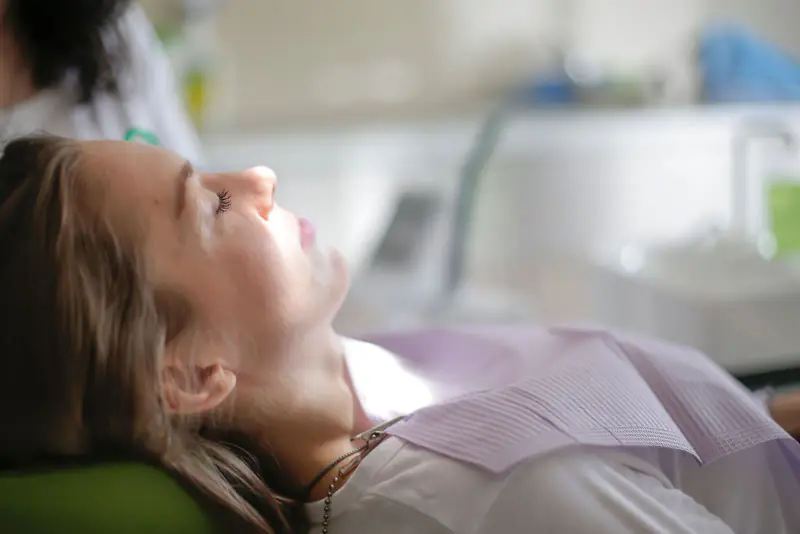
- Cleaning: the nozzle is moved from tooth to tooth while a suction tip removes the spray. You feel a cool rinse, with no scraping.
- Finishing: you rinse, and your teeth usually feel very smooth. The dentist can then show you where plaque tends to build up, so that your brushing reaches those areas.
After the session, daily brushing and cleaning between the teeth keep the surfaces clean until the next visit.
What air polishing does not do
This is probably the most important point, and the one where marketing creates the most confusion.
Air polishing does not whiten teeth. It removes stains and biofilm deposited on the surface; by clearing away what dulls the enamel, it restores the teeth’s original shade, but it does not change the natural color of the enamel itself. If a tooth is naturally yellow, it will stay that way after air polishing. True whitening relies on an entirely different, peroxide-based technique, which we cover in our article on teeth whitening: effectiveness and safety. Confusing the two leads to disappointed expectations.
Air polishing does not remove calcified tartar. As explained above, it acts on soft deposits, not on hard tartar, which is a matter for scaling.
It does not treat gum disease on its own. It can be one tool within a maintenance program, but it replaces neither the diagnosis, nor the treatment of periodontitis, nor daily hygiene.
A few precautions and contraindications are worth knowing:
- The procedure must be adapted in cases of severely inflamed gums, fragile root surfaces, or sensitive restorations, by choosing the appropriate powder and settings.
- Certain medical situations call for caution or a prior assessment: for example, sodium bicarbonate powders should be avoided in people who must follow a low-sodium diet, and the use of air polishing is debated in cases of respiratory disease (uncontrolled asthma, chronic obstructive pulmonary disease) because of the aerosol produced.
- Protection of the eyes and mucous membranes is required during the session, and patients with certain mucosal conditions should be assessed beforehand.
These precautions are not absolute prohibitions: they are simply a reminder that air polishing, like any procedure, should be decided after an examination — not applied systematically without thought.
In summary
Air polishing — often called “air-flow” — is a cleaning technique that sprays a jet of air, water, and fine powder to lift away bacterial biofilm and surface stains. It is a complement to scaling, not a substitute: it acts on soft deposits and stains, whereas scaling removes calcified tartar. Its recognized indications are stain removal (coffee, tea, tobacco), biofilm removal in hard-to-reach areas, periodontal maintenance, and cleaning around implants and orthodontic appliances. Modern powders — glycine and, above all, erythritol — are fine, mildly abrasive, and considered safe when used according to protocols. But we must be honest about its limits: air polishing does not whiten teeth, does not remove hard tartar, and replaces neither daily hygiene nor the treatment of gum disease. Used well, it is one useful tool among others; sold as a miracle treatment, it disappoints.
Frequently asked questions
Does air polishing whiten teeth?
What is the difference between air polishing and scaling?
Is air polishing painful or harsh on the enamel?
Is air polishing useful around implants?
Are there contraindications to air polishing?
Can I have air polishing if I have sensitive teeth?
How often can you air polish your teeth?
Sources
Medical references consulted for this article.
- 1Ng E, Byun R, Spahr A, Divnic-Resnik T. Efficacy of air polishing in comparison with hand instruments and/or power-driven instruments in supportive periodontal therapy and implant maintenance: a systematic review and meta-analysis. BMC Oral Health 2022 (PMC)
- 2Delucchi F, et al. Efficacy and safety of erythritol air-polishing in implant dentistry: A systematic review. Int J Dent Hyg 2025 (PubMed)
- 3Subgingival Use of Air-Polishing Powders: Status of Knowledge — A Systematic Review. J Clin Med 2023 (PMC)
- 4Impact of air-polishing using erythritol on surface roughness and substance loss in dental hard tissue: an ex vivo study. PLOS One 2024 (PMC)
- 5Janssens B, et al. Air polishing with erythritol powder — In vitro effects on dentin loss (PMC)
- 6EFP, Prevention and treatment of peri-implant diseases — The EFP S3 level clinical practice guideline (Herrera et al., J Clin Periodontol 2023)
Contents
Share