In short: piezosurgery cuts bone with ultrasonic micro-vibrations instead of a rotating bur (drill). The instrument is often called a piezotome. It is designed to cut bone while reducing the risk of injuring the soft tissue it touches. This means the gum, nerves and the sinus membrane. Procedures usually take longer. Implant success is similar to that obtained with conventional instruments.
Piezosurgery is a bone surgery technique. It uses ultrasonic vibrations, rather than a rotary bur, to cut bone. The piezotome makes a tip vibrate at very high frequency, with tiny amplitudes (very small movements). This way of cutting is quite different from that of conventional rotary instruments.
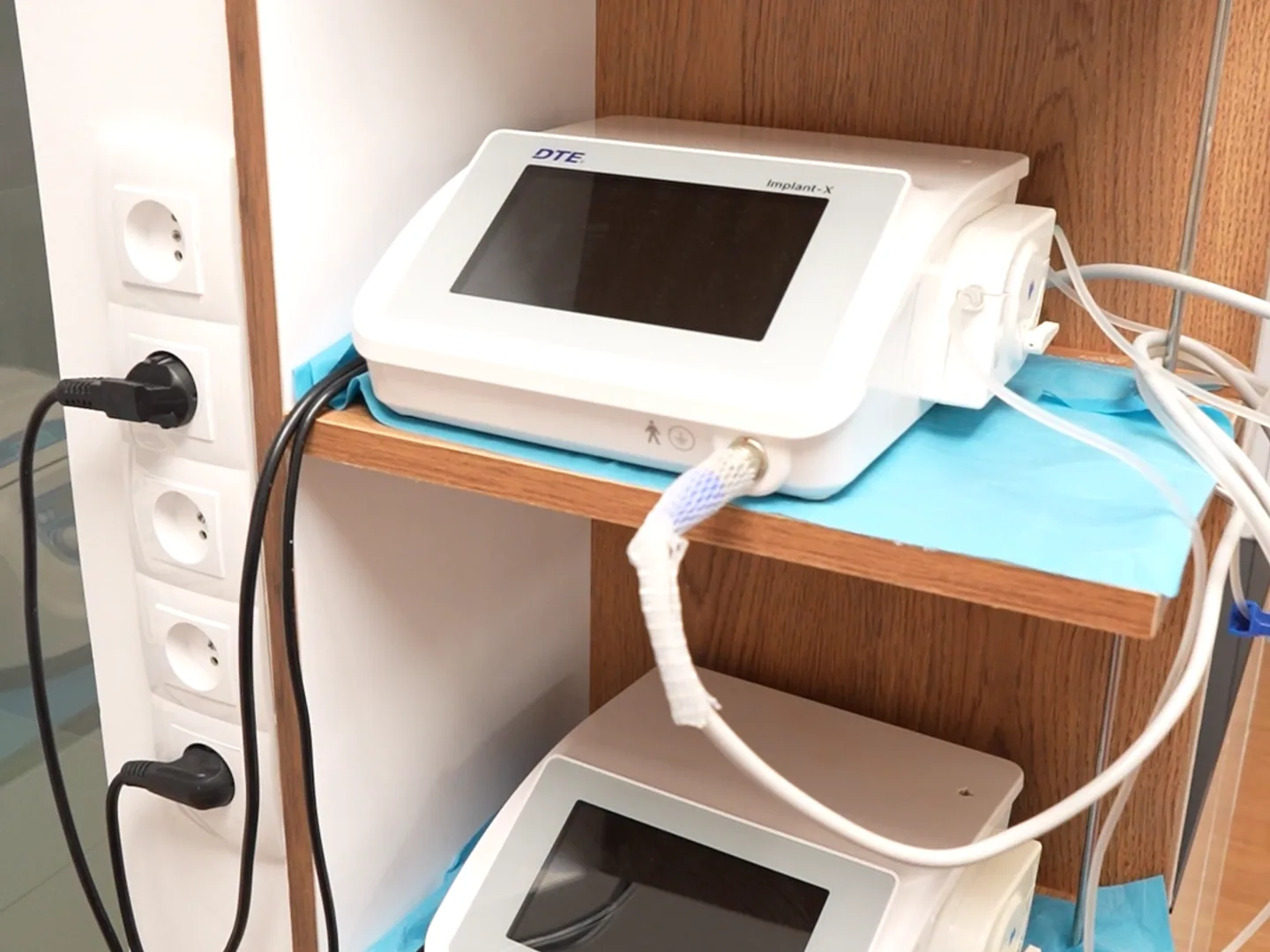
At the practice in Kénitra, piezosurgery is part of the clinical equipment used for certain bone procedures. This article describes:
- what it is;
- the principle of selective cutting that spares soft tissue;
- its indications;
- what the scientific literature actually says;
- its limits.
It draws on identified medical sources. It makes no promise of superiority that has not been demonstrated.
The aim is not to present piezosurgery as an instrument that is necessarily better in every situation. It is one tool among others. It has certain documented strengths and equally documented constraints. The first of these constraints is an often longer operating time. Describing a piece of equipment means describing its advantages as well as its limits. That nuance is what makes for honest information.
What is piezosurgery?
Piezosurgery relies on the piezoelectric effect. When an electric current is applied to certain crystals, they change shape and create vibrations. Inside the instrument, these vibrations pass to a tip that vibrates at ultrasonic frequency. It is this micrometric movement (on the scale of thousandths of a millimeter), not a rotation, that breaks up bone on contact.
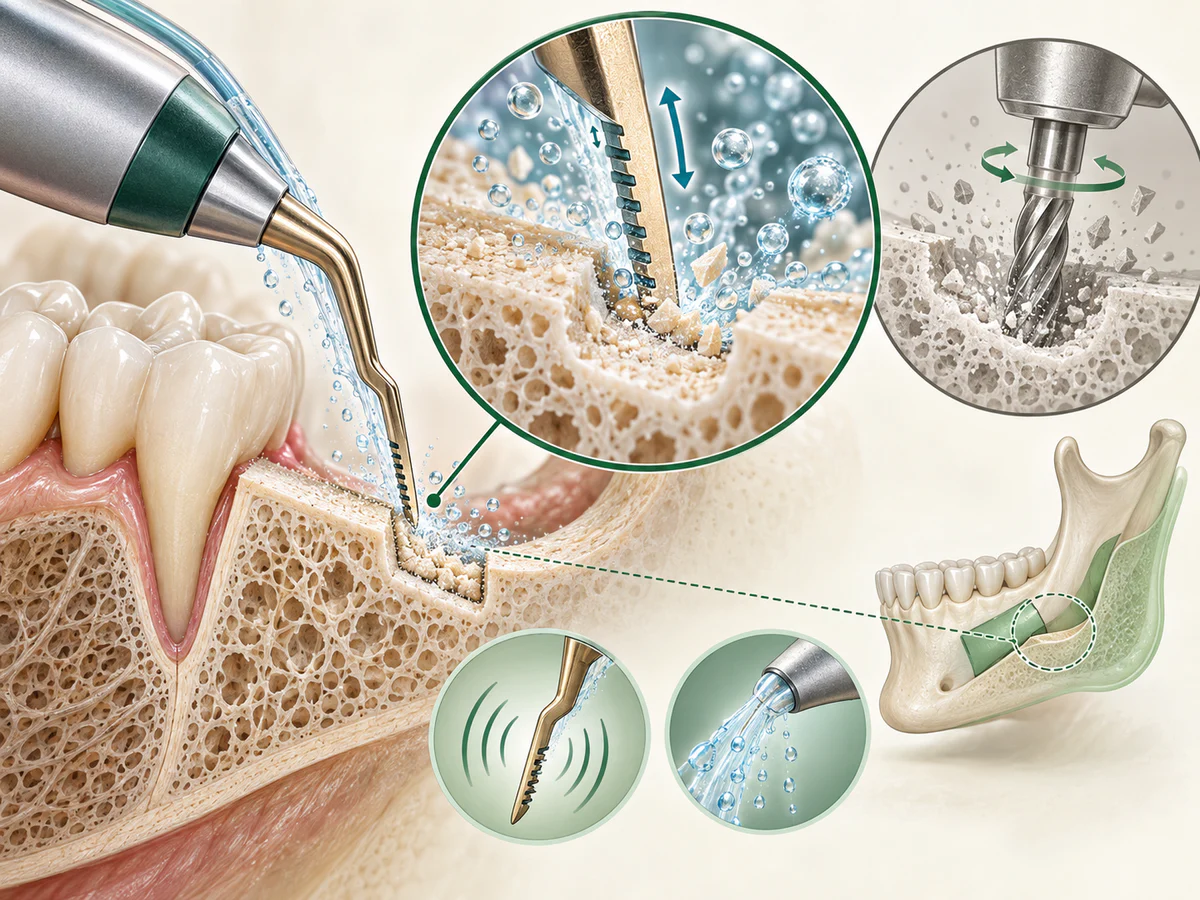
Agarwal, Masamatti and Kumar published a review in the Journal of Clinical and Diagnostic Research in 2014. According to this review, the device produces modulated vibrations in the range of 25 to 29 kHz. That is 25 to 29 thousand vibrations per second. The tip amplitudes are roughly 60 to 200 micrometers. This description is useful because it pinpoints what sets piezosurgery apart. It cuts through low-amplitude micro-vibrations rather than through the friction of a rotating instrument.
The introduction of this technology into oral surgery is attributed to the work of Tomaso Vercellotti, from 1988 onward. Several reviews recall this, including that of Magrin and colleagues (The Open Dentistry Journal, 2015). It is therefore not a recent novelty. It is a technique that is now well described in the literature, with several decades of hindsight.
Selective bone cutting: sparing soft tissue
The central argument for piezosurgery is what is known as selective cutting. At the frequency used, the tip cuts mineralized tissue, that is, bone, effectively. But it has far less effect on soft tissue in the event of accidental contact:
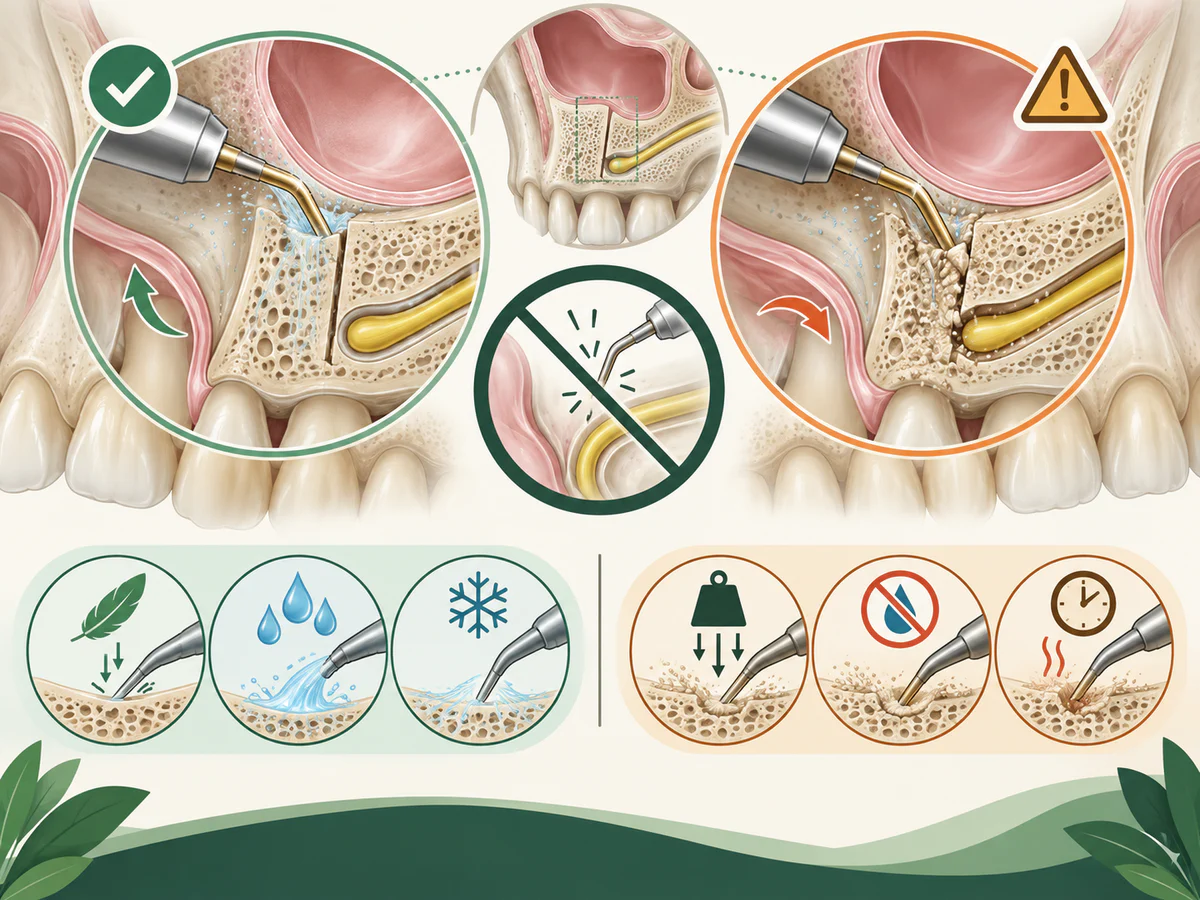
- mucosa (the moist lining of the mouth);
- blood vessels;
- nerves;
- the sinus membrane.
The review by Agarwal and colleagues (2014) explains this behavior by the working frequency. Ultrasound settings tuned for bone do not have the same cutting effect on soft neurovascular structures (nerves and blood vessels). In practice, the tip may touch a nerve or a membrane by accident. If it does, the risk of severing it is lower than with a rotary instrument.
That said, the wording must remain careful. We are talking about a reduced risk in the event of contact. It does not make injury to these structures impossible. Selectivity is an asset, not absolute protection.
This property explains why piezosurgery is often considered near structures that must be respected. Examples are the inferior alveolar nerve, which runs through the lower jaw (mandible), and the membrane lining the maxillary sinus. The clinical equipment and radiological planning remain essential for locating these structures before the procedure. This includes in particular Cone Beam imaging, a three-dimensional X-ray scan. No instrument replaces a prior anatomical assessment.
What are the indications for piezosurgery?
Piezosurgery is not used for everything. Its place is in situations where the bone cut must be precise and where soft tissue lies close by.
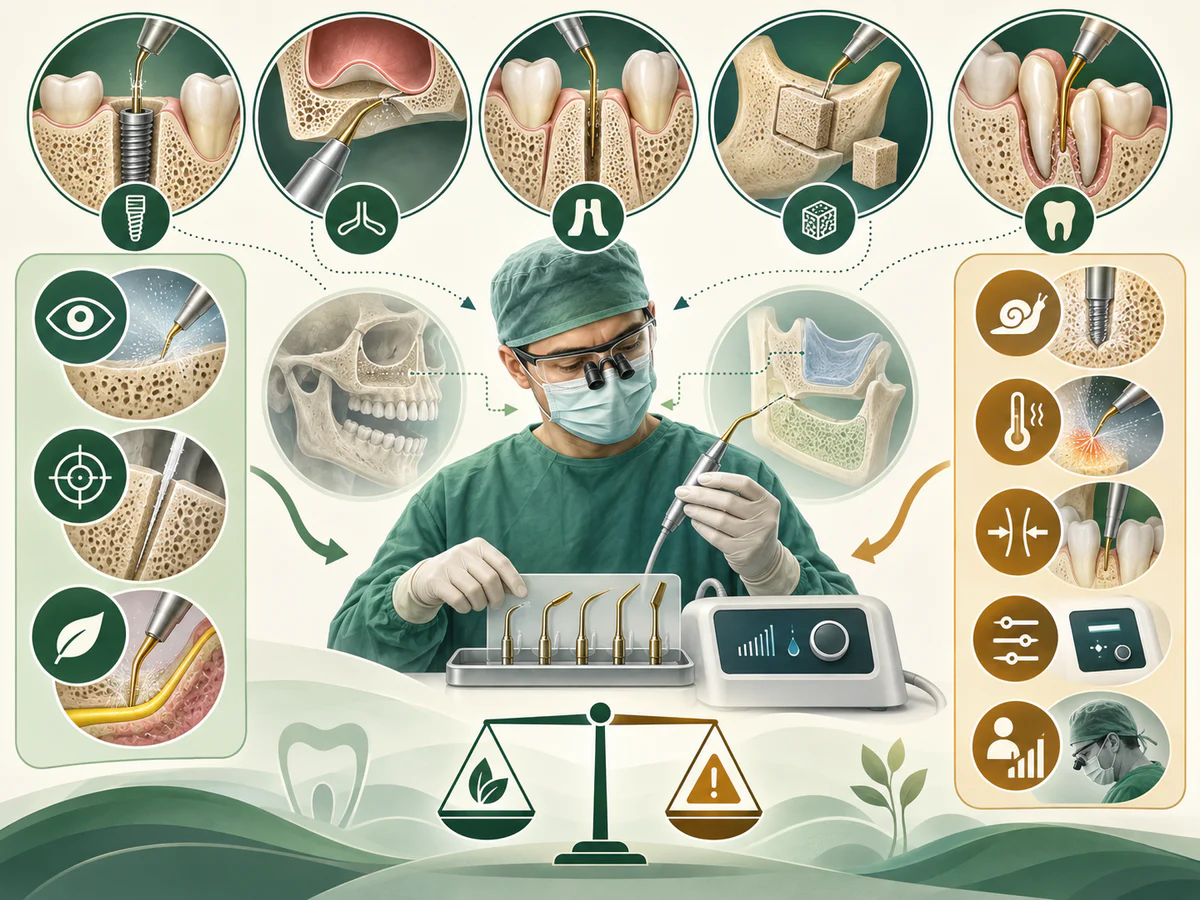
The review by Magrin and colleagues (2015) is devoted to piezosurgery in bone augmentation procedures prior to implant placement. Bone augmentation means adding bone where there is not enough. The review describes several applications:
- sinus floor elevation (sinus lift);
- harvesting autogenous bone (the patient’s own bone), as particles or blocks, from a donor site inside the mouth;
- lateralization of the inferior alveolar nerve (moving the nerve aside);
- ridge splitting to widen bone that is too thin.
Alongside these pre-implant indications are difficult extractions, particularly of impacted teeth (teeth that stay blocked in the bone). More broadly, there is pre-implant surgery.
In practice, the main indications group together as follows:
- sinus augmentation, where the lateral bone window (an opening in the side wall of the sinus) is cut close to the sinus membrane. Our article on sinus augmentation, or sinus lift covers it in detail;
- bone harvesting and preparation during a reconstruction, discussed in our article on bone grafting before an implant;
- difficult extractions, in particular the extraction of an impacted wisdom tooth, where bone sometimes has to be worked close to the nerve;
- pre-implant surgery, such as ridge splitting or site preparation.
The choice of technique is decided case by case, after the assessment. Piezosurgery is not automatic. For many procedures, rotary instruments remain perfectly suitable.
What the literature says: recovery and precision
It is tempting to present piezosurgery as superior in every respect. The literature calls for more restraint. Some benefits are documented, but with a variable level of evidence. They also come with a cost in operating time that comes up in almost every study.
Wisdom tooth extractions
Liu and colleagues published a meta-analysis in the Journal of Dental Sciences in 2018. A meta-analysis combines the results of several studies with statistics. This one pooled five randomized controlled trials (where the technique is assigned at random), totaling 402 patients. They compared piezosurgery with rotary instruments for third molar (wisdom tooth) extraction. In the piezosurgery group, the authors report:
- significantly less pain on day six or seven;
- less swelling at seven days;
- better mouth opening on day one.
On the other hand, operating time was significantly longer, by about 6 minutes on average. The authors themselves point out the limitations:
- trials conducted in a single country;
- sometimes small sample sizes;
- risk of bias in certain studies.
Another analysis, by Cicciù, Stacchi and colleagues (International Journal of Oral and Maxillofacial Surgery, 2021), points in the same direction while remaining cautious. It used trial sequential analysis, a method that checks whether the data are enough for a firm conclusion. It concludes that there is firm evidence that piezosurgery lengthens the duration of the procedure. But there is only weak evidence that it reduces pain and trismus (limited mouth opening) after extraction.
The data were judged insufficient to draw conclusions about nerve complications and swelling. In other words, the benefit for comfort after surgery probably exists. But it is moderate, and the level of evidence remains limited.
Sinus augmentation
For sinus lift, the issue at stake is the sinus membrane, which is thin and easy to perforate (tear). The meta-analysis by Jordi, Mukaddam, Lambrecht and Kühl (International Journal of Implant Dentistry, 2018) covered 69 studies. It found an average perforation rate of 8% with the piezoelectric device, compared with 24% with rotary instruments. This difference was statistically significant.
This result is encouraging, but the authors themselves call for caution:
- most of the included studies were neither randomized nor controlled;
- detecting perforations was not their primary objective;
- some perforations may have been missed.
They consider the comparison not fully reliable and call for randomized trials. This figure should therefore be read as a favorable trend, not as a guarantee.
Implant site preparation
For preparing the implant bed itself (the site in the bone that receives the implant), the data are more nuanced. The systematic review by Stacchi and colleagues (International Journal of Oral Implantology, 2020) looked at this. It finds moderate evidence of better secondary implant stability at twelve weeks with piezosurgery. Secondary stability is the hold that develops as bone heals around the implant. But the review finds insufficient data to draw conclusions about marginal bone loss and implant survival. Here too, operating time is longer.
The meta-analysis by Godoy-Reina and colleagues (Medicina Oral Patología Oral y Cirugía Bucal, 2020) finds no difference in primary stability. Nor does it find a difference in marginal bone loss at medium term. Primary stability is the implant’s hold in the bone right after placement. The authors conclude that survival and bone loss are similar between the two techniques. Piezosurgery therefore does not appear to be a factor in implant success in and of itself.
Our article on dental implants in Kénitra describes the full course of implant placement, once the site has been prepared.
What are the limits of piezosurgery?
An honest presentation also means setting out the constraints, which are real and consistently reported in the literature.
| Aspect | What the data say |
|---|---|
| Operating time | Longer than with rotary instruments (Liu 2018; Cicciù 2021; Stacchi 2020) |
| Recovery after extraction | Pain and trismus possibly reduced, weak evidence (Cicciù 2021) |
| Sinus membrane | Lower perforation rate, but evidence judged unreliable (Jordi 2018) |
| Implant success | Survival and marginal bone loss similar (Godoy-Reina 2020) |
The limitation most regularly reported is time. Ultrasonic cutting is slower than rotary cutting, especially in dense cortical bone (the hard outer layer of bone). Agarwal and colleagues (2014) and Magrin and colleagues (2015) both note this. For the most demanding indications, fewer instrument changes may partly offset this extra time. But it remains a real factor to take into account.
It should also be remembered that piezosurgery is a technique, not a guarantee of results. The precision of the instrument does not remove the need for:
- a proper assessment;
- a correct indication;
- adherence to aseptic (sterile) and healing conditions.
Its presence in the clinical equipment describes a means. It does not replace clinical judgment. It does not eliminate the risks inherent in any surgery.
In summary
Piezosurgery is a technique for cutting bone with ultrasound. It is based on micro-vibrations that cut bone while reducing the risk of injuring soft tissue on contact. Its main indications in oral surgery are:
- sinus augmentation;
- bone harvesting;
- difficult extractions;
- certain pre-implant procedures.
The literature suggests a benefit for recovery after extraction and less membrane perforation during sinus lift. But the level of evidence is often limited, and the operating time is longer. As for the success of the implant itself, results are comparable to those of conventional techniques. It is therefore a useful tool in specific situations, to be chosen after assessment. It is not an argument for absolute superiority.
Frequently asked questions
Is piezosurgery less painful than a conventional bur?
Does piezosurgery really protect the nerves and the sinus membrane?
Does piezosurgery increase the implant success rate?
Does the procedure take longer with piezosurgery?
In which cases is piezosurgery indicated?
Is piezosurgery a recent technology?
Sources
Medical references consulted for this article.
- 1Liu et al., Piezosurgery vs conventional rotary instrument in third molar surgery, Journal of Dental Sciences (2018), PMC6388871
- 2Cicciù, Stacchi et al., Piezoelectric bone surgery for impacted lower third molar extraction, Int J Oral Maxillofac Surg (2021), PMID 32284166
- 3Jordi et al., Membrane perforation rate in lateral sinus floor augmentation: rotating vs piezoelectric, Int J Implant Dent (2018), PMC5787532
- 4Stacchi et al., Piezoelectric bone surgery for implant site preparation, Int J Oral Implantol (2020), PMID 32424381
- 5Godoy-Reina et al., Stability and marginal bone loss: piezoelectric osteotomy vs conventional drilling, Med Oral Patol Oral Cir Bucal (2020), PMC7980295
- 6Magrin et al., Piezosurgery in Bone Augmentation Procedures Previous to Dental Implant Surgery, The Open Dentistry Journal (2015), PMC4765509
- 7Agarwal, Masamatti & Kumar, Escalating Role of Piezosurgery in Dental Therapeutics, J Clin Diagn Res (2014), PMC4253291
Contents
Share