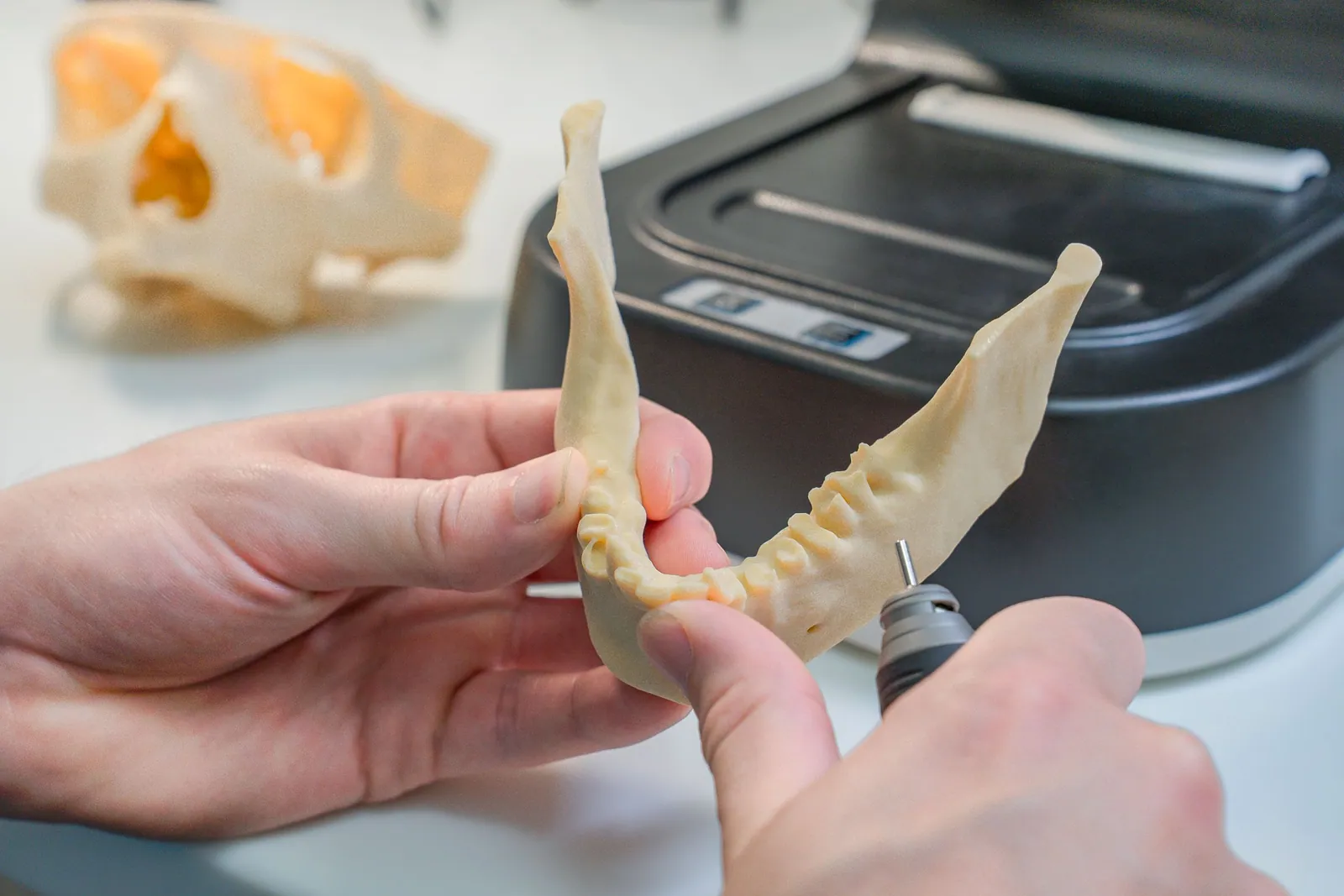
In short: 3D printing builds dental devices layer by layer from a digital file: surgical guides, splints, dental models, and temporary crowns and bridges in resin. Final ceramic crowns and veneers are still made mainly by milling, and every printed device depends on a sound plan, a suitable material, post-processing and a check in the mouth. Biocompatible resins still require the correct printing and post-curing protocol for their intended dental use.
3D printing, or additive manufacturing, refers to a family of processes that build an object layer by layer from a digital file, instead of carving it out of a block. Applied to dentistry, it is used to produce custom-made devices — surgical guides for implant placement, occlusal splints, study and working models, temporary prostheses — often faster and with good reproducibility. It is a manufacturing technology, not a treatment in itself: the machine gives physical form to a plan designed by the practitioner, but it is the clinical indication, the quality of the digital file and the work done chairside that determine the result.
As a dental surgeon in Kénitra, I offer here a factual, measured explanation of 3D printing in dentistry: what it is, what it can be used to make, what the literature says about its accuracy, and where its limits lie. This article is educational: it describes the technology in general, not any particular piece of equipment. Every statement points back to a verifiable source, and no figure is presented as a guarantee: these are data from studies, to be read as orders of magnitude.
What is 3D printing in dentistry?
3D printing is one of the two main routes in computer-aided manufacturing. The subtractive route — milling — starts from a block of material out of which a milling unit cuts the piece; it is the reference for ceramic crowns and veneers, as we explain in our article on digital CAD/CAM prosthetics. The additive route, by contrast, builds the object by stacking thin layers of resin or powder, each hardened in turn.
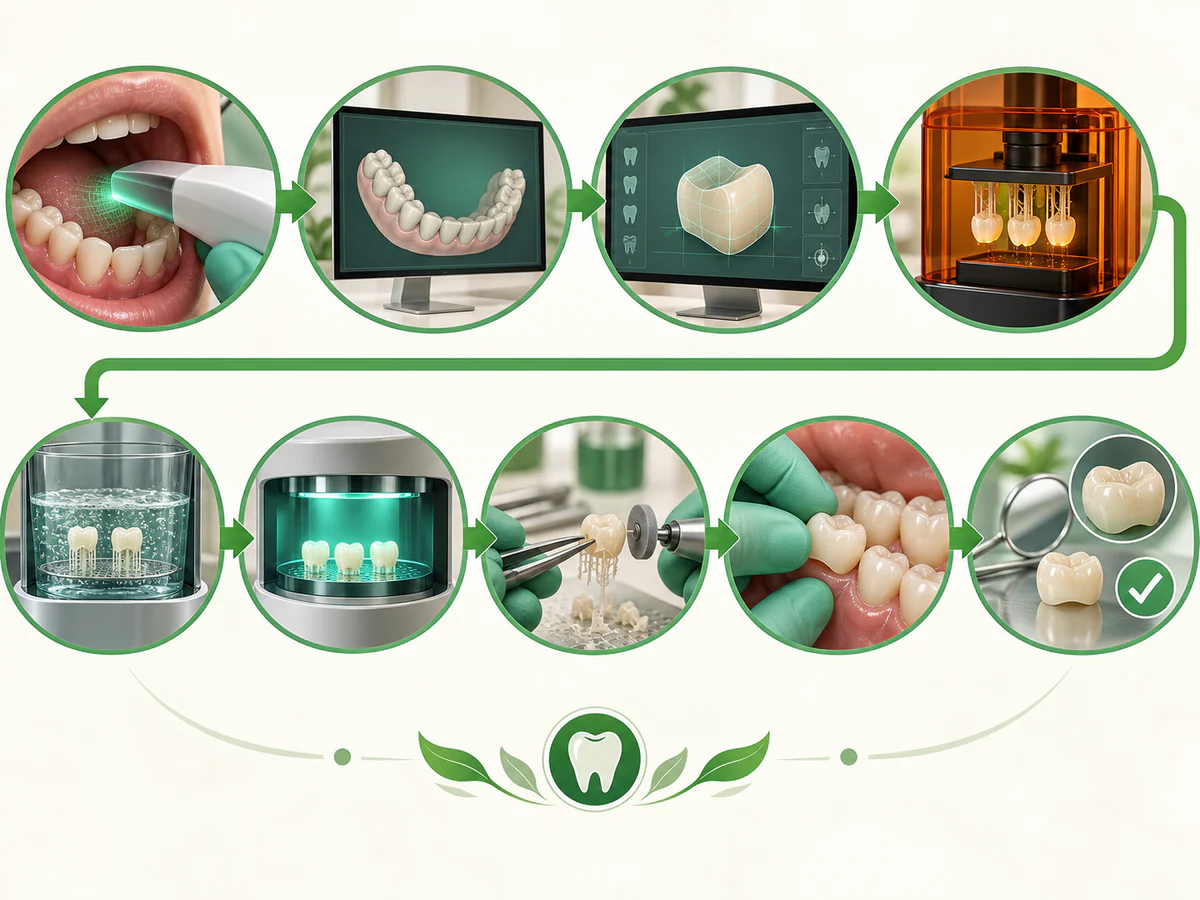
According to a review published in the journal Scanning (Tian and colleagues, 2021), several technologies coexist in dentistry: stereolithography (SLA) and digital light processing (DLP), which cure a liquid resin using light, are the most widespread for everyday devices; fused deposition modeling (FDM) is used mainly for models; powder bed fusion (SLS, SLM) makes it possible to print metals such as titanium or chrome-cobalt. All of these processes fall under photopolymerization or material fusion, which are among the seven families of additive manufacturing defined by international standards (review by Pillai and colleagues, Polymers, 2021).
One point deserves to be made straight away: these technologies are now widely available, but they are not present in every practice, and many printed devices are made in a dental laboratory from the digital impressions sent by the practitioner.
What 3D printing can be used to make
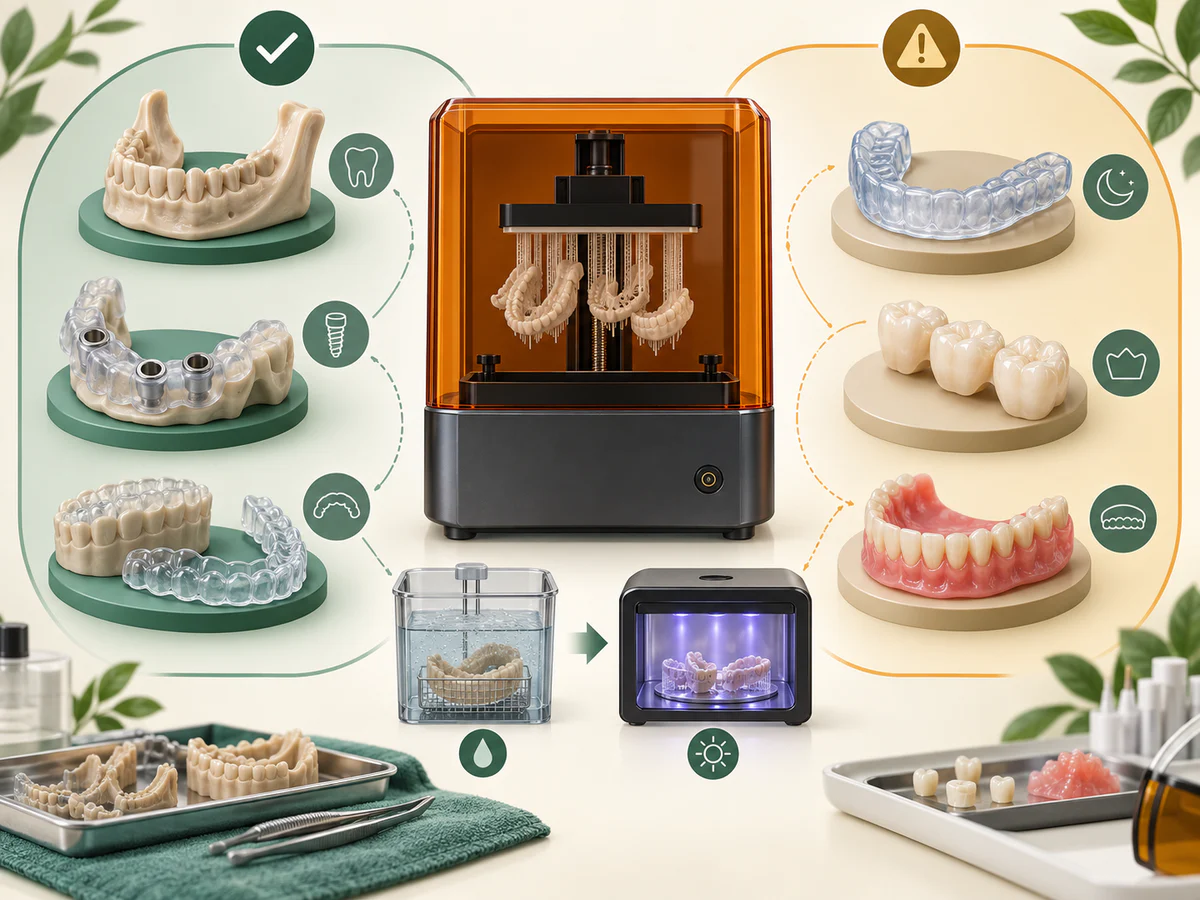
Additive manufacturing has found natural ground in dentistry, because every mouth is unique and calls for personalized devices. The best-documented applications are the following.
Surgical guides for implants
A surgical guide is a rigid splint, designed on a computer from 3D imaging and the digital impression, which sits on the teeth or the gum and directs the drilling of the implant according to the plan. 3D printing is one of the ways of producing it. This device is central to guided implant surgery, which itself relies on cone beam (CBCT) imaging and the digital impression taken with an intraoral scanner.
Splints and occlusal devices
Occlusal splints — used in particular in the management of bruxism and joint disorders — can be printed in resin. The models used to fabricate clear orthodontic aligners are also very often printed.
Study and working models
From an intraoral scan, a physical model of the arch is printed, which then serves to design, check or thermoform a device. This is one of the most mature and most accurate applications of the technology.
Temporary prostheses
Temporary crowns and bridges in resin can be printed, to protect a prepared tooth while the definitive prosthesis is being made.
What the literature says about accuracy
The central argument in favor of 3D printing is the accuracy and reproducibility of the devices. The data support it, but with nuances depending on the use.
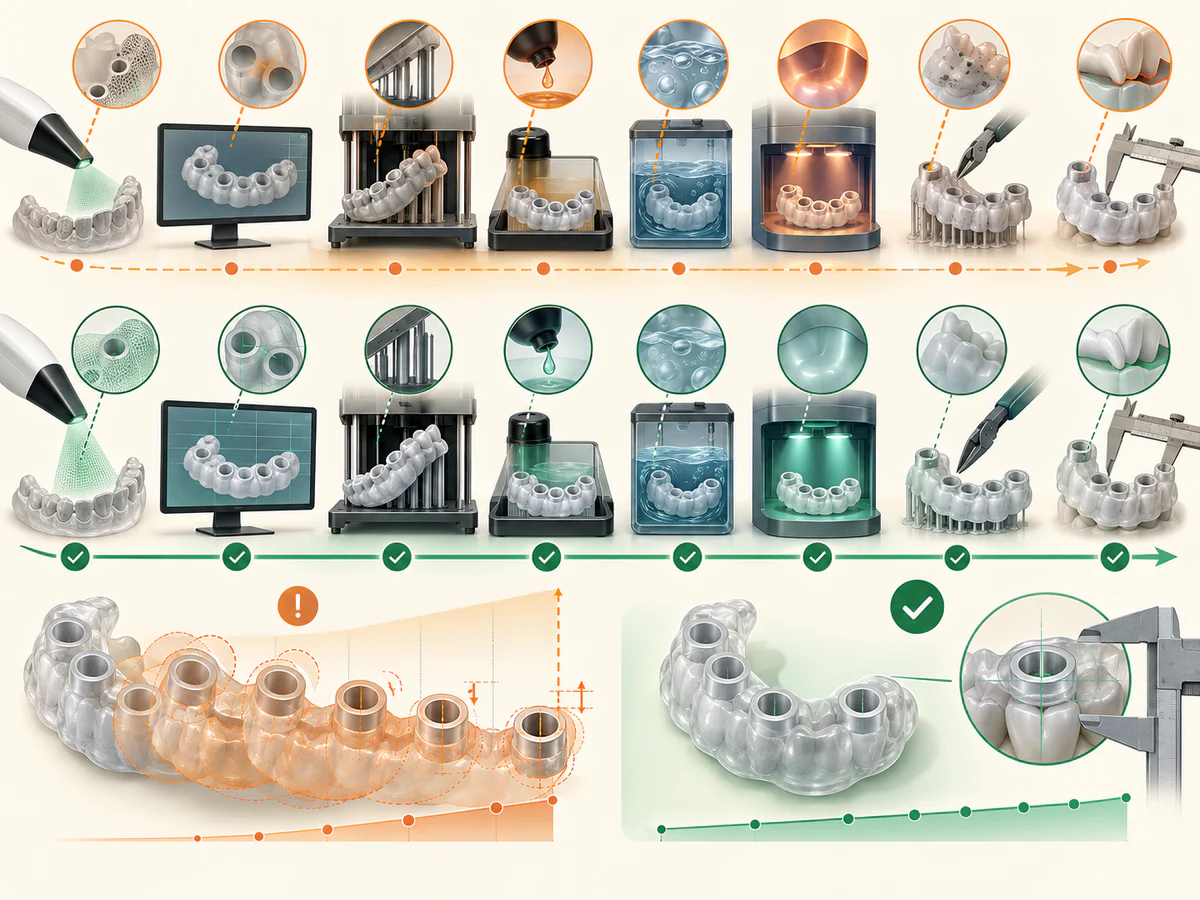
For surgical guides, what matters is not the accuracy of the guide itself, but that of the final implant position, which depends on the whole chain (imaging, planning, guide, surgical technique). A systematic review and meta-analysis published in the Journal of Stomatology, Oral and Maxillofacial Surgery (Eftekhar Ashtiani and colleagues, 2021) reported, for static guides, mean deviations of about 1.2 mm at the entry point, 1.4 mm at the apex and on the order of 3.4 degrees of angulation compared with the plan. The authors stress that these deviations vary appreciably depending on the system used: the technology reduces error without eliminating it.
For models intended for aligners, a study published in BMC Oral Health (Grassia and colleagues, 2023) compared several printers. All the models tested stayed below the clinically accepted threshold of 0.25 mm of error, but with clear differences: SLA printers showed a trueness on the order of 0.08 mm, versus 0.15 to 0.21 mm for DLP/LCD printers, with the entry-level machine approaching the limit threshold. The type of machine, and the way it is set up, therefore matter.
For occlusal splints, a comparative analysis published in the journal Materials (Abad-Coronel and colleagues, 2023, study “Comparative Analysis between Conventional Acrylic, CAD/CAM Milled, and 3D CAD/CAM Printed Occlusal Splints”) observed that milled splints had the greatest fracture resistance, ahead of the printed versions and then conventional acrylic resin splints. In other words, printing offers efficient fabrication, but it does not lead on every mechanical criterion.
For printed temporaries, a systematic review and meta-analysis published in Polymers (Jain and colleagues, 2022) compared printed, milled and conventional resins: printed materials show mechanical properties that are overall superior or comparable to milled and conventional resins, but physical properties (color stability, for example) that are rather inferior, and long-term clinical follow-up remains limited.
| Printed device | Accuracy / performance benchmark | Source |
|---|---|---|
| Surgical guide (implant) | implant deviation ≈ 1.2 mm entry, 1.4 mm apex, ≈ 3.4° | Eftekhar Ashtiani et al., 2021 |
| Model for aligners | trueness ≈ 0.08 mm (SLA) to 0.21 mm (DLP), 0.25 mm threshold | Grassia et al., 2023 |
| Occlusal splint | printed < milled for fracture resistance | Abad-Coronel et al., 2023 |
| Temporary (crown/bridge) | mechanical ≥ milled, physical properties often < milled | Jain et al., 2022 |
These figures are orders of magnitude drawn from studies, not a promise for any given device. Actual accuracy depends on the quality of the starting file, the material, the printing orientation and, above all, the post-processing.
Turnaround and personalization: real advantages, with caveats
Two advantages come up often: shorter turnaround times and personalization. They are real. Additive manufacturing makes it possible to produce several custom-made devices in parallel, from a single file, and to avoid certain manual steps. For models or guides, the gain in time and reproducibility is documented.
But “faster” does not mean “instant”. A printed object is not usable straight out of the machine: it has to be cleaned, separated from its supports, then post-cured under light. This post-processing determines both the mechanical properties and the biological safety of the piece, as we will see below. The promise of speed must therefore take this whole chain into account.
What 3D printing does not provide
Honest information means naming what this technology does not do.
It does not replace diagnosis or indication. A perfectly printed guide based on questionable planning will produce a poorly positioned implant: accuracy of manufacture is only worth something if the design is sound. Printing gives physical form to a clinical decision; it does not make that decision. That decision stays with the dental professionals who examine you and plan your treatment.
It does not guarantee automatic biocompatibility. Photopolymerizing resins contain monomers which, if poorly cured, can persist and irritate the tissues. A study published in Brazilian Oral Research (Pacheco and colleagues, 2025, on resins for temporary restorations) is a reminder that biocompatibility depends closely on the printing and post-curing protocols: insufficient post-curing leaves more residual monomers liable to be released. The safety of a printed device therefore rests as much on the post-processing as on the printing itself, and it calls for materials certified for medical use for the intended indication.
It does not supplant milling for everything. For the ceramics of definitive crowns and veneers, the subtractive route remains the reference; the printing of dense ceramic is still emerging. And depending on the mechanical criterion considered, milled devices sometimes retain the advantage, as the comparison on occlusal splints illustrates.
Finally, it does not do away with clinical checks. A printed device is tried in, verified and adjusted in the mouth, and it ages like any material. The technology reduces certain errors and certain delays; it removes neither expertise nor follow-up.
3D printed dental restorations: temporary or final?
A frequent question is whether a printed crown or bridge can be worn as a final restoration. Today, the answer depends on the material.
- Temporary crowns and bridges in resin are an established use: they protect a prepared tooth while the final prosthesis is being made. Printed resins compare well with milled and conventional resins on mechanical properties, but they are less stable in color, and long-term clinical follow-up remains limited (Jain and colleagues, 2022).
- Final crowns and veneers in ceramic are still made mainly by milling from a block, the established digital route for these ceramics. Printing dense ceramic is still emerging.
- Metals such as titanium or chrome-cobalt can be printed by powder bed fusion, a different process from the resin printers used for everyday devices.
Whatever the material, the chain is the same: digital scans or impressions, a design on the computer, printing layer by layer, then post-processing (cleaning, removal of the supports, post-curing under light) and a try-in in the mouth. 3D printers are not present in every practice, and many printed devices are made by dental labs from the files sent by the dentist.
In summary
3D printing, or additive manufacturing, builds custom-made dental devices layer by layer: surgical guides, splints, models and temporaries, often faster and in a reproducible way. The literature confirms good accuracy depending on the use — models for aligners below the 0.25 mm threshold (Grassia et al., 2023), guides bringing the implant deviation down to about 1 to 1.5 mm and a few degrees (Eftekhar Ashtiani et al., 2021) — while showing that the mechanical benefit varies with the device and the material, and that safety depends on the post-processing (Pacheco et al., 2025). It is a powerful tool at the service of the indication, the material and the follow-up, not a substitute for any of them. These same principles — diagnosis first, a suitable material, clinical checks and follow-up — guide evidence-based care, whether the treatment involves dental implant placement, prosthetics or orthodontics.
Frequently asked questions
What is dental 3D printing?
What can be made with 3D printing in dentistry?
Is a 3D printed surgical guide accurate?
Is a printed splint as good as a milled one?
Are 3D printed devices safe for the mouth?
Does 3D printing make treatments faster?
Are clear aligners 3D printed?
Sources
Medical references consulted for this article.
- 1Tian Y et al., A Review of 3D Printing in Dentistry: Technologies, Affecting Factors, and Applications, Scanning, 2021 (technologies SLA/DLP/FDM/SLS, applications)
- 2Pillai S et al., Dental 3D-Printing: Transferring Art from the Laboratories to the Clinics, Polymers, 2021 (familles de fabrication additive)
- 3Eftekhar Ashtiani R et al., Accuracy of static digital surgical guides for dental implants based on the guide system: a systematic review, Journal of Stomatology, Oral and Maxillofacial Surgery, 2021
- 4Grassia V et al., Accuracy (trueness and precision) of 3D printed orthodontic models finalized to clear aligners production, BMC Oral Health, 2023
- 5Abad-Coronel C et al., Comparative Analysis between Conventional Acrylic, CAD/CAM Milled, and 3D CAD/CAM Printed Occlusal Splints, Materials (Basel), 2023
- 6Jain S et al., Physical and Mechanical Properties of 3D-Printed Provisional Crowns and Fixed Dental Prosthesis Resins Compared to CAD/CAM Milled and Conventional Provisional Resins: A Systematic Review and Meta-Analysis, Polymers, 2022
- 7Pacheco LE et al., Properties of 3D-printed resins for interim restorations: effects of printing and post-curing protocols (post-curing et monomères résiduels), Brazilian Oral Research, 2025
- 8Monalisa S et al., Transforming Dental Care, Practice and Education with Additive Manufacturing and 3D Printing: Innovations in Materials, Technologies, and Future Pathways, Dentistry Journal, 2025
Contents
Share