In short: Ceramic inlays and onlays are custom-made pieces of ceramic, bonded into a back tooth to replace the part lost to decay or to an old filling. An inlay stays inside the cavity, while an onlay also covers one or more cusps. They are an option between a filling and a crown when the damage is too large for a direct composite, and they preserve more natural tooth structure than a crown.
When a back tooth is too damaged for a simple composite filling, yet not broken down enough to justify a full crown, we find ourselves in an in-between zone. That is exactly where ceramic inlays and onlays fit in: a custom-made piece, produced in a laboratory or directly at the practice, that fills the missing part of the tooth precisely. These are known as “indirect” restorations, as opposed to composite, which the dentist sculpts directly in the mouth.
As a dentist in Kénitra, I find that patients are often unfamiliar with these solutions, thinking only of a filling on one side or a crown on the other. This article explains honestly what an inlay-onlay is, how it differs from composite and from a crown, when it is appropriate, how it is made today, and what the scientific literature actually says about how long it lasts. The aim is not to sell a technique, but to help you understand one more option.
What is an inlay or an onlay?
Inlays and onlays are partial bonded restorations: they replace the portion of tooth destroyed by decay or by an old filling, without covering the whole tooth. The piece is designed to fit precisely into the prepared cavity, then it is bonded in place to last. It is this fabrication outside the mouth, from an impression, that places them among the indirect restorations.
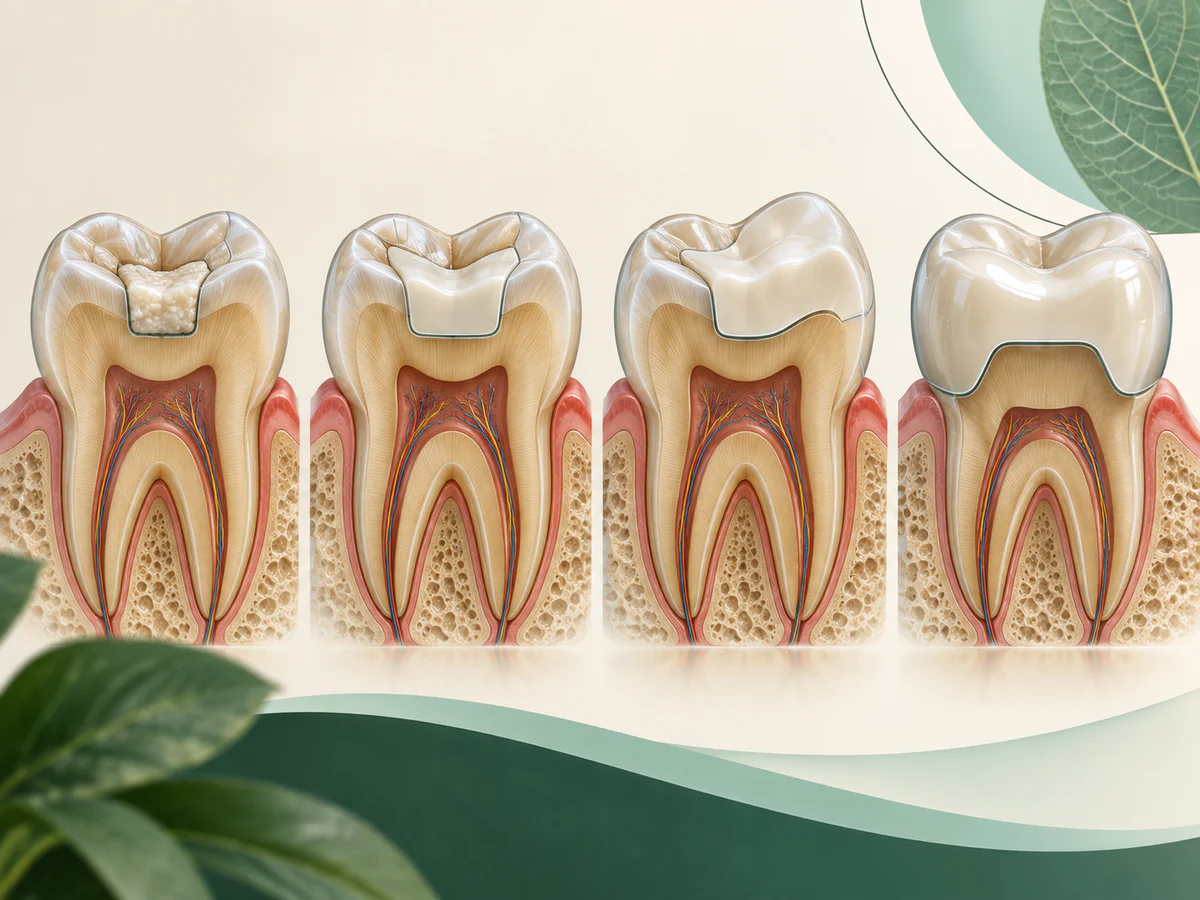
The difference between the terms simply comes down to how much is being rebuilt. It is a question of the surface covered, not of the material or the technique.
- Inlay: the piece sits inside the tooth, within the cavity, between the cusps (the points of the chewing surface). It does not cover any cusp.
- Onlay: the piece is larger and also covers one or more cusps, because these are weakened or already fractured.
- Overlay: this is an even more extensive onlay, covering the entire chewing surface while leaving the side walls of the tooth. It is used when the whole occlusal table needs to be protected.
The idea shared by these three variants is to remove only what is necessary and to protect what is fragile, preserving as much healthy tooth tissue as possible. This is the principle of what is known as conservative, or “minimally invasive”, dentistry.
Inlay-onlay, composite or crown: when to choose which?
There is no absolute hierarchy: these three solutions answer different situations, and the right choice depends above all on how much healthy tooth remains.
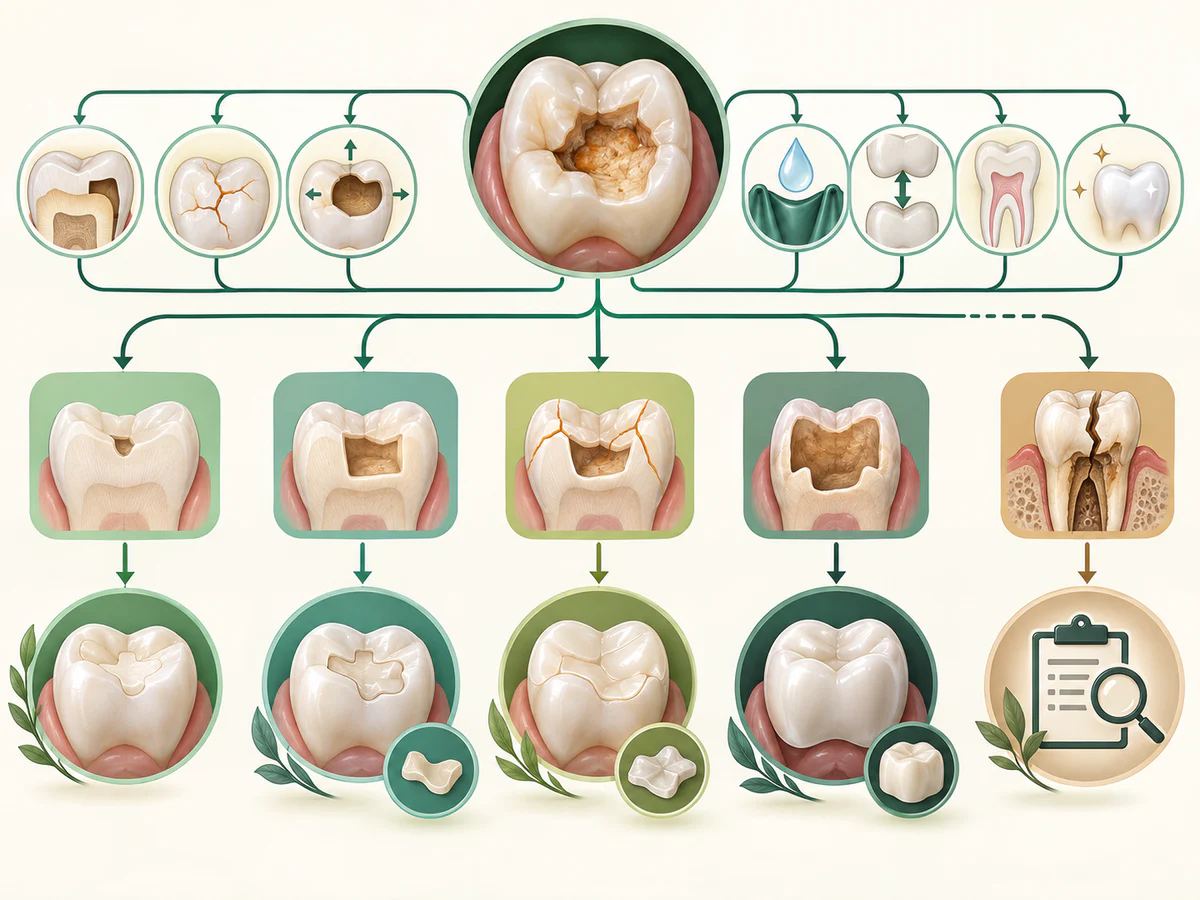
Direct composite is still the first-line treatment for most cavities. The dentist sculpts the resin directly into the cavity, in a single visit, sacrificing very little tissue. It is the simplest and most conservative solution as long as the cavity stays moderate in size. To understand how decay is treated step by step, our article on tooth decay in adults sets out this gradation.
An inlay-onlay becomes worth considering when the loss of tooth structure is too great for a direct composite to hold up over time: a large cavity, weakened side walls, or the need to rebuild the contact points between teeth with precision. Made outside the mouth, it offers an anatomical shape and contacts that are better controlled than those of a large composite shaped directly in place.
A full crown, for its part, wraps around the entire circumference of the tooth. It becomes necessary when there is no longer enough healthy structure to anchor a partial restoration, or after certain root canal treatments that leave the tooth weakened. Its drawback is that it requires trimming the tooth all the way around: one consumer-facing review estimates that a crown removes on the order of 60 to 75% of the tooth structure, compared with roughly 35 to 45% for an onlay. When the question of a crown comes up, our article on ceramic or zirconia crowns sets out the indications.
| Criterion | Direct composite | Inlay / onlay | Full crown |
|---|---|---|---|
| Tooth tissue removed | The least | Intermediate | The most (≈ 60-75%) |
| Fabrication | In the mouth, 1 visit | In a lab or at the practice (CAD/CAM) | In a lab or at the practice |
| Typical indication | Small to medium cavity | Large cavity, weakened cusp | Severely broken-down tooth |
| Coverage of the tooth | Cavity only | Cavity ± cusps | The whole tooth |
| Esthetics on back teeth | Good | Very good | Very good |
This table is a teaching simplification. Only a clinical examination, supplemented if needed by an X-ray, makes it possible to decide which option suits your tooth: the decision is made case by case.
Which materials?
Two main families of materials exist for these indirect restorations.
Ceramic is today the most widely used choice, for esthetic and mechanical reasons. It reproduces the shade and the translucency of the natural tooth, resists wear well and does not stain with coffee or tea. A distinction is made in particular between feldspathic ceramics and glass-ceramics (such as lithium disilicate), which are stronger. Laboratory composite is the other option: it is a little less hard than ceramic but easier to repair and potentially gentler on the opposing tooth.
On the choice of material, a systematic review with meta-analysis comparing ceramic and resin (Naik et al., 2022) found higher survival for ceramic inlays, onlays and overlays than for resin ones, at both 5 and 10 years. The material is not the whole story, though: the indication, the quality of the bonding and the follow-up also matter.
Porcelain inlays and onlays: the same as ceramic?
You will often read about “porcelain inlays and onlays” as well as “ceramic inlays and onlays”. In everyday language, the two names describe the same restorations. Strictly speaking, porcelain is one kind of dental ceramic: the traditional feldspathic ceramic, valued for how closely it imitates enamel. “Ceramic” is the broader family, which also includes the stronger glass-ceramics such as lithium disilicate described above.
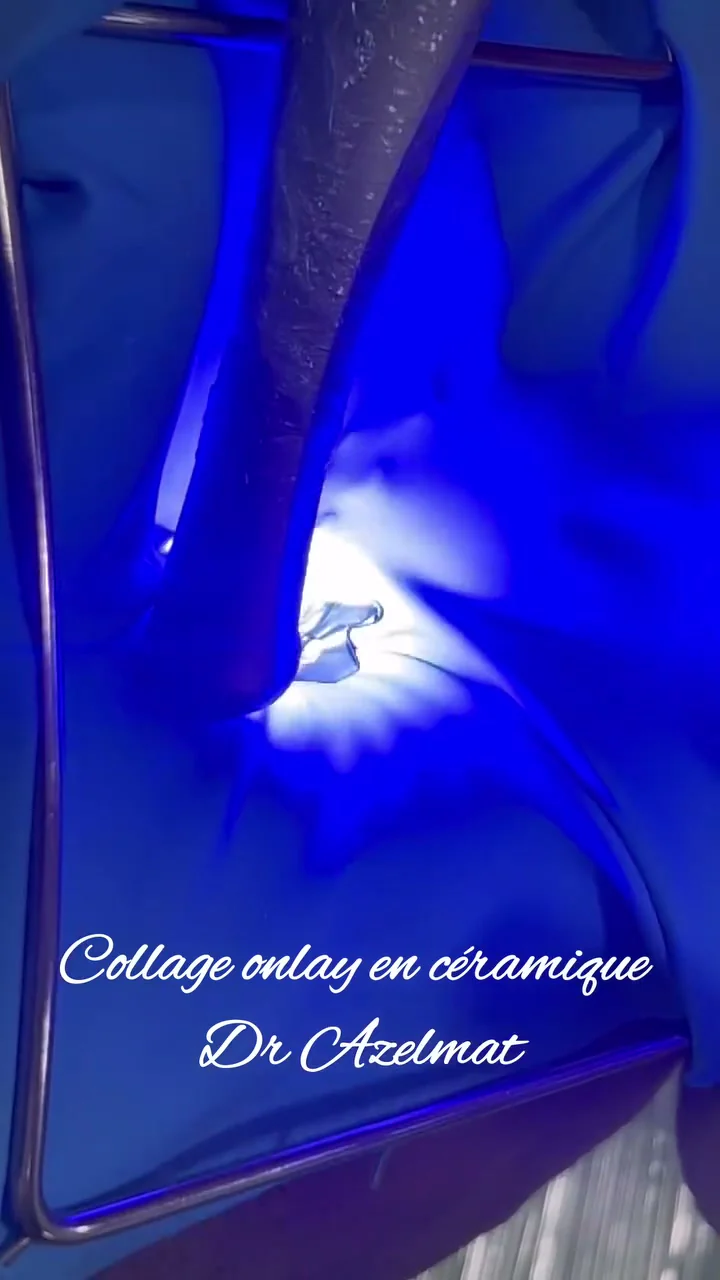
For you, the label matters less than the choice of material for your tooth. The dentist weighs the size of the cavity, the forces the tooth takes when you chew, any clenching or grinding, and the appearance you expect. Whatever the name, a ceramic inlay or onlay is a bonded restoration: the quality of the bonding and the follow-up count at least as much as the material itself.
How it is made: from the impression to CAD/CAM
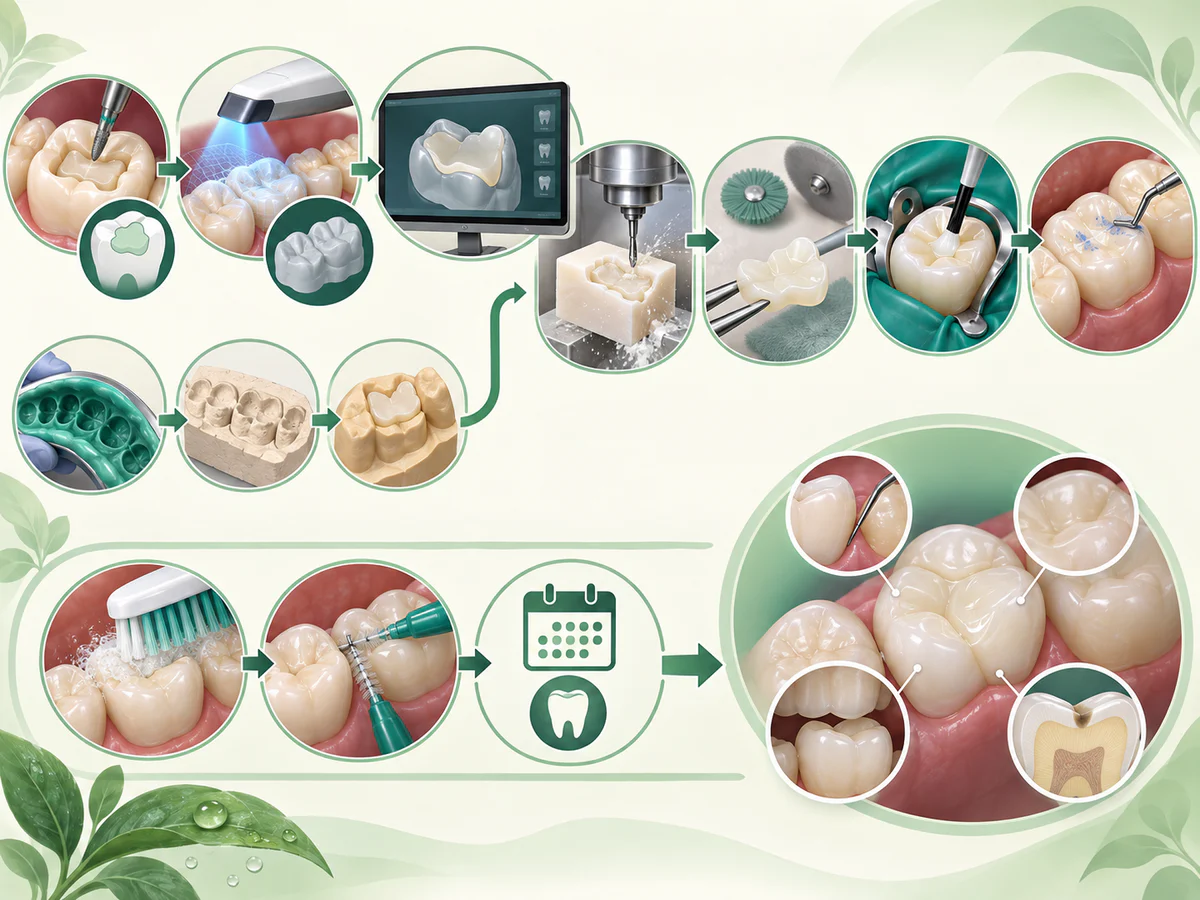
Traditionally, the work is done over two visits. At the first, the dentist removes the old filling or the decay, prepares the cavity, then takes a precise impression of the tooth. A temporary piece protects the tooth in the meantime. The laboratory makes the inlay-onlay in a few days to a few weeks. At the second visit, the dentist tries in the definitive piece, checks its fit and the occlusion (the way the teeth come together), then bonds it.
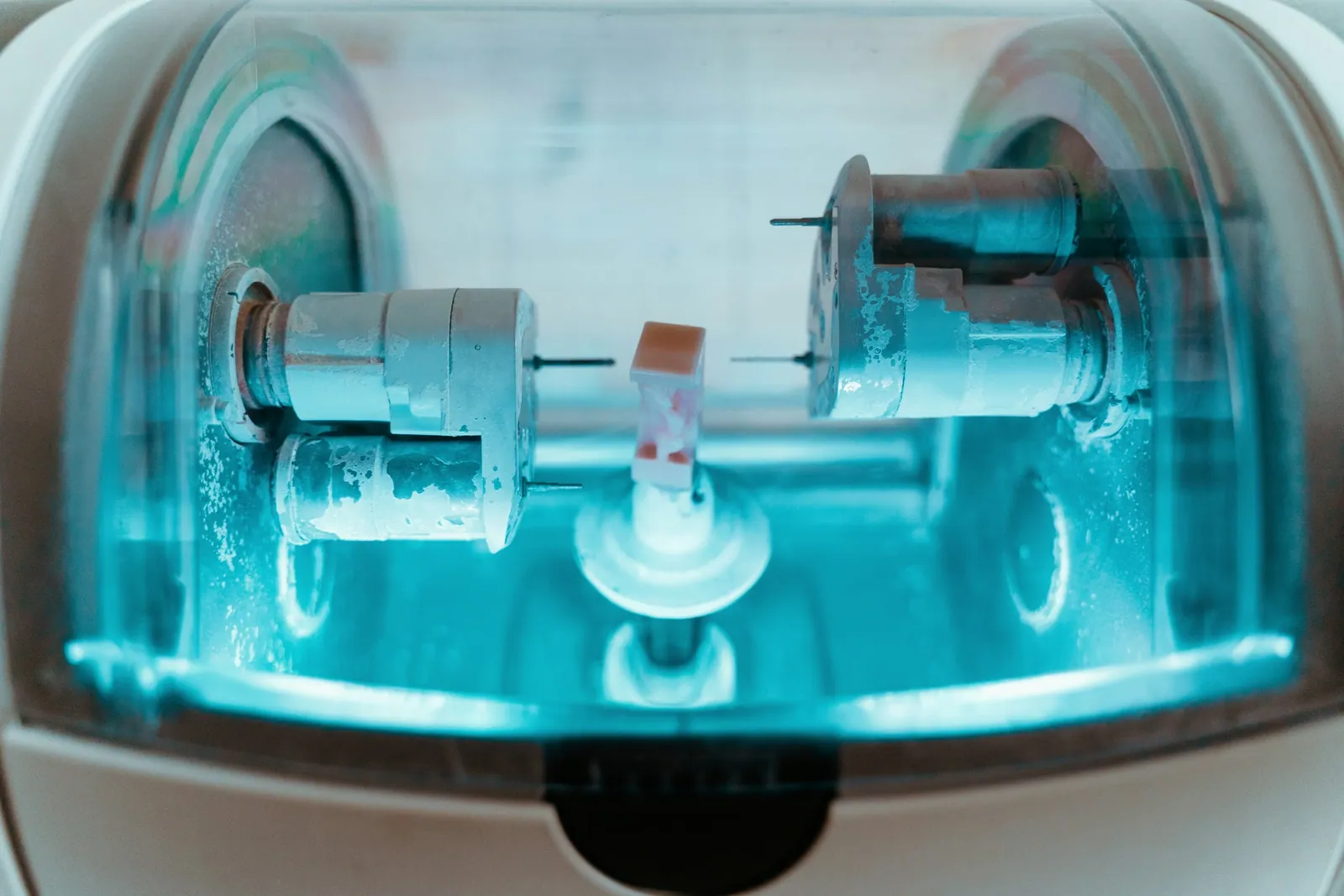
The new development of recent years is CAD/CAM, computer-aided design and manufacturing (CFAO in French). Instead of a physical impression taken with paste, the dentist takes a digital impression with an intraoral scanner, designs the piece on screen, then mills it from a block of ceramic using a milling unit. In an equipped practice, the inlay-onlay can therefore be made and bonded in a single visit, with no temporary. Our article on CAD/CAM and digital prosthetics describes this workflow in more detail.
Some nuance is called for: CAD/CAM does not replace the dentist’s skill and is not automatically superior to the laboratory route. It is a tool that, used well, brings comfort (a single visit, no temporary) and good precision.
What longevity does the literature show?
This is probably the most useful question, and it is also the one where honesty is needed: no restoration lasts “for life”, and the figures are statistical averages, not individual promises.
The available data are rather reassuring. A systematic review devoted to the longevity of ceramic onlays reports survival rates on the order of 91 to 100% in the medium term (2 to 5 years) and 71 to 98.5% in the long term (more than 5 years). A broader meta-analysis on resin and ceramic inlays, onlays and overlays estimated survival rates of 90 to 92% at 5 years and 89 to 91% at 10 years for ceramic, compared with 86% at 5 years and 75% at 10 years for resin.
Restorations milled with CAD/CAM follow the same trend. A review of the literature on chairside CAD/CAM restorations indicates survival of about 97% at 5 years and 90% at 10 years, and case series with very long follow-up still find success rates on the order of 87 to 89% after 17 to 27 years. These are remarkable results, provided the indication has been correctly set.
When an inlay-onlay fails, the causes most frequently reported are fracture of the ceramic or of the tooth, debonding and recurrent decay at the margin of the restoration. The risk of failure increases in particular when the tooth has had root canal treatment and in patients who clench or grind their teeth (bruxism).
Limitations
Ceramic inlays and onlays also come with constraints that are worth knowing before choosing.
- It is not a universal solution. For a small cavity, direct composite remains simpler and more sparing. For a severely broken-down tooth, a crown is called for. The inlay-onlay occupies a specific niche.
- Ceramic can fracture. It is in fact the leading reported cause of failure. Unprotected bruxism is a real risk factor; a night guard is sometimes necessary.
- The quality of the bonding is decisive. A bonded restoration depends on a rigorous protocol and a clean operating field, shielded from saliva. It is a demanding technique for the dentist.
- Temporary sensitivity may appear in the first few days after placement, most often related to the occlusion and resolving after a simple adjustment.
- The cost falls between that of a composite and that of a crown, and coverage varies from one country and one insurance plan to another. This is a point to discuss at your appointment.
Finally, a restored tooth is not an invulnerable tooth: daily hygiene and regular check-ups remain essential to prevent decay from returning around the edge of the piece.
What happens before the inlay or onlay is made?
The dentist prepares the tooth before the impression or scan is taken, removing decay or the old filling and shaping the cavity for the restoration. The aim is to preserve the sound tooth structure that can safely remain. The ceramic piece is then made to fit that preparation, tried in, and bonded. The preparation and bonding matter alongside the choice of ceramic; a digital manufacturing method alone does not guarantee the result.
In summary
Ceramic inlays and onlays are partial bonded restorations that fill a loss of tooth structure too great for a direct composite, without going as far as a full crown. The inlay stays within the cavity, the onlay also covers one or more cusps, and the overlay covers the entire chewing surface. Their great advantage is that they preserve more tooth tissue than a crown does.
The literature shows high survival rates for ceramic, on the order of 90% at 5 years and often close to 90% at 10 years, and lower long-term survival for resin. Fabrication can be done in a laboratory or, in an equipped practice, in a single visit thanks to CAD/CAM and the digital impression. But none of these figures is an individual guarantee: fracture and debonding remain possible, especially in cases of bruxism, and the decision is always made case by case, after an examination at the practice.
Frequently asked questions
What is the difference between an inlay and an onlay?
Inlay-onlay or a filling: which should I choose?
When is a crown needed rather than an onlay?
How long does a ceramic inlay or onlay last?
Can an inlay-onlay be done in a single visit?
Do ceramic inlays and onlays match the color of my teeth?
How do I look after a ceramic inlay or onlay?
Sources
Medical references consulted for this article.
- 1Abduo J, Sambrook RJ, Longevity of ceramic onlays: A systematic review, J Esthet Restor Dent (PubMed)
- 2Morimoto S et coll., Survival Rate of Resin and Ceramic Inlays, Onlays, and Overlays: A Systematic Review and Meta-analysis, J Dent Res (PubMed)
- 3Naik VB et coll., Comparative evaluation of clinical performance of ceramic and resin inlays, onlays, and overlays: A systematic review and meta-analysis (J Conserv Dent 2022, PubMed)
- 4Angeletaki F et coll., Direct versus indirect inlay/onlay composite restorations in posterior teeth: A systematic review and meta-analysis, J Dent (PubMed)
- 5Wittneben JG et coll., Clinical performance of chairside CAD/CAM restorations, JADA (PubMed)
- 6Otto T, Schneider D, Long-term clinical results of chairside CEREC CAD/CAM inlays and onlays (Cerec 1, jusqu’à 27 ans), via PubMed
Contents
Share