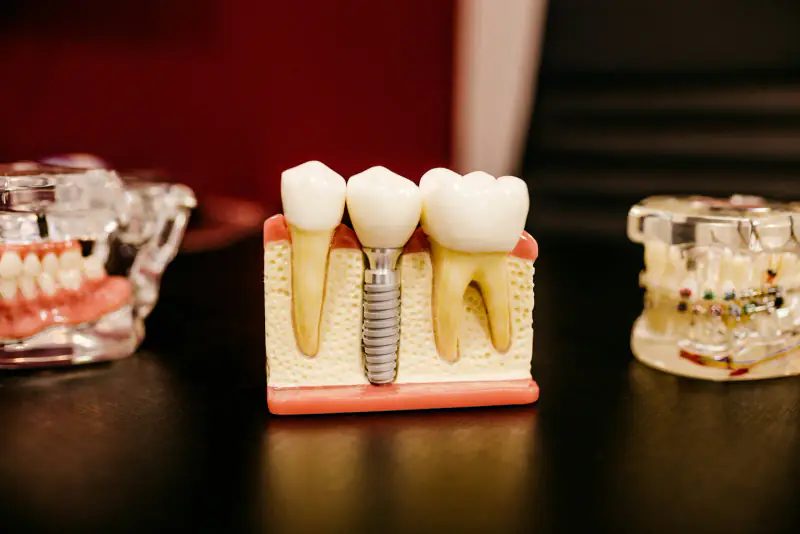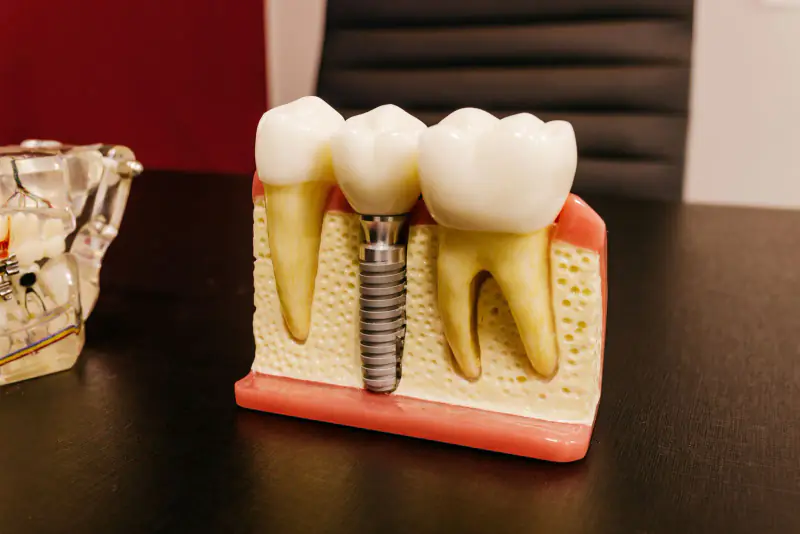
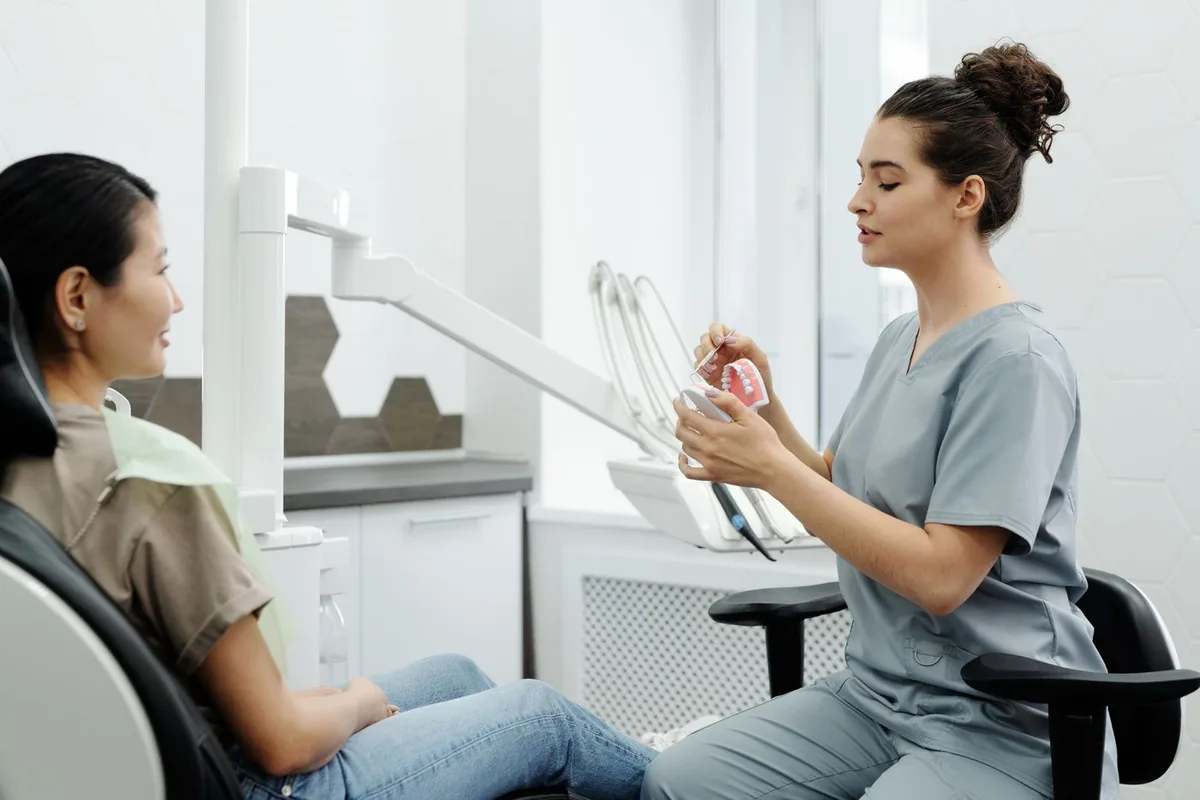
There is no single dental implant price that applies to every case in Morocco. At Dr Fatima Azelmat’s practice in Kénitra, the published reference is 8,000–12,000 MAD for a complete implant, including the implant, abutment and crown. This is an indicative practice fee, not a national tariff; the final amount depends on the clinical and radiographic assessment.
Bone grafting, a sinus lift, additional imaging or a more extensive prosthetic restoration can change the total. A written quote itemises the planned work before treatment begins. For practice fees, equipment and consultation booking, see the dental implants in Kénitra service page.
Complete implant: what is stated and what to check
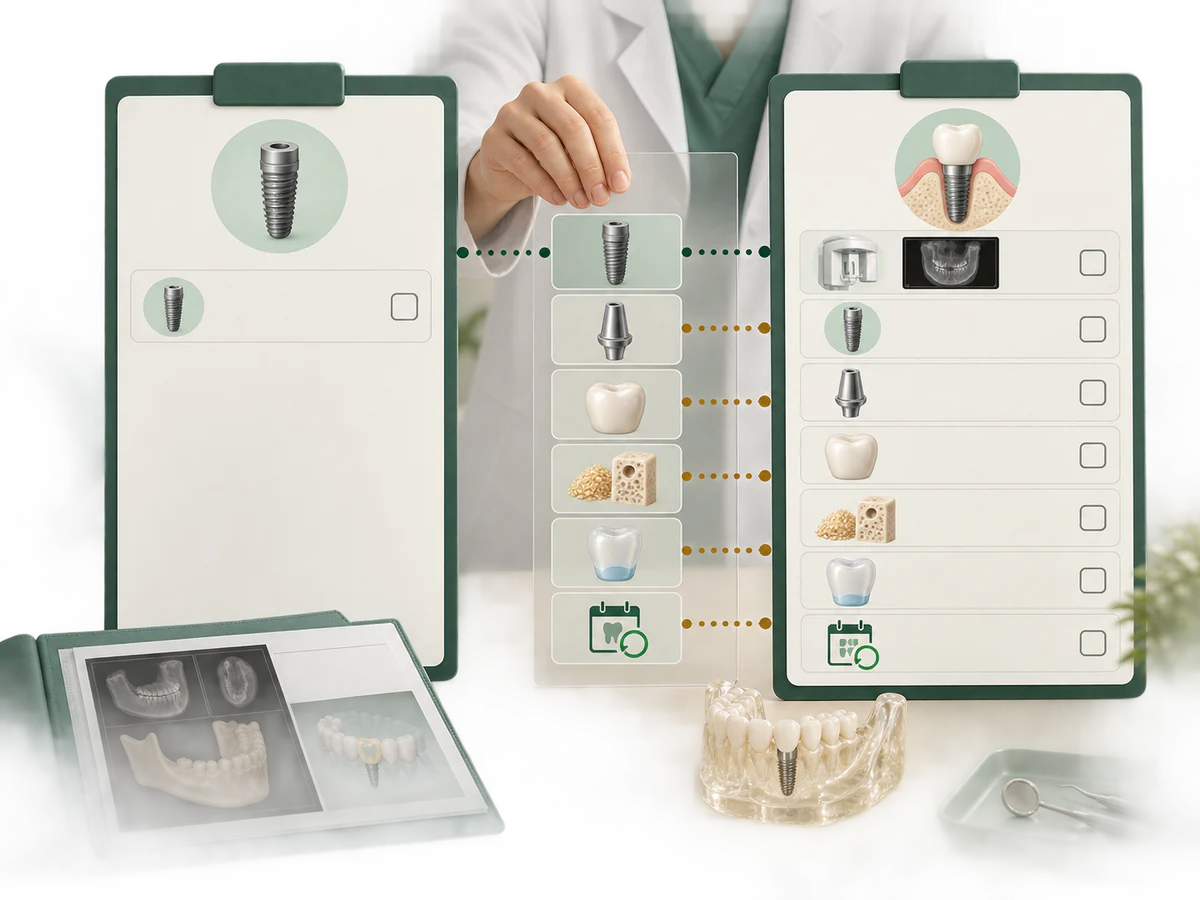
The practice’s existing 8,000–12,000 DH reference includes the implant, abutment and crown. It does not establish that all examinations, preliminary care or types of prosthesis are included. This table helps prepare a written quote; it is not a new package offer.
| Item | What the displayed information establishes | Question for the quote |
|---|---|---|
| Implant, abutment and crown | These three items are listed in the practice’s 8,000–12,000 DH reference. | Which system, abutment and crown material are planned for my tooth? |
| Assessment and imaging | Inclusion is not established by this amount alone. | Are consultation, radiographs and any indicated Cone Beam included or charged separately? |
| Extraction or gum care | These depend on oral condition and are not automatic. | Which preliminary treatments are needed and what is their separate cost? |
| Bone graft or sinus lift | These may change the plan and total if indicated. | Is the procedure necessary, conditional or not planned? |
| Temporary prosthesis | A temporary restoration differs from the definitive crown. | Will I need one and is it in the total? |
| Checks and maintenance | Follow-up needs explanation; the amount alone does not establish coverage. | Which checks are included and what remains payable? |
| Full-arch rehabilitation | Its price cannot be obtained by multiplying a single-tooth price. | Does the quote detail implants, the full-arch prosthesis and temporary/definitive phases? |
Ask for the total, itemised costs, conditions that may change it and the payment schedule. Do not compare an implant screw alone with a treatment including an abutment and crown. The practice’s reference information is on dental fees in Kénitra.
Why an implant is not a single procedure
Replacing a missing tooth is rarely an isolated step. Losing a tooth is most often the end point of a longer oral health story: according to the WHO fact sheet on oral health (March 2025), tooth loss is generally the final stage of advanced decay or severe periodontal disease, and it becomes more common with age. The environment in which an implant is placed is therefore rarely neutral: sometimes diseased gums must be treated first, a recent extraction site managed, or bone that has resorbed compensated for.

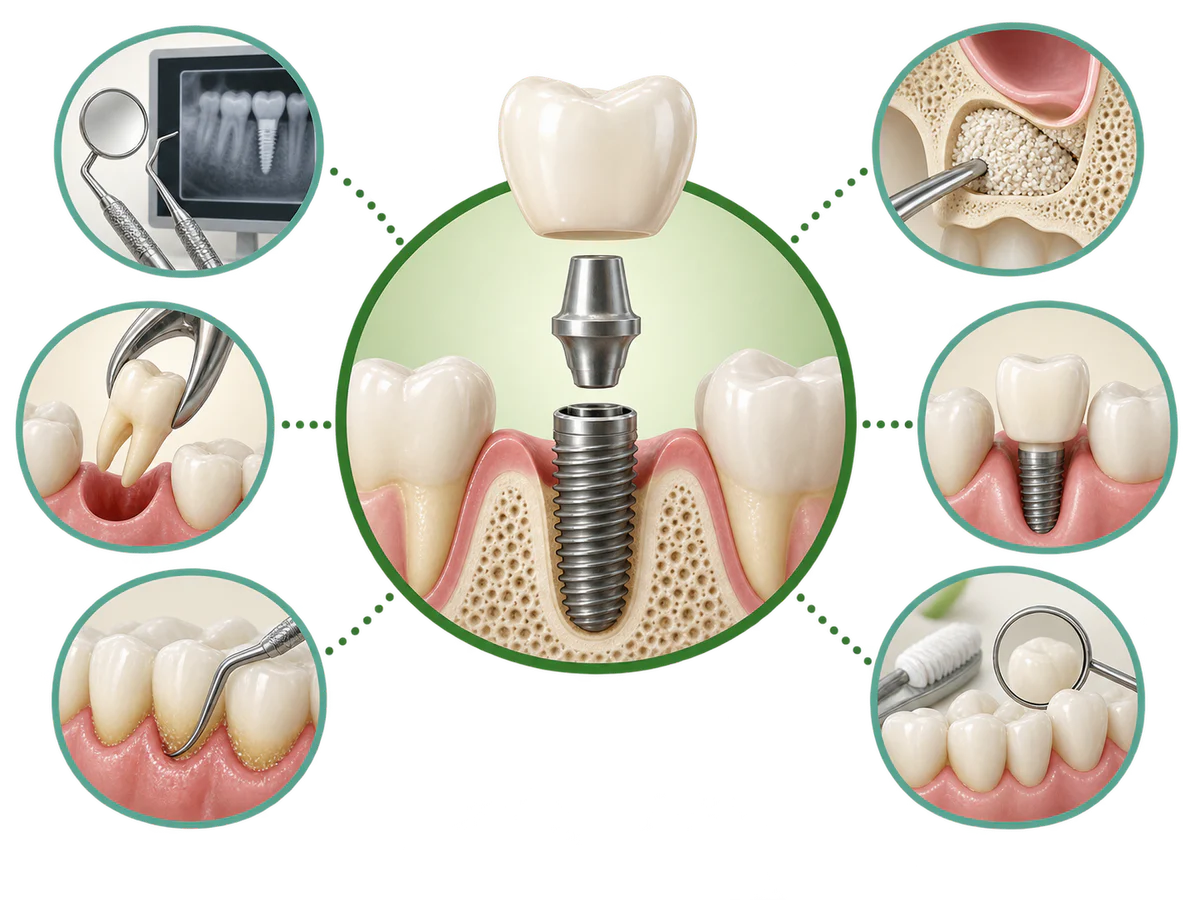
Implant treatment therefore breaks down into several distinct phases, each requiring time, materials and sometimes additional surgery:
- the initial assessment and imaging;
- any preparation of the site (periodontal treatment, bone graft, sinus lift);
- the surgical placement of the implant;
- the healing and osseointegration period;
- the fabrication and fitting of the prosthesis.
Assessment, planning, implant placement and prosthetic restoration form the treatment pathway. Preliminary care, extraction or bone augmentation are needed only in some situations. Their organisation and timing can vary.
The number of implants: the first factor
The most obvious factor remains the number of implants to be placed. Replacing a single tooth, several separate teeth, or an entire arch does not call for the same resources.
- For a single tooth, one implant supports an individual crown.
- For several adjacent missing teeth, an implant-supported bridge can rest on fewer implants than the number of teeth being replaced.
- For a full arch, protocols based on a set number of implants support a large-span prosthesis.
The cost therefore does not rise in strict proportion to the number of teeth: the prosthetic design comes into play. If you are weighing up the main families of solutions, the article Implant, bridge or denture: how to choose sets out the advantages and limits of each option before the question of the quote arises.
Does a bone graft or sinus lift change the treatment plan?
Yes, when it is indicated. Placing an implant requires a sufficient volume and quality of bone to stabilize it. When that bone is lacking, particularly in the posterior upper jaw where the proximity of the sinus reduces the available height, a reconstruction step may precede or accompany placement.
The 2014 Cochrane review on maxillary sinus augmentation procedures describes these interventions as additional surgical steps, determined by the available bone volume. They are added to the treatment plan, with their own timelines and their own aftermath. That same review calls for nuance: it does not demonstrate that a graft or a sinus lift systematically performs better than shorter implants in reducing failures, and it observes more complications at the grafted site. A graft is therefore not a default step: it is an option indicated case by case, when the anatomy calls for it.
In practical terms, this means that:
- If bone volume suits the plan, a graft is not needed for that reason.
- If it is insufficient, the clinician compares changes to the implant plan, bone augmentation and other prosthetic options. If a graft is selected, its procedures, timing and costs should appear in the quote.
To understand in which cases these steps are proposed, you can read Bone graft before an implant: why, how and healing. When bone is lacking, the choice between a graft, a sinus lift or other approaches is discussed case by case.
At our practice, the assessment of bone volume relies on a three-dimensional Cone Beam examination (Dürr Dental). When it is indicated, it allows us to measure the height and thickness of bone actually available before deciding whether a graft is necessary, and to avoid planning a surgical step that is not justified.
What a graft line on a quote covers
A graft sometimes appears after the first quote, because it is the imaging that shows whether there is enough bone. When a graft is planned, the “graft” line may group several items or list them separately:
- the filling material: bone taken from you, bone of human or animal origin, or a synthetic material;
- a membrane, if used, which protects the area during healing;
- a concentrate prepared from your own blood (PRF), if used, as an adjunct in some protocols;
- follow-up imaging, when it is planned before the implant is placed;
- the check-up appointments and the removal of stitches.
What is included varies from one quote to another. Ask for each item to be named, with what the line covers and what would be charged separately. The materials and the procedure are described in bone graft before an implant: why, how and healing.
The type of prosthesis: what is fitted onto the implant
The implant is only the artificial root. The visible part, the one that handles chewing and appearance, is the prosthesis. Its cost depends on several technical choices:
- single-tooth prosthesis, bridge or large-span prosthesis;
- screw-retained or cement-retained prosthesis;
- the material of the prosthesis and of the connecting element between the implant and the prosthesis (the abutment).
A crown on a visible tooth does not face the same aesthetic constraints as a back tooth, and a full-arch prosthesis involves more laboratory work than a single crown. Fixed implant-supported solutions generally restore chewing better than removable prostheses, but the choice depends on your situation. Prosthetic design is therefore a cost factor in its own right, separate from the surgery.
A full-arch quote concerns a different treatment plan from a single crown: see full-arch implant rehabilitation.
Examinations and assessment: included or separate?
Before any placement, an assessment is essential. It generally includes a clinical examination, X-rays and, when indicated, a three-dimensional examination. It evaluates whether the treatment is feasible and determines the rest of the plan.
These examinations may appear as separate lines on the quote, because they represent real procedures. It is imaging that reveals insufficient bone volume, a residual root, or the proximity of an anatomical structure that must be respected. A precise assessment makes it possible to draw up a reliable quote rather than a rough estimate.
What the assessment adds to the quote: it helps discuss care suited to your situation instead of assuming a graft or protocol from an advertised price. See Cone Beam and 3D dental scans.
The number of appointments and the length of treatment
Implant treatment takes place over several appointments, sometimes spread over several months to allow the bone to heal around the implant, a process known as osseointegration. The number of appointments depends on the complexity of the case:
- a single tooth in favorable bone requires fewer appointments;
- a case with a prior graft adds surgical and follow-up appointments;
- a full-mouth rehabilitation involves several stages of prosthetic design.
Some protocols make it possible to fit a temporary prosthesis soon after surgery, when clinical conditions allow, with the final prosthesis made once healing is complete. Fitting a temporary tooth quickly should therefore not be confused with completing the treatment.
Spreading implant treatment over time: which steps can be spaced out
An implant project divides into stages. Some can be spaced out to suit your budget; others follow an order or a timing set by healing. Payment arrangements are explained with the quote and on the fees page.
- Gums first. Active periodontitis is treated before placement, in steps, with a re-evaluation before moving on (EFP). This stage cannot be skipped, but it can start the timetable without committing to the whole project.
- One area at a time. When several teeth are missing, the plan can treat one area, then another, as long as the order stays coherent for chewing and for the balance of the teeth.
- Between placement and the final tooth. The interval is set by the bone and the clinical check, not by the payment schedule: the final tooth is not fitted before healing.
- After an extraction, without an immediate implant. Preserving the socket with a filling material can be discussed. The Cochrane review by Atieh et al. (2021) indicates that it may limit the loss of ridge height and width at six months, with very uncertain evidence, and with no demonstrated difference in the need for a graft when the implant is placed. Most of the remodelling happens in the year after the extraction (Schropp et al., 2003): if the implant is postponed for a long time, the bone volume is reassessed before placement.
- What cannot be spaced out. A surgical stage, once started, follows its plan: check-ups and stitch removal come in the days or weeks after placement or grafting.
The written plan given after the assessment can show, stage by stage, what comes first, what can wait and the amount for each phase.
Patient-related factors that can affect the plan
Beyond the technical side, a patient’s health and habits influence the plan, the follow-up and sometimes the prognosis. These factors do not translate into price lines, but they can change the number of check-ups or the decision to postpone placement.
Smoking
Smoking is associated with more implant failures and warrants discussion of cessation and follow-up. Mustapha et al. (2021) report a measure of association, not a personal risk percentage that applies to every patient.
Medical history
Diabetes does not automatically rule out implants. Disease control, other risks and follow-up require individual assessment; the diagnosis alone cannot predict a person’s outcome. Smoking cessation should be discussed. Insufficient bone calls for comparison of options, not automatically a graft. Radiotherapy history and medication are also reviewed. See Wagner 2022 and Al Ansari 2022.
The condition of the gums
Healthy gums are a prerequisite. Active periodontitis must be treated before placement, because it compromises the anchorage of the implant and creates a risk of peri-implantitis. Bleeding gums or tooth mobility warrant a consultation before considering an implant.
How long does an implant last, and why this matters for the quote
No implant can be guaranteed for life. Howe et al. (2019) report about 96.4% survival at ten years, or 93.2% in the analysis accounting for missing data. These group results do not predict your personal outcome. An implant still in place may need care or repairs.
In practice, an implant is not a device you place and then forget: its longevity depends on follow-up, hygiene and the early management of complications. Knowing how to recognize warning signs is part of the care; the article Implant failure and peri-implantitis: signs to watch for sets out what to look out for after placement.
A table to place the factors of variation
The table below summarizes the main factors that make a quote vary. It contains no amounts: it only indicates the direction in which each factor exerts its influence.
| Factor | Influence on the treatment plan |
|---|---|
| Number of implants | More implants or a full arch require more resources, without strict proportion |
| Graft or sinus lift | Additional surgical step, only if bone volume is insufficient |
| Type of prosthesis | Single-tooth, bridge or full arch; screw-retained or cement-retained; different materials |
| Examinations and imaging | Assessment and imaging: check the quote for inclusion or separate billing |
| Number of appointments | More appointments for complex cases or those with lengthy healing |
| Patient factors | Smoking, medical history, periodontal condition: follow-up and caution adapted accordingly |
What about insurance coverage?
The ANAM page describes general benefit categories. It does not by itself establish coverage for a specific dental implant. This does not mean a dental implant is automatically covered. Request written confirmation before starting.
Coverage depends on your policy and the procedures involved. Before treatment, send the quote to your coverage provider or insurer and request written confirmation of covered procedures, conditions and your remaining costs.
How to read and compare a quote
A clear quote should make it possible to understand what is being billed. A few useful pointers:
- check that the steps are itemized: assessment, any graft, placement, prosthesis;
- distinguish the surgical part from the prosthetic part;
- ask whether a graft or sinus lift is genuinely indicated, or merely being considered;
- make sure that post-operative follow-up is included.
Comparing two quotes only makes sense if they are based on the same assessment and the same plan. A less detailed quote is not necessarily less expensive in the end: it may postpone steps that will appear later.
The price of a graft is added to that of the implant; the page explains what makes it vary.
In summary
The quote distinguishes essential treatment stages from additional procedures chosen after assessment. Implant number, restoration, imaging, any graft and follow-up explain differences. Medical factors are not simply price supplements.
The final patient-specific price cannot be confirmed before a clinical and radiographic assessment; 8,000–12,000 MAD remains the practice’s indicative reference for a complete implant. The assessment makes it possible to draw up a personalized, itemized and comparable quote. To understand the full process beforehand, our dental implant placement steps describes each phase of treatment.
If you have two documents that are difficult to compare, Two quotes, two different opinions explains what a written plan lets you compare line by line.
Frequently asked questions
Why can two implant quotes be so different?
Does a bone graft automatically increase the cost?
Does smoking change the treatment plan?
Does an implant last a lifetime?
Do I need a quote before starting?
Sources
Medical references consulted for this article.
- 1OMS, Santé bucco-dentaire (aide-mémoire, 17 mars 2025)
- 2Howe, Keys & Richards, Long-term (10-year) dental implant survival, J Dent 2019 (PubMed)
- 3Esposito, Felice & Worthington, Augmentation procedures of the maxillary sinus, Cochrane 2014 (PMC)
- 4Mustapha, Salame & Chrcanovic, Smoking and Dental Implants, Medicina 2021 (PMC)
- 5Chen et coll., Smoking, Radiotherapy, Diabetes and Osteoporosis as Risk Factors for Dental Implant Failure, PLOS ONE 2013
- 6ANAM, Prestations garanties par l'Assurance Maladie Obligatoire
- 7ANAM, Référentiel des dispositifs médicaux admis au remboursement
- 8Wagner et coll. 2022, revue systématique sur le diabète et les implants dentaires
- 9Al Ansari et coll. 2022, revue systématique et méta-analyse sur diabète et implants dentaires
- 10Atieh et coll., Techniques de préservation de la crête alvéolaire avant implant, revue Cochrane 2021
- 11Schropp et coll., Cicatrisation osseuse et modifications du contour après extraction d'une dent, Int J Periodontics Restorative Dent 2003
- 12European Federation of Periodontology, recommandation sur le traitement de la parodontite de stade I à III
Contents
Share