“I lost my teeth to periodontitis — am I still eligible for implants?” This is one of the most frequent questions we hear in consultation, and the honest answer comes in two parts. Yes, a history of periodontitis is not a contraindication to implants: many patients who have been treated for periodontal disease keep their implants for many years. But that possibility comes with precise conditions, because having had periodontitis increases the risk of later developing peri-implantitis. The risk is therefore not zero, and presenting it as if it were would be dishonest.
This article explains what such a history actually involves, what the meta-analyses and the international consensus really say about this risk factor, and above all the conditions under which an implant can be considered with peace of mind: a mouth restored to health before placement, good plaque control, reducing or quitting smoking, and maintenance sustained over time. The aim is neither to discourage nor to over-reassure, but to set out the elements of a shared, informed decision. Every clinical statement is based on an identified source, with no promise of longevity or guaranteed outcome.
What does having had periodontitis change?
Periodontitis is a chronic inflammatory disease that destroys the tooth’s supporting tissues — the deep gum and the alveolar bone — under the effect of a bacterial biofilm in a susceptible host. It is today a major cause of tooth loss. If you are unsure about the nature of your past gum problems, the article on the difference between periodontitis and gingivitis will help you place your own profile: gingivitis is reversible and limited to the gum, whereas periodontitis has already affected the bone.
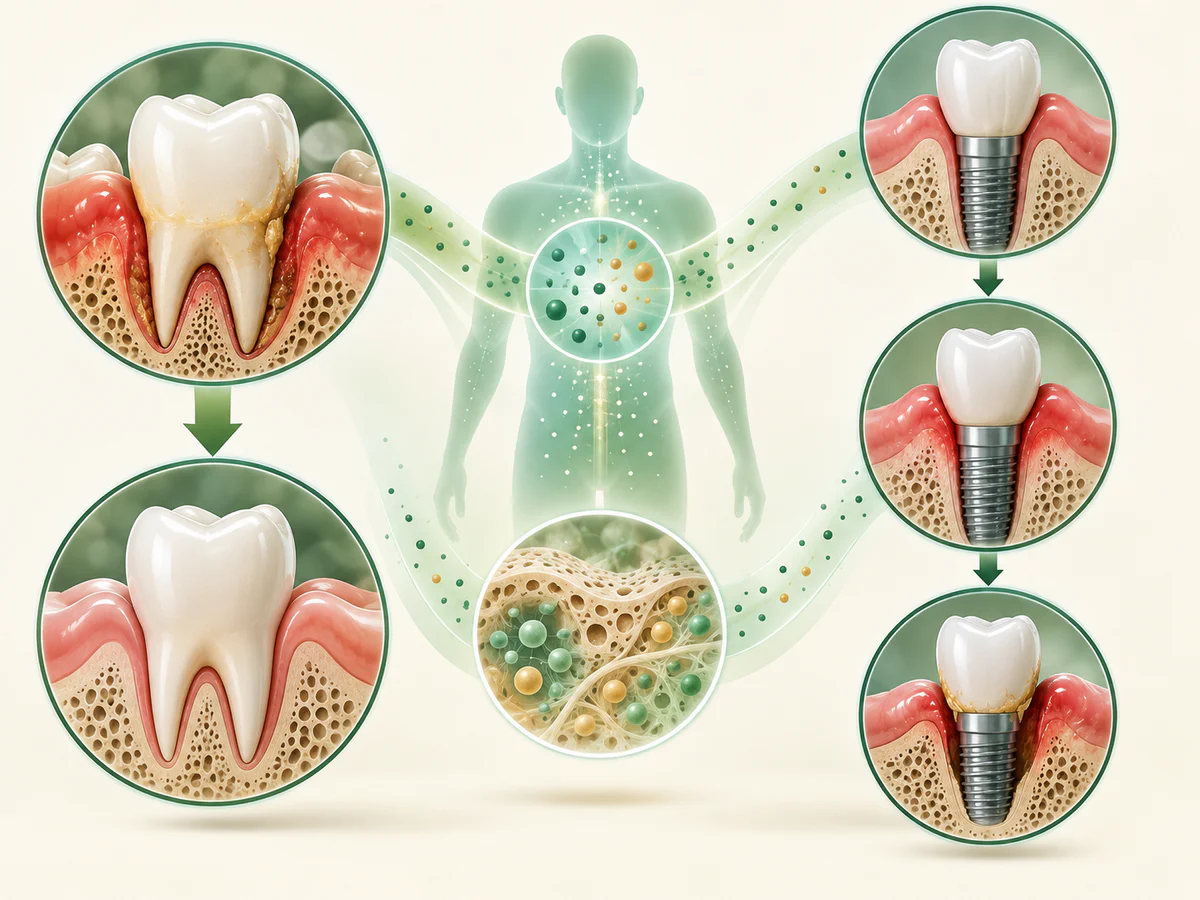
This point is essential to understanding implants. Peri-implantitis, the disease that can affect an implant, works on a principle comparable to periodontitis: plaque-associated inflammation that leads to progressive loss of the bone around the implant. A patient who has already shown, on their natural teeth, a susceptibility to losing bone in response to biofilm remains liable to react the same way around their implants. A history of periodontitis is therefore not trivial: it describes a biological terrain, not simply a past episode.
That does not mean periodontitis mechanically “contaminates” implants. It means that a person’s risk profile does not disappear along with their teeth: it has to be taken into account in the decision and in the follow-up.
The risk of peri-implantitis is real: what the studies say
The literature converges on this point, and it is important to present it with figures, without dramatizing them.
The international consensus
The 2017 World Workshop, organized jointly by the American and European periodontology societies, established the reference classification of peri-implant diseases. Its consensus report (Berglundh et al., 2018) concludes that there is strong evidence of an increased risk of peri-implantitis in patients with a history of periodontitis, poor plaque control, and no regular maintenance after implant placement. These three factors are cited together, which is instructive: the history counts, but hygiene and follow-up weigh just as heavily.
The review by Schwarz et al. (2018), from the same Workshop, confirms that a history of periodontitis is among the best-supported risk indicators for peri-implantitis, alongside plaque control and maintenance.
What the meta-analyses quantify
Several syntheses put numbers on this added risk. The meta-analysis by Sgolastra et al. (2015, Clinical Oral Implants Research) reports, in patients with periodontal disease, a relative risk of implant loss of 1.69 (95% CI: 1.31–2.17) and a risk of peri-implantitis of 2.17 (95% CI: 1.51–3.12), both statistically significant compared with periodontally healthy patients.
A more recent and broader synthesis, by Serroni et al. (2024, Clinical Implant Dentistry and Related Research), pooled 12 prospective cohort studies. It found a significantly higher risk of implant loss in patients with a history of periodontitis — a relative risk of 1.62 up to 5 years and 2.26 beyond 5 years — and an incidence of peri-implantitis roughly four times higher (relative risk 4.09; 95% CI: 1.93–8.58), with a greater mean marginal bone loss. The authors point out, however, that the level of evidence remains low, in the absence of randomized trials, and that these figures describe a population risk, not an individual fate.
| Source | Risk of implant loss | Risk of peri-implantitis |
|---|---|---|
| Sgolastra et al. 2015 | RR 1.69 (1.31–2.17) | RR 2.17 (1.51–3.12) |
| Serroni et al. 2024 | RR 1.62 (≤ 5 years); 2.26 (> 5 years) | RR 4.09 (1.93–8.58) |
The message to take away is not that an implant “is going to fail” after periodontitis. It is that the risk of complications is measurably higher, which justifies particular precautions and close follow-up — not a refusal on principle.
The conditions that make an implant possible
If an implant remains an option, it is on condition that a certain number of elements come together. None of them is optional.
Periodontitis treated and stabilized before placement
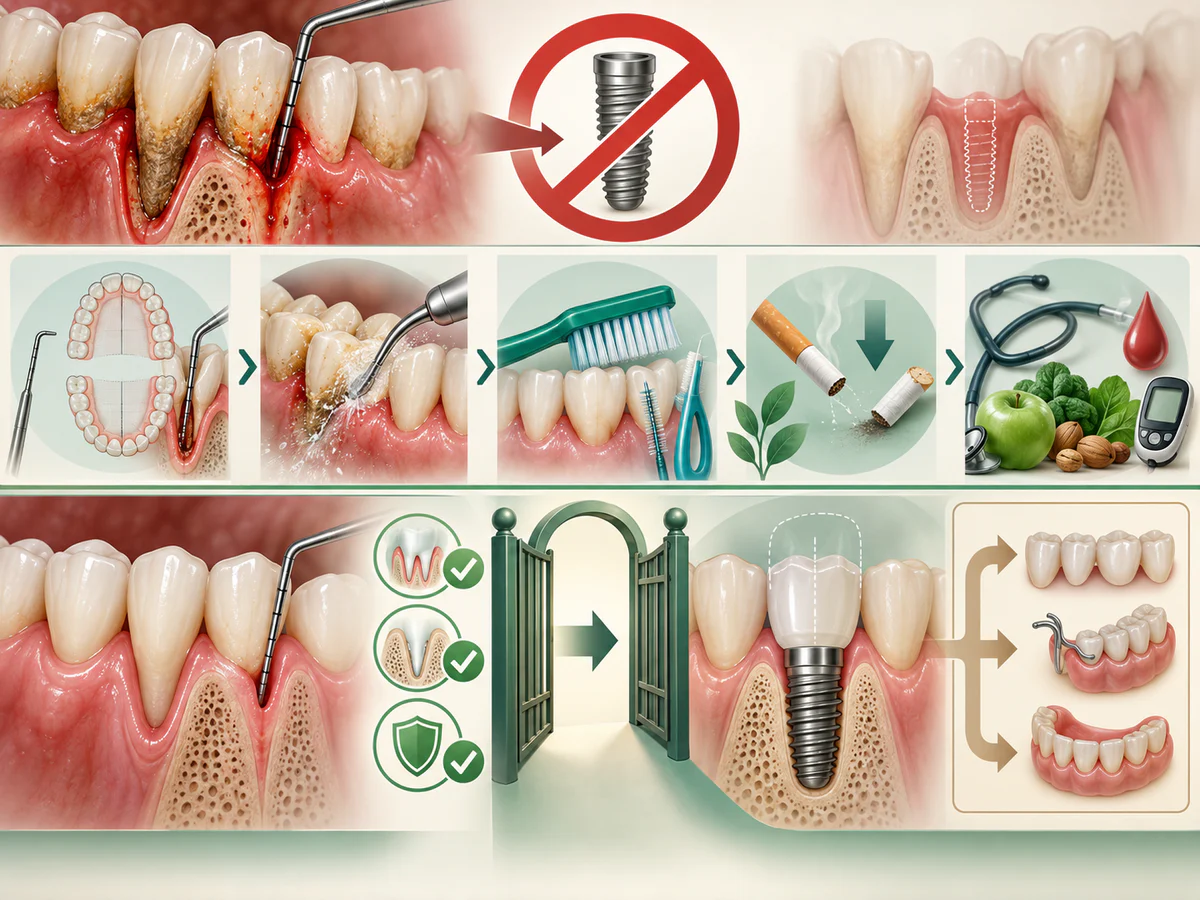
This is the first rule, and the most important: an implant is not placed in a mouth that is still diseased. The periodontal disease must first be treated and controlled. The EFP S3 guideline on the prevention and treatment of peri-implant diseases (Herrera et al., 2023) sets out this principle: preventing peri-implantitis begins as early as implant planning, which presupposes that the periodontium has first been restored to health. In practical terms, this means a periodontal assessment, scaling and root planing, then a re-evaluation to check that the inflammation is under control before implant surgery is considered.
A “stabilized” periodontitis means controlled inflammation, reduced pockets and bleeding under control — not merely a periodontitis that is “old”. It is this stabilization, confirmed at the re-evaluation, that determines what follows.
Good day-to-day plaque control
Biofilm control by the patient is a direct determinant of risk, underlined both by the 2017 consensus and by the EFP (2023). Effective brushing and interdental cleaning are not comfort recommendations: they are part of the conditions for success. The article on daily dental hygiene sets out the method and the tools suited to implants as well as natural teeth. Without plaque control, the benefit of the initial treatment is quickly exhausted.
Reducing or quitting smoking
Smoking is an additional risk factor often associated with periodontal disease. The level of evidence linking it specifically to peri-implantitis is judged less conclusive than for a history of periodontitis (Schwarz et al., 2018), but it remains a well-documented unfavorable factor for healing and tissue health. Reducing or stopping smoking before and after surgery improves the conditions, and this point is discussed at the assessment, without judgment.
Sustained maintenance, for life
This is the pivot of the whole project. The most telling data come from the 20-year prospective study by Roccuzzo et al. (2022, Journal of Clinical Periodontology), which followed both healthy patients and patients with a history of periodontitis. Overall implant survival there reaches 93% at 20 years, and the periodontally at-risk patients who regularly attended their maintenance showed no significant excess risk of implant loss compared with healthy patients who were also followed. Patients who did not comply with the maintenance program, by contrast, showed a very greatly increased risk of implant loss.
In other words, what most clearly separates success from failure is not so much the history of periodontitis as diligence with follow-up. Maintenance is not an option added after the fact: it is an integral part of implant treatment in the periodontal patient.
When periodontitis has taken bone: rebuilding, or working with the remaining bone
Periodontitis destroys the bone around the roots. The 2018 classification measures this loss relative to the length of the root: limited to the third nearest the crown in stages I and II, it reaches the middle third of the root, or goes beyond, in stages III and IV. Moderate or severe ridge defects are also among the complexity criteria for these stages. When a tooth is lost because of the disease, the bone that held it has therefore often already diminished.
The answer is not decided in advance. The gums are stabilised first, then the remaining bone is measured, in height and width, using three-dimensional imaging. Three paths are then discussed:
- Working with the remaining bone, when its volume allows an implant to be placed in a correct position. Options without a graft are presented in the article on a dental implant without enough bone.
- Rebuilding, when bone is missing where it is needed: a bone graft or bone regeneration, before or during placement, described in the guide to bone grafting before an implant. It too is planned in a stabilised mouth.
- Not placing an implant, and choosing a bridge or a removable prosthesis, when that is simpler or safer in your case: see implant, bridge or denture.
From gum treatment to implant: the steps specific to periodontitis
After periodontitis, the implant timeline begins well before placement. The steps follow this order:
- The periodontal assessment: probing tooth by tooth and X-rays. The guide to reading a periodontal exam explains its numbers.
- Non-surgical treatment: control of plaque and risk factors, then scaling and root planing, in one or more sessions.
- Reassessment, a few weeks later, once the gum has had time to respond. It is described in the article on reassessment after root planing.
- Further treatment of the pockets that persist, if needed, followed by further healing and a new measurement.
- Stability confirmed by these measurements.
- Implant planning, then placement, whose timeline is detailed in the stages of dental implant placement.
“Stabilised” is checked with measurements, not with an impression. The definition used in the EFP S3 guideline on stage IV periodontitis (Herrera et al., 2022) requires pockets of 4 mm or less, no 4 mm pocket that bleeds on probing, and bleeding at fewer than one in ten measured points. Added to this, in daily life, are effective cleaning between the teeth and risk factors that are being managed. The same guideline advises against placing an implant before the non-surgical phase is complete and, if possible, waiting until the treatment goals have been reached at reassessment.
How long do you need to wait? There is no single duration. The time for non-surgical treatment is followed by a few weeks of healing before reassessment, then, if pockets need to be treated, further healing and a new measurement. If a tooth must be extracted or bone rebuilt, their healing is added too. The timeline becomes clearer at each reassessment: it is the result of the measurement, not the date, that decides what comes next.
Peri-implant maintenance: the real long-term issue
The EFP S3 guideline (Herrera et al., 2023) places maintenance, or supportive peri-implant care, at the heart of prevention: periodic professional removal of the biofilm, reinforcement of hygiene, and regular assessment of the health of the tissues around the implants. For a patient with a history of periodontitis, this maintenance in fact combines periodontal follow-up of the remaining teeth with peri-implant follow-up of the implants — the two are inseparable.
There is no universal recall interval valid for everyone. The rhythm of follow-up, often a matter of a few months, is adapted to the individual level of risk: a patient with a history of severe periodontitis, poor plaque control or smoking will be seen more closely than a low-risk patient. The principle and the organization of this follow-up are detailed in the article on periodontal maintenance and follow-up.
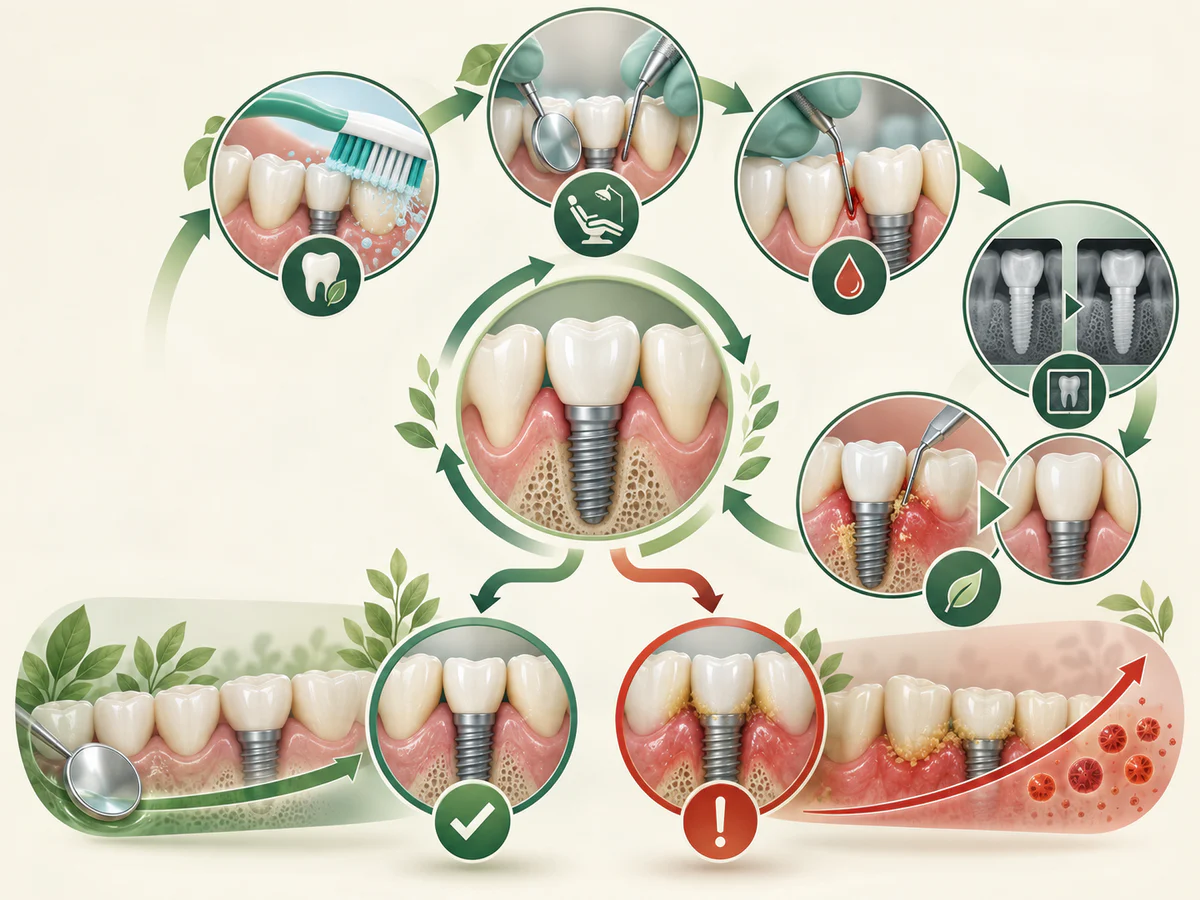
The purpose of this maintenance is twofold: to preserve the periodontal health that has been achieved, and to detect early any mucositis or beginning peri-implantitis, while the situation is still reversible or manageable. Because peri-implantitis often gives signs before it gives way.
Recognizing the signs early: survival is not success
One important clarification, valid for anyone with an implant and all the more so after periodontitis: the survival of an implant — the fact that it is still in place — is not the same thing as its success — the fact that it is healthy, with no bone loss. An implant can be “present” while developing a peri-implant disease.
The consensus of the 2017 World Workshop distinguishes peri-implant mucositis, a reversible inflammation of the gum without bone loss, from peri-implantitis, which involves a loss of supporting bone and is far more difficult to correct. The signs to watch for — gum bleeding when brushing, redness, swelling, discharge of pus, and, late on, mobility — as well as what to do about them are detailed in the article on the symptoms of implant failure to watch for. Bleeding often precedes pain: it is the signal that should prompt a consultation, without waiting.
For a patient with a history of periodontitis, this vigilance is all the more useful in that their baseline risk is higher. Knowing these signs means giving yourself the means to act at an early stage, where treatment is at its most conservative.
A shared decision, based on honest information
Deciding to place implants after periodontitis does not come down to a technical question. It is a shared decision, taken after fair information about the expected benefits as well as the real risks. The patient has the right to know that this history raises the risk of peri-implantitis, that this risk can be managed but not eliminated, and that their own involvement — hygiene and diligence with maintenance — weighs heavily on the result.
At the practice in Kénitra, this thinking translates into a clear sequence: a periodontal and clinical assessment, restoring the mouth to health before any placement, planning supported by three-dimensional CBCT imaging to assess the volume and quality of the bone, then close, personalized follow-up after placement. These means describe a cautious method; they do not, in themselves, constitute a guarantee of results. The full implant journey is presented in the article on how a dental implant is placed, step by step.
Gum treatment is described on Periodontics in Kenitra: the five-step pathway, and the placement that follows on Dental implant: what the assessment looks at first. Real-life situation: A loose tooth, bleeding gums.
In summary
Yes, an implant remains possible after periodontitis. But on three inseparable conditions: a periodontitis treated and stabilized before placement, good plaque control and reduced smoking, and maintenance sustained for life. A history of periodontitis is a recognized risk factor for peri-implantitis, confirmed by the consensus of the 2017 World Workshop (Berglundh et al., 2018) and quantified by the meta-analyses (Sgolastra et al. 2015; Serroni et al. 2024): the risk is higher, but it does not rule out implants. The long-term data from Roccuzzo et al. (2022) show that periodontally at-risk patients who are regular with their maintenance achieve results close to those of healthy patients, whereas the absence of follow-up sharply multiplies the risk of failure. Survival is not success: organized follow-up and an honest, shared decision are the best way to approach an implant project after periodontitis.
Frequently asked questions
Can you really place an implant if you have had periodontitis?
Does my history of periodontitis really increase the risk of peri-implantitis?
What needs to be done before placing an implant after periodontitis?
If I have a history of periodontitis, will my implants last as long?
How often do I need to come back after the implants are placed?
Is smoking a problem if I have had periodontitis and I want implants?
Can periodontitis cause enough bone loss to require a graft before an implant?
How long should I wait after gum treatment before an implant is placed?
Sources
Medical references consulted for this article.
- 1Berglundh et coll., consensus péri-implantaire, World Workshop 2017, J Clin Periodontol 2018 (PubMed)
- 2Schwarz et coll., Peri-implantitis, World Workshop 2017, J Clin Periodontol 2018 (PubMed)
- 3Serroni et coll., antécédent de parodontite et échec implantaire/péri-implantite : revue systématique et méta-analyse, Clin Implant Dent Relat Res 2024 (PubMed)
- 4Sgolastra et coll., parodontite, perte implantaire et péri-implantite : méta-analyse, Clin Oral Implants Res 2015 (PubMed)
- 5Stacchi et coll., antécédents parodontaux et tabac comme facteurs de risque de péri-implantite : revue systématique et méta-analyse, J Oral Maxillofac Res 2016 (PMC)
- 6Roccuzzo et coll., implants chez le patient avec/sans antécédent de parodontite : étude prospective sur 20 ans, J Clin Periodontol 2022 (PMC)
- 7EFP, recommandation S3 sur la prévention et le traitement des maladies péri-implantaires (Herrera et coll., 2023)
- 8Herrera D, Sanz M, Kebschull M, et al. Treatment of stage IV periodontitis : the EFP S3 level clinical practice guideline. J Clin Periodontol. 2022;49 Suppl 24:4-71 (PubMed)
- 9AAP et EFP, Staging and Grading Periodontitis : tableaux de la classification 2018, d'après Tonetti, Greenwell et Kornman
Contents
Share