
Tooth decay is not a childhood disease that you leave behind you. In adults, it remains common, and it even takes on particular forms linked to age: receding gums that expose the roots, dry mouth encouraged by certain medications, and old restorations that break down. The World Health Organization also points out that tooth decay is the most widespread noncommunicable disease in the world, affecting around 2.5 billion people, including nearly 2 billion adults with permanent teeth. In other words, this is not a marginal problem.
As a dental surgeon in Kenitra, I see that many adults come in late, because an early cavity doesn’t hurt. It is precisely this gap between the silent onset of the lesion and the appearance of pain that makes early detection so valuable. This article honestly explains what a cavity is as a process, why adults are exposed to it, how it is detected today, and how treatment is graded according to the stage, without promising a miracle or being alarmist.
Tooth decay is a process, not an accident
It is tempting to see a cavity as a hole that appears all at once. The reality is more gradual. According to the World Health Organization, tooth decay results from plaque that forms on the surface of the tooth and turns the free sugars in food into acids that attack the hard tissues of the tooth over time. These acids first demineralize the enamel, the outer layer, then the dentin, which is deeper, and can finally reach the pulp, where the nerve and blood vessels are located.
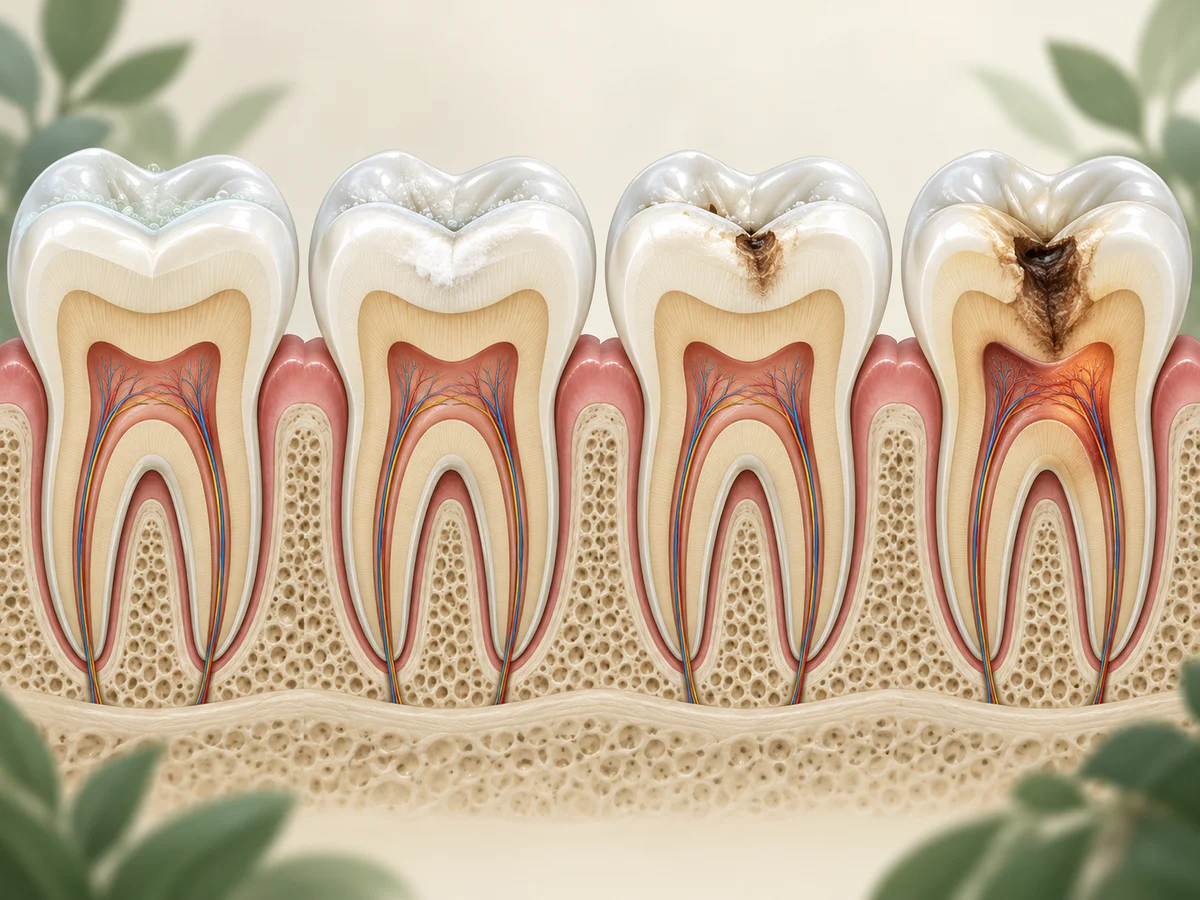
An essential point, often overlooked, is that this process is not one-way. The reference synthesis from StatPearls (NCBI) describes tooth decay as a dynamic process that alternates between periods of demineralization and remineralization: the lesion progresses or regresses depending on which factors prevail. It is this back-and-forth that explains why a very early lesion can sometimes be stopped, whereas an established cavity never fills back in on its own.
Two ingredients feed the imbalance toward demineralization: the bacterial biofilm (plaque) and the frequency of sugar intake. The WHO is explicit: the consumption of free sugars in food and drinks is the most common risk factor for tooth decay. Free sugars are not limited to added sugar; they also include those in fruit juices, honey and syrups. And it is often frequency, more than quantity, that poses a problem: snacking or sipping something sugary all day long multiplies the acid attacks and doesn’t leave saliva the time to neutralize the environment.
Why adults are exposed to specific types of decay
Adult tooth decay is not simply a continuation of childhood decay. Several factors specific to adulthood change the terrain. If the pediatric version interests you for your children, our article on tooth decay in children covers that topic separately.
Gum recession and root caries
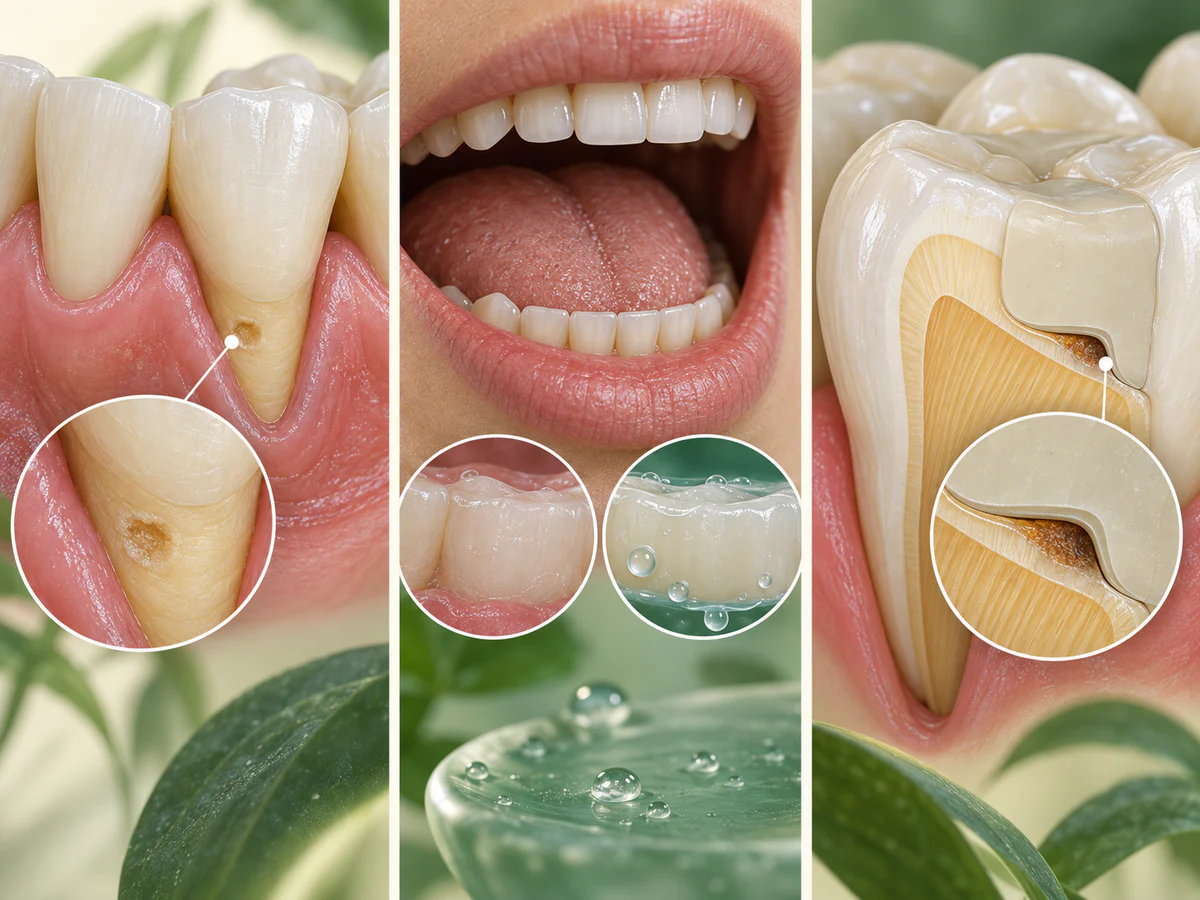
With age, and under the effect of aggressive brushing or gum disease, the gum can pull back and expose the root of the tooth. But the root is not protected by enamel: it is covered by cementum and dentin, tissues that are markedly more vulnerable to acid. The literature on root caries (a PMC synthesis on caries risk in older adults) emphasizes that recession exposes surfaces that were previously protected, which increases the risk of decay on the root. These root caries are a particularity of adults and older people, rarely seen in children. To understand and limit recession, our article on gum recession details the causes and options.
Dry mouth and medications
Saliva plays a major protective role: it neutralizes acids, supplies minerals and limits bacterial growth. When salivary flow drops, the risk of decay climbs. But many medications commonly prescribed in adults dry out the mouth: the same synthesis cites treatments for high blood pressure, cholesterol-lowering drugs, certain pain relievers, muscle relaxants, antiallergy drugs and asthma treatments. Conditions such as Sjögren’s syndrome or radiation therapy to the head and neck also strongly reduce salivation. Dry mouth is therefore a risk factor for decay that is all the more relevant as one grows older and takes several medications.
Old restorations
A tooth that has already been treated is not out of danger. Over time, the margins of an old filling or composite can break down, and a cavity can start up again at the edge of the restoration, sometimes discreetly beneath the filling. This is one of the reasons regular follow-up remains useful even when everything has “already been taken care of.”
How is a cavity detected in adults?
An early cavity is most often painless: you therefore can’t rely on pain to know whether a tooth is fine. Detection relies on several complementary tools.
The clinical examination comes first: the tooth is cleaned, dried and inspected. A very early lesion may show up as a simple white or dull spot on the enamel, visible especially after drying. The X-ray complements this examination, particularly for the surfaces between teeth and under old restorations, where the eye alone is not enough. At the practice, the X-ray is part of the routine examination and helps to confirm a lesion objectively or to track its progression.
The ICDAS score
To describe a lesion precisely and reproducibly, practitioners use an international system, ICDAS (International Caries Detection and Assessment System). As described in the reference publication (PMC), it is a visual scale with seven levels, from code 0 (healthy surface) to code 6 (extensive cavity), which makes it possible to record both the first signs of enamel involvement and deep cavities. Its value is in spotting decay at all stages, including before a cavity forms, and in tracking its progression over time.
| ICDAS Code | What is observed | General idea of the stage |
|---|---|---|
| 0 | Healthy surface after drying | No visible lesion |
| 1-2 | Change in color or a spot within the enamel | Early lesion, without a cavity |
| 3-4 | Small break in the enamel or dark shadow coming from the dentin | More marked involvement |
| 5-6 | Clear cavity with visible dentin, sometimes extensive | Established cavity |
This table is a teaching simplification: only an examination at the practice, complemented if needed by an X-ray, allows a diagnosis to be made and a treatment to be decided. The value of ICDAS for the patient is above all to understand that a cavity “rated 1 or 2” does not call for the same intervention as a cavity “rated 5 or 6.”
Treatment is graded according to the stage
There is not a single treatment for tooth decay, but a logical gradation depending on the depth of the involvement. The guiding principle of modern dentistry is to preserve the maximum of healthy tooth tissue. The French health insurance service (ameli.fr) states it clearly: the objective of treating cavities is to preserve the maximum of dental tissue, and infected tissue is removed while preserving the tooth’s structure as much as possible.
Early cavity: remineralize rather than drill
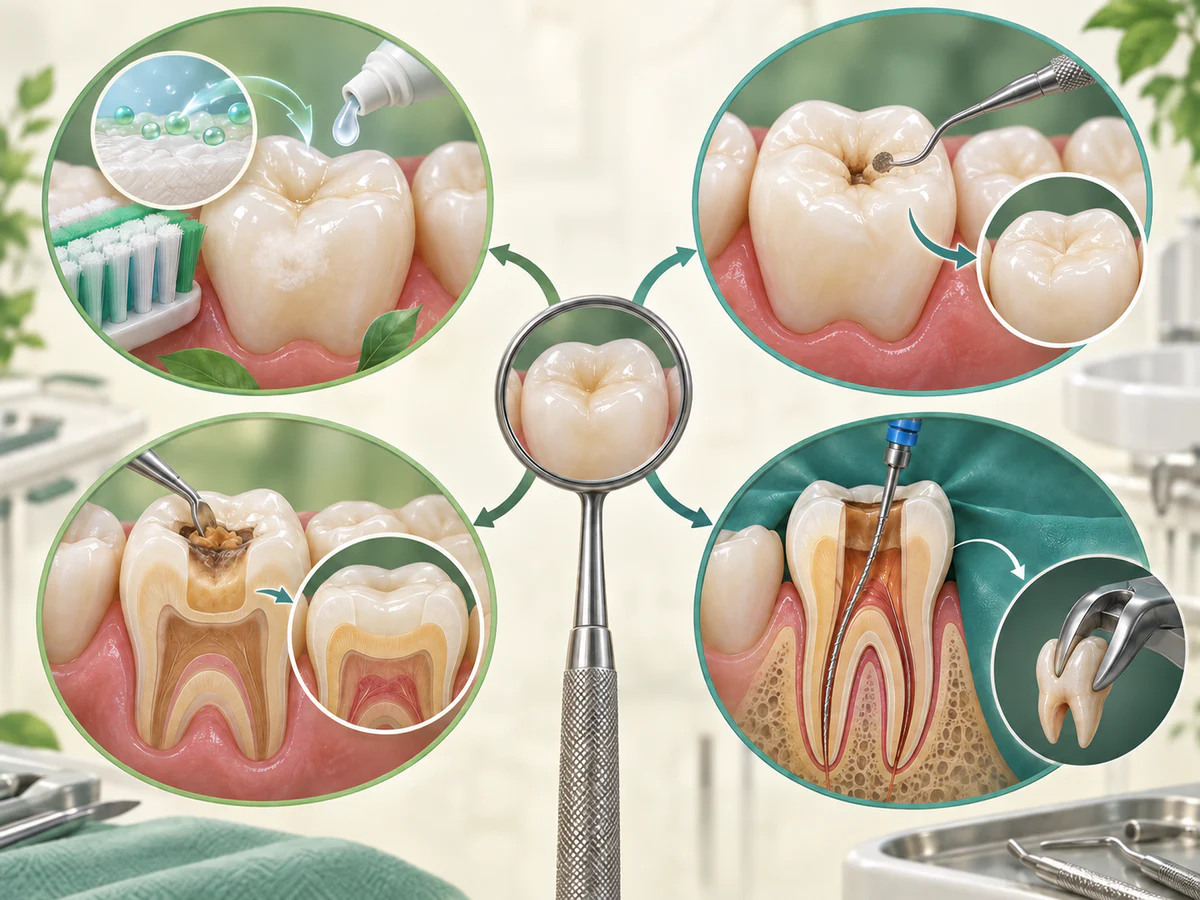
When the lesion is very early and the enamel is not yet cavitated (low ICDAS codes), it is sometimes possible to stop it without touching the drill. The StatPearls synthesis indicates that the early stages of decay can be prevented, stopped or even reversed by acting on the underlying factors, notably diet, and by promoting remineralization. It specifies that the means with the highest level of evidence to prevent, stop or reverse an early cavity is topical fluoride.
This role of fluoride is solidly documented. The Cochrane review by Marinho and colleagues, covering more than 40,000 children and adolescents, established that fluoride toothpaste reduces the risk of decay compared with a fluoride-free toothpaste, with an effect that is more marked the higher the concentration and the more brushing is done twice a day. Even though this review concerns a young population, the protective mechanism of topical fluoride holds for adults. In practical terms, when faced with an early lesion, one can combine a suitable fluoride toothpaste, better plaque control and a reduction in the frequency of sugar intake, then monitor how it progresses. This approach does not erase a cavity that has already formed: it addresses only very early lesions.
Cavitated decay: composite in minimally invasive dentistry
As soon as a cavity is established, the lesion no longer regresses and intervention is needed. The treatment consists of removing the infected tissue and then rebuilding the tooth. Today, the most commonly used material is composite, an adhesive resin with a shade close to that of the tooth. ameli.fr describes this composite material as more esthetic and more conservative than amalgam. At the practice, I favor esthetic composite for this kind of conservative treatment.
The current philosophy is that of minimal-intervention, or minimally invasive, dentistry. As summarized in a clinical guide published in the literature (PMC), minimally invasive dentistry brings together conservative operative techniques that preserve the hard and soft tissues, and the systematic removal of all affected dentin is no longer considered mandatory. We are far from the old logic of “extension for prevention” that consisted of enlarging cavities on principle. The idea is to remove what is necessary, no more.
This approach makes full sense in deep lesions, close to the pulp. Rather than removing everything at the risk of opening the pulp, one can perform selective removal: the edges of the cavity are cleaned completely down to healthy dentin, but a thin layer of affected dentin is deliberately left in contact with the pulp. The literature on selective removal shows that this strategy reduces the risk of exposing the pulp compared with complete removal, which helps preserve the vitality of the tooth. It is a reasoned compromise that favors preserving the nerve when possible.
Deep decay: root canal or extraction
When decay has reached the pulp irreversibly, or has caused an infection (pulpitis, necrosis, abscess), composite is no longer enough. The inside of the tooth must then be treated: this is devitalization, or root canal treatment. ameli.fr describes this procedure as the removal of all the pulp tissue, then the cleaning and disinfection of the root canals, all under X-ray control. Contrary to a widespread idea, this treatment is not, in itself, particularly painful: our article on devitalization and pain honestly details what to expect and what should raise concern.
Finally, when the tooth is too damaged to be restored reliably, extraction becomes the most reasonable solution, followed by consideration of a replacement. This decision is never taken lightly: it depends on the amount of healthy tissue remaining and the overall prognosis of the tooth. The principle remains to preserve whenever possible, and to extract only when preservation is no longer reasonable.
When pain sets in
A cavity that becomes painful, especially if the pain is spontaneous, throbbing or wakes you at night, suggests that the pulp is already affected. Pain triggered by cold or heat can have causes other than decay; our article on tooth sensitivity to cold and heat helps to see things more clearly. In case of intense pain, swelling or fever, you should not wait: these are signs that warrant a prompt consultation.
Preventing tooth decay in adulthood
Prevention in adults relies on simple, well-established measures, the same ones that rebalance the process toward remineralization.
- Brush your teeth twice a day with a fluoride toothpaste, as recommended by the WHO, which specifies that a toothpaste with 1000-1500 ppm of fluoride is among the protective measures.
- Limit free sugars, in quantity and especially in frequency: the WHO recommends staying below 10% of energy intake, ideally below 5%.
- Clean between the teeth (floss or interdental brushes), where the brush doesn’t reach and where adult cavities readily settle.
- Tell your dentist about a dry mouth or a new medication, because dry mouth increases the risk of decay.
- Keep up regular follow-up, which makes it possible to spot an early lesion that is still reversible, or a recurrence of decay under an old restoration.
For the technique and the details of daily habits, our article on daily dental hygiene rounds out these guidelines.
In summary
Adult tooth decay is common and silent at the start, but it is not inevitable. Understood as a dynamic process of demineralization and remineralization, it can often be turned around if it is detected early. Adults are exposed to particular forms, notably root caries linked to gum recession and the increased risk in case of dry mouth. Detection combines the examination, the X-ray and, to describe the lesion, the ICDAS score.
Treatment is graded: remineralization with fluoride for an early cavity, composite in minimally invasive dentistry for an established cavity, and root canal treatment and then extraction when the tooth is too badly affected. At each step, the common thread is the same: preserve as much dental tissue as possible, as the French health insurance service reminds us. None of these solutions guarantees a lifelong result, but a cavity caught early is treated more simply and more durably than a neglected one.
Frequently asked questions
Can an early cavity be treated without a drill?
Why do adults get cavities on the roots of their teeth?
Is composite a good material for treating a cavity?
Does dry mouth really promote cavities?
Do you always have to devitalize or pull out a decayed tooth?
How often should you see a dentist as an adult?
Sources
Medical references consulted for this article.
- 1OMS (Organisation mondiale de la santé), Sucres et carie dentaire (aide-mémoire), consulté 2026
- 2Pitts ND et coll., International Caries Detection and Assessment System (ICDAS): A New Concept, via PMC
- 3StatPearls (NCBI Bookshelf), Remineralization of Initial Carious Lesions
- 4Marinho VCC et coll., Fluoride toothpastes for preventing dental caries in children and adolescents (Cochrane), résumé grand public
- 5Banerjee A et coll., Minimally invasive selective caries removal: a clinical guide, via PMC
- 6Heng C, Elderly at Greater Risk for Root Caries (risques multifactoriels, récession et xérostomie), via PMC
- 7ameli.fr (Assurance Maladie), Carie dentaire : le traitement
Contents
Share