In the morning, when you brush your teeth, there is a little pink in the sink. For some time, one tooth has not felt like the others when you bite. You push it with your tongue and it gives a little. One evening, you searched for ‘loose tooth’ on your phone, then closed the page.
What you feel is a signal. By itself, it is not proof that all your teeth will be lost.
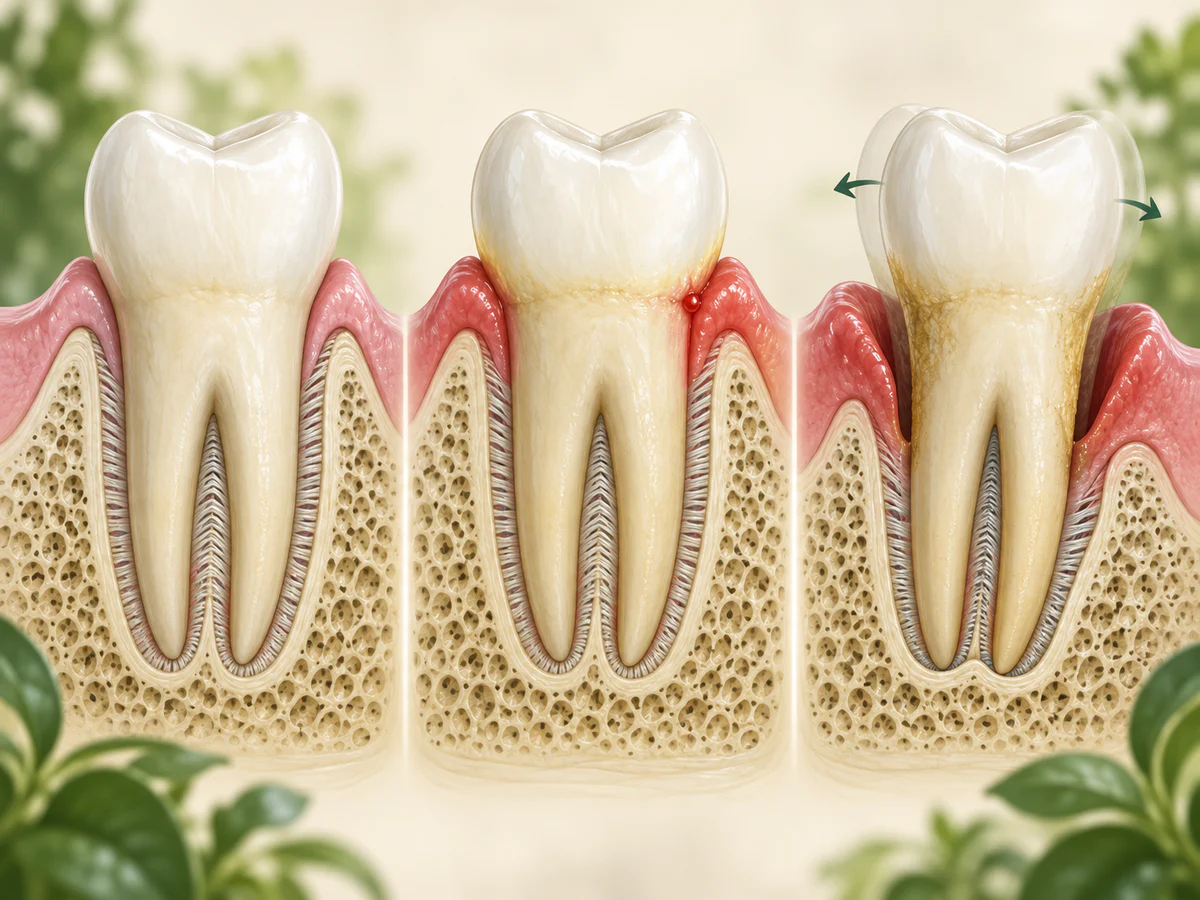
A tooth is not planted directly in the bone. It is connected to its support by tissues that include the gum, ligament and bone around the root. When the gum becomes inflamed, it may bleed. When the disease extends into the supporting tissues, periodontitis can cause bone loss and mobility. This progression is often not painful, which is why it may remain unnoticed.
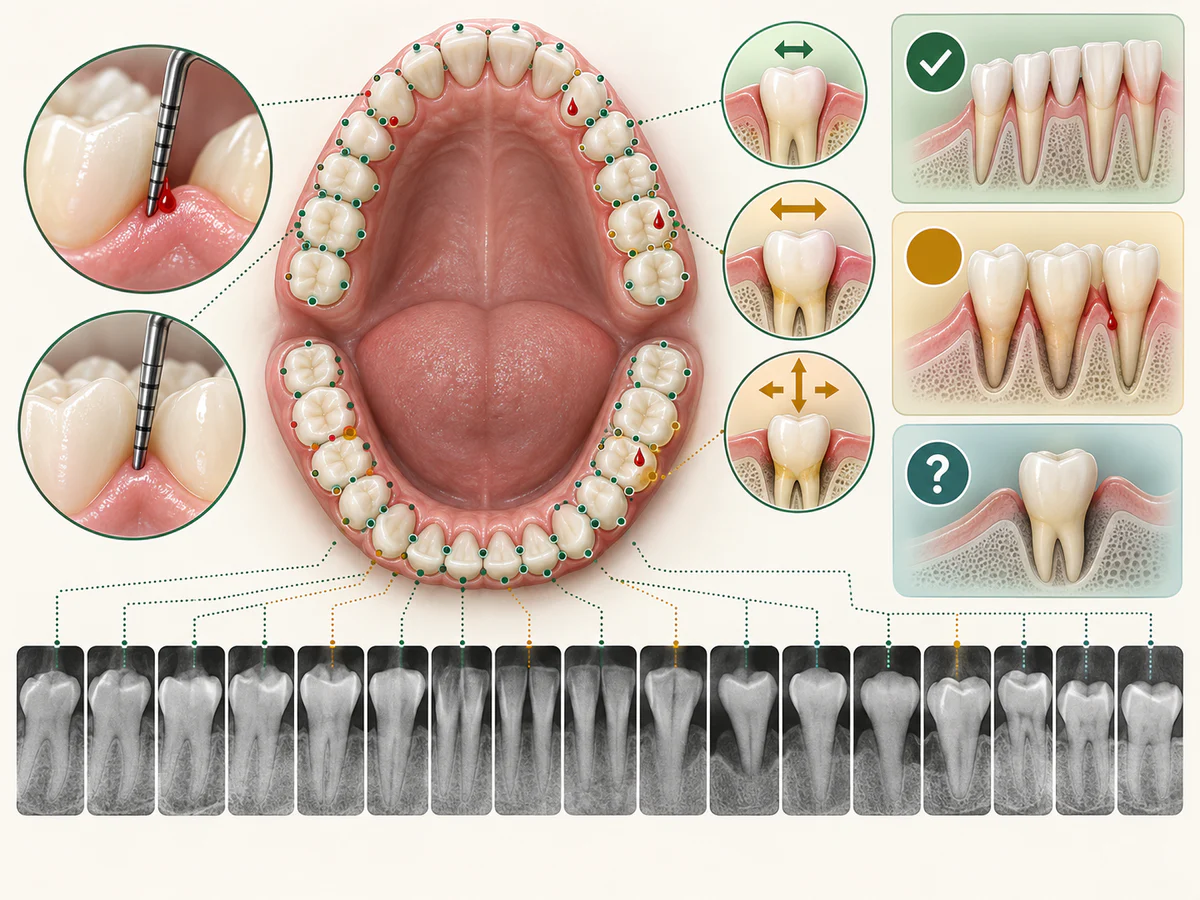
The difference between gingivitis and periodontitis cannot be determined from a photograph. It requires an examination. A graduated probe can measure the space between the gum and each tooth; an X-ray can show the bone level. The aim is to assess each tooth individually: which ones are stable, which ones are vulnerable, and what may explain the mobility.
A loose tooth: degrees and causes
All teeth move very slightly in their sockets. We speak of mobility when this movement becomes noticeable. It is described in degrees: slight, when the tooth moves 1 mm or less from front to back; marked, when it moves more or sinks when pressed (source: Peditto et al., 2024). The numbers written on an examination chart can be read with the guide to reading a periodontal exam.
Several causes can add up:
- Loss of support. When periodontitis has destroyed part of the bone and attachment, the tooth is held over a shorter height and moves more.
- Jaw forces. Clenching or grinding does not cause periodontitis. But on a tooth that has already lost support, these forces increase mobility, and still-weak evidence suggests they may speed up attachment loss; adjusting the bite can help reduce mobility (source: Fan and Caton, 2018). Bruxism and night guards are explained in a separate article.
- A knock. A tooth that moves after a blow calls for a different approach: the article on what to do in a dental emergency describes the first steps.
Gaps opening between the front teeth
Sometimes it is not a single tooth that moves: the front teeth shift, fan out towards the front, look longer, and gaps appear where there were none. The European guideline on advanced forms of periodontitis associates these movements, called migration, with significant attachment loss around the teeth involved (source: EFP S3 guideline, 2022). The order stays the same: stabilise the gums first. Orthodontic realignment can be discussed afterwards, but the same guideline advises starting it only once the goals of gum treatment have been reached.
Stabilise before replacing
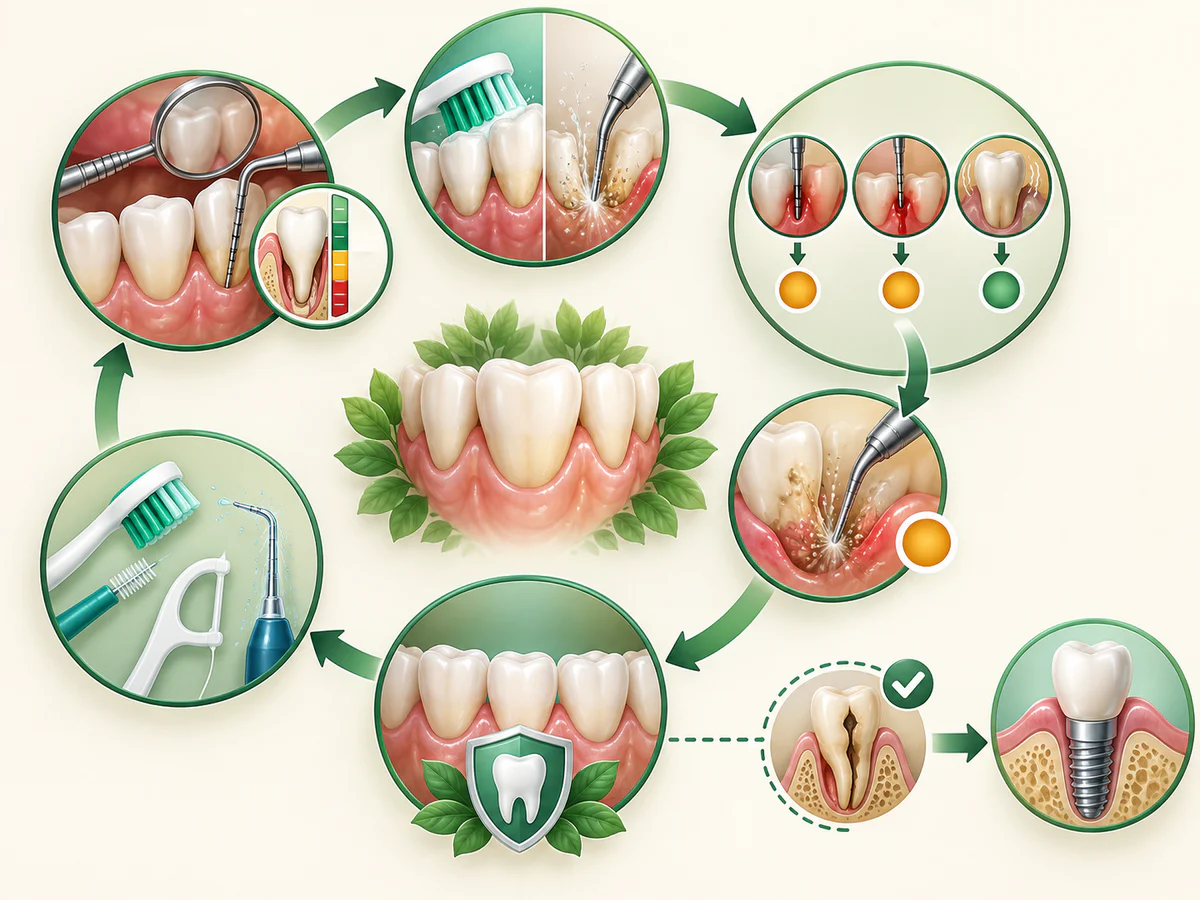
Periodontal guidelines describe care in stages. It begins by controlling inflammation and biofilm, particularly through professional cleaning and suitable daily care. Scaling and root planing may be part of this first phase when the condition warrants it. A reassessment then measures how the tissues have responded. Targeted care may be discussed if some areas remain active, followed by periodontal maintenance to help monitor the situation.
An honest limit must also be stated: not every tooth can always be preserved, and lost bone does not necessarily return to its original condition. The aim is to control progression and retain what can be retained. The prognosis is made tooth by tooth, not for the entire mouth as a single unit.
The question of an implant only comes after this. If a tooth cannot be preserved, replacing it may be discussed once the gum has been assessed and stabilised. The tissues around an implant also require monitoring; an implant after periodontitis is therefore not a decision separate from gum health.
Keeping or extracting the tooth: what the decision rests on
A loose tooth is not, for that reason alone, a tooth to extract. A review of studies that followed treated patients for ten years or more shows that mobile teeth are lost more often than others, but that most could be kept; its authors conclude that mobility alone should not be a reason for extraction (source: Peditto et al., 2024). The European guideline on advanced forms also advises against extracting too early a tooth whose future is merely uncertain (source: EFP S3 guideline, 2022).
The decision is therefore made after the inflammation has been controlled and the tissues reassessed, based on specific elements:
- the remaining bone around the root, read on the X-ray;
- the mobility measured after treatment, not only on the first day;
- the gum’s response: have the pockets reduced, has the bleeding stopped;
- the tooth’s role: for chewing, for supporting a future prosthesis or for the balance of the mouth;
- whether it can be cleaned every day, and what you want.
Extraction becomes a reasonable option when, despite this period of treatment, the tooth remains infected or painful, its support no longer allows it to function, or it compromises the overall plan. It is then discussed with you, together with the replacement options and their limits.
Splinting: a brace for loose teeth
A splint is a thin wire or fibre strip bonded to the inner surface of the teeth, linking a loose tooth to its neighbours. The European guideline presents it as an aid to comfort: temporary, during treatment, to make chewing easier and facilitate care; sometimes long-term, when troublesome mobility persists after successful treatment (source: EFP S3 guideline, 2022).
Its limits are worth knowing. It does not treat the cause and does not rebuild bone. The level of evidence supporting it remains very low. It also makes cleaning between the teeth more demanding, and it is checked at every follow-up visit.
Shame, breath, difficulty eating: where to start
Many people wait because they are ashamed of their breath or their teeth, or because eating has become difficult. None of this is a reproach: these are common signs of gum inflammation, and persistent bad breath can be part of it.
A simple order helps you regain control:
- Write down what you notice: which tooth, since when, bleeding, pain, swelling.
- Report as a priority any swelling, abscess or very loose tooth, which need prompt attention.
- Until the appointment, keep brushing gently, cut food into small pieces and choose soft textures if chewing is difficult.
- Have it measured: the assessment shows which teeth are stable and which are vulnerable.
- Treat the inflammation first: it is what makes the gum bleed and can sustain bad breath.
What the assessment should clarify
- What is happening: the condition of the gum, the bone level and mobility, tooth by tooth.
- What needs prompt attention: a very loose tooth, swelling or an abscess; the rest is treated in an order defined after the examination.
- The reasonable options: controlling inflammation, reassessment, targeted care when indicated, and regular follow-up.
- The steps: phases separated by a new measurement of the tissues’ response.
- The plan: if treatment is being considered, the information needed to order the phases and establish the cost after the evaluation.
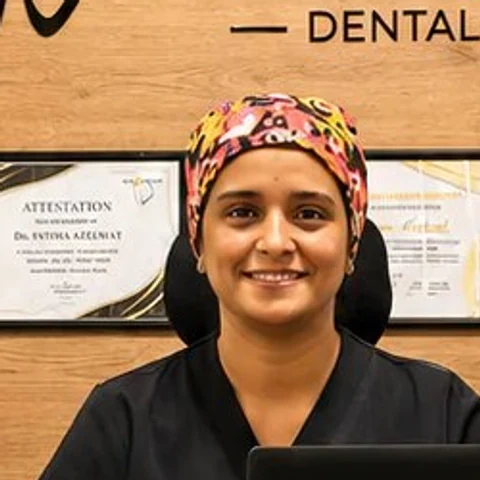
The assessment is carried out by Dr Fatima Azelmat, a dental surgeon in Kenitra. The Periodontology in Kenitra page explains the general stages of this care and its objective: to preserve natural teeth whenever their condition allows. Scheduling an assessment does not commit you to any treatment.
If a tooth cannot be kept, its replacement is discussed after stabilisation: implant after the gums have been stabilised. What the assessment clarifies first.
Frequently asked questions
Will a loose tooth inevitably fall out?
Why do gums bleed when brushing?
Should I stop brushing a gum that bleeds?
Does an implant immediately replace a loose tooth?
Sources
Medical references consulted for this article.
Contents
Share