In short: navigated implant surgery, also called dynamic navigation, shows the drill and the planned implant position on a screen in real time, over your 3D images. It is an alternative to a fixed, printed surgical guide. Studies report accuracy comparable to a static guide and better than freehand placement, yet a deviation of about a millimetre remains, which is why planning and safety margins still matter.
Navigated surgery, also called dynamic implant navigation, is a computer-assisted method of placing an implant in which the practitioner follows the position of the drill and of the future implant relative to the patient’s anatomy in real time, on a screen.
The image often used is that of a “GPS”: just as a GPS shows your car on a map and tells you live whether you are still on route, the navigation system displays the surgeon’s instrument on the patient’s 3D images and signals, moment by moment, any deviation from the planned position. It is an aid to guidance, not a guarantee of results.
As a dental surgeon practising in Kénitra, I offer here a factual and measured look at this technology: what it is, how it works, how it differs from surgery guided by a static guide, what research actually says about its accuracy, and where its limits lie.
This article is an educational reference for understanding the subject; every statement points to a verifiable source, and no figure is presented as a promise for any individual case — these are study data, to be read as probabilities.
What is navigated surgery?
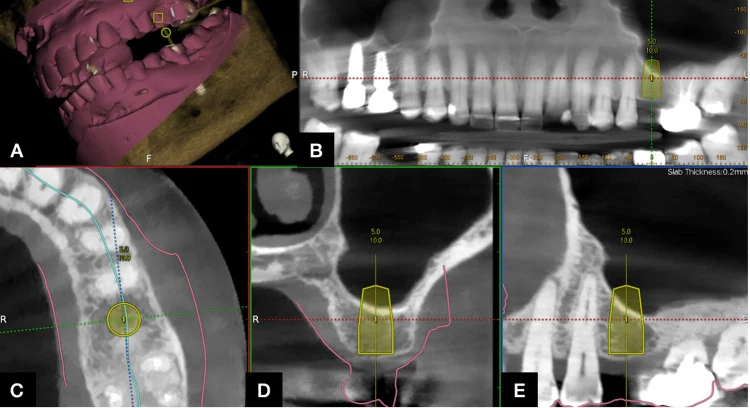
Navigated surgery applies to implantology a principle drawn from computer-assisted surgery: continuously displaying the position of an instrument in space, superimposed on the patient’s 3D imaging. In practice, the system brings together three elements: a three-dimensional examination (a CBCT, or cone beam), planning software in which the ideal position of the future implant is mapped out, and an optical tracking device that “sees”, during the procedure, markers fixed to the surgeon’s handpiece and to the patient’s mouth.
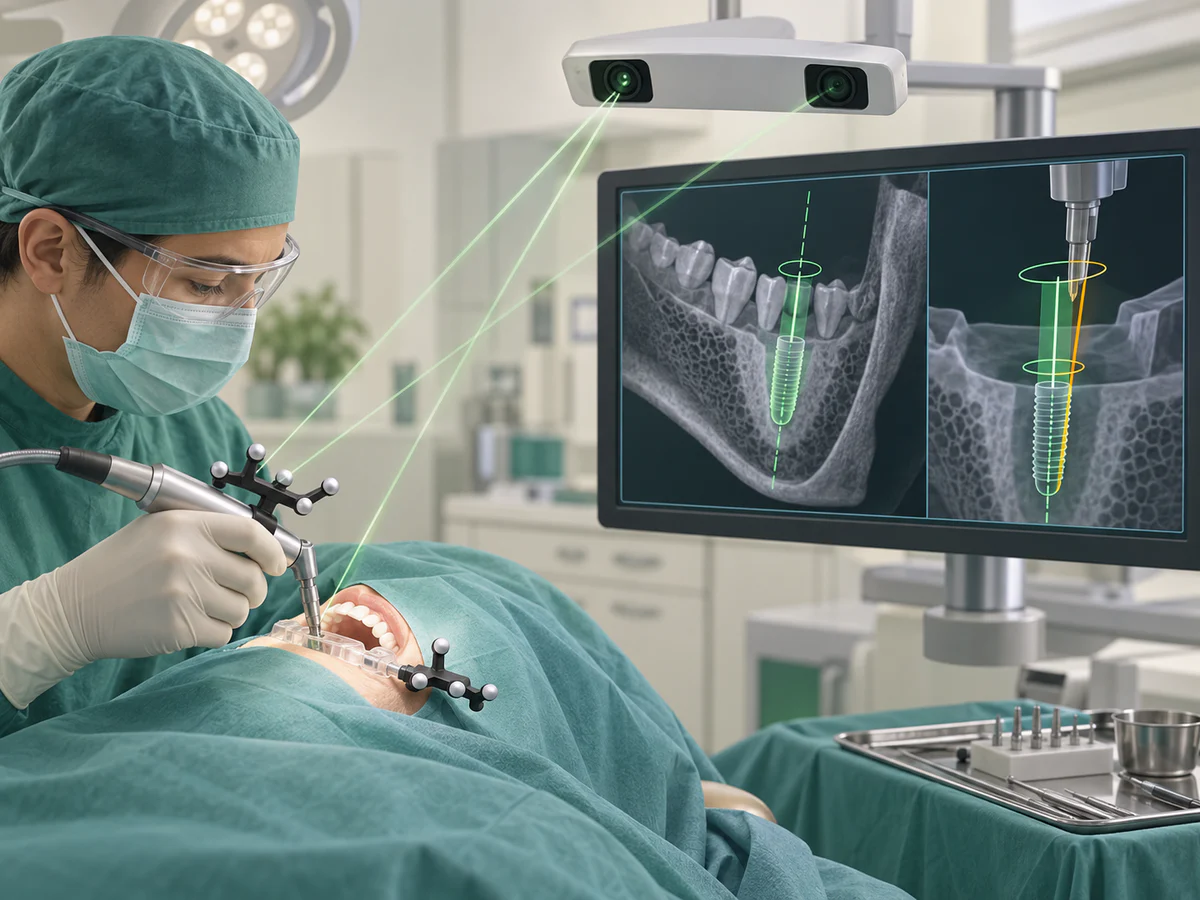
Once planning is complete and the system is calibrated, the screen shows in real time the axis, depth and angulation of the drill relative to the planned position. The surgeon corrects the movement live, much as a driver adjusts their route based on the GPS.
The review by Wang and colleagues (Australian Dental Journal, 2025) sums up the benefit this way: these systems make it possible to “track in real time the relative position between the handpiece, the virtual implant plan and the patient’s anatomical structures” during the procedure.
It is important to keep in mind that navigation guides the trajectory; it does not decide the indication, the diagnosis, or the quality of the bone. Understanding the role of 3D imaging in this approach helps put the technology in context: that is the subject of our article on CBCT and dental 3D imaging.
Navigated (dynamic) surgery or guided (static) surgery?
“Navigated surgery” and “guided surgery” are often confused, since both rest on prior 3D planning. The difference lies in when and how the guidance happens.
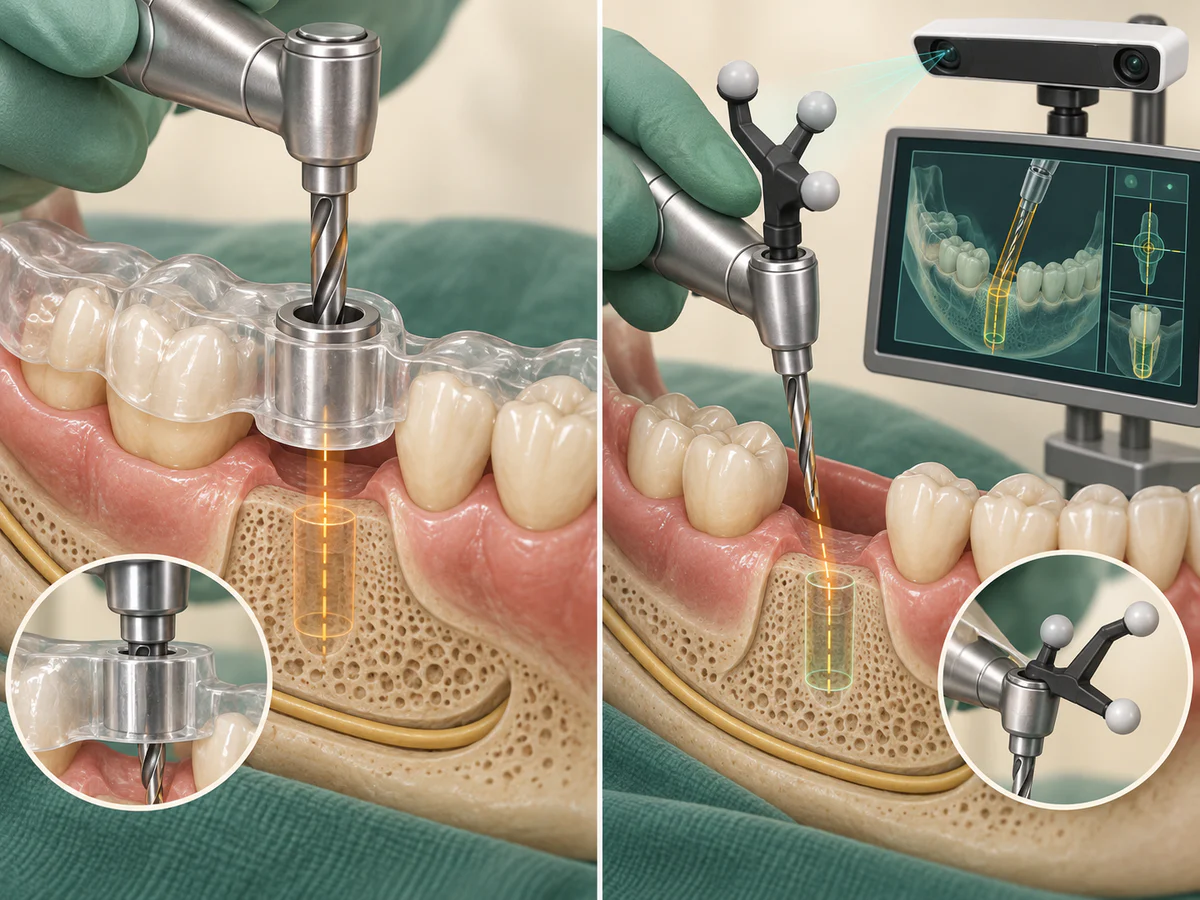
In static guided surgery, the plan is translated into a physical surgical guide — a printed template fitted with metal sleeves — which sits on the teeth or the gum and mechanically imposes the path of the drills. The guidance is fixed: it was decided before the procedure and does not change afterwards. That is the approach detailed in our article on guided implant surgery.
In dynamic navigated surgery, there is no physical guide in the mouth: guidance takes place on screen, in real time, and the trajectory can be adjusted during the procedure. The surgeon watches the drill advance and remains free to adapt the movement — hence the flexibility of the method.
| Criterion | Guided surgery (static) | Navigated surgery (dynamic) |
|---|---|---|
| Guidance support | Printed physical guide (sleeves) | Screen, real-time optical tracking |
| When the decision is made | Trajectory fixed before the procedure | Trajectory adjustable during the procedure |
| Direct view of the drill | Limited by the guide | Preserved, view of the surgical field |
| Mouth opening required | Substantial (room for the guide and drills) | Less, useful in posterior areas |
| Prior fabrication | Guide manufacturing lead time | Same-day planning possible |
| Main weak point | Rigidity, bulk | Line of sight, learning curve |
An advantage often cited for navigation is that it does not depend on a bulky guide: it can be useful when mouth opening is limited, or for implants placed far back, where a static guide with its sleeves becomes difficult to fit. But neither approach is “better” in absolute terms: they are two tools, to be chosen according to the clinical case.
What does the literature say about accuracy?
This is the central question, and the answer is measured: navigated surgery is accurate, broadly on a par with static guided surgery, and both are more accurate than freehand placement. Neither is perfect.
Accuracy is measured by the gap between the planned position and the position actually achieved, at three points: the entry (the implant neck), the apex (the tip), and the angulation.
The large systematic review and meta-analysis by Khaohoen and colleagues (BMC Oral Health, 2024), covering 67 studies and more than 5,600 implants, reports mean deviations, across all systems, of roughly 1.11 mm at the entry, 1.40 mm at the apex and 3.51° of angulation.
For dynamic navigation specifically, the values were of the same order as for static guides (about 1.18 mm at the entry, 1.36 mm at the apex, 3.51° of angulation), confirming comparable performance.
For its part, the review by Wu and colleagues (International Journal of Implant Dentistry, 2020) directly compared dynamic navigation with static guides and concluded that “dynamic navigation can achieve implant placement as accurate as the static surgical guide”, with no significant overall difference — with some variation by location (angulation favoured navigation in molar areas, while the apex favoured the static guide in the anterior region).
The prospective clinical study by Younis and colleagues (Head & Face Medicine, 2024) illustrates the hierarchy well: dynamic navigation and the static guide showed small, closely matched deviations (about 0.99 and 0.92 mm at the entry), whereas freehand placement performed clearly less well (1.36 mm at the entry, 5.82° of angulation). Both computer-assisted methods were significantly more accurate than freehand.
These figures are averages from studies, not a guarantee for any given placement. They say something simple: navigation improves control of the trajectory compared with freehand placement, without eliminating every margin of error.
One particular benefit: reducing the weight of experience
An interesting point emerges from several studies: dynamic navigation appears to reduce the influence of the surgeon’s experience on accuracy. In other words, real-time guidance helps standardise the procedure.
In the study by Younis and colleagues (2024), no significant difference was observed between the first 50% and the last 50% of implants placed with navigation, which suggests a limited learning effect once the method has been mastered; the authors note that it “may reduce the influence of the surgeon’s experience on accuracy”. Wu and colleagues (2020) had made a similar observation: after adequate training, level of experience no longer influenced the accuracy of navigation.
This does not mean the technology replaces clinical judgement. The decision to place an implant, the assessment of the bone, the management of the soft tissues and of the healing period remain the practitioner’s responsibility. Navigation helps carry out a plan; it does not devise one.
In which cases can navigation be useful?
Navigated surgery is chiefly of interest in situations where accuracy matters a great deal and where a static guide is impractical. Several cases come up repeatedly in the literature and in practice: posterior areas with limited mouth opening, implants close to sensitive structures (nerve, sinus), cases where one wishes to plan and operate on the same day without waiting for a guide to be manufactured, and anatomically complex situations.
Navigation does not, however, replace any of the fundamentals of implantology. The assessment, the 3D examination, the evaluation of bone volume and, where applicable, preparation of the site remain essential.
When bone is insufficient, the question of a prior graft arises, which we cover in our article on bone grafting before an implant; and the overall choice of an implant solution in Kénitra is detailed on our page about dental implants in Kénitra. Guidance technology is added to this approach; it does not take its place.
What navigated surgery does not provide
Honest information means naming what this technology does not do — and the constraints that come with it.
First, it does not guarantee the success of the implant. Accurate placement is a useful condition, not a sufficient one: osseointegration depends on the quality of the bone, on periodontal health, on smoking, on the healing period and on maintenance. A perfectly positioned implant can fail for other reasons, as our article on the signs of implant failure points out.
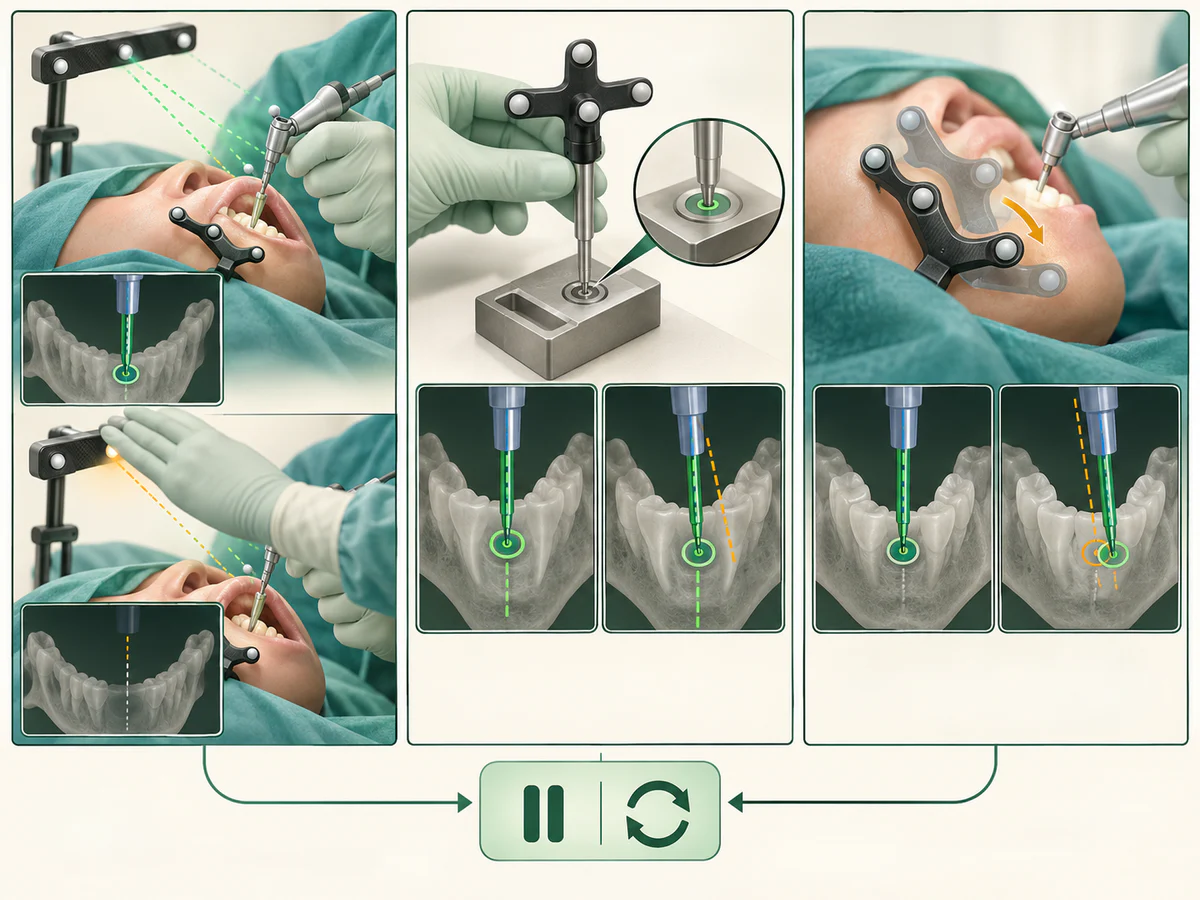
Next, it has technical weak points of its own. Optical tracking requires a clear line of sight between the camera and the markers: if an instrument, a hand or the lip hides the markers, tracking may be disrupted. A calibration error, or movement of the marker fixed in the mouth, degrades the accuracy displayed.
The literature also notes longer operating and preparation times due to the calibration steps: Wang and colleagues (2025) cite specifically, among the main obstacles, the high cost of the equipment — which limits its spread beyond university settings — and the longer duration of procedures in routine practice.
Finally, it does not eliminate the margin of error. Even when guided, placement retains a deviation on the order of a millimetre and a few degrees (Khaohoen et al., 2024). It is precisely for this reason that a safety margin is maintained relative to sensitive structures. Presenting navigation as a guarantee of “absolute” accuracy would be an over-promise.
Note that this article describes the technology in general terms, for educational purposes. Whether any given practice is equipped with it is a separate question; what matters for the patient is understanding that the outcome of an implant depends first and foremost on the indication, the diagnosis and the follow-up, and that the mode of guidance is only one element of it.
In summary
Navigated surgery, or dynamic implant navigation, is a computer-assisted method of placing an implant that displays in real time, on a screen, the drill’s trajectory relative to the planned position — hence the image of a “GPS” for the implant. It differs from static guided surgery, which relies on a fixed physical guide, in its flexibility: the movement can be adjusted during the procedure and no bulky template is required.
The literature shows accuracy comparable to that of the static guide, and superior to freehand placement (Khaohoen et al., 2024; Wu et al., 2020; Younis et al., 2024), with the added benefit of reducing the weight of the surgeon’s experience.
But it retains a margin of error on the order of a millimetre, depends on a clear line of sight and good calibration, lengthens operating time and remains costly (Wang et al., 2025). Above all, it does not guarantee the success of the implant, which depends first of all on the bone, the diagnosis and the follow-up. It is a guidance tool at the service of the indication, not a substitute for clinical judgement.
Frequently asked questions
What is navigated surgery for an implant?
How does it differ from conventional guided surgery?
Is navigated surgery more accurate than a static guide?
Does navigation guarantee that the implant will succeed?
What are the limits of navigated surgery?
Is navigation suitable for every case?
Sources
Medical references consulted for this article.
- 1Khaohoen A et al., Accuracy of implant placement with computer-aided static, dynamic, and robot-assisted surgery: a systematic review and meta-analysis of clinical trials, BMC Oral Health, 2024
- 2Wu D et al., Accuracy of dynamic navigation compared to static surgical guide for dental implant placement (revue systématique et méta-analyse), International Journal of Implant Dentistry, 2020
- 3Younis H et al., Accuracy of dynamic navigation compared to static surgical guides and the freehand approach in implant placement: a prospective clinical study, Head & Face Medicine, 2024
- 4Wang Y et al., Dynamic and robotic computer-assisted implant surgery — A possible workflow for the future?, Australian Dental Journal, 2025
- 5Comparison of the accuracy/precision among guided (static), manual, and dynamic navigation in dental implant surgery: a systematic review and meta-analysis, Oral and Maxillofacial Surgery, 2025
- 6Reiff S et al., Accuracy of Freehand, Static, and Dynamic Computer-Assisted Implant Placement: A Systematic Review and Meta-Analysis, Journal of Periodontal Research, 2026
Contents
Share